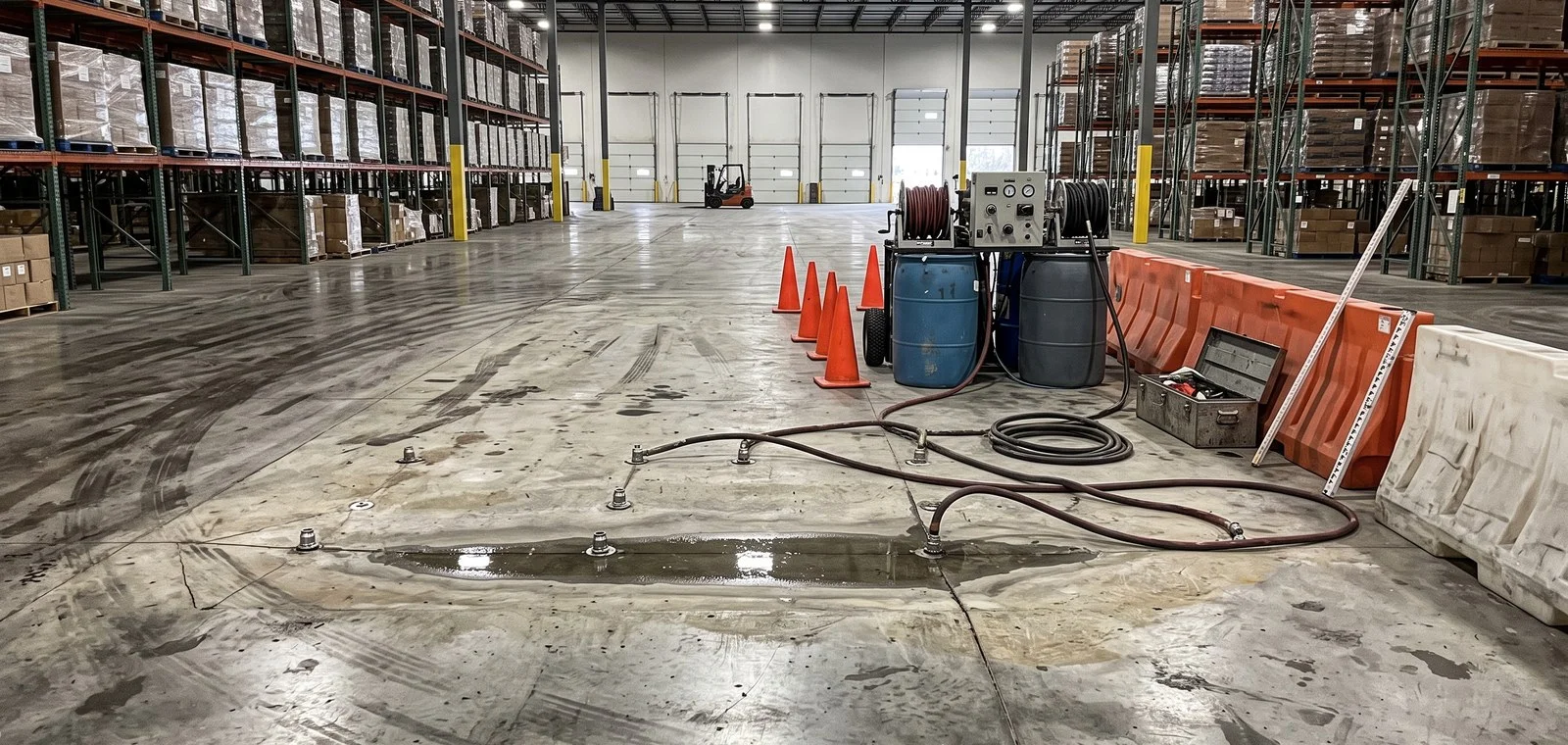


A settled floor in a distribution center is a throughput problem before it is a concrete problem. Loss of subgrade support at a joint changes the floor profile, and that profile governs whether a turret truck can run at height in a narrow aisle, whether a dock leveler seats correctly, and whether rack uprights stay inside plumb tolerance. Superior Grouting performs warehouse floor repair by polyurethane injection through 5/8 inch ports, sectioning the floor and lifting one zone at a time, without excavation, without removing racking, and without taking the building offline.
The Warehouse Floor Repair Procedure (Polyurethane Injection) includes:

Distribution center concrete does not fail uniformly. It fails along the paths the building actually uses, which is why damage concentrates in aisles, at joints, and at the dock face rather than across the bay.
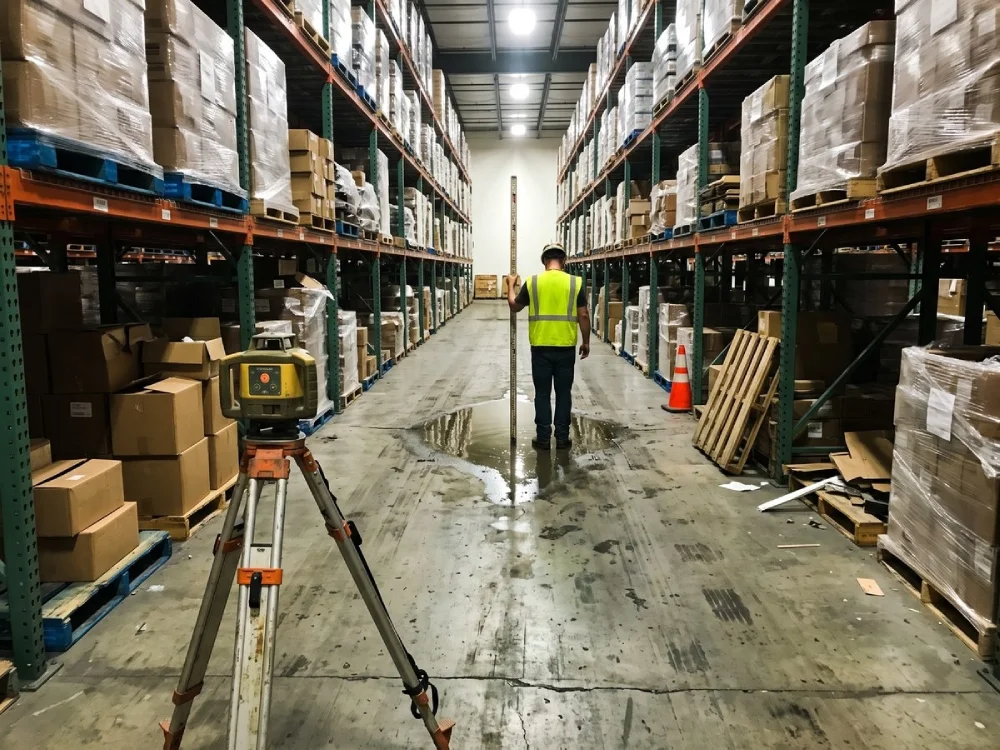
Lift truck and turret truck wheel paths concentrate repeated dynamic load into narrow lanes. Marginally compacted fill consolidates along those lanes rather than uniformly, producing a dish-shaped depression down the aisle centerline. The floor profile changes before any visible cracking appears, which is why equipment operators usually notice it before maintenance does.
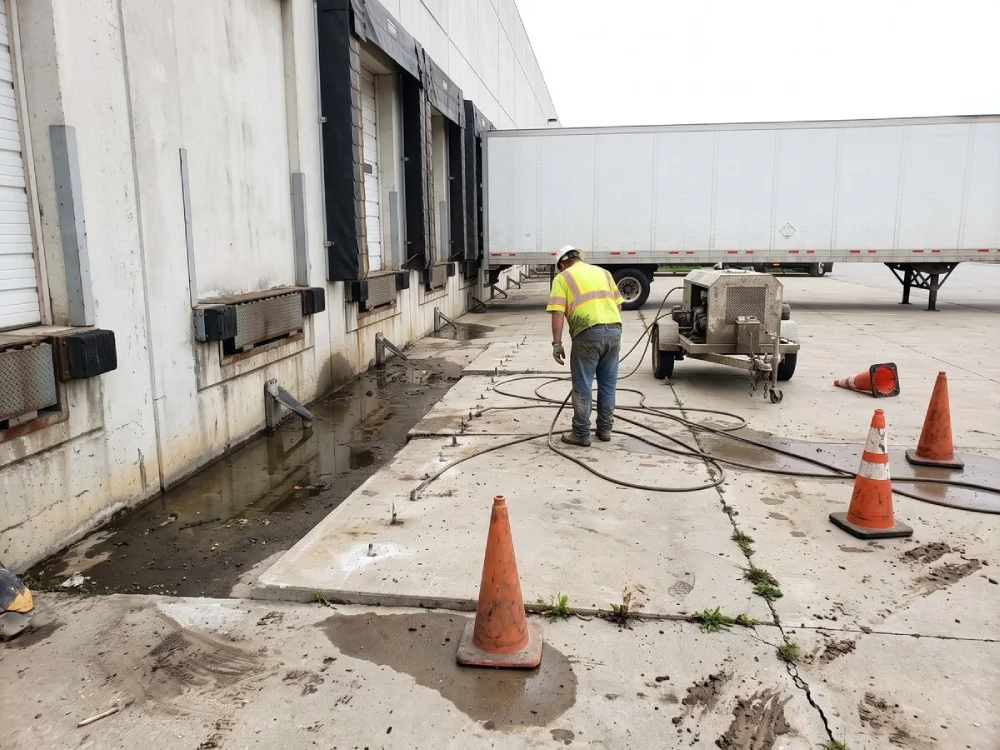
The exterior approach carries trailer landing gear point loads at a transition where compaction was always difficult. Utility trenches crossing the floor were compacted in a confined space and consolidate differently from native subgrade, telegraphing to the surface as a linear depression. At the dock face and on exterior truck court slabs, joint pumping compounds both: water beneath the slab is ejected under wheel load and carries fines out through the joint, enlarging the void with each pass.
Superior Grouting approaches warehouse concrete repair by polyurethane concrete lifting, injecting high-density polyurethane through 5/8 inch ports drilled in a controlled grid. The material fills voids to continuous support first, then restores elevation in staged passes monitored throughout. Interior work uses low-dust drilling equipment and proceeds bay by bay around live operations.
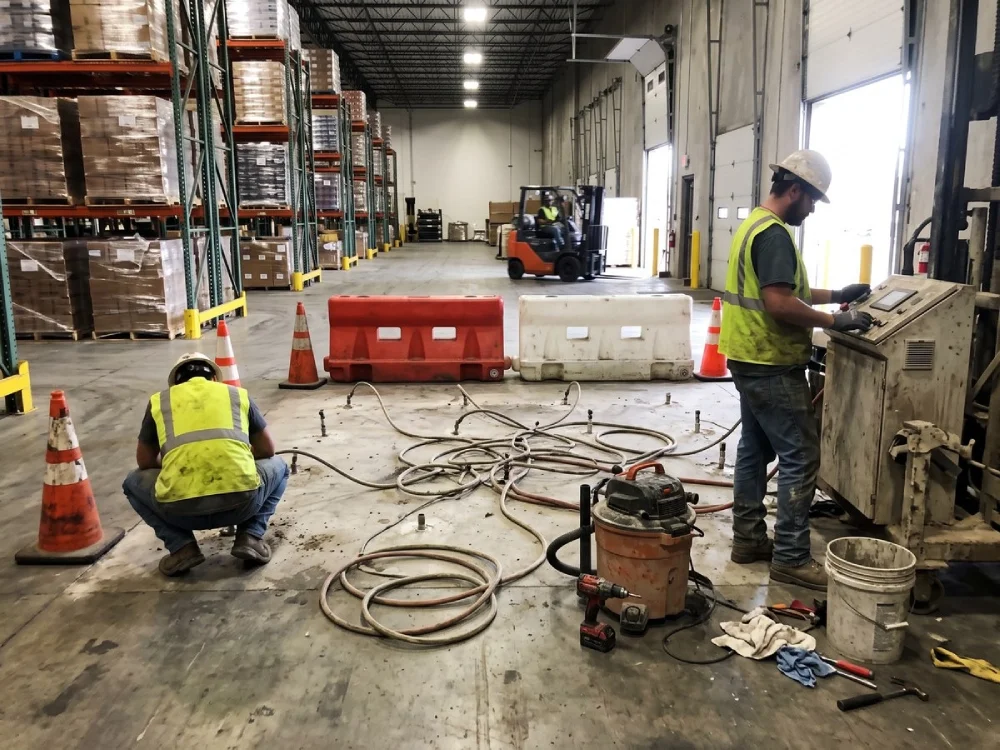
The floor is sectioned rather than closed. One aisle or bay is barricaded, corrected, and released before the next section opens, so the rest of the building keeps running. That matters most in the facilities where a floor cannot come out of service at all: national parcel and freight sortation hubs, grocery and cold-chain cross-docks, third-party logistics operations, and e-commerce fulfillment centers running multiple shifts.
Common uses for warehouse floor repair include:
Advantages of polyurethane injection in an operating facility:
Cured density is the parameter that matters most on a floor that has already failed. A cementitious slurry weighs 100 to 130 lb per cubic foot of void filled. Polyurethane placed in the same void weighs 2 to 9 lb per cubic foot, depending on grade. Where the mechanism is bearing capacity rather than void alone, that difference is why warehouse concrete leveling by polyurethane injection holds while heavier methods drive further consolidation.
|
Parameter |
Value |
Reference standard |
|---|---|---|
|
Cured density, standard grade |
2 to 4 PCF |
ASTM D1622-26 |
|
Cured density, high-density industrial grade |
Up to 9 PCF |
ASTM D1622-26 |
|
Compressive strength, standard grade |
40 to 60 psi |
ASTM D1621-16(2023) |
|
Compressive strength, high-density grade |
Up to 200+ psi |
ASTM D1621-16(2023) |
|
Cell structure |
Closed cell |
Superior Grouting |
|
Injection pressure |
Up to 1,100 psi |
Superior Grouting |
|
Injection port diameter |
5/8 in |
Superior Grouting |
|
Compressive strength development |
90 percent of compressive strength within 15 minutes |
Superior Grouting |
|
Return to forklift traffic |
15 to 30 minutes |
Project specification |
|
Documented maximum correction |
Lifts up to 17 in on interior commercial slabs |
Superior Grouting |
|
Service life |
50+ years, closed cell and waterproof. The correction is permanent unless new settlement occurs beneath the material. |
Superior Grouting |
Published injection pressure is not the pressure applied to the underside of the slab. Uplift pressure is limited by slab weight, thickness, and reinforcement, and is established for each project before the first port is drilled.
Commercial slab lifting on an operating site is priced by correction height, void volume, and access. Warehouse floor leveling and repair typically runs $7,000 to $25,000 per 1,000 square feet. See our concrete leveling cost breakdown for detail across other project types.
At Glazer's Real Estate in Houston, a tilt wall distribution center, steel storage racks along the north and west perimeter walls had begun leaning to the point of a critical safety concern, and the client had already begun moving product off the racks. The failure was in the pour strip, the closure pour between the slab edge and the wall base, which had settled in a band extending 3 to 8 ft out from the perimeter wall. Drilling confirmed large voids beneath it, with little subgrade left supporting the foundation. Superior Grouting was contacted late on a Wednesday, made a site visit Thursday morning, mobilized Friday, worked through the weekend, and completed the work early Monday. 8,000 pounds of high-density polyurethane was placed and the pour strip was realigned to within the required tolerance.
That project is a perimeter condition specific to tilt wall construction rather than one of the aisle and dock mechanisms described above, and it is covered in full on the tilt wall slab repair page. It is included here for what it shows about response on an operating distribution center: emergency mobilization inside two days, the work completed over a single weekend, and the building fully operational without an extended shutdown.
Acceptance on industrial warehouse floor repair is numerical, not visual.
|
Criterion |
Target |
Governing reference |
|
Elevation monitoring during work |
Continuous, rotary laser reference plane |
Superior Grouting |
|
Elevation acceptance tolerance |
Per project specification |
ACI 117-10 (R2015) §4.4.1 permits ±3/4 in on a new slab on ground |
|
Joint faulting after repair |
Per project specification |
Superior Grouting |
|
Random-traffic floor flatness and levelness |
Project FF and FL values |
ACI 117-10 (R2015) §4.8.5, Table 4.8.5.1, measured per ASTM E1155/E1155M-23 |
|
Defined-traffic aisle profile |
Project Fmin value |
Project specification. Fmin classes appear in ACI 360R-10 Table 1.1 as guidance; there is no ASTM method, and Fmin is measured by profileograph along each wheel path |
|
Rack condition before and after |
Recorded and issued to the owner's rack engineer |
ANSI MH16.1-2023 sets a 1/240 in-service limit on loaded columns. Verification is the rack engineer's scope |
|
Volume reconciliation |
Placed volume within tolerance of calculated void |
Superior Grouting |
Superior Grouting documents placement volume by weighing containers before and after work, by electronic flow meter where project specifications require it, and by project records identifying every injection point and the volume placed. That package supports lease, insurance, and engineer-of-record review.
Where deep compressible fill is still consolidating, injection beneath the slab corrects the surface without addressing the cause. Industrial concrete leveling in those conditions requires densification of the soil column first. Compaction grouting places low-mobility grout through a small-diameter casing, displacing and densifying the surrounding soil to increase bearing capacity. Improvement can be demonstrated by cone penetration testing before and after densification.
Superior Grouting has applied compaction grouting to building foundation stabilization, drilled pier end bearing, and site improvement across commercial and industrial projects since 1983, and maintains in-house soils engineering capability.
Full replacement remains the correct answer where a slab has failed through its section, where reinforcement is corroded and delaminating, or where the floor was never constructed to the required F-number. It is also the most expensive answer available, requiring demolition, haul-off, new placement, and a 7 to 28 day cure before the bay returns to service.
Slab curl is a separate condition and requires a separate judgment. Curling is upward deformation at slab edges caused by differential drying shrinkage, and injection must not be used to lift a curled slab, because the panel has not dropped and lifting it can crack the section. Grinding corrects the profile. Filling the void beneath a curled edge, without lifting, remains appropriate and prevents edge breakage under wheel load.
Isocyanate handling requires respiratory protection under OSHA 29 CFR 1910.134, and hazard communication controls under OSHA 29 CFR 1910.1200. Work areas are signed, barricaded, and kept clear of aisle and passageway obstructions under the site traffic control plan. Injection pressure limits are established against slab thickness, reinforcement, and bearing conditions before drilling begins.
Superior Grouting publishes a four-year record of zero total recordable incident rate, zero days away restricted or transferred, and zero fatalities.
This guidance is advisory. Final design parameters, pressure limits, and material specifications must be confirmed by the engineer of record and validated against project-specific geotechnical, structural, and regulatory conditions.
Superior Grouting provides warehouse floor repair services across nine Texas cities and two in Louisiana, dispatched from Houston. Facility teams across the Gulf Coast looking for a warehouse floor leveling company reach the same Houston-based crews.
Established in 1983, Superior Grouting Services, Inc. is one of the best known and most reliable concrete leveling services in Greater Houston and the Texas Gulf Coast Region. We are a family owned business established in 1983 to provide small line grouting services to general contractors serving the underground utilities, oil & gas, commercial & industrial properties, railroad and public works markets.
Coming from the concrete boom pumping industry in the 70's and early 80's, the owner had extensive experience in the concrete pumping world. Having placed over one million cubic yards in the Houston market he saw a segment in the industry that needed a specialty contractor with the knowledge and expertise to execute conventional and non-conventional projects, thus Superior was born.
Starting with one Mayco C30 small line grout pump and a 1969 Chevy Truck, the owner sold and completed each and every job. Superior is a performance-oriented company that works with engineering firms and general contractors and continues to evolve into becoming the exceptional specialty grouting company that it is today.
The owner, Ron Rumpza, has diligently worked to grow the company through his persistence and dedication by providing excellent customer service with a quality finished product on time and on budget. The broad experiences of our principal employees combined with unique construction methods and materials, has made Superior an authority in the fields of pressure grouting, compaction grouting, chemical grouting and polyurethane.
For more than 40 years — since our founding in 1983 — Superior Grouting has built a reputation as one of the best known and most reliable concrete leveling services in Greater Houston and the Texas Gulf Coast Region
The foundation of Superior Grouting's success lies in building trust with our customers, employees, and suppliers. We believe in being reliable, honest, competent, and compassionate to earn the trust of our stakeholders and earn the right to grow. We conduct business every day with our core values, which include:
Ethics
Integrity
Honesty
Safety-First
Commitment
Accountability
Our vision is to be the premier provider of Geo-technical Compaction, Polyurethane, and Pressure Grouting Solutions for Soil Stabilization and Concrete Lifting Applications. We cater to a range of sectors, including the Oil & Gas Pipeline, Underground Utility, Railroad, Public Works, and Commercial-Industrial Property Management Sectors, serving Texas and the Surrounding States. We are committed to providing the highest quality Remedial Grouting Services that are safe, reliable, and responsive to our customers' needs.
At Superior Grouting, we take our responsibility to our customers seriously. We've earned a reputation as a trusted concrete solutions provider, delivering exceptional results for government agencies and large corporations across various sectors. We understand the importance of liability in our industry and take every precaution to ensure the safety of our employees, customers, and the general public.
We recognize that oftentimes, finding the right grouting solution can be a challenge. That's why we are committed to providing personalized service to each of our clients, taking the time to understand their unique needs and developing custom solutions that meet their requirements.
Racking stays in place, and most warehouse floor repair proceeds with ports placed in aisles adjacent to loaded racking. Injection directly beneath a loaded upright requires the rack to be unloaded or the load path confirmed by the engineer of record, because working under an eccentrically loaded baseplate introduces a stability risk that is not acceptable. Where perimeter racking is already leaning, expect to unload that run before work begins.
One zone at a time. The affected bay or aisle is barricaded and the rest of the building continues operating. Because the material reaches most of its compressive strength within 15 minutes, practical downtime is governed by barricade setup and takedown rather than by cure. On a Houston tilt wall distribution center with perimeter pour strip settlement, Superior Grouting mobilized on a Friday, worked the weekend, completed early Monday, and the client was fully operational within days.
Upright condition is recorded before work begins and again after, and that record goes to the owner's rack engineer. ANSI MH16.1 sets a 1/240 limit on out-of-plumb and out-of-straight for loaded columns in service, and judging a rack against it is the rack engineer's scope, not ours. A floor repair cannot deliver rack plumb on its own, because plumb also depends on baseplates, shims, anchorage, and how the rack was erected. What the repair controls is the floor beneath it, and elevation correction is executed in staged passes rather than a single pass specifically to keep differential movement small enough that rack geometry is not disturbed.
Three factors combine at the dock face. Trailer landing gear applies concentrated point loads through a small bearing area. The apron sits at a transition where the original backfill was difficult to compact. Water shed off the building and the trailer ponds at that same transition and migrates into the subgrade. The result is a step at the dock face and a leveler that no longer seats correctly.
Curling is upward deformation at slab edges and joints caused by differential drying shrinkage between the top and bottom of the slab. The panel has not dropped, the edges have lifted. Settlement is downward movement of the panel caused by loss of subgrade support beneath it. The two look similar at a joint and require different remedies. Grinding corrects a curled profile, while settlement is corrected by filling the void and restoring grade. A curled edge does have a real void beneath it, and filling that void without lifting is appropriate to prevent edge breakage.
Project records include injection point locations, volume placed at each point, pre-work and post-work elevation data, and volume reconciliation against calculated void. Where project specifications require electronic flow metering, floor profile survey, or third-party verification, that is coordinated as part of scope.