Annular grouting (also called annular space grouting, annulus grouting, or annular gap grouting) is the process of filling the void between two concentric structures — typically a host pipe and an inner liner — with a controlled grout mixture. Superior Grouting in Houston, TX has performed annular space grouting for pipeline abandonment, slip-lining rehabilitation, electrical duct banks, and tunnel liner backfill across the Texas and Louisiana Gulf Coast for over 40 years. Mix designs include cellular grout (30-90 PCF), sanded grout (100-130 PCF), and neat cement, custom-engineered to project specifications and pumped at low pressure. Call (281) 894-4175 for a project-specific estimate.
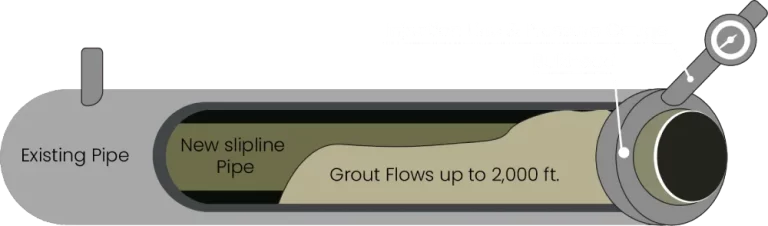
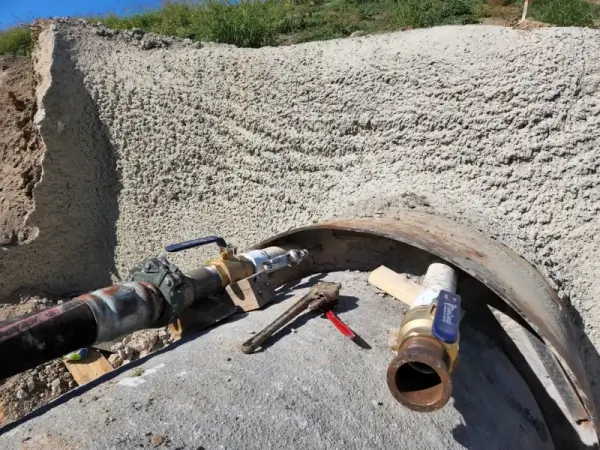
Annular grouting is the process of filling the space between a host pipe and liner pipe to ensure structural integrity and prevent soil movement. Our team specializes in annular space grouting, delivering precise solutions for underground utility projects, electrical duct banks, and tunnel backfill while minimizing excavation and disruption.

Underground Utility Line
Concrete Structures
Dams, Levees & Bulkheads
Erosion Control





Superior Grouting has extensive experience in the art of annular and abandonment grouting, with four decades of experience.
On-site Footprint — Small and compact
Mobility — Our team can move easily between locations
Cleanliness — Minimal waste and clean-up
Responsiveness — Multiple crews means we are quick to respond
Annular grouting is the process of filling the space between a host pipe and liner pipe during re-lining applications. This method is widely used for annular space grouting in electrical duct banks, tunnels, and underground utility projects.
Superior Grouting offers expert solutions using annular space grout, ensuring a secure seal that prevents voids and long-term settlement issues. Where residual infiltration remains at joints or laterals after lining, we seal it with chemical grouting that permeates the surrounding soil, closing the pathways a fill alone leaves open.
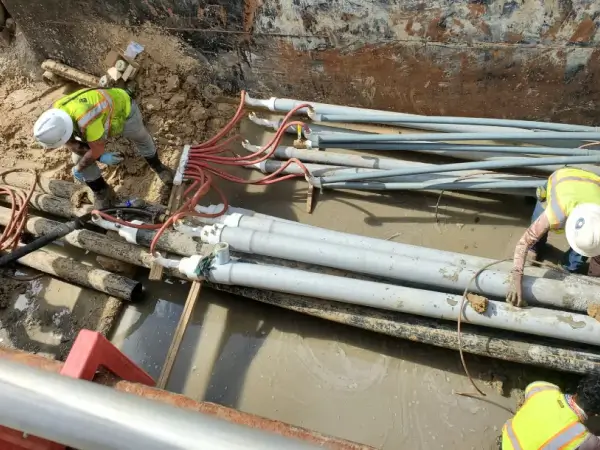
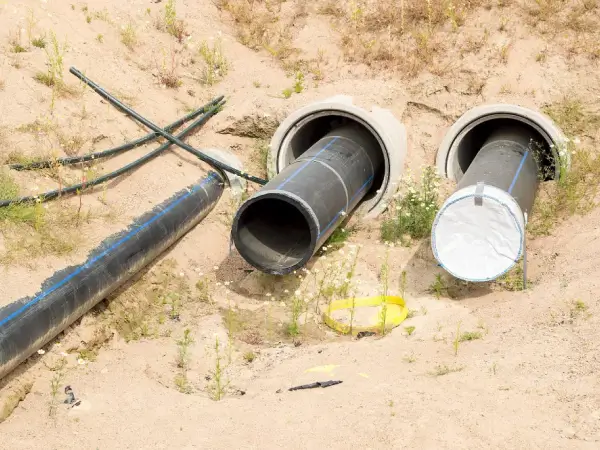
Excavating and removing abandoned underground pipes can be costly and disruptive. Instead, our team uses grout annulus fill techniques to safely secure abandoned pipes in place and prevent collapse.
We also specialize in annular gap grouting, using cellular grout to fill voids efficiently while minimizing disruption to the surrounding area.
Abandonment and
is the process of filling the pipe with a cellular grout or sanded grout. It is important to remember when pressure grouting to abandon a pipe, it must be done right the first time, since there is not a second chance. Superior Grouting has mastered the art of abandonment grouting and
with four decades of experience.
When an underground pipeline is decommissioned, federal PHMSA regulations and state DOT requirements typically mandate that the pipe be filled with a cementitious or cellular grout to prevent future collapse and surface settlement. Cellular grout at 30-50 PCF is the standard specification because it pumps long distances at low pressure.
Superior Grouting routinely abandons pipelines up to 1,400 linear feet of 36-inch and 40-inch diameter in a single placement. The Colonial Pipeline project (Channelview, TX, November 2017) involved the abandonment of 1,365 linear feet of 36-inch and 1,430 linear feet of 40-inch pipeline under the San Jacinto River — pumped continuously with 45 PCF cellular grout.
Contact Superior Grouting at (281) 894-4175 for pipeline abandonment grouting projects in Texas and Louisiana.
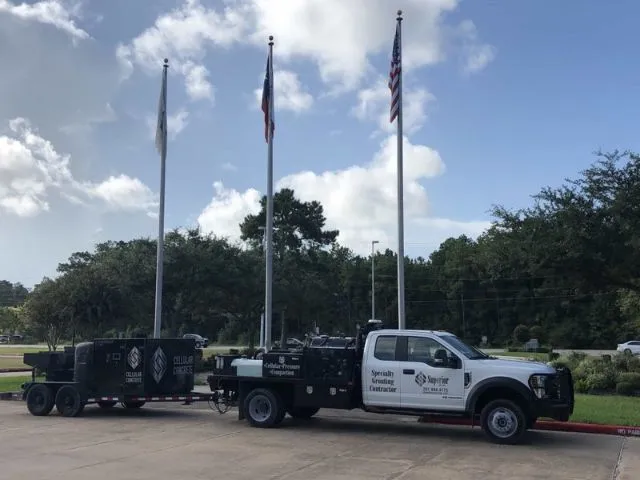
Annular grouting and annular space grouting are used across utility, transportation, and infrastructure applications:
Underground utility line projects — water, sewer, gas, fiber, electrical
Electrical duct banks — sealing the annular space between concrete encasement and duct
Tunnel backfill — slip-lining rehabilitation, microtunneling, jack-and-bore
Contact grouting — filling the void space between cast-in-place (CIP) structures and the in-situ geomaterial
In annular space grouting, cellular grout mix design is tuned to the specific annulus dimensions, pump distance, and the void volume that must be filled around the host pipe and liner. Unlike load-reducing backfill (where weight reduction is the primary objective), annular cellular grout design balances flowability (to fill the entire annulus without bridging), low pump pressure (to prevent damage to the carrier pipe), and sufficient strength (typically 50-300 PSI for utility duct banks; 100-500 PSI for slip-lined pressure pipes).
A cardinal rule of cellular grout mix design is that as density decreases, so does strength. For annular applications:
Low density (30-50 PCF · 50-200 PSI) — used for tunnel liner backfill and large-diameter pipe abandonment, where long pump distances and minimal pipe loading are critical
Medium density (50-70 PCF · 200-500 PSI) — used for utility duct bank fills and slip-lined gravity sewers, where flowability and engineered strength are both required
Higher density (70-90 PCF · 500-1,000 PSI) — used for slip-lined pressure pipes (water, gas) where the annular grout must resist internal carrier pipe pressures without deflection
Superior Grouting's standard annular mix is 45 PCF cellular grout — the same mix used for our long-distance pipeline abandonment work, including the Colonial Pipeline project documented above.
For non-annular cellular grout applications (load-reducing backfill, void fill, voided slab fill), see our Cellular Grouting page for general mix-design specifications.
Annular space grout for utility, DOT, and pipeline projects is typically specified against published standards-body criteria. Superior Grouting mix designs are engineered to meet or exceed:
ASTM D4832 — Standard Test Method for Preparation and Testing of Controlled Low Strength Material (CLSM) Test Cylinders. Governs how compressive strength is verified for cellular grout and CLSM annular fills.
ASTM D6023 — Standard Test Method for Density (Unit Weight), Yield, Cement Content, and Air Content (Gravimetric) of Controlled Low Strength Material (CLSM). Governs density verification for cellular grout.
ASTM D8024 — Standard Practice for Selecting Polyurethane Foam. Applicable when polyurethane resin is used for crack-sealing in lieu of or in addition to cellular annular grout.
AASHTO M295 — Standard Specification for Coal Fly Ash and Raw or Calcined Natural Pozzolan for Use in Concrete. Applicable when Class C or Class F fly ash is incorporated into the cellular grout mix to reduce cement content.
ACI 229R — Controlled Low-Strength Materials. The American Concrete Institute's guideline reference for CLSM design, including annular space and load-reducing applications.
For TxDOT and LADOTD pipeline and utility projects, Superior Grouting also conforms to applicable state DOT specifications for annular and abandonment grouting.
|
Application |
Density |
28-Day Compressive Strength |
Pump Pressure |
|
Tunnel liner backfill |
30-50 PCF |
50-200 PSI |
Low (gravity-assisted where possible) |
|
Slip-lined gravity sewer |
50-70 PCF |
100-300 PSI |
Low (≤30 psi) |
|
Slip-lined pressure pipe (water, gas) |
70-90 PCF |
300-1,000 PSI |
Low to moderate |
|
Pipeline abandonment |
30-50 PCF |
50-200 PSI |
Low (long-distance pumping) |
|
Electrical duct bank |
50-70 PCF |
100-300 PSI |
Low |
Superior Grouting provides project-specific mix design submittals and 28-day compressive strength testing per ASTM D4832 for every annular grouting project.
Contact grouting is the injection of grout between the initial support and the ground or jacked carrier pipe and the ground. It involves the filling of void space between a cast-in-place (CIP) structure and the in-situ geomaterial or another structure.
When contact grouting, normally the extent of the void space is not known. Generally, the intent of contact grouting is to increase the structural integrity of the structure.
|
Factor |
Annular Grouting |
Contact Grouting |
|
What's being filled |
The annulus — the geometric ring between two concentric pipes/structures |
An unknown void space between a structure and the surrounding ground |
|
Void size known? |
Yes (calculated from pipe diameters) |
No — generally unknown until injected |
|
Primary intent |
Seal the annulus, prevent pipe shifting, distribute load |
Bond the structure to the surrounding ground; increase structural integrity |
|
Typical mix |
Cellular grout (30-90 PCF) or sanded grout (100-130 PCF) |
Microfine cement or chemical grout for fine voids; cementitious for larger voids |
|
Common use cases |
Slip-lining, duct banks, tunnel liner, pipeline abandonment |
Microtunneling, jack-and-bore, retaining wall backfill voids, foundation underseal |
Superior Grouting performs both — annular grouting and contact grouting — for utility, DOT, and oil & gas clients across the Texas and Louisiana Gulf Coast.

Annular grouting cost in Houston typically falls into these ranges:
|
Project Type |
Typical Cost Range |
Notes |
|
Annular space grouting (small utility — single pipe segment) |
$3 - $15 per linear foot |
Depends on diameter and grout density |
|
Slip-lined sewer / gravity pipe (mid-size) |
$5 - $25 per linear foot |
Includes mix design + 28-day testing |
|
Slip-lined pressure pipe (water / gas) |
$8 - $40 per linear foot |
Higher-density mix; testing-heavy |
|
Pipeline abandonment (cellular grout fill) |
$8 - $50 per linear foot |
Larger diameters; bigger volume |
|
Tunnel liner backfill |
$250 - $800 per cubic yard |
Project-specific (long-distance pumping setup) |
|
Electrical duct bank annular fill |
$4 - $18 per linear foot |
Depends on bank size + grout density |
|
Small contact grouting project |
$1,000 - $8,000 per project |
Mobilization-dominated |
Cost factors include: required density (30-90 PCF for cellular; 100-130 PCF for sanded), required compressive strength (50-1,000 PSI), pump distance, access (interior vs exterior, surface vs vault), and total project volume. Standards-body acceptance criteria (ASTM D4832 + D6023 testing) typically add $500-$2,000 per project for mix design submittals and 28-day testing.
For a project-specific estimate, contact Superior Grouting at (281) 894-4175.
40+ years of annular and abandonment grouting since 1983
Mix design library: cellular grout (30-90 PCF) · sanded grout (100-130 PCF) · neat cement — custom-engineered per project
Long-distance cellular grout pumping for annular fills and pipeline abandonment
Colonial Pipeline abandonment (Channelview, TX, November 2017): 1,365 LF of 36-inch + 1,430 LF of 40-inch pipeline under the San Jacinto River, placed with 45 PCF cellular grout
Standards-body compliance: ASTM D4832, ASTM D6023, ASTM D8024, AASHTO M295, ACI 229R
CSI Codes: 31 43 13 (Cementitious Pressure Grouting), 33 05 23 (Trenchless Utility Installation)
Annular grouting work performed for: Colonial Pipeline, Port of Houston Authority, Houston Airports, U.S. Army Corps of Engineers, City of Houston, TxDOT, LADOTD, major Gulf Coast utility and petrochemical clients
Texas + Louisiana Gulf Coast service area: 11 cities
Call (281) 894-4175 for project-specific estimates and mix design submittals.
Superior Grouting provides annular grouting, annular space grouting, pipeline abandonment, slip-lining annular fills, duct bank grouting, and contact grouting services across:
Call (281) 894-4175 to discuss a project in your area.
Since 1983, Superior Grouting has been a pressure grouting contractor working with various government agencies, large businesses, and corporations. For years, Superior Grouting has been in charge of these customers' specialized pressure grouting and concrete remediation needs.













































Annular grouting is the process of filling the void (the annulus) between two concentric structures — most commonly a host pipe and an inner liner — with a controlled grout mixture. The grout is injected through ports at controlled pressure to fill the entire annular space, eliminating voids that could cause settlement, water infiltration, or carrier pipe shifting. Common applications include slip-lining rehabilitation, electrical duct banks, tunnel liner backfill, and pipeline abandonment.
The terms annular grouting, annulus grouting, annular space grouting, and annular gap grouting are all used interchangeably in the construction industry to describe the same activity: filling the void between two concentric structures. "Annulus" is the geometric term for the ring-shaped space between two concentric objects; "annular" is its adjective form. Specifications and contracts may use any of the four terms.
Annular grouting is required whenever a void exists between two concentric structures that must be eliminated for structural, hydraulic, or regulatory reasons. The most common scenarios are: slip-lining rehabilitation of existing sewers and water mains (where a smaller liner is inserted into the existing host pipe), electrical duct bank installation (where conduits are encased in concrete with an annular space), tunnel liner installation (where the precast liner must be bonded to the surrounding ground), and pipeline abandonment (where the abandoned pipe is filled to prevent future collapse per PHMSA and state DOT regulations).
Three mix-design families are commonly used: cellular grout (30-90 PCF, lightweight, pumpable long distances at low pressure — preferred for tunnel liner backfill and pipeline abandonment); sanded grout (100-130 PCF, higher strength, lower flowability — preferred for high-strength annular fills around pressure pipes); and neat cement grout (Portland cement and water only, high strength, low volume — preferred for small annular fills and crack sealing). Superior Grouting custom-engineers the mix per project, balancing flowability, pump pressure, and design strength.
The primary standards-body specifications are: ASTM D4832 (Standard Test Method for Preparation and Testing of Controlled Low Strength Material — CLSM — Test Cylinders, governing compressive strength verification); ASTM D6023 (Standard Test Method for Density, Yield, Cement Content, and Air Content of CLSM, governing density verification); ASTM D8024 (Standard Practice for Selecting Polyurethane Foam, applicable when polyurethane resin is used); AASHTO M295 (Coal Fly Ash specification, when fly ash is incorporated); and ACI 229R (Controlled Low-Strength Materials, the ACI guideline reference for CLSM design).
When a pipeline is decommissioned, federal PHMSA regulations and state DOT requirements typically mandate that the abandoned pipe be filled with a cementitious or cellular grout to prevent future collapse and surface settlement. Cellular grout at 30-50 PCF is the standard specification because it pumps long distances at low pressure. Superior Grouting routinely abandons pipelines up to 1,400 linear feet of 36-inch and 40-inch diameter in a single placement. The Colonial Pipeline project (Channelview, TX, November 2017) involved abandonment of 1,365 LF of 36-inch and 1,430 LF of 40-inch pipeline under the San Jacinto River.
Annular grouting fills the calculated geometric annulus between two concentric pipes or structures (you know the void volume in advance from the pipe diameters). Contact grouting fills an unknown void space between a structure (typically a cast-in-place tunnel liner or jacked carrier pipe) and the surrounding ground — the void extent is generally not known until grout is injected. Both use cementitious or chemical grouts, but contact grouting often uses microfine cement or chemical grout for fine voids and is primarily about increasing structural integrity, while annular grouting is primarily about sealing the engineered annulus.
In trenchless tunneling (microtunneling, jack-and-bore, slip-lining), a precast or steel liner is installed inside a bored tunnel or through an existing host pipe. The annular space between the liner and the tunnel wall (or host pipe) must be filled to bond the liner to the ground, eliminate settlement, and prevent groundwater migration along the annulus. Cellular grout at 30-50 PCF is the standard tunnel-liner annular backfill because it pumps long distances at low pressure and minimizes hydrostatic load on the liner during placement.
Annular grouting cost in Houston typically ranges from $3 to $40 per linear foot of pipe, depending on grout density, compressive strength requirement, pump distance, access, and total project volume. Small utility duct-bank fills run $4-$18 per linear foot; slip-lined sewer fills run $5-$25 per linear foot; pipeline abandonment runs $8-$50 per linear foot for larger diameters. Tunnel liner backfill is priced per cubic yard ($250-$800 per CY). Standards-body acceptance criteria (ASTM D4832 + D6023 testing) add $500-$2,000 per project for mix design submittals and 28-day testing. Contact Superior Grouting at (281) 894-4175 for project-specific pricing.
Electrical duct banks are arrays of conduits encased in concrete (typically reinforced) used for utility and industrial power distribution. The annular space between each conduit and the surrounding concrete encasement (or between conduits within the bank) is often grouted with cellular grout at 50-70 PCF density and 100-300 PSI compressive strength. The grout provides thermal contact between the conduit and the surrounding mass (important for cable ampacity), prevents void migration, and seals the duct bank against groundwater infiltration. Superior Grouting performs electrical duct bank annular grouting for utility, industrial, and DOT projects across the Texas and Louisiana Gulf Coast.

“Thank you for helping us before the break, you guys have been great to work with!! Ross did a great job communicating and coordinating."
“Great to see a subcontractor where everyone is wearting their PPE! Thank you for that."
“Wow, you made that look easy. Thank you so much for helping us through this nightmare. You guys are great!!"
“Thanks for your help and pulling us out of a very sticky situation. Your guys ROCK!"
“Your crew knew exactally what to do and how to coordinate things. Shout out to Martin & Paul, tell them thanks! "
“Couldn't have done it without you!! Thanks"
“They called it good, thanks for your fast response. I'll call you on the next one."
“We have worked with Ron since 1997 helping him grow his business. Superior is a company that you know is going to be successful for the long haul. Their attention to customer service, quality of workmanship and their ability to find creative solutions to see that the job is done right the first time is what makes them a great company!"
“Thank you for a job well done, The attention to detail by Andy and Octavio is praise worthy. Companies build their name based on the quality of their people this is evident. The product performed as indicated, or better than expected, look forward to years of good performance and remaining leveled. To the entire staff, thank you for a job very well done”
“Superior Grouting used injectable foam to fix my cracked concrete. At the same time they lifted various parts of the concrete to even out the surfaces. They were FANTASTIC. On-time, hard-working, clean, precise – everything you want in a contractor. Their pricing was more than fair and their work speaks for itself. I highly recommend anyone using injectable foam for foundations, or lifting any kind of uneven surface to call Ron or Erica at Superior.”
“Great work performed by Andy and Octavio, they stuck around until the work was done it was almost 2200 as they wrapped things up. Professional, courteous and a great attention to detail, most companies build a great name based on the quality of their people and these guys demonstrated it. The product worked amazingly well during installation, it was a dramatic improvement with almost no damage. I am looking forward to seeing how well it will perform in years to come."
“I wasn’t even expecting the job to turn out as good as it did honestly? It exceeded my expectations way above and beyond better! You guys are truly the best!”
“Very friendly, knowledgeable, and efficient service. Crew explained the process and cleaned up after the work was finished. Very professional team.”

Superior Grouting is Houston's specialty annular and pipeline abandonment grouting contractor. Call (281) 894-4175 or email sales@superiorgrouting.com for a project-specific estimate.