
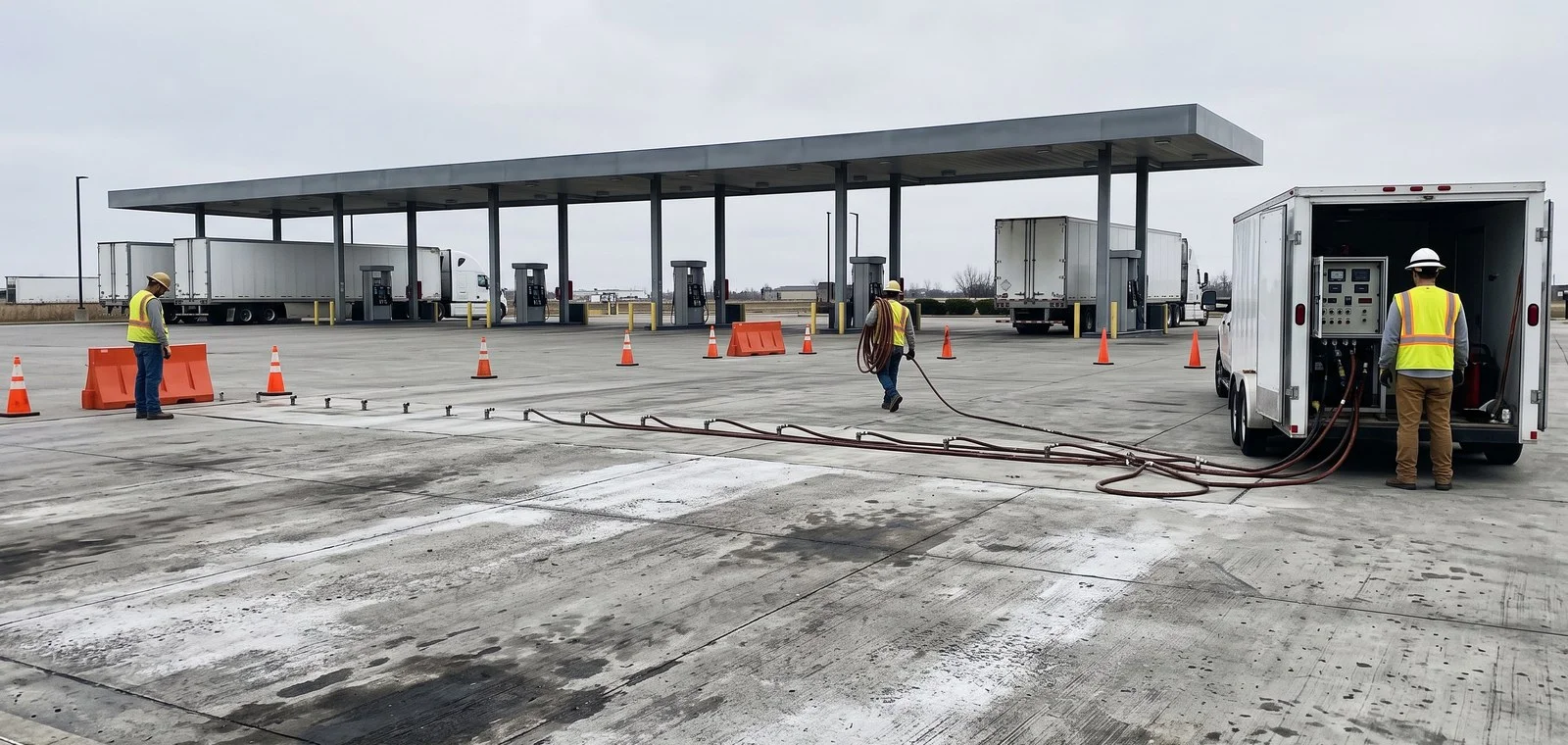


A truck stop cannot close a fueling lane for three days. It also cannot excavate freely, because the ground under a fuel island holds product piping, vapor recovery lines, conduit, and tank backfill. Superior Grouting performs truck stop concrete repair by polyurethane injection through 5/8 inch ports, which adds negligible load to backfill that is already consolidating and returns the lane to service within the same shift.
The Truck Stop Concrete Repair Procedure (Polyurethane Injection) includes:

Loading at a fueling position is heavier, slower, and more concentrated than anywhere else on the property. That is why the forecourt fails first while the rest of the site holds.
Tractors approach on a fixed path, stop, idle under load, and depart. Federal Interstate limits under 23 CFR 658.17 allow 20,000 lb on a single axle and 34,000 lb on a tandem at 80,000 lb gross, subject to the bridge formula, concentrated into a narrow band on both sides of the island. A tractor sitting at a dispenser then applies that load without movement, and creep settlement under sustained dwell produces a different depression pattern than distress under rolling load.
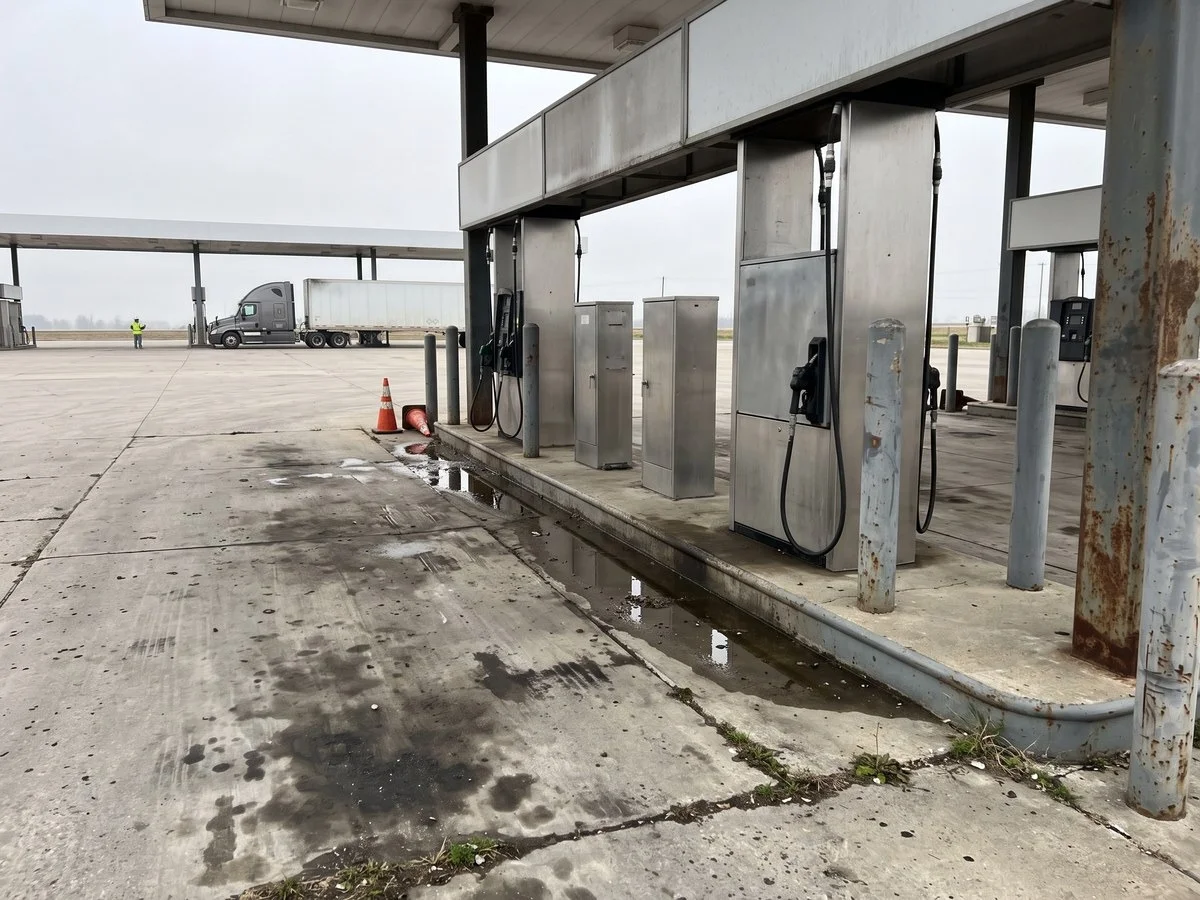
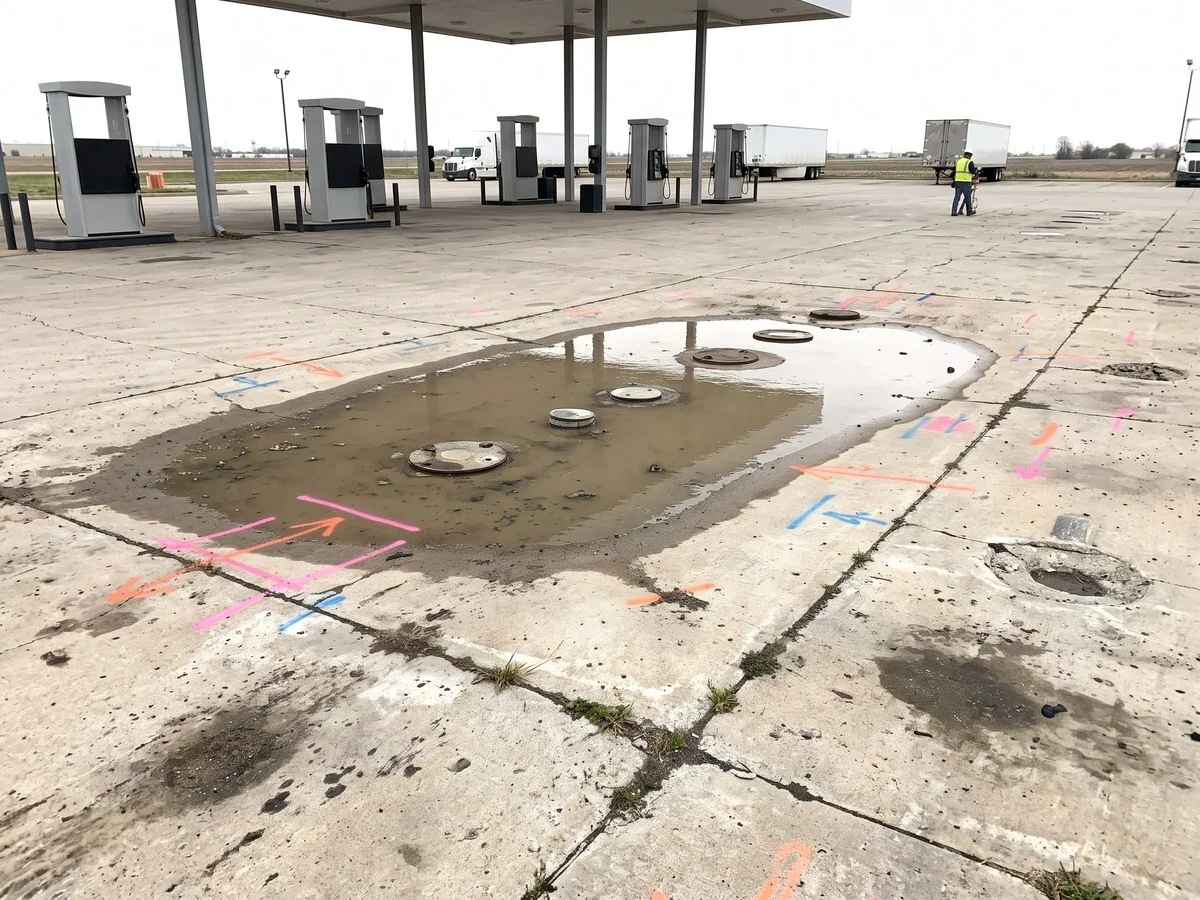
Granular backfill placed around the tank pit and product piping migrates and consolidates over time. The surface expression is a broad depression tracking the tank field footprint rather than the traffic path, which is the single most useful diagnostic distinction on a forecourt. Trailer landing gear adds isolated punch-through depressions in parking positions, and ponding at the island perimeter accelerates all of it.
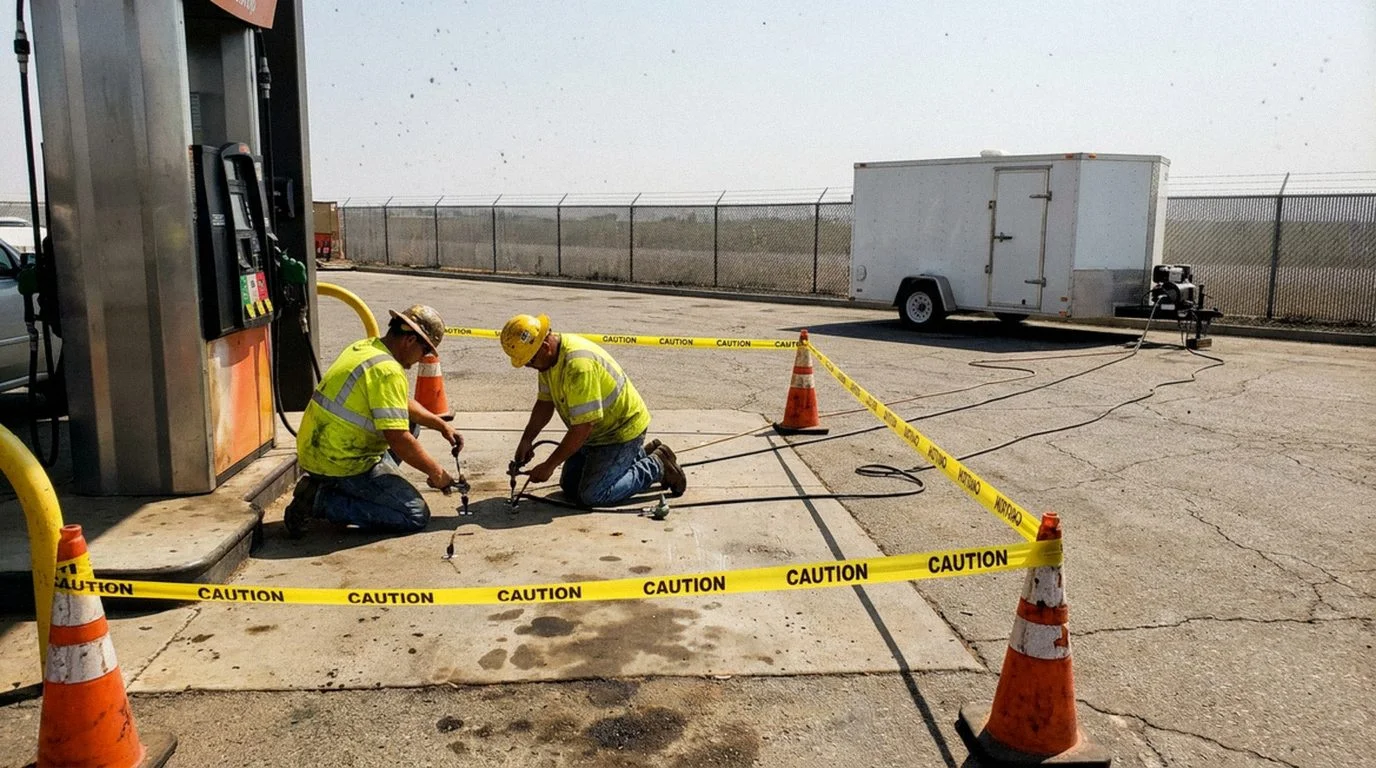
Superior Grouting approaches truck stop concrete lifting and repair by polyurethane foam injection, placing high-density material through 5/8 inch ports drilled clear of all marked utilities. Locating precedes drilling in every case, and drilling is limited to the slab section with depth controlled to the thickness of the concrete. Injection introduces no water and involves no hot work, cutting, welding, or open flame, and the equipment is self-contained in an enclosed truck or trailer that can be parked up to 210 feet from the injection point.
|
Constraint |
Control applied |
Governing reference |
|---|---|---|
|
Buried product piping and vapor recovery lines |
Locate and mark before drilling, port depth limited to slab section |
Texas Utilities Code ch. 251, Texas811, CGA best practices |
|
Ignition sources near dispensers |
No hot work, cutting, welding, or open flame in the process |
NFPA 30A-2024 |
|
Flammable liquid dispensing and storage on site |
Work planned around the dispensing system design and clearances |
OSHA 29 CFR 1910.106, NFPA 30A-2024 |
|
Work zone control on an open forecourt |
Warning signs and tags per 1910.145, barricading and cones per the site traffic control plan |
OSHA 29 CFR 1910.145 |
|
Sump, vault, or tank pit entry |
Permit-required confined space entry, attendant and entry permit |
OSHA 29 CFR 1910.146 |
|
Isocyanate handling |
Respiratory protection under 1910.134, hazard communication and SDS under 1910.1200 |
OSHA 29 CFR 1910.134, 1910.1200 |
|
Suspected release during investigation |
Stop work, report, and defer to release detection and corrective action |
EPA 40 CFR 280 |
Cured density is the parameter that matters most on a forecourt. A cementitious slurry weighs 100 to 130 lb per cubic foot of void filled, added to tank and trench backfill that is already consolidating. Polyurethane placed in the same void weighs 2 to 9 lb per cubic foot, depending on grade, which is why it holds where heavier methods drive further settlement.
|
Parameter |
Value |
Reference standard |
|---|---|---|
|
Cured density, standard grade |
2 to 4 PCF |
ASTM D1622-26 |
|
Cured density, high-density industrial grade |
Up to 9 PCF |
ASTM D1622-26 |
|
Compressive strength, standard grade |
40 to 60 psi |
ASTM D1621-16(2023) |
|
Compressive strength, high-density grade |
Up to 200+ psi |
ASTM D1621-16(2023) |
|
Cell structure |
Closed cell |
Superior Grouting |
|
Injection pressure |
Up to 1,100 psi |
Superior Grouting |
|
Injection port diameter |
5/8 in |
Superior Grouting |
|
Compressive strength development |
90 percent of compressive strength within 15 minutes |
Superior Grouting |
|
Return to lane service |
15 to 30 minutes |
Project specification |
|
Equipment standoff from injection point |
Up to 210 ft |
Superior Grouting |
|
Service life |
50+ years, closed cell and waterproof. The correction is permanent unless new settlement occurs beneath the material. |
Superior Grouting |
Published injection pressure is not the pressure applied to the underside of the slab. Uplift pressure is limited by slab weight, thickness, and reinforcement, and is established for each project before the first port is drilled.
Most sites run this on an overnight window with two to four fueling positions out at a time. Downtime is governed by barricade setup and takedown rather than by cure.
Guessing at void location on a fueling apron wastes ports and produces uneven correction.
Each lane closes out with an injection log recording port location, sequence, volume, and elevation change.
Cured material sits beneath the slab and is not in contact with dispensed product under normal operation. Spill migration through open joints and cracks is a documented pathway, and prolonged hydrocarbon contact degrades some polyurethane chemistries.
Two things follow. The material specified for a fuel island must carry documented chemical resistance for the exposure condition, verified against its technical data sheet rather than assumed from the material class. And the joint sealant system above it should be restored as part of the overall repair, coordinated with your sealant contractor, because a correction that restores grade and leaves the joints unsealed has treated the symptom and left the mechanism running.
Where the tank field backfill is still consolidating, injection beneath the slab corrects the surface without addressing the cause. In those conditions the soil column requires densification first. Compaction grouting places low-mobility grout through a small-diameter casing, displacing and densifying the surrounding soil to increase bearing capacity. Improvement can be demonstrated by cone penetration testing before and after densification.
Superior Grouting has stabilized subgrade beneath large diameter product storage tanks using compaction grouting, and maintains in-house soils engineering capability. The same method applies where a tank field rather than the pavement is the source of movement.
Full replacement remains the correct answer where a slab has failed through its section, where dispenser bases are spalled and delaminating, or where reinforcement is corroded. It is also the most disruptive answer available at a fuel facility, requiring saw cutting and demolition within a dispensing area, excavation adjacent to product piping, and lane closures measured in days rather than hours. Polyurethane injection is typically a fraction of replacement cost on a comparable area, and our concrete leveling cost breakdown covers the comparison across project types.
If settlement over a tank field is accelerating, the priority is release detection under EPA 40 CFR 280, not concrete repair. Address the cause before the symptom, and do not let a surface correction obscure evidence of a problem below it.
Superior Grouting publishes a four-year record of zero total recordable incident rate, zero days away restricted or transferred, and zero fatalities.
This guidance is advisory. Final design parameters, pressure limits, and material specifications must be confirmed by the engineer of record and validated against project-specific geotechnical, structural, and regulatory conditions.
Superior Grouting provides truck stop concrete repair across nine Texas cities and two in Louisiana, dispatched from Houston. Most Houston-area estimates are completed within 5 business days of a site visit.
Established in 1983, Superior Grouting Services, Inc. is one of the best known and most reliable concrete leveling services in Greater Houston and the Texas Gulf Coast Region. We are a family owned business established in 1983 to provide small line grouting services to general contractors serving the underground utilities, oil & gas, commercial & industrial properties, railroad and public works markets.
Coming from the concrete boom pumping industry in the 70's and early 80's, the owner had extensive experience in the concrete pumping world. Having placed over one million cubic yards in the Houston market he saw a segment in the industry that needed a specialty contractor with the knowledge and expertise to execute conventional and non-conventional projects, thus Superior was born.
Starting with one Mayco C30 small line grout pump and a 1969 Chevy Truck, the owner sold and completed each and every job. Superior is a performance-oriented company that works with engineering firms and general contractors and continues to evolve into becoming the exceptional specialty grouting company that it is today.
The owner, Ron Rumpza, has diligently worked to grow the company through his persistence and dedication by providing excellent customer service with a quality finished product on time and on budget. The broad experiences of our principal employees combined with unique construction methods and materials, has made Superior an authority in the fields of pressure grouting, compaction grouting, chemical grouting and polyurethane.
For more than 40 years — since our founding in 1983 — Superior Grouting has built a reputation as one of the best known and most reliable concrete leveling services in Greater Houston and the Texas Gulf Coast Region
The foundation of Superior Grouting's success lies in building trust with our customers, employees, and suppliers. We believe in being reliable, honest, competent, and compassionate to earn the trust of our stakeholders and earn the right to grow. We conduct business every day with our core values, which include:
Ethics
Integrity
Honesty
Safety-First
Commitment
Accountability
Our vision is to be the premier provider of Geo-technical Compaction, Polyurethane, and Pressure Grouting Solutions for Soil Stabilization and Concrete Lifting Applications. We cater to a range of sectors, including the Oil & Gas Pipeline, Underground Utility, Railroad, Public Works, and Commercial-Industrial Property Management Sectors, serving Texas and the Surrounding States. We are committed to providing the highest quality Remedial Grouting Services that are safe, reliable, and responsive to our customers' needs.
At Superior Grouting, we take our responsibility to our customers seriously. We've earned a reputation as a trusted concrete solutions provider, delivering exceptional results for government agencies and large corporations across various sectors. We understand the importance of liability in our industry and take every precaution to ensure the safety of our employees, customers, and the general public.
We recognize that oftentimes, finding the right grouting solution can be a challenge. That's why we are committed to providing personalized service to each of our clients, taking the time to understand their unique needs and developing custom solutions that meet their requirements.
Yes, with locating discipline. Drilling is limited to 5/8 inch through the slab section only, with depth controlled to the concrete thickness, and every port is located clear of marked product piping, vapor recovery, and conduit. One-call locating under Texas Utilities Code ch. 251 plus review of site as-builts and field verification precedes drilling in every case, without exception.
Typically two to four, depending on forecourt layout and the extent of the void. The affected positions are barricaded and the remainder of the site continues operating. Sequencing is planned around your peak hours rather than ours.
Prolonged hydrocarbon contact degrades some polyurethane chemistries, so this is a material selection question rather than a settled property of the material class. Cured material sits beneath the slab and is not in contact with dispensed product under normal operation, but spill migration through open joints is a documented pathway. The system specified for a fuel island must carry documented chemical resistance for the exposure condition, and the joint sealant system above it should be restored as part of the overall repair.
No hot work, cutting, welding, or open flame is used. Equipment staging, zone isolation, and barricading follow NFPA 30A requirements for motor fuel dispensing facilities. The injection equipment is self-contained in an enclosed truck or trailer and can be parked up to 210 feet from the injection point, which keeps the working envelope well clear of the dispensing area.
Then surface correction is the wrong first step. A depression tracking the tank footprint rather than the traffic path points to backfill consolidation, which requires soil densification. If the movement is accelerating, release detection under EPA 40 CFR 280 comes before any concrete work. Repairing the surface over an active problem hides it.
Water trapped beneath the slab is ejected under wheel load, carrying fines with it. Those fines are deposited beneath the approach slab while the leave slab loses support, so the departure side drops relative to the approach side and a step forms at the joint. Fueling lanes accelerate this because loading is channelized into the same narrow band and dwell time keeps water in contact with the subgrade longer than on a through lane.