


High-Density vs. Low-Density Polyurethane Foam: Selecting the Right Material for Your Project
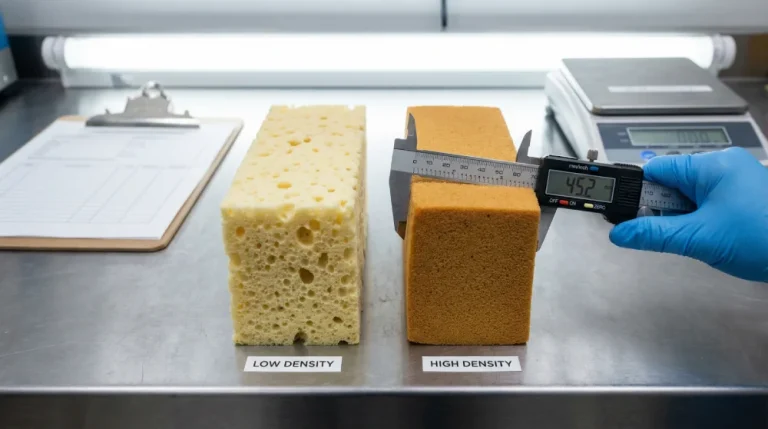
The density of polyurethane foam used in concrete lifting directly determines its compressive strength, load capacity, and cost. Low-density formulations at 2.0 to 3.0 PCF deliver 30 to 60 PSI compressive strength for residential applications, while high-density formulations at 4.0 to 8.0 PCF achieve 100 to 200+ PSI for commercial and industrial projects supporting loads up to 14,000 pounds per square foot.
Choosing the wrong foam density is one of the most common mistakes in polyurethane foam injection projects. Using a low-density foam where heavy loads demand higher compressive strength leads to premature failure. Using a high-density formulation where a lighter product would suffice wastes material and inflates project costs without adding meaningful performance.
The right density depends on what the slab supports, what caused the settlement, and how the repaired surface will be used going forward. Understanding the performance characteristics of each density range helps property owners and project managers make informed decisions that balance structural requirements with budget. A qualified polyurethane injection contractor evaluates these factors before recommending a specific formulation for your project.
What Foam Density Means and Why It Matters
Foam density refers to the weight of cured polyurethane foam measured in pounds per cubic foot (PCF). A 2.0 PCF foam weighs 2 pounds per cubic foot when fully cured. A 6.0 PCF foam weighs 6 pounds per cubic foot. The difference in weight reflects a fundamental difference in cellular structure that directly affects every performance characteristic.
Lower-density foams have larger, more widely spaced cells within their structure. This makes them lighter, more expansive, and less expensive per cubic foot, but also less resistant to compressive force. Higher-density foams have smaller, more tightly packed cells that create a denser, stronger material capable of supporting significantly heavier loads.
The relationship between density and compressive strength is not linear. Doubling the density more than doubles the compressive strength because the tighter cell structure distributes force more efficiently across the material. This means the jump from a 2.0 PCF residential foam to a 4.0 PCF commercial foam represents far more than a 2x improvement in load-bearing capacity.
| Density (PCF) | Compressive Strength (PSI) | Load Capacity | Typical Application |
| 2.0 to 2.5 | 30 to 40 | Light pedestrian and residential vehicle | Sidewalks, patios, pool decks |
| 2.5 to 3.0 | 40 to 60 | Standard residential vehicle | Driveways, garage floors, residential foundations |
| 3.5 to 4.0 | 80 to 100 | Commercial vehicle and equipment | Retail floors, parking garages, loading docks |
| 4.5 to 6.0 | 120 to 150 | Heavy commercial and industrial | Warehouse floors, manufacturing facilities |
| 6.0 to 8.0 | 150 to 200+ | Extreme industrial and infrastructure | Airport runways, highways, bridge approach slabs |
Every polyurethane grout formulation falls somewhere on this spectrum. The concrete lifting foam you need depends entirely on where your project sits on the load-bearing scale.
When to Use Low-Density Polyurethane Foam
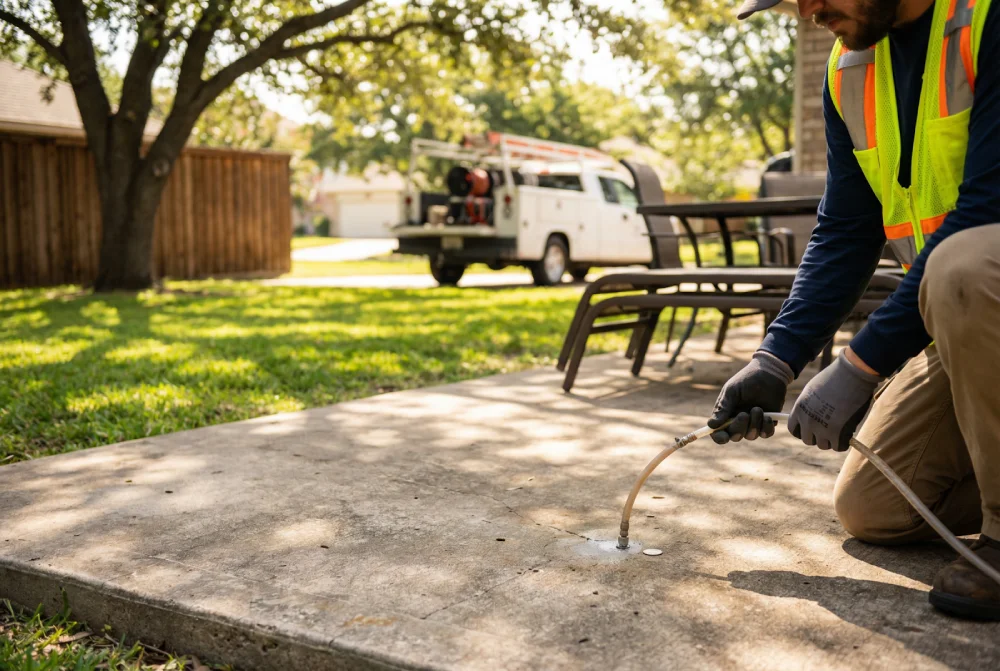
Low-density formulations in the 2.0 to 3.0 PCF range are designed for residential and light commercial applications where the primary loads come from pedestrian traffic and standard passenger vehicles. These foams expand more aggressively than their high-density counterparts, filling larger void volumes with less material.
Residential driveways and garage floors are the most common applications for low-density foam. A standard passenger vehicle weighs approximately 3,000 to 4,000 pounds distributed across four tires, creating ground pressure well within the capacity of a 2.5 to 3.0 PCF foam. The foam's lighter weight is actually an advantage here because it adds minimal stress to the already compromised soil that caused the settlement in the first place.
Sidewalks, patios, and pool decks support primarily pedestrian loads and occasional light equipment like lawn mowers. A 2.0 to 2.5 PCF foam provides more than adequate compressive strength for these applications while keeping project costs at their lowest. For homeowners addressing settled walkways or entertaining areas, foam concrete repair with low-density formulations delivers a fast, affordable solution that lasts 10 to 15 years.
Residential foundation stabilization uses low-density foam to fill voids and stabilize soil beneath home foundations where settlement is caused by erosion or poor compaction rather than extreme loading. Polyurethane foam foundation repair at the residential level rarely requires densities above 3.0 PCF because the loads are distributed across the entire foundation footprint rather than concentrated at specific points.
Key advantages of low-density foam:
- Higher expansion ratio means less material needed to fill the same void volume, reducing material costs
- Lighter weight puts less additional stress on already weakened soil, reducing re-settlement risk
- Faster reaction time allows quicker project completion for straightforward residential jobs
- Lower material cost per cubic foot makes it the most budget-friendly option for qualifying applications
Key limitations of low-density foam:
- Insufficient compressive strength for heavy commercial or industrial loads
- Lower resistance to sustained point loads from heavy equipment or concentrated traffic
- Not suitable for applications where the slab supports forklift traffic, heavy machinery, or commercial vehicle fleets
When to Use High-Density Polyurethane Foam
High-density formulations in the 4.0 to 8.0 PCF range are engineered for commercial, industrial, and infrastructure applications where slabs must support heavy, sustained, or concentrated loads. The tighter cell structure and greater material mass per cubic foot deliver the compressive strength these environments demand.
Warehouse and manufacturing floors support forklift traffic that concentrates thousands of pounds on small wheel contact patches. A loaded forklift can exert ground pressure exceeding 100 PSI at its tire contact points, well beyond what low-density foam can handle. High-density formulations at 4.0 to 6.0 PCF provide the compressive resistance to support these concentrated loads without deformation over time.
Commercial parking garages and loading docks handle heavy delivery trucks, service vehicles, and consistent traffic volumes that create cumulative stress on the slab and the material beneath it. A concrete slab foam jacking project in a commercial parking structure requires 4.0 PCF minimum to ensure the repair withstands years of heavy vehicle traffic without degradation.
Highway and road slab stabilization falls under DOT-grade applications where state and federal specifications dictate minimum material performance standards. These projects use 4.0 to 6.0 PCF formulations that meet or exceed department of transportation requirements for compressive strength, water resistance, and long-term stability under continuous heavy truck traffic.
Airport runways and bridge approach slabs represent the most demanding applications for polyurethane foam injection. Aircraft landing loads and bridge dynamic loads require the highest-density formulations at 6.0 to 8.0 PCF, capable of supporting up to 14,000 pounds per square foot. High pressure polyurethane injection techniques are used in these applications to ensure complete void filling and maximum soil compaction beneath the slab.
Key advantages of high-density foam:
- Compressive strength exceeding 100 PSI handles heavy equipment, commercial vehicles, and industrial loads
- Tighter cell structure provides superior resistance to long-term creep under sustained loading
- Greater durability under repeated impact and vibration from heavy traffic
- Meets DOT and FAA specifications for infrastructure applications
Key limitations of high-density foam:
- Higher material cost per cubic foot increases project budgets
- Lower expansion ratio means more material is needed to fill the same void volume
- Heavier weight adds more mass to the soil beneath, though still a fraction of mudjacking slurry
- Overkill for residential applications where lower densities perform equally well
Material Properties Comparison
The performance gap between low-density and high-density polyurethane foam extends beyond compressive strength into every property that affects long-term repair performance.
| Property | Low-Density (2.0 to 3.0 PCF) | High-Density (4.0 to 8.0 PCF) |
| Compressive strength | 30 to 60 PSI | 100 to 200+ PSI |
| Expansion ratio | 20 to 25x liquid volume | 15 to 18x liquid volume |
| Water absorption | Less than 2% | Less than 1% |
| Cure time to 90% strength | 10 to 15 minutes | 15 to 20 minutes |
| Load capacity per sq ft | Up to 5,000 lbs | Up to 14,000 lbs |
| Material cost per cubic foot | Lower | Higher |
| Soil stress added | Minimal | Low (still far less than mudjacking) |
| Creep resistance | Moderate | High |
Water absorption rates differ between the two categories. While both are classified as closed-cell and hydrophobic, high-density foams achieve slightly lower water absorption rates because their tighter cell structure leaves fewer potential pathways for moisture infiltration. In environments with high water tables or persistent soil saturation, this difference can affect long-term performance. PU grouting with high-density formulations is the preferred approach for projects where water exposure is a constant factor.
Creep resistance, the ability to maintain shape under sustained static load over time, is another important differentiator. High-density foams resist long-term deformation under constant pressure significantly better than low-density alternatives. For a warehouse floor supporting heavy racking systems 24 hours a day, creep resistance determines whether the repair maintains its level for 5 years or 15 years.
Soil Conditions and Density Selection
The condition of the soil beneath the slab influences which foam density will perform best, sometimes overriding what the surface load alone would suggest.
Weak or poorly compacted soils may require higher-density foam than the surface load demands. If the soil beneath a residential driveway is severely eroded or composed of loose fill that hasn't been compacted, a 3.0 to 3.5 PCF foam may be warranted even though the vehicle loads would normally call for 2.5 PCF. The additional density provides a more rigid structural mass that bridges weak spots in the subgrade rather than relying entirely on the soil for support.
Clay soils prone to expansion and contraction create ongoing movement beneath the slab. In Houston and Gulf Coast regions where expansive clay is the dominant soil type, the foam must maintain its structural properties despite seasonal soil movement. Both density ranges perform well in clay environments because cured polyurethane is dimensionally stable regardless of surrounding moisture changes, but higher-density foams provide an additional margin of safety against movement-induced stress.
Sandy and silty soils prone to erosion may continue losing material even after the initial voids are filled. In these environments, polyurethane grout injection serves a dual purpose: the foam fills existing voids and the injection pressure compacts surrounding soil to reduce future erosion. Higher-density foams compact soil more effectively due to their greater injection pressures, which can justify the added cost in erosion-prone environments.
Saturated soils and high water table conditions demand foams with the lowest possible water absorption. While all closed-cell polyurethane foams resist water, high-density formulations with water absorption rates below 1% provide the best long-term performance in perpetually wet conditions. PU foam injection in saturated environments requires careful material selection because any moisture infiltration into the foam's cellular structure compromises compressive strength over time.
How to Choose the Right Density for Your Project
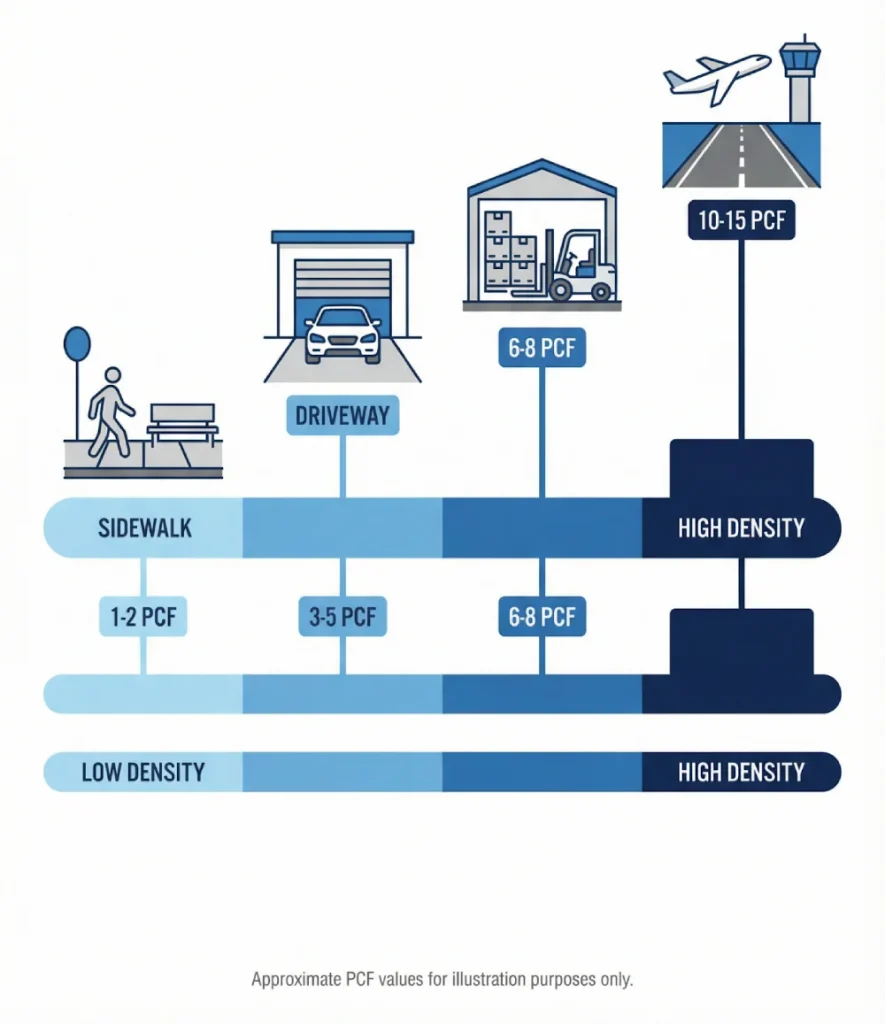
Selecting the correct foam density requires evaluating four factors in order of priority.
Load requirements come first. Identify the heaviest loads the repaired slab will support, not just typical loads but peak loads including heavy delivery trucks on a commercial driveway, loaded equipment on a warehouse floor, or emergency vehicles on a residential street. The foam density must support the maximum expected load with a safety margin, not just the average daily load.
Soil conditions come second. Even if surface loads are light, weak or unstable soil may call for a higher density to create a more rigid support structure. A professional assessment that includes soil evaluation ensures the foam selection accounts for subsurface conditions that aren't visible from the surface.
Project environment comes third. Water exposure, temperature extremes, chemical exposure, and vibration all influence which foam characteristics matter most. An indoor warehouse floor in a climate-controlled environment has different requirements than an outdoor loading dock exposed to Houston's heat, humidity, and heavy rain.
Budget comes last. Cost should inform the decision but never override structural requirements. Using a lower-density foam to save money on a project that requires higher density creates a repair that fails prematurely, costing more in the long run than specifying the right material from the start.
| Project Type | Recommended Density | Key Decision Factor |
| Residential sidewalk or patio | 2.0 to 2.5 PCF | Pedestrian loads only |
| Residential driveway | 2.5 to 3.0 PCF | Passenger vehicle loads |
| Residential foundation | 2.5 to 3.0 PCF | Distributed loads, soil stabilization |
| Commercial retail floor | 3.5 to 4.0 PCF | Cart and light equipment traffic |
| Parking garage | 4.0 to 4.5 PCF | Heavy vehicle traffic |
| Warehouse floor | 4.5 to 6.0 PCF | Forklift and racking loads |
| Highway slab | 4.0 to 6.0 PCF | DOT specifications, heavy truck traffic |
| Airport runway | 6.0 to 8.0 PCF | Aircraft landing loads, FAA specifications |
A qualified grouting company performs the site assessment, evaluates all four factors, and recommends the density that balances performance requirements with project economics. This professional evaluation prevents both over-specification that wastes budget and under-specification that leads to premature failure.
Cost Implications of Density Selection
Foam density directly affects project cost through two mechanisms: material price per unit and the volume of material required. Understanding both helps property owners evaluate quotes and make informed budget decisions.
Higher-density foams cost more per pound because they use higher ratios of isocyanate to polyol and require more precise manufacturing processes. However, the total project cost difference between density ranges is often smaller than expected because higher-density foams expand less, requiring more material volume to fill the same void, which partially offsets the per-unit price difference.
For residential projects where low-density foam is appropriate, the material cost represents a smaller portion of the total project cost relative to labor, equipment, and mobilization. Moving from a 2.0 PCF to a 3.0 PCF foam on a residential driveway might add 10 to 20% to the material cost but only 5 to 10% to the total project cost.
For commercial and industrial projects, material cost becomes a larger percentage of the total because the volumes are significantly higher. Specifying a 6.0 PCF foam when a 4.0 PCF formulation would meet requirements can add meaningful cost to a large warehouse floor project. This is where professional material selection pays for itself by preventing over-specification.
The cost of choosing the wrong density always exceeds the cost of choosing the right one. A low-density foam that fails under commercial loads requires complete re-injection with the correct material, effectively doubling the project cost. A high-density foam used unnecessarily on a residential patio wastes 20 to 40% of the material budget without any performance benefit. Working with an experienced poly injection contractor who matches density to project requirements protects both your investment and the repair's longevity.
Multi-Density Applications
Some projects benefit from using different foam densities in different zones rather than applying a single formulation across the entire area. This approach optimizes both performance and cost by matching material properties to the specific demands of each zone.
Warehouse facilities often have distinct loading zones. Dock areas where forklifts operate and heavy pallets are staged need high-density foam at 4.5 to 6.0 PCF. Interior storage aisles with lighter foot traffic and static racking loads may perform well with 3.5 to 4.0 PCF. Office areas within the same facility might only need 2.5 to 3.0 PCF. Using a single high-density formulation everywhere wastes material in zones that don't need it.
Commercial properties with mixed-use areas combine pedestrian walkways, vehicle access drives, and heavy delivery zones on the same site. Each zone has different load requirements that a multi-density approach addresses more efficiently than a one-size-fits-all specification.
Infrastructure projects sometimes require higher-density foam at approach transitions where dynamic loads are greatest and standard density in the middle spans where loads distribute more evenly. Bridge approach slabs, for example, experience the heaviest impact loads where vehicles transition from the flexible road surface to the rigid bridge deck.
The key to successful multi-density applications is accurate zone mapping during the assessment phase. The technician identifies load zones, maps injection points for each density, and manages the transition between formulations during the injection process. This requires experience and the right equipment setup to switch between materials efficiently. Polyurethane injection grouting with multiple densities is a specialty capability that not all contractors offer.
Long-Term Performance by Density
Both density categories deliver significantly longer service life than traditional mudjacking, but understanding the performance trajectory helps set realistic expectations for each application.
Low-density foams in residential applications typically maintain full structural performance for 10 to 15 years when the original settlement cause has been addressed. If soil erosion continues because drainage issues weren't corrected, even the best foam will eventually lose its subgrade support. The foam itself doesn't degrade, but the soil around it can continue to move if the root cause isn't resolved.
High-density foams in commercial and industrial applications commonly exceed 15 years of service life because they're inherently more resistant to the compressive fatigue that accumulates under heavy repeated loading. DOT-grade formulations used in highway and airport applications are engineered to perform for 20+ years under the most demanding conditions.
Both density categories share the same fundamental advantages that make polyurethane foam grout superior to cement-based alternatives: closed-cell hydrophobic structure that blocks water infiltration, chemical inertness that prevents biological or chemical degradation, dimensional stability that maintains the lift even as surrounding soil conditions change, and lightweight composition that avoids adding problematic mass to weakened subgrades.
Key Takeaways
- Foam density measured in pounds per cubic foot directly determines compressive strength, load capacity, and cost, with low-density formulations at 2.0 to 3.0 PCF delivering 30 to 60 PSI for residential use and high-density at 4.0 to 8.0 PCF achieving 100 to 200+ PSI for commercial and industrial applications
- Low-density foam is the correct choice for residential driveways, sidewalks, patios, pool decks, and light commercial areas where loads come from pedestrian traffic and standard passenger vehicles, offering higher expansion ratios that reduce material costs
- High-density foam is required for warehouse floors, parking garages, highways, and airport runways where concentrated forklift loads, heavy truck traffic, and aircraft landing forces demand compressive strength exceeding 100 PSI
- Soil conditions can override surface load calculations, with weak, eroded, or saturated soils sometimes requiring higher-density foam than the load alone would suggest to create a more rigid structural mass that bridges subgrade deficiencies
- Multi-density applications using different formulations in different zones optimize both performance and cost for facilities with varying load requirements, such as warehouses with distinct dock, aisle, and office areas
- Choosing the wrong density always costs more than choosing the right one because under-specified foam fails prematurely requiring re-injection while over-specified foam wastes 20 to 40% of the material budget without performance benefit
Conclusion
Selecting the right polyurethane foam density is the single most important material decision in any concrete lifting project. Low-density formulations deliver cost-effective, long-lasting results for residential driveways, sidewalks, and patios where loads are light and budgets matter. High-density formulations provide the compressive strength and creep resistance that commercial, industrial, and infrastructure projects demand under heavy, sustained loading.
The decision comes down to matching material properties to real-world demands. Load requirements, soil conditions, environmental exposure, and budget all factor into the specification, and getting it right the first time prevents the costly rework that comes from under-specifying or the wasted spend that comes from over-specifying.Ready to determine the right polyurethane foam density for your concrete lifting project? Contact our team for a professional site assessment that matches material selection to your specific structural and budgetary requirements.