


Polyurethane Grouting for Airport Runways and Taxiways: Meeting Aviation Infrastructure Demands
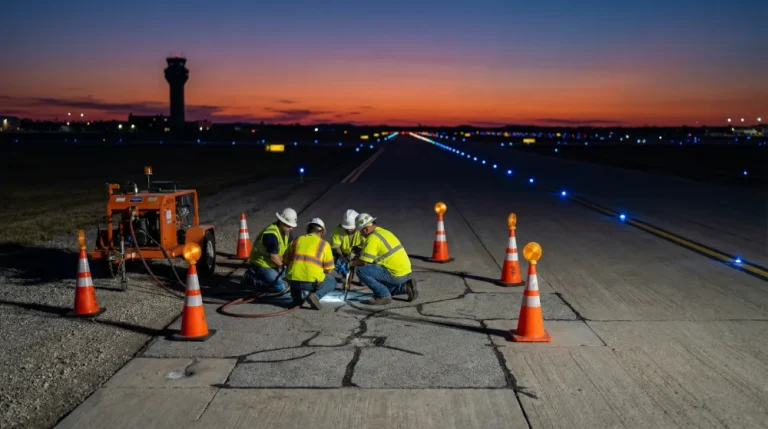
Polyurethane foam injection has become the preferred rapid-repair solution for airport pavement stabilization, using high-density formulations at 6.0 to 8.0 PCF that support aircraft wheel loads exceeding 50,000 pounds while returning runways to service within minutes to hours. Airport case studies consistently demonstrate 40 to 60% cost savings and 50 to 60% reductions in closure time compared to full-depth reconstruction, with treated pavements maintaining structural performance for decades.
Airport pavements operate under loading conditions that no other concrete infrastructure experiences. Commercial aircraft concentrate enormous wheel loads onto small tire contact areas at high speed, and any surface irregularity, whether settlement, faulting, or ponding, creates immediate safety risk. A single inch of depression on a runway can damage light aircraft during landing. Ponding from disrupted surface contours creates ice patches that cause aircraft to skid. Joint faulting generates loose concrete fragments that become Foreign Object Debris capable of catastrophic jet engine damage.
Traditional repair methods like full-depth slab replacement address these problems but require weeks of runway closure that cost airports millions in diverted flights, schedule disruptions, and lost revenue. Poly injection delivers equivalent or superior structural results in overnight work windows, allowing airports to maintain operations while restoring pavement to FAA standards.
Why Airport Pavements Settle
Airport concrete pavements deteriorate through specific mechanisms driven by the extreme and repetitive nature of aircraft loading. Understanding these failure modes explains why polyurethane foam injection addresses airport settlement more effectively than surface-only repair methods.
Subgrade pumping is the primary settlement mechanism on airport pavements. Heavy aircraft wheel loads compress the slab against its base, forcing water through joints and cracks. This water carries fine soil particles with it, progressively eroding the base and subbase layers and creating voids beneath the slab. Over thousands of aircraft movements, the cumulative soil loss creates cavities that leave entire slab sections unsupported.
Vibration-induced compaction from aircraft landing gear transmits dynamic impact energy deep into the subgrade. The touchdown forces from commercial aircraft, particularly wide-body jets, generate vibration that propagates through the pavement structure and into the underlying soil. Over thousands of landing cycles, loose or poorly compacted soils consolidate under this repeated energy input, leaving gaps between the slab and its support.
Drainage failures accelerate every other settlement mechanism. When joint sealants deteriorate and surface drainage systems fail, water infiltrates the pavement system and saturates underlying soils. Saturated soils lose bearing capacity and become highly susceptible to the pumping erosion that aircraft loading drives. Maintaining drainage is the single most important preventive measure for airport pavement longevity.
Thermal cycling causes concrete slabs to curl and warp as temperature fluctuates between day and night and across seasons. This curling repeatedly loads and unloads the subgrade in a rocking motion that compounds the soil erosion from pumping and vibration. In climates with large daily temperature swings, thermal cycling can be as damaging as aircraft loading itself.
Subsurface infrastructure creates localized settlement zones where utilities, culverts, and drainage pipes cross beneath runways. The trench backfill surrounding these installations settles at different rates than the surrounding native soil, producing depressions that progress over time. These infrastructure-related voids are often the most severe because the trench geometry concentrates settlement into narrow bands that create sharp faulting at slab joints.
| Settlement Mechanism | How It Creates Voids | Why Surface Repair Fails |
| Subgrade pumping | Water carries soil particles through joints under aircraft loading | Problem originates beneath the slab at the base/subbase interface |
| Vibration compaction | Aircraft landing forces consolidate loose soil at depth | Settlement originates 4 to 14 feet below the surface |
| Drainage failure | Saturated soil loses bearing capacity and erodes | Water infiltration continues until subsurface pathways are sealed |
| Thermal cycling | Slab curling repeatedly loads and unloads subgrade | Rocking motion compounds erosion regardless of surface condition |
| Subsurface infrastructure | Trench backfill settles at different rates than native soil | Localized voids form around buried utilities at depth |
FAA Pavement Maintenance Framework
The FAA establishes the regulatory and advisory framework governing airport pavement maintenance through a series of Advisory Circulars that define standards for design, construction, and ongoing maintenance. Polyurethane foam injection fits within this framework as both a preventive and remedial maintenance technique.
The Economics of Prevention
The FAA's Pavement Life Cycle curve demonstrates a principle that drives the economic case for polyurethane injection: pavement condition drops slowly in early years but accelerates dramatically as deterioration compounds. The FAA estimates that one dollar spent on preventive maintenance early in a pavement's life equals four to five dollars spent later to address advanced deterioration.
This multiplier effect means that addressing settlement with polyurethane grouting before it progresses to structural failure avoids reconstruction costs that can exceed the injection cost by 5 to 10 times. Airports that incorporate polyurethane injection into their Pavement Maintenance Program treat problems early when the intervention is smallest, fastest, and least disruptive to operations.
Key Regulatory Standards
FAA Advisory Circular 150/5380-6C provides guidelines for maintenance of airport pavements, covering distress identification, preventive maintenance, and remedial repair. AC 150/5320-6F covers pavement design and evaluation, establishing structural standards based on aircraft type, traffic volume, and subgrade conditions with a target minimum 20-year structural life. AC 150/5370-10 sets construction standards that all federally funded maintenance and repair projects must follow.
Many airports receiving Airport Improvement Program grants are required to develop and maintain a Pavement Maintenance Program that includes up-to-date pavement inventory, inspection records, and repair scheduling. Polyurethane injection qualifies under this framework because it restores pavement structural capacity to FAA standards without the cost and closure time of full reconstruction.
FOD Prevention
Foreign Object Debris is a safety concern unique to airport pavements. Surface distresses that produce loose material, called FOD generators, are a primary target of airport maintenance programs. Polyurethane injection addresses a root cause of FOD generation by restoring slab support and preventing the faulting, spalling, and cracking that produce debris. Unlike grinding or slab replacement, the injection process itself generates zero loose material on the pavement surface.
The Deep Injection Process for Airport Pavements
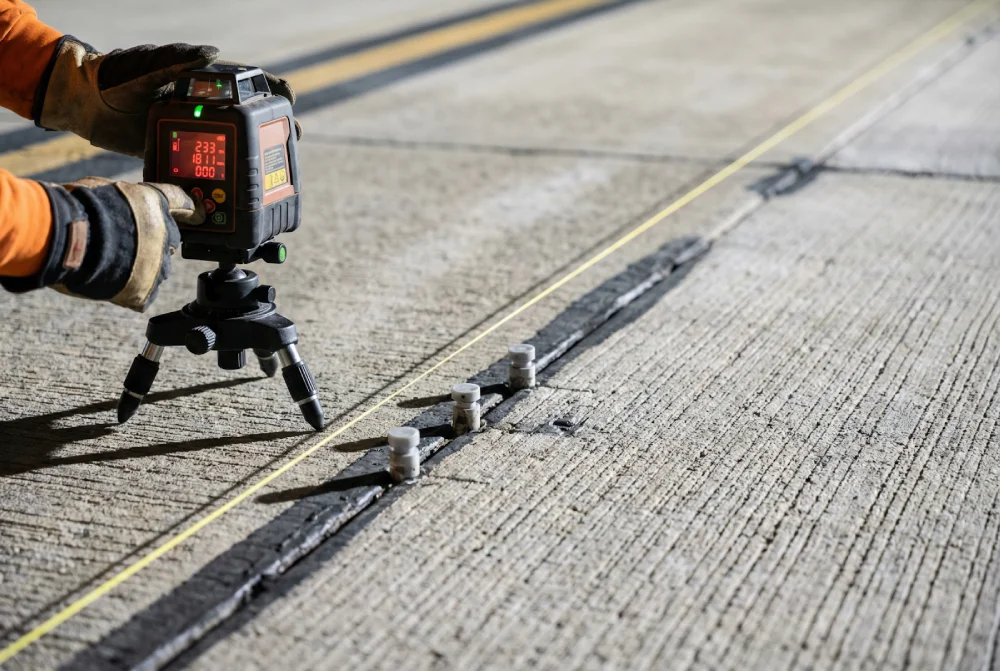
Airport polyurethane injection follows a systematic approach tailored to the unique demands of aviation infrastructure. The process addresses settlement at its source, targeting weak soil and voids at the specific depths where they exist rather than applying a surface-level treatment.
Pre-Treatment Assessment
Dynamic Cone Penetrometer (DCP) testing identifies void locations and weak soil zones beneath the pavement before any injection begins. This testing pinpoints the specific depths and areas requiring treatment, enabling targeted injection rather than blanket coverage that wastes material and time. DCP data maps the subsurface condition across the project area, revealing whether voids are concentrated at the base-subbase interface, deeper in the subgrade, or distributed across multiple depths.
For large projects, Ground-Penetrating Radar (GPR) supplements DCP testing to provide a broader subsurface picture. The combination of DCP point data and GPR area data produces the most complete void map possible, ensuring injection reaches every problem zone.
Drilling and Multi-Depth Injection
Small holes at 5/8-inch diameter are drilled through the pavement at strategic locations determined by the pre-treatment assessment. For deep stabilization, channels are drilled to specific target depths, commonly 4, 7, or even 14 feet below the surface depending on where voids and weak soils are detected.
High-density polyurethane polymer is then injected at multiple depth levels through these channels. The expanding foam flows into voids, compacts surrounding soils, and eliminates weak zones throughout the targeted depth profile. This multi-depth approach is what distinguishes airport-grade PU grouting from standard concrete lifting. Rather than just filling the void immediately beneath the slab, the injection treats the entire soil column contributing to settlement.
Real-Time Monitoring and Alignment
Laser monitors track pavement surface movement during injection, detecting the first flicker of upward slab movement that indicates void filling is complete and lifting has begun. String lines and straight edges provide additional verification against over-lifting, which is particularly critical on runway surfaces where even minor elevation deviations affect aircraft operations.
Once stabilization is confirmed at all target depths, injection continues as needed to bring the pavement surface back to design grade with precision. The foam cures to operational strength within 15 to 30 minutes, after which the runway can accept aircraft traffic.
Material Specifications for Aviation
Airport applications demand the highest-density polyurethane formulations available, engineered to withstand loading conditions that far exceed any commercial or industrial application.
| Property | Aviation-Grade Specification |
| Foam density | 6.0 to 8.0 PCF |
| Compressive strength | 150 to 200+ PSI |
| Load capacity | 10,000 to 14,000 lbs per square foot |
| Aircraft wheel load rating | 50,000+ lbs |
| Chemical resistance | Resistant to de-icing agents and jet fuel |
| Cure to operational strength | 15 to 30 minutes |
| Water absorption | Less than 1% (closed-cell structure) |
The foam's closed-cell structure provides inherent waterproofing that serves a dual function in airport applications. It supports the slab structurally while simultaneously creating a moisture barrier that prevents the pumping action that caused the original settlement. De-icing chemicals, a constant presence on airport pavements during winter operations, do not degrade the cured foam's properties. Jet fuel, hydraulic fluid, and other aviation chemicals that contact the pavement surface are equally harmless to the cured polyurethane grout beneath.
This chemical resistance is critical because airport pavements are exposed to an aggressive chemical environment that degrades many conventional repair materials. Cement-based grouts absorb moisture and can deteriorate when exposed to repeated de-icing chemical application. Polyurethane foam grout maintains its compressive strength and hydrophobic properties regardless of chemical exposure.
Real-World Airport Case Studies
Documented airport projects demonstrate the technology's performance across different scales, conditions, and operational constraints.
San Francisco International Airport
Heavy departure and landing traffic on Runway 10R-28L caused premature pavement deterioration. A remaining-life pavement analysis indicated urgent action was needed. The problem involved a saturated weak soil layer approximately 8 feet below the surface with voids between the cement-treated base and subbase.
Deep injection at 10-foot depth targeted voids detected by DCP testing. Independent third-party testing by Dynatest Consulting confirmed the subgrade modulus improved by an average of 15.7% and the cement-treated base modulus improved by 21.1%, despite record rainfall between pre-treatment and post-treatment testing. The results demonstrated that high pressure polyurethane injection provides measurable, independently verifiable structural improvement even in adverse conditions.
Los Angeles International Airport
As the second-busiest airport in the United States, LAX maintains a long-term maintenance contract for ongoing pavement stabilization using polyurethane injection. A Terminal 6 and Runway 24R/6L project addressed cracking and depression requiring immediate stabilization.
Work began at 10:00 PM to avoid heavy traffic. DCP testing confirmed void locations, and channels were drilled to 4 and 5-foot depths for treatment. The terminal and runway were fully stabilized and lifted in a single overnight shift. By 6:00 AM, crews had departed and air traffic resumed on schedule with zero operational disruption.
Andrews Air Force Base
The primary runway for Air Force One, Runway 1L/19R, developed a 2-inch depression caused by water infiltrating through a leaking culvert beneath the runway. Security constraints made extended closures unacceptable, and frequent presidential operations further complicated scheduling.
The project addressed five tasks: initial slab lifting, soil stabilization to 14 feet below the surface, culvert repair coordination, final slab alignment, and joint and crack sealing. Fifteen slabs within a 60 by 88-foot work area were realigned. The project saved approximately $125,000 and 20 days of runway closure time, a 60% reduction in work time and 50% reduction in costs compared to the original full-depth reconstruction proposal.
Gimpo International Airport, South Korea
South Korea's second-largest airport experienced subsidence across 10,000 square meters of runway and taxiway pavement, ranging from 50mm to 160mm. Disrupted stormwater profiles caused ponding after rain, creating ice patches that could cause aircraft skidding.
Multiple operations rigs injected expanding structural resins beneath slabs to restore hydraulic contours and strengthen the foundation ground at depth. The entire 10,000 square meter area was rehabilitated in 28 days with zero interruption to airport operations. Ponding was eliminated completely, surface contours were restored to design specifications, and aircraft operated on injected areas just 30 minutes after treatment.
| Airport | Problem | Scale | Closure Time | Key Result |
| San Francisco (SFO) | Weak soil at 8 ft depth, base voids | Single runway | Phased treatment | 15.7% subgrade improvement, 21.1% base improvement |
| Los Angeles (LAX) | Terminal and runway cracking and depression | Terminal plus runway | Single overnight shift | Zero operational disruption |
| Andrews AFB | 2-inch depression from culvert leak | 60 x 88 ft area | Reduced by 20 days | 50% cost savings, 60% time reduction |
| Gimpo (South Korea) | 50 to 160mm subsidence across 10,000 sq m | 10,000 square meters | 28 days, zero interruption | Complete ponding elimination |
Advantages Over Traditional Airport Repair Methods
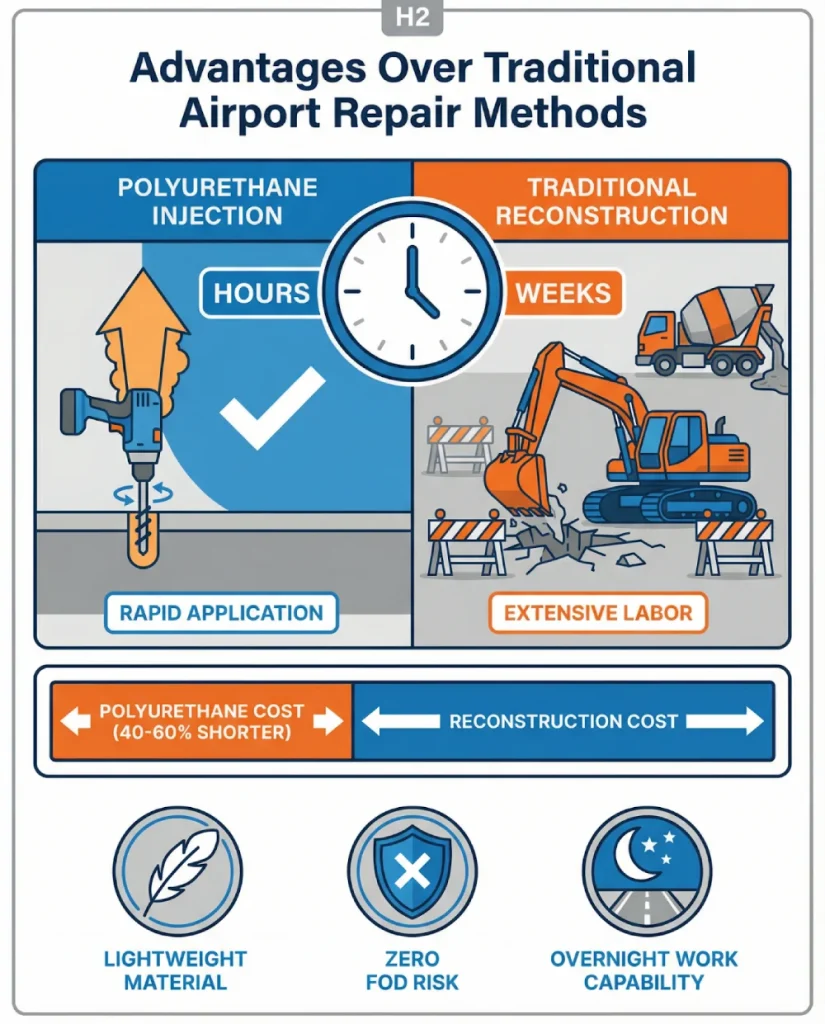
Traditional airport pavement repair methods include full-depth slab replacement, mudjacking, diamond grinding, and asphalt overlay. Polyurethane injection offers distinct advantages over each method across the factors that matter most for airport operations.
Speed and Minimal Closure Time
The most significant advantage for airport operations is speed. Polyurethane injection returns pavement to service within minutes to hours compared to days or weeks for conventional reconstruction. This translates directly to reduced revenue loss from flight diversions, fewer schedule disruptions, and lower economic impact on airlines and passengers. Work consistently fits within overnight windows between 9:00 PM and 5:00 AM when traffic is minimal, and completed sections accept aircraft immediately.
Zero FOD Generation
Unlike slab replacement or grinding that produces loose concrete fragments, chips, and dust, polyurethane foam injection generates zero debris on the pavement surface. The small 5/8-inch drill holes are sealed after injection, leaving no material that could break free and become FOD. This is a critical safety advantage that surface-disrupting repair methods cannot match.
Lightweight Material
Polyurethane foam weighs 2 to 8 pounds per cubic foot compared to 100 to 150 pounds for cement-based mudjacking slurry. This weight difference is critical for airport pavements built on weak or already stressed subgrades. Adding heavy material on top of compromised soil accelerates re-settlement. Concrete raising foam eliminates that cycle by providing structural support without significant mass, while its expansion mechanism simultaneously densifies the surrounding soil.
Deep Stabilization Capability
Unlike surface treatments that only address the slab itself, deep injection targets the root cause of settlement at depth. Injections at 4, 7, 10, or even 14 feet below the surface stabilize weak soil layers that no surface repair can reach. This addresses the underlying problem rather than masking symptoms, which is why polyurethane-treated airport pavements demonstrate significantly less re-settlement than surface-repaired pavements over multi-year monitoring periods.
Cost Efficiency
Airport case studies consistently demonstrate 40 to 60% cost savings compared to full-depth reconstruction. The Andrews AFB project achieved a 50% cost reduction. The economic advantage compounds when factoring in the reduced closure costs, since every hour of runway closure represents significant revenue loss that traditional methods extend by days or weeks. For airport operators managing tight maintenance budgets, polyurethane injection grouting delivers more structural improvement per dollar than any alternative.
Quality Verification and Testing
Airport pavement repairs demand rigorous verification to confirm that treatment meets FAA performance standards. The testing protocol for aviation-grade polyurethane injection is more comprehensive than any other application category.
Dynamic Cone Penetrometer testing before injection maps void locations and soil strength at various depths, establishing the baseline that the repair must improve. Heavy Weight Deflectometer testing before and after treatment provides objective, quantifiable comparison of structural capacity, measuring how much the pavement deflects under a standardized load. The SFO case study demonstrated best practice by hiring independent third-party consultants to perform this testing.
Laser monitoring during injection tracks slab elevation in real time, preventing over-lifting that would create new surface irregularities. Ground-Penetrating Radar after injection verifies complete void filling and foam distribution beneath the slab. Core sampling assesses cured foam density and cell structure quality, confirming the material meets specification. Plate load testing verifies field load-bearing capacity under simulated loads one to three days after cure.
This multi-phase verification approach ensures that every treated section meets the structural standards the FAA requires and provides the documentation airports need for their Pavement Maintenance Program records.
Operational Considerations for Airport Projects
Night Work and Scheduling
Most airport polyurethane injection is performed during overnight windows when flight operations are reduced. The compact equipment footprint and rapid setup and teardown enable crews to mobilize, complete treatment, and demobilize within a single shift. LAX's terminal and runway repair completed entirely between 10:00 PM and 6:00 AM, demonstrating that significant repairs fit within standard overnight maintenance windows.
Security and Access
Airside work requires security clearances, escort protocols, and coordination with airport operations and FAA tower personnel. Crews work alongside airport engineering staff, concrete crews, and electrical teams while maintaining the safety and security protocols that aviation environments demand. Experienced grouting services contractors understand these requirements and build compliance into their project planning from the start.
Weather Sensitivity
Polyurethane foam chemistry is temperature-sensitive. Cold weather slows the reaction while extreme heat accelerates it. Heated hose systems and proportioner temperature controls maintain material within the optimal processing window regardless of ambient conditions. The SFO project achieved strong results despite record rainfall between testing phases, demonstrating the foam's resilience in adverse weather conditions.
Phased Treatment
Large airport projects are broken into phases that treat individual slab panels or sections without affecting adjacent operational areas. Gimpo Airport's 10,000 square meter rehabilitation used multiple operations rigs working in coordinated phases over 28 days, with aircraft operating continuously on completed sections while adjacent areas were being treated. This phased approach allows airports to maintain operations throughout the entire project duration.
Long-Term Performance
Field data confirms that polyurethane stabilization provides decades of reliable performance in the demanding airport environment. State DOT monitoring over 5 to 10 year periods confirms lasting effectiveness, with treated sections showing minimal re-settlement compared to untreated control areas. The compressive strength of the polyurethane material shows no reduction after years of underground exposure to moisture, chemicals, and loading.
Geotechnical polyurethane grouts have a documented half-life exceeding 150 years, meaning the material retains structural properties far beyond the 20-year minimum pavement life the FAA targets for airport infrastructure. The foam's chemical resistance to de-icing agents, jet fuel, and saltwater ensures that the aggressive chemical environment on airport pavements does not degrade performance over time.
This durability, combined with the ability to perform targeted retreatment if localized settlement recurs, makes polyurethane injection a sustainable long-term component of any airport's Pavement Maintenance Program. Rather than a one-time repair, it becomes an ongoing maintenance tool that preserves pavement condition at the lowest lifecycle cost.
Key Takeaways
- Airport-grade polyurethane foam at 6.0 to 8.0 PCF supports aircraft wheel loads exceeding 50,000 pounds with compressive strength of 150 to 200+ PSI and chemical resistance to de-icing agents and jet fuel
- Deep injection at 4 to 14 feet below the surface targets the root cause of settlement rather than masking surface symptoms, with DCP testing and GPR mapping ensuring injection reaches every void and weak soil zone
- Repairs complete within overnight work windows and return pavement to service within minutes, with documented case studies showing zero operational disruption at LAX and 28-day rehabilitation of 10,000 square meters at Gimpo with continuous aircraft operations
- Cost savings of 40 to 60% compared to full-depth reconstruction are consistently documented across airport projects, with the Andrews AFB project achieving 50% cost reduction and 60% time reduction versus the original reconstruction proposal
- Zero FOD generation during the repair process eliminates the safety risk that grinding, slab replacement, and other surface-disrupting methods create on active airfields
- Multi-phase quality verification including DCP, Heavy Weight Deflectometer, laser monitoring, GPR, core sampling, and plate load testing provides the objective documentation airports need to confirm FAA compliance and maintain Pavement Maintenance Program records
Conclusion
Airport pavement demands the highest performance from every material and method used in its maintenance. Polyurethane foam injection meets that demand by delivering aviation-grade structural capacity through a process that minimizes the closure time, operational disruption, and cost that make traditional reconstruction so burdensome for airport operators.
The technology's ability to target settlement at its source through deep injection, verify results through rigorous multi-phase testing, and return pavement to service within overnight work windows makes it uniquely suited to the operational constraints of active airports. Documented results at SFO, LAX, Andrews AFB, and Gimpo International demonstrate consistent performance across different scales, conditions, and operational environments.Ready to discuss polyurethane injection for your airport or infrastructure pavement project? Contact our team for a professional assessment backed by the equipment and expertise aviation-grade projects demand.