


Polyurethane Grouting vs. Traditional Methods: A Comprehensive Comparison Guide
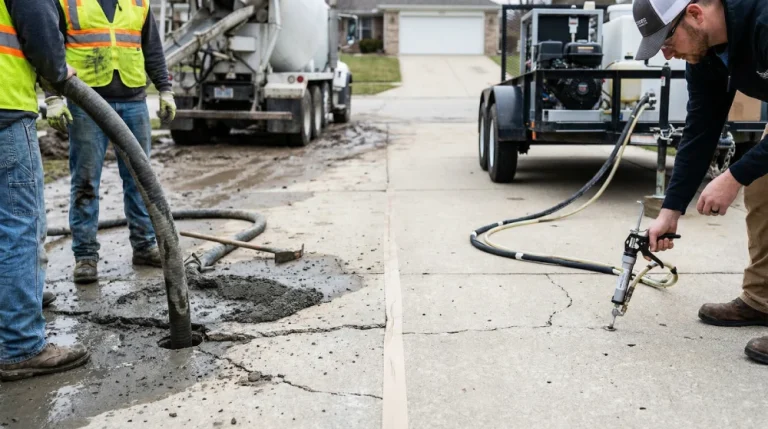
Polyurethane foam injection outperforms mudjacking, cement grouting, and self-leveling overlays across lifespan, precision, cure time, and total cost of ownership for most concrete repair scenarios. Foam lasts 10 to 15+ years with a documented half-life exceeding 150 years, cures in 15 minutes, achieves precision within 1/8 inch, and saves 50 to 70% versus full slab replacement when factoring in avoided downtime. However, each traditional method retains specific niches where it remains the better choice.
Concrete repair is not a one-size-fits-all discipline. The right method depends on the type of problem, whether it's settlement, cracking, void formation, or water infiltration, along with the structural demands of the application, environmental conditions, budget, and timeline. Polyurethane foam injection has gained significant market share over the past two decades, but traditional methods including mudjacking, cement grouting, full slab replacement, self-leveling overlays, compaction grouting, and epoxy injection each retain scenarios where they perform well.
Making an informed decision requires understanding what each method does, where it excels, and where it falls short. A qualified concrete leveling company evaluates your specific conditions and recommends the approach that delivers the best long-term outcome for your project rather than defaulting to a single method regardless of circumstances.
Polyurethane Foam Injection vs. Mudjacking
This is the most common comparison in the concrete lifting industry. Both methods raise settled slabs by pumping material beneath them, but the materials, processes, and long-term results differ substantially.
Mudjacking, also called slabjacking, drills 1.5 to 2 inch holes into the settled slab and pumps a slurry of cement, water, soil, and sometimes sand or limestone beneath it. The heavy slurry fills voids and pushes the slab upward through hydraulic pressure.
Polyurethane foam injection, also called polyjacking, drills 3/8 to 5/8 inch holes and injects a two-component expanding polymer that fills voids, compacts soil, and lifts the slab through controlled chemical expansion.
| Factor | Polyurethane Foam Injection | Mudjacking |
| Material weight | 2 to 8 lbs per cubic foot | 100 to 150 lbs per cubic foot |
| Injection hole size | 3/8 to 5/8 inch (dime-sized) | 1.5 to 2 inches (soda can-sized) |
| Cure time | 15 minutes to 90% strength | 24 to 72 hours before use |
| Typical lifespan | 10 to 15+ years | 2 to 5 years on average |
| Water resistance | Hydrophobic, closed-cell, does not absorb or erode | Absorbs moisture, can erode and wash out |
| Precision | Within 1/8 inch using laser monitoring | Less precise, difficult to control slurry flow |
| Void penetration | Flows into small cracks before expanding | Cannot reach narrow gaps, slurry too viscous |
| Re-settlement risk | Low, lightweight material doesn't stress weak soil | Higher, heavy slurry adds load to compromised soil |
| Upfront cost | Higher ($5 to $25 per square foot) | Lower ($3 to $6 per square foot) |
| Long-term cost | Lower (fewer re-repairs needed) | Higher (more frequent re-treatment) |
The weight difference is the most consequential factor. Adding 100 to 150 pounds per cubic foot of cement slurry on top of soil that already failed under the original slab weight is why mudjacked driveways frequently re-settle within 2 to 5 years. Concrete lifting foam at 2 to 8 pounds per cubic foot provides structural support without adding problematic mass.
Choose polyurethane when long-term performance matters, the slab supports vehicle or heavy traffic, soil conditions are poor or wet, precision is critical, or minimal downtime is required.
Choose mudjacking when budget is the primary constraint on a low-priority slab that supports only light foot traffic on stable, well-drained soil where long-term performance is secondary to immediate cost savings.
Polyurethane Foam Injection vs. Cement Grouting
Cement grouting encompasses cementitious grout injected under pressure for void filling, soil stabilization, and structural repair. The comparison centers on their performance as subsurface void-filling materials.
The fundamental difference is expansion versus gravity. Polyurethane foam expands to fill the space it occupies, creating uniform contact with all surrounding surfaces. Cement grout relies on gravity to flow and settle into position. This means cement grout can leave unfilled pockets in overhead voids, irregularly shaped cavities, and upward-facing gaps where the grout simply cannot flow against gravity. Polyurethane grout injection fills these spaces from the inside out.
Cement grout's tendency to shrink 1 to 3% during curing compounds this disadvantage. Even voids that are initially filled can develop gaps as the grout contracts, requiring re-injection. Polyurethane foam exhibits zero shrinkage after curing, maintaining full contact with surrounding surfaces indefinitely.
Cement grout weighs approximately 120 pounds per cubic foot compared to 2 to 20 pounds for polyurethane foam depending on formulation. Cement grout is porous and absorbs water, which can deteriorate the material and reduce adhesion in wet conditions. Polyurethane foam's closed-cell hydrophobic structure blocks water absorption entirely.
When cement grout still makes sense: Deep permeation grouting in coarse-grained soils where the grout needs to penetrate the soil matrix rather than fill discrete voids. Cement grouting is also cost-effective for very large-volume fills where structural demands are minimal and the material cost of polyurethane would be prohibitive. For most void-filling and soil stabilization applications, polyurethane injection grouting delivers superior results through its expansion, zero shrinkage, and water resistance.
Polyurethane Foam Injection vs. Full Slab Replacement
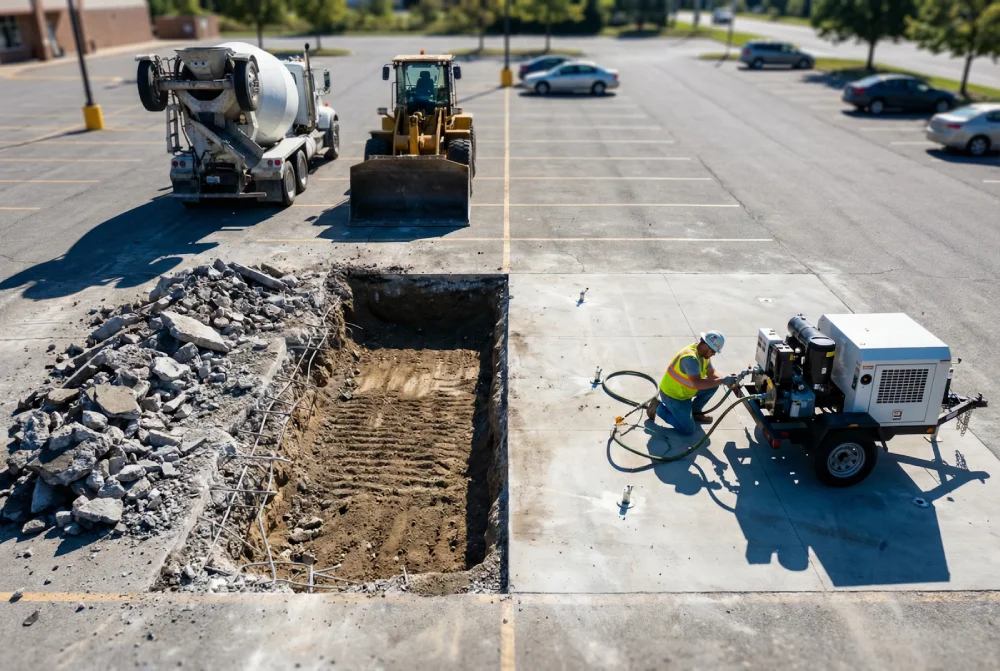
Full slab replacement is the most invasive and expensive option, removing and replacing the entire concrete structure. It remains necessary in some situations, but polyurethane foam injection eliminates the need for replacement in most concrete settlement scenarios.
Full replacement involves breaking up the existing slab with jackhammers, hauling away debris, regrading and compacting the subgrade, installing forms, pouring new concrete, and waiting 7 days for foot traffic and 28 days for full load capacity. The process generates significant waste, requires heavy equipment on-site, and disrupts the surrounding property.
Polyurethane injection drills small holes in the existing slab, injects expanding foam, and returns the surface to service in minutes. No excavation, no debris, no heavy equipment, and no curing delays.
| Factor | Polyurethane Injection | Full Slab Replacement |
| Cost per square foot | $5 to $25 | $8 to $15+ (residential), higher for commercial |
| Project duration | 2 to 6 hours | 3 to 7 days minimum |
| Time to foot traffic | 15 to 20 minutes | 24 to 72 hours |
| Time to vehicle traffic | 1 to 2 hours | 5 to 7 days |
| Total savings vs. replacement | 50 to 70% | Baseline |
| Waste generated | Virtually none | Tons of demolished concrete |
| Environmental impact | Preserves existing slab | Carbon-intensive new concrete production |
Full slab replacement generates significant environmental impact beyond the jobsite. The demolished concrete must be trucked to a landfill or recycling facility, and new concrete production is highly carbon-intensive, with cement manufacturing accounting for approximately 8% of global CO2 emissions. Polyurethane injection preserves the existing slab, generates virtually no waste, and avoids the environmental cost of new concrete production.
When replacement is necessary: The slab is severely crumbled, disintegrated, or structurally compromised beyond lifting. Multiple large cracks have divided the slab into unstable fragments. The original concrete is severely deteriorated from freeze-thaw damage, deicing salt exposure, or alkali-silica reaction. A complete redesign of slab thickness, reinforcement, or drainage is required. Code violations in the original construction require a new pour to specification.
Polyurethane Foam Injection vs. Self-Leveling Concrete Overlays
Self-leveling concrete is a pourable cementitious compound applied over an existing surface to create a smooth, level finish. It serves a fundamentally different purpose than polyurethane injection, and confusing the two leads to failed repairs.
Self-leveling concrete is a surface treatment. It pours onto the top of an existing slab and flows to fill low spots, creating a flat surface. It does not address the root cause of settlement. Voids and weak soil beneath the slab remain untreated.
Polyurethane injection works beneath the slab, filling voids and lifting the concrete from below. It addresses the cause of settlement rather than masking the symptoms.
Self-leveling concrete adds 120 to 150 pounds per cubic foot to an already compromised slab. If the slab settled because the soil beneath it couldn't support the original weight, adding more weight on top accelerates the problem. The surface may look level temporarily, but re-settlement is virtually guaranteed because the underlying voids remain unfilled and the additional weight stresses the weakened soil further.
Self-leveling concrete is typically limited to 1 to 2 inches of correction and cannot lift a slab that has settled several inches. It works well for cosmetic surface corrections where the slab is structurally sound but slightly uneven, typically as preparation for flooring installation. It is not a substitute for structural repair.
Polyurethane Injection vs. Compaction Grouting
Traditional compaction grouting uses a stiff, low-slump cementitious grout injected at high pressure through steel casings to displace and densify loose soil. Polyurethane compaction grouting achieves similar soil improvement through chemical expansion rather than hydraulic pressure.
Cement-based compaction grouting requires drilling steel casings to target depth, sometimes 30 feet or more, then injecting thick cement grout under 200 to 800 PSI pressure. The grout forms a solid bulb that displaces surrounding soil outward, increasing density. The process requires large drill rigs, mixing equipment, and significant mobilization.
Polyurethane compaction grouting uses smaller injection tubes and relies on the foam's chemical expansion to fill voids, fracture soil with expanding resin lenses, and compact surrounding soil. PU foam injection for compaction grouting costs 5 to 8 times less than cement-based methods, fits equipment in a trailer rather than requiring heavy drill rigs, and cures in minutes rather than days.
Polyurethane compaction grouting excels for shallow to moderate depth problems up to approximately 14 feet, where cost-effectiveness and speed matter, and where voids beneath concrete slabs are the primary issue.
Cement-based compaction grouting is the better choice for deep soil stabilization problems at 20 to 60+ feet, large-scale geotechnical projects, and situations requiring comprehensive soil densification at significant depth, such as major building foundations over deep fill or collapsible soils.
Polyurethane Injection vs. Epoxy Injection
This comparison applies specifically to crack repair and structural bonding, not slab lifting. Both polyurethane and epoxy are injected into concrete cracks, but they serve fundamentally different purposes.
Polyurethane crack injection is designed for waterproofing and sealing. The material cures to a flexible state that accommodates ongoing crack movement from thermal expansion, vibration, or structural settling. It expands to fill voids and block water paths, cures in minutes, and performs excellently in wet conditions and active leaks because it reacts with water. Polyurethane injection grouting waterproofing is the standard method for stopping active water infiltration through concrete cracks.
Epoxy crack injection is designed for structural bonding and repair. The material cures to a rigid state that restores or exceeds the original concrete's tensile strength. It does not expand and relies on gravity and low-pressure injection to fill the crack. Epoxy requires a dry substrate and cures over several hours. It is the standard for structural crack repair in foundations, beams, and columns where the crack must be bonded at full strength to transfer load across the repair.
| Property | Polyurethane Crack Injection | Epoxy Crack Injection |
| Primary function | Waterproofing and flexible sealing | Structural bonding and rigid repair |
| Flexibility when cured | Flexible, accommodates movement | Rigid, does not flex |
| Curing time | Minutes | Several hours |
| Wet or active leak application | Excellent, reacts with water | Poor, requires dry substrate |
| Structural strength | Not structural | Restores or exceeds original concrete strength |
| Best crack types | Hairline cracks, actively leaking cracks | Structural cracks, wider dormant cracks |
In some projects, both methods are used sequentially. Polyurethane is injected first to stop active water flow, then epoxy provides permanent structural bonding once the area is dry. This combined approach leverages the strengths of both materials.
Master Comparison Matrix
| Method | Best For | Cost Range | Timeline | Durability |
| Polyurethane foam injection | Slab lifting, void fill, soil stabilization | $5 to $25/sq ft | Hours, 15-min cure | 10 to 15+ years, half-life 150+ years |
| Mudjacking | Budget residential lifting | $3 to $6/sq ft | Same day, 24 to 72 hr cure | 2 to 5 years |
| Cement grouting | Deep permeation, large-volume fill | Varies by volume | Hours to days | Moderate, porous and shrinks |
| Full slab replacement | Severely damaged slabs | $8 to $15+/sq ft | 3 to 7 days, 28-day cure | 20 to 30 years (new slab) |
| Self-leveling concrete | Minor surface imperfections | $2 to $8/sq ft | Hours, 24-hr cure | 5 to 10 years surface |
| Compaction grouting (cement) | Deep soil stabilization 20 to 60+ ft | High | Days to weeks | Long-term |
| Epoxy crack injection | Structural crack repair (dry conditions) | $300 to $600 per crack | Hours | Decades |
| Polyurethane crack injection | Water leak sealing, flexible crack seal | $250 to $500 per crack | Minutes | Long-term flexible seal |
Decision Framework: Choosing the Right Method
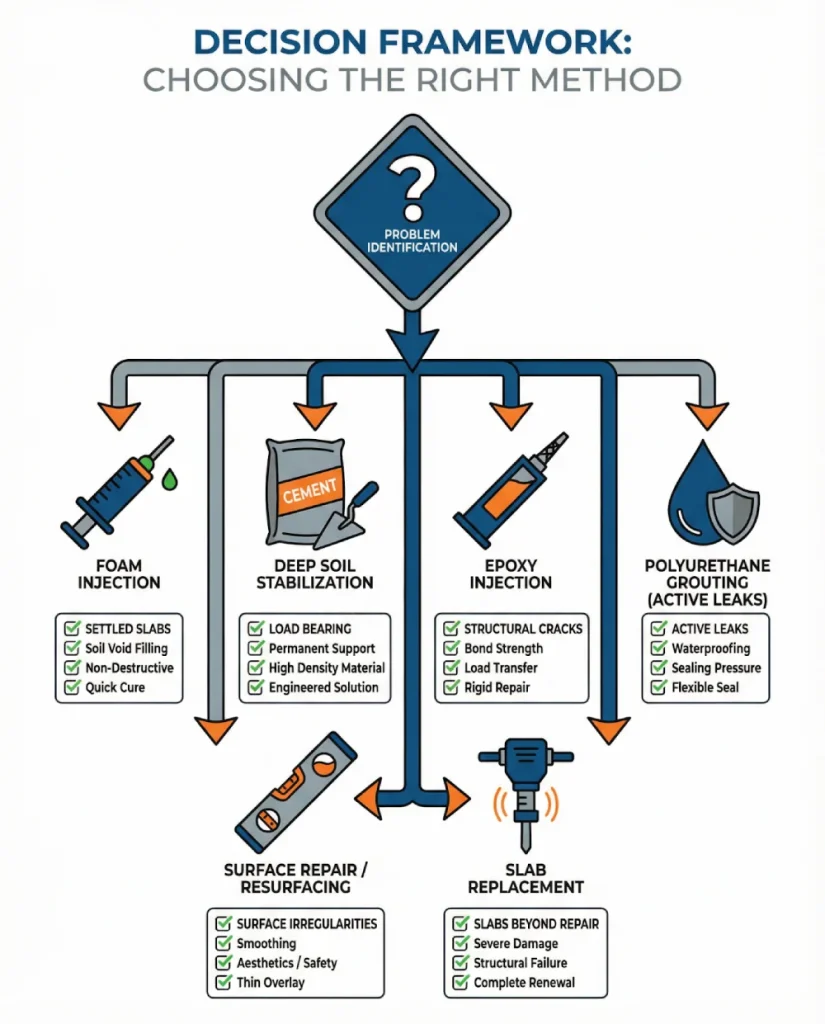
Selecting the right concrete repair method requires a structured evaluation that starts with the problem, considers the constraints, and factors in total cost of ownership rather than first-invoice price alone.
Step 1: Identify the Problem
A settled or sunken slab points to polyurethane injection or mudjacking. Subsurface voids without visible settlement call for polyurethane void fill or cement grouting. Structural cracking requires epoxy injection. Active water leaks demand polyurethane crack injection. Weak soil at depth needs polyurethane or cement compaction grouting depending on the depth. Surface irregularities on a structurally sound slab suit self-leveling concrete. A slab that is crumbled, fragmented, or structurally compromised beyond repair requires full replacement.
Step 2: Evaluate Constraints
Budget limitations point toward mudjacking for light-duty applications and polyurethane for anything load-bearing. Time limitations favor polyurethane injection, which delivers the fastest return to service across all methods. Wet environments demand polyurethane because its hydrophobic, closed-cell structure performs in saturated conditions where cement-based materials degrade. Heavy loads require high-density polyurethane formulations rated for industrial, DOT, and airport applications. Deep soil failure below 14 feet calls for cement-based compaction grouting. Structural bonding requirements specify epoxy injection.
Step 3: Consider Total Cost of Ownership
The lowest upfront price rarely delivers the lowest total cost. Mudjacking's 2 to 5 year lifespan means potential re-treatment 3 to 4 times within the service life of a single polyurethane repair. Full replacement's 28-day downtime in a commercial setting can cost more in lost revenue than the repair itself. A pressure grout company that evaluates total cost, including initial repair plus re-treatments plus operational downtime, helps property owners avoid the false economy of choosing the cheapest first repair that requires the most expensive maintenance cycle.
The right comparison is lifetime cost, not the first invoice alone. Polyurethane foam injection's higher upfront price typically delivers the lowest total cost across a 10 to 15 year horizon for any application involving vehicle traffic, heavy loads, wet conditions, or operational facilities where downtime carries financial consequences.
Key Takeaways
- Polyurethane foam injection outperforms mudjacking across lifespan (10 to 15+ years vs. 2 to 5), precision (1/8 inch vs. imprecise), cure time (15 minutes vs. 24 to 72 hours), and re-settlement risk because its 2 to 8 PCF weight avoids stressing already compromised soil that mudjacking's 100 to 150 PCF slurry further degrades
- Polyurethane foam expands to fill irregularly shaped voids while cement grout relies on gravity, meaning cement grout leaves unfilled pockets in overhead and upward-facing gaps, and its 1 to 3% curing shrinkage creates new gaps that polyurethane's zero-shrinkage formulation avoids
- Full slab replacement costs 50 to 70% more than polyurethane injection when factoring in demolition, hauling, new concrete, 28-day cure time, and the operational downtime that hits commercial facilities hardest
- Self-leveling concrete is a surface treatment that masks settlement symptoms by adding 120 to 150 pounds per cubic foot on top of an already compromised slab without addressing the underlying voids, virtually guaranteeing re-settlement
- Each traditional method retains a specific niche: mudjacking for budget light-duty work, cement compaction grouting for deep soil problems exceeding 14 feet, epoxy for structural crack bonding, and full replacement for slabs that are structurally compromised beyond lifting
- Total cost of ownership over 10 to 15 years, not first-invoice price, is the right comparison, because mudjacking's shorter lifespan requires 3 to 4 re-treatments within a single polyurethane repair's service life
Conclusion
Every concrete repair method exists because it solves a specific problem well. Polyurethane foam injection has earned its market share by delivering the best combination of lifespan, precision, speed, and total cost across the widest range of applications. But it is not the right answer for every scenario. Mudjacking serves budget-constrained light-duty work. Cement compaction grouting reaches depths polyurethane cannot. Epoxy bonds structural cracks with rigid strength. Full replacement rebuilds what cannot be repaired.
The decision between methods comes down to matching the repair to the problem, the constraints, and the long-term economics. Property owners who evaluate total cost of ownership rather than upfront price consistently choose the method that costs less over the life of the repair, even if it costs more on the first invoice.Ready to determine which concrete repair method is right for your project? Contact our team for a professional assessment that evaluates your specific conditions and recommends the approach that delivers the best long-term outcome.