Industrial Floor Leveling with Polyurethane: Warehouse and Manufacturing Facility Solutions
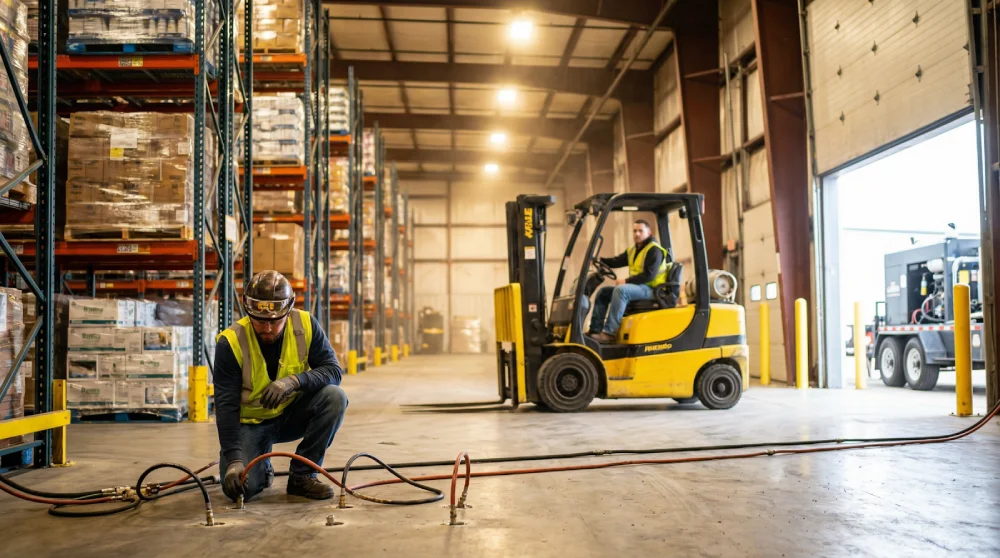
Polyurethane foam injection restores structural support beneath settled, curled, or void-compromised industrial floors in 2 to 6 hours with same-day return to forklift traffic, delivering 30 to 40% direct cost savings over full slab replacement and 50 to 70% total savings when factoring in avoided operational downtime. High-density formulations at 4.0 to 6.0 PCF provide compressive strength of 100 to 150+ PSI and load capacities up to 14,000 pounds per square foot, matching the demands of heavy forklift traffic, pallet racking, and manufacturing equipment.
Warehouse and manufacturing facility floors endure a punishing combination of heavy static loads, dynamic forklift traffic, machinery vibration, and environmental stress that no residential or light commercial slab ever faces. When these floors settle, curl, or develop voids, the consequences cascade quickly. Damaged inventory and equipment, safety hazards from trip points and unstable surfaces, forklift maintenance costs from uneven floors, and operational downtime from repair closures all compound into losses that dwarf the cost of the floor repair itself.
Traditional solutions like full slab replacement require 2 to 4 weeks including a 28-day concrete cure period before the floor supports full loads. For a warehouse generating $50,000 to $100,000 or more per day in throughput, that timeline is catastrophic. Polyurethane injection delivers equivalent or superior structural results with same-day return to service, allowing facilities to maintain operations during the repair and avoid the revenue loss that extended shutdowns create.
The Problem: Why Industrial Floors Fail
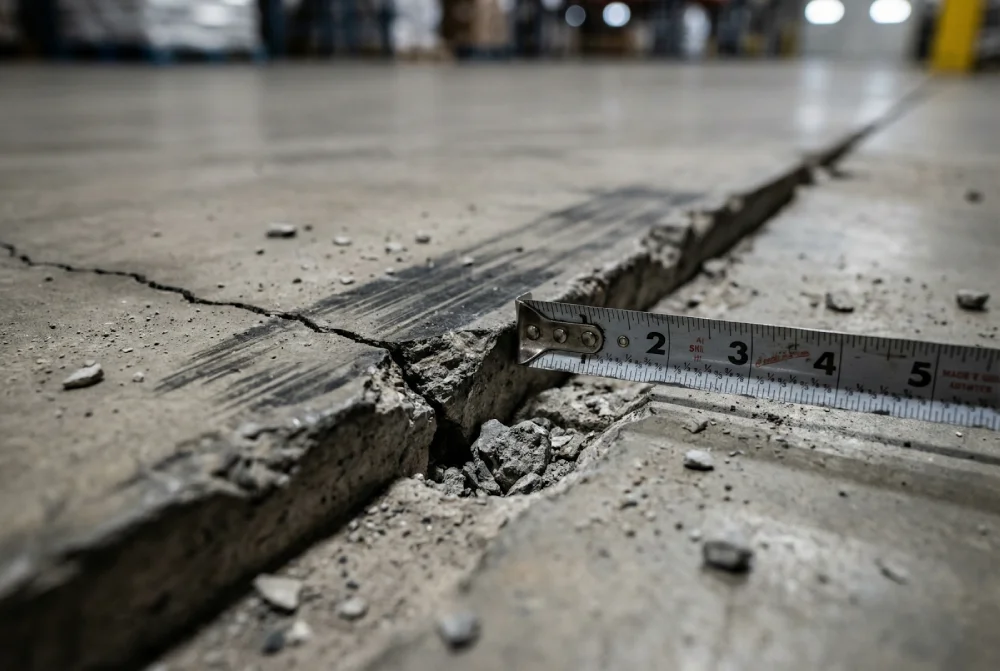
Industrial concrete floors fail through mechanisms that are amplified versions of the same forces affecting residential slabs but with far greater intensity and far higher economic consequences. Understanding these failure modes is essential for selecting the right repair approach and preventing recurrence.
Soil-Related Settlement
The soil beneath a warehouse slab is under constant stress from the combined dead load of the concrete itself and the live loads above it. Poorly compacted fill from original construction gradually consolidates under the sustained weight of the slab, stored materials, and equipment, creating voids that develop over months or years. Water infiltration from plumbing leaks, poor perimeter drainage, and groundwater migration washes away fine soil particles beneath the slab, progressively undermining support in patterns that follow water flow paths.
Vibration-induced compaction from continuous forklift traffic and heavy machinery transmits energy into the subgrade, accelerating soil consolidation in the high-traffic zones that also happen to carry the heaviest loads. Organic decomposition from buried tree roots, vegetation, or construction debris creates expanding voids as material breaks down beneath the slab. Each of these mechanisms operates independently, but in most industrial facilities several act simultaneously, compounding the rate and severity of settlement.
Slab Curl and Warping
Slab curl is one of the most common and most destructive industrial floor problems. It occurs when the top and bottom surfaces of a concrete slab dry and shrink at different rates during the original curing process. The top surface dries faster, contracting and pulling the slab edges upward, creating a concave shape where corners and edges lift away from the subgrade.
In a warehouse environment, curled slabs create a destructive cycle that progressively worsens. The lifted slab edges create gaps between the slab underside and the soil. Forklifts drive over the unsupported edges, causing the slab to rock back and forth with each wheel pass. The rocking motion hammers the adjacent slab's joint edge repeatedly. Joint edges progressively deteriorate, producing spalling, chipping, and loose debris. Damaged joints widen, allowing more water infiltration that accelerates soil erosion beneath both slabs.
This cycle is the primary driver of joint deterioration in industrial warehouse floors. Addressing slab curl with polyurethane foam injection is a prerequisite for any lasting joint repair because simply resealing joints on unstable slabs fails. Joint sealants are designed for horizontal expansion and contraction, not the vertical shear movement that rocking slabs produce.
Heavy Load Concentration
Warehouse floors must support several distinct load types simultaneously, each creating different stress patterns on the slab and subgrade.
Loaded forklifts can exceed 15,000 to 25,000 pounds with small solid tires concentrating that weight on narrow contact patches, creating extreme point loads that stress both the concrete and the supporting soil. Pallet racking systems transfer the weight of stored inventory through steel columns directly to the slab at small base plate areas, creating sustained concentrated loads that never relent. Manufacturing equipment, presses, conveyors, and automated systems generate both static loads and dynamic vibration that compounds soil consolidation. Block-stacked or floor-stored materials create area loads that can exceed the original design assumptions, particularly when facility use changes from the original intent.
When any of these loads act on a slab with compromised subgrade support, settlement accelerates rapidly and the damage compounds with each loading cycle.
F-Numbers: The Industry Standard for Floor Quality
Industrial floors are measured against the F-Number System established by ACI Standard 117 and ASTM E 1155. Two values define floor quality and determine whether a floor meets operational requirements.
FF (Floor Flatness) measures the bumpiness or waviness of the surface. Higher FF means a smoother floor with fewer undulations that affect forklift stability and load handling. FL (Floor Levelness) measures the overall tilt or pitch of the slab relative to a horizontal plane. Higher FL means a more level surface that ensures racking systems, equipment, and automated systems operate within tolerance.
F-Numbers are linear, meaning an FF 40 is twice as flat as an FF 20. This mathematical relationship makes it straightforward to quantify how much settlement has degraded floor performance and how much improvement the repair achieves.
| Floor Classification | FF / FL Specification | Typical Application |
| Conventional | FF 20 / FL 15 | General storage, light traffic areas |
| Flat | FF 25 / FL 20 | Standard warehouse with forklift traffic |
| Very Flat | FF 35 / FL 25 | Distribution centers with narrow-aisle trucks |
| Super Flat | FF 50 / FL 30+ | Very Narrow Aisle racking with guided vehicles |
When settlement, curl, or voids compromise a floor's F-Numbers, the consequences include increased forklift maintenance from uneven surfaces, damaged inventory from unstable handling, slower pick rates from operator caution on rough floors, and potential safety violations from trip hazards and vehicle instability. Polyurethane grouting restores subgrade support and slab position, helping bring F-Numbers back toward their original specifications.
How Polyurethane Leveling Works in Industrial Settings
The polyurethane foam injection process for industrial floor leveling follows the same fundamental steps as residential work but scaled for the demands of larger, heavier, and more intensely loaded slabs. Each step is calibrated to the specific challenges industrial environments present.
Comprehensive Floor Assessment
Industrial projects begin with a thorough evaluation that goes beyond visual inspection. Laser scanning maps the entire floor surface, producing a detailed elevation profile that identifies all settled, tilted, and curled areas. This data establishes the baseline for measuring repair success and guides the injection plan.
Void detection using sounding methods identifies areas where the slab has separated from its support. Technicians use chain drag or hammer testing to listen for the hollow sounds that indicate voids beneath the surface. Floor flatness measurement using F-Number profiling equipment quantifies the current FF and FL values against the original specification or current operational requirements. Severity ranking prioritizes repairs so areas with the worst settlement, highest traffic, or greatest safety risk are addressed first.
Strategic Drilling and Injection
Small holes at 3/8 to 5/8 inch diameter are drilled through the slab at strategic locations. For uniform settlement, holes follow a grid pattern spaced 4 to 6 feet apart. For slab curl, holes concentrate around the perimeter and corners of affected panels where the curl lifts the edges. A typical 5,000 square foot section requires approximately 200 to 250 injection holes. Despite the quantity, the small hole diameter means disruption is minimal and adjacent warehouse operations continue safely around the marked-off work area.
High-density polyurethane foam at 4.0 to 5.0 PCF is injected through installed ports. The expanding foam fills voids between the slab underside and the soil, compacts loose soil particles to increase bearing capacity, generates controlled upward pressure to lift the slab back to grade, and seals cracks on the slab underside to block future water infiltration.
For slab curl specifically, a slow-rising 4 PCF polyurethane foam is typically used. The slow rise time allows the material to flow beneath the curled edges and fill the void completely before expansion begins, ensuring full contact between the foam and both the slab and subgrade. This complete contact is what stops the rocking motion that destroys joints.
Real-Time Monitoring and Precision
Laser levels or rotating laser reference systems track slab elevation changes in real time as foam is injected. Digital readouts provide instant feedback, allowing the operator to stop injection the moment the slab reaches target elevation and preventing over-lift. For super-flat floor applications, this monitoring achieves precision within fractions of an inch, the tolerance these demanding environments require.
Cure and Return to Service
The foam reaches approximately 85 to 90% of its final compressive strength within 15 minutes of injection. Most warehouse floor leveling projects complete in 2 to 6 hours, with the repaired area ready for forklift traffic the same day. This represents a dramatic improvement over traditional slab replacement, which requires a 28-day concrete cure period before the floor supports full loads.
Joint Repair After Stabilization
Once slab curl is stabilized and the slabs no longer rock, damaged joints can be properly repaired with confidence that the fix will last. Minor spalling requires removing existing joint filler and refilling with semi-rigid epoxy or polyurea at minimum Shore A hardness of 80. Medium spalling requires routing the joint wider to remove damaged edges, then filling with semi-rigid joint filler. Severe spalling requires full-depth joint repair with epoxy mortar or engineered joint systems.
The critical principle is that joint repair only lasts if the underlying slab instability is addressed first through polyurethane stabilization. Investing in joint repair on unstable slabs wastes the entire repair budget when the rocking motion destroys the new filler within months.
Specialty Industrial Environments
Cold Storage and Refrigerated Facilities
Cold storage facilities present unique challenges for concrete floors that standard repair methods handle poorly. Thermal cycling at transitions where cold interior temperatures meet ambient exterior temperatures, at dock doors, vestibules, and between temperature zones, subjects the concrete to repeated freeze-thaw stress. Warm moist air entering the cold zone condenses and freezes, creating ice formation within and beneath the slab. If the sub-slab insulation or vapor barrier fails, moisture freezes in the subgrade, causing frost heave followed by settlement when thawing occurs.
Polyurethane foam's closed-cell structure is particularly advantageous in these environments because it does not absorb water that would expand during freezing. Its thermal coefficient of expansion is similar to concrete, allowing both materials to move together during temperature fluctuations without delamination. Concrete lifting foam in cold storage environments maintains consistent compressive strength through thousands of freeze-thaw cycles that would degrade cement-based alternatives within a few seasons.
Food and Beverage Processing
Food processing facilities require floors that are seamless, non-porous, and resistant to thermal shock, chemical exposure, and aggressive cleaning protocols. The FDA requires that indoor flooring in food facilities be nonabsorbent for areas subject to moisture. Daily cleaning with caustics, disinfectants, hot water, and high-pressure washdowns creates severe thermal and chemical stress on the flooring surface and the structural slab beneath it.
When the structural slab beneath a food processing floor settles, polyurethane injection stabilizes the subgrade without breaking the surface seal, preserving the facility's FDA-compliant flooring system. The injected foam is chemically inert once cured and does not leach into surrounding soil or water, meeting the safety requirements these regulated environments demand.
Manufacturing and Precision Assembly
Precision manufacturing environments require absolute floor stability for equipment calibration. Even minor settlement can throw CNC machines, robotic assembly systems, and inspection equipment out of tolerance, producing defective output and requiring costly recalibration. High-density polyurethane injection at 4.0 to 6.0 PCF provides the bearing capacity needed to support concentrated equipment loads while maintaining dimensional stability over years of continuous operation. PU grouting for manufacturing floor stabilization delivers the sub-millimeter consistency these operations demand.
Real-World Performance: Warehouse Slab Curl Case Study
A major commercial warehouse with over 75,000 square feet of floor space experienced significant slab curling that caused rocking slabs and progressive joint damage under continuous forklift traffic.
The problem: Slab curl from the original curing process created voids beneath slab edges. Forklifts rocking the slabs back and forth damaged 450 linear feet of joint edges, creating spalling, loose debris, and safety hazards across high-traffic aisles.
The assessment: Inspection confirmed the curl was caused by differential temperature and moisture during original concrete curing rather than soil failure. The voids beneath the curled edges were the direct cause of the rocking motion destroying the joints.
The solution: 5/8-inch holes were drilled around the 450-linear-foot perimeter of the affected area. A 4 PCF slow-rising polyurethane foam was injected to fill voids beneath the curled edges and stabilize the slabs against rocking.
The result: The entire repair completed in one day. The client operated around the repair zone with zero productivity loss. Post-repair verification with a loaded forklift confirmed the slabs no longer shifted or rocked. Joint repairs performed after stabilization have held because the underlying instability was eliminated first.
Cost and ROI Analysis
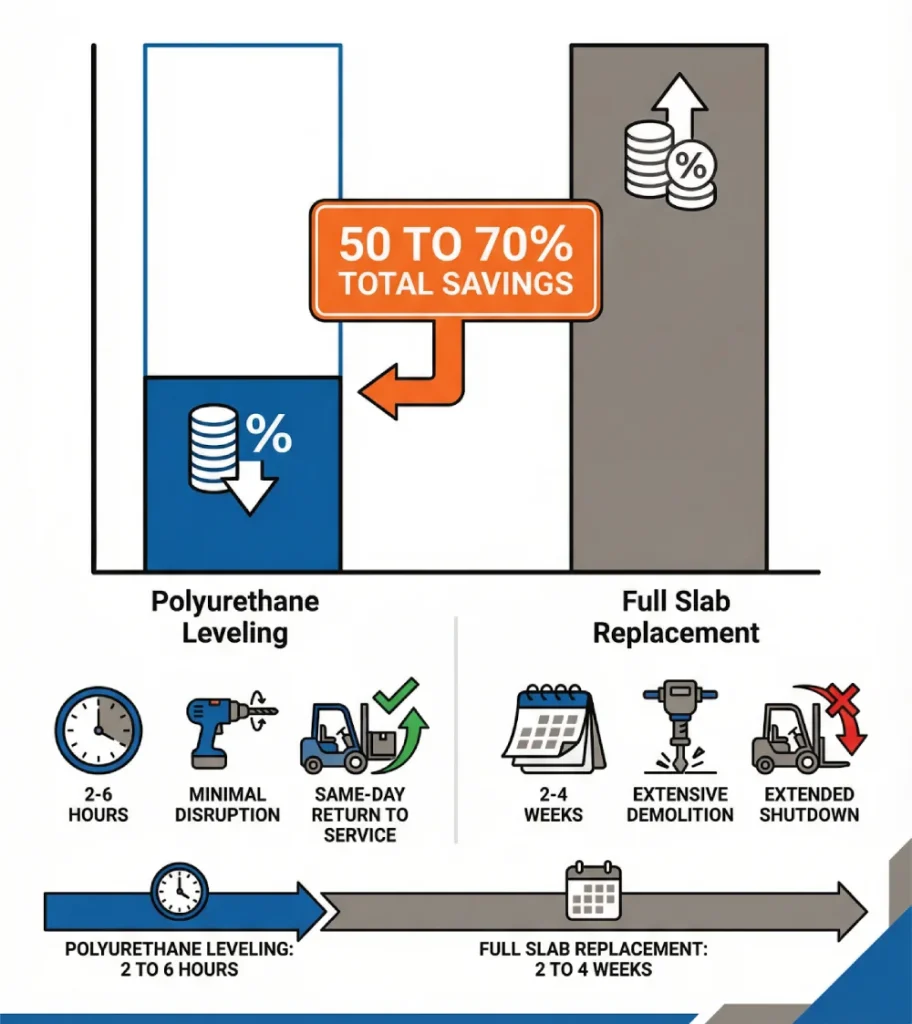
Industrial polyurethane floor leveling delivers compelling economics compared to full slab replacement, with the total savings far exceeding the direct cost difference when operational impact is factored in.
| Factor | Polyurethane Leveling | Full Slab Replacement |
| Cost per square foot | $5 to $25 | $15 to $50+ |
| Project duration | 2 to 6 hours, same-day return | 2 to 4 weeks including 28-day cure |
| Operational downtime | Minimal, work around repairs | Complete shutdown of affected area |
| Excavation required | None | Full demolition and removal |
| Heavy equipment on-site | None | Jackhammers, loaders, concrete trucks |
| Waste generated | Virtually none | Tons of demolished concrete |
The hidden cost driver in industrial settings is operational downtime. A warehouse generating $50,000 to $100,000 or more per day in throughput cannot afford weeks of closure for slab replacement. Even partial shutdowns that reroute operations through unaffected areas create bottlenecks, overtime costs, and fulfillment delays that compound daily.
Properly executed poly injection saves 30 to 40% versus full replacement on direct costs alone, with total savings including avoided downtime reaching 50 to 70%. For facilities running multiple shifts, the operational savings alone can exceed the entire cost of the polyurethane repair. A grouting company experienced in industrial floor work provides detailed cost comparisons during the assessment phase to help facility managers make data-driven repair decisions.
Preventive Maintenance and Long-Term Performance
Proactive industrial floor management extends the service life of both the original slab and any polyurethane repairs, reducing the lifetime cost of floor maintenance significantly.
Regular sounding surveys using periodic chain-drag or hammer testing identify developing voids before they cause visible settlement. Early injection of small voids is far less expensive than addressing large-scale settlement after the damage has progressed to joint destruction and surface deterioration.
Joint maintenance keeps joint fillers in good condition, preventing the water infiltration that erodes subgrade soil and initiates the settlement cycle. Semi-rigid epoxy or polyurea fillers with Shore A hardness of 80 or higher protect joint edges from forklift wheel impact while maintaining the flexibility needed for thermal movement.
Drainage management ensures proper drainage around the facility perimeter and addresses plumbing leaks promptly. Water infiltration causes most industrial floor soil erosion, and preventing it is the single most cost-effective maintenance action a facility can take.
Load monitoring verifies that actual floor loads don't exceed original design specifications, especially when changing facility use or adding heavier equipment. A floor designed for general storage may not have the subgrade support for heavy manufacturing equipment without supplemental stabilization.
Cured polyurethane foam maintains its structural properties for decades. With compressive strengths of 100 to 150+ PSI and load capacities up to 14,000 pounds per square foot for high-density formulations, the polyurethane foam grout itself is rarely the failure point in a properly executed repair. When re-settlement does occur, it typically indicates continued soil issues like ongoing water infiltration rather than foam degradation, and targeted re-injection addresses the specific area without repeating the entire project.
Key Takeaways
- Industrial floors fail through soil settlement, slab curl, and heavy load concentration that create voids, rocking slabs, progressive joint destruction, and safety hazards compounding at rates far exceeding residential environments
- Slab curl creates a destructive cycle where lifted edges rock under forklift traffic, hammering adjacent joint edges into progressive deterioration that no joint repair can fix without first stabilizing the slab with polyurethane injection
- High-density foam at 4.0 to 6.0 PCF delivers 100 to 150+ PSI compressive strength supporting forklift traffic exceeding 25,000 pounds, pallet racking systems, and manufacturing equipment with load capacities up to 14,000 pounds per square foot
- Repairs complete in 2 to 6 hours with same-day return to forklift traffic, compared to 2 to 4 weeks for full slab replacement including 28-day concrete cure, preserving $50,000 to $100,000+ per day in warehouse throughput
- Total cost savings of 50 to 70% versus full replacement when factoring in direct repair costs at $5 to $25 per square foot and the avoided operational downtime that represents the largest cost component in industrial floor repair
- Specialty environments including cold storage, food processing, and precision manufacturing benefit from the foam's freeze-thaw resistance, chemical inertness, and dimensional stability under sustained loading
Conclusion
Industrial floor settlement is not just a structural problem. It is an operational and financial problem that compounds daily through damaged inventory, equipment wear, safety incidents, and throughput losses. Every day a warehouse operates on compromised floors, the cumulative cost of inaction grows.
Polyurethane foam injection addresses industrial floor failure at its source by restoring subgrade support, eliminating voids, and stabilizing curled slabs in hours rather than weeks. The combination of high-density formulations that match industrial load demands, same-day return to service that preserves operational revenue, and total cost savings of 50 to 70% versus replacement makes it the clear choice for warehouse and manufacturing facility floor repair.Ready to restore your industrial floor to operational standards without shutting down production? Contact our team for a professional floor assessment including laser scanning, void detection, and a detailed cost comparison tailored to your facility.