Polyurethane Grouting Applications: Where Foam Injection Delivers Superior Results
Polyurethane foam injection has expanded far beyond residential slab lifting into a full spectrum of geotechnical, structural, and waterproofing applications. The material's ability to expand into confined spaces, cure in minutes, resist water absorption with less than 1% moisture uptake, and support loads up to 14,000 pounds per square foot makes it the most versatile concrete repair and ground stabilization technology available across residential, commercial, industrial, and infrastructure settings.
Most property owners first encounter polyurethane grouting when a driveway sinks or a sidewalk becomes a trip hazard. What they often don't realize is that the same fundamental technology, adapted through different foam densities and formulations, stabilizes airport runways, seals active water leaks in tunnels, fills abandoned mine voids, and remediates sinkholes in karst terrain.
The versatility comes from the chemistry. By adjusting the ratio of polyols, isocyanates, and additives, manufacturers produce foams ranging from lightweight 2.0 PCF residential formulations to heavy-duty 8.0 PCF infrastructure-grade materials. Each formulation targets a specific application with the precise density, expansion rate, and curing speed the job demands. A qualified concrete lifting company evaluates your specific conditions and selects the formulation that matches both the structural requirements and the environment.
Residential Concrete Lifting
Residential applications remain the most common use case for polyurethane foam injection and represent the entry point where most property owners first experience the technology. Low-density formulations at 2.0 to 3.0 PCF handle the lighter loads and smaller void volumes typical of residential projects.
Driveways and Garage Floors
Driveways and garage slabs experience settlement from vehicle weight compressing poorly compacted fill soil, water erosion from downspout runoff, and seasonal moisture changes in clay soils. Polyurethane foam concrete lifting raises these slabs back to grade through dime-sized holes, and the surface is ready for vehicle traffic within 15 to 20 minutes of completion.
Because the foam weighs just 2 to 6 pounds per cubic foot compared to 100 to 150 pounds for cement grout used in mudjacking, it doesn't add the dead load that contributes to re-settlement. This weight advantage is particularly important for driveways where the soil has already demonstrated it cannot support the original slab weight. Adding more heavy material on top of weakened soil is the primary reason mudjacked driveways frequently re-settle within 2 to 5 years. Concrete lifting foam eliminates that cycle.
Sidewalks and Walkways
Uneven sidewalks create trip hazards and potential liability issues for homeowners. These are among the simplest polyjacking jobs, typically requiring just a few injection ports and minimal material. The small 5/8-inch drill holes are virtually invisible after patching, preserving the walkway's appearance completely. For homeowners who need foam concrete repair on a budget, sidewalk leveling often represents the most affordable entry point into polyurethane injection.
Patios and Outdoor Living Areas
Patios settle when backfill soil around a foundation compresses or when landscaping irrigation erodes supporting soil beneath the slab. Foam injection restores the surface without disturbing adjacent landscaping, garden beds, or hardscaping. This is a significant advantage over full slab replacement, which requires heavy equipment access that damages the surrounding yard and can take days to complete versus hours for polyurethane injection.
Pool Decks
Pool decks are uniquely vulnerable to settlement because they are typically poured over loose backfill surrounding the pool shell and face constant moisture exposure from splash-out, drainage, and elevated water tables. Settled pool deck slabs create trip hazards, direct water toward the pool edge accelerating further erosion, and stress coping and tile connections.
Polyurethane foam is particularly well-suited for pool deck repair because its closed-cell, hydrophobic structure resists the persistent moisture environment that would degrade cement-based repairs. The fast cure time means the deck can be used the same day, minimizing disruption during pool season when the deck sees its heaviest use.
Stoops, Steps, and Porches
Front stoops and porch slabs often separate from the main foundation as the fill soil beneath them settles. Polyurethane foam foundation repair lifts these back into alignment with the house's threshold, eliminating gaps that allow water infiltration and restoring proper drainage away from the foundation. Addressing stoop settlement early prevents the progressive water damage that settled, gap-creating porches accelerate.
Commercial Applications
Commercial concrete lifting scales up from residential work in both slab size and load requirements, demanding medium- to high-density foam formulations and significantly more material per job. The economic stakes are also higher because settled commercial concrete creates liability exposure, disrupts business operations, and degrades professional appearance.
Warehouse and Distribution Center Floors
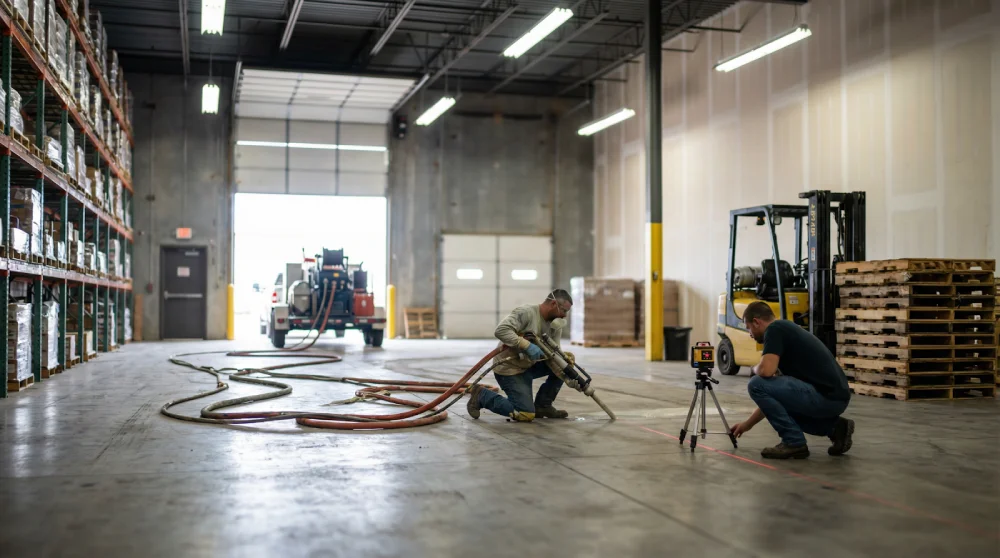
Warehouse floors are among the most demanding commercial applications for polyurethane grouting. These slabs must support forklift traffic, pallet racking systems, and heavy inventory loads, often with concentrated point loads from rack columns that can exceed 100 PSI at the contact point.
When voids develop beneath warehouse slabs, the result is bouncy or vibrating floors that create safety hazards for forklift operators and can damage both equipment and inventory. Polyurethane foam injection stabilizes warehouse floors by filling subsurface voids and providing uniform support across the entire slab. The foam's rapid cure time is especially valuable in active warehouses where extended shutdowns are costly. Operations can typically resume within hours rather than the days required for traditional concrete repair. Medium-density foam at 4.0 to 5.0 PCF handles forklift loads and heavy machinery without issue.
Retail and Office Buildings
Settled concrete in retail storefronts and office complexes creates liability from trip hazards and damages the professional appearance that attracts and retains customers and tenants. Poly injection repairs these surfaces during off-hours with minimal noise and no heavy equipment, allowing businesses to open normally the following day. The small injection holes patched with matching material leave virtually no visible trace of the repair.
Parking Lots and Structures
Large commercial parking lots develop settlement patterns from traffic loading and water infiltration through joints. Foam injection addresses individual settled panels without closing the entire lot, maintaining revenue-generating capacity during the repair. In parking structures, the foam's waterproofing properties provide additional protection against moisture migration to lower levels, addressing both the structural settlement and the water intrusion that often accompanies it.
| Commercial Application | Typical Foam Density | Key Advantage | Typical Downtime |
| Warehouse floor | 4.0 to 5.0 PCF | Supports forklift and racking loads | Hours (same-day return to service) |
| Retail storefront | 3.0 to 4.0 PCF | Off-hours repair, no business disruption | Overnight |
| Office building | 3.0 to 4.0 PCF | Minimal noise, no heavy equipment | Overnight |
| Parking lot | 3.5 to 4.5 PCF | Panel-by-panel repair, lot stays open | Hours per section |
| Parking structure | 4.0 to 5.0 PCF | Waterproofing plus structural lift | Hours per level |
Industrial Applications
Industrial polyurethane injection grouting addresses the most demanding load and environmental conditions, requiring high-density specialty formulations at 5.0 to 8.0 PCF that deliver compressive strength exceeding 150 PSI and load capacities reaching 14,000 pounds per square foot.
Manufacturing Facility Floors
Production floors supporting heavy presses, CNC machines, and assembly equipment require absolute stability. Even minor settlement can throw precision equipment out of calibration, producing defective output and requiring costly recalibration. High-density polyurethane injection provides the bearing capacity exceeding 10,000 pounds per square foot needed to support concentrated industrial loads while maintaining the sub-millimeter flatness tolerances these operations demand.
Cold Storage and Refrigerated Facilities
Cold storage facilities face unique settlement challenges from repeated freeze-thaw cycling at the slab perimeter where cold interior temperatures meet ambient exterior temperatures. This thermal boundary creates ongoing soil movement that conventional repair materials cannot withstand. Polyurethane foam's closed-cell structure prevents the water absorption that would expand during freezing, making it significantly more durable than cement-based alternatives in environments where the concrete lifting foam must perform through thousands of freeze-thaw cycles over its service life.
Infrastructure and DOT Applications
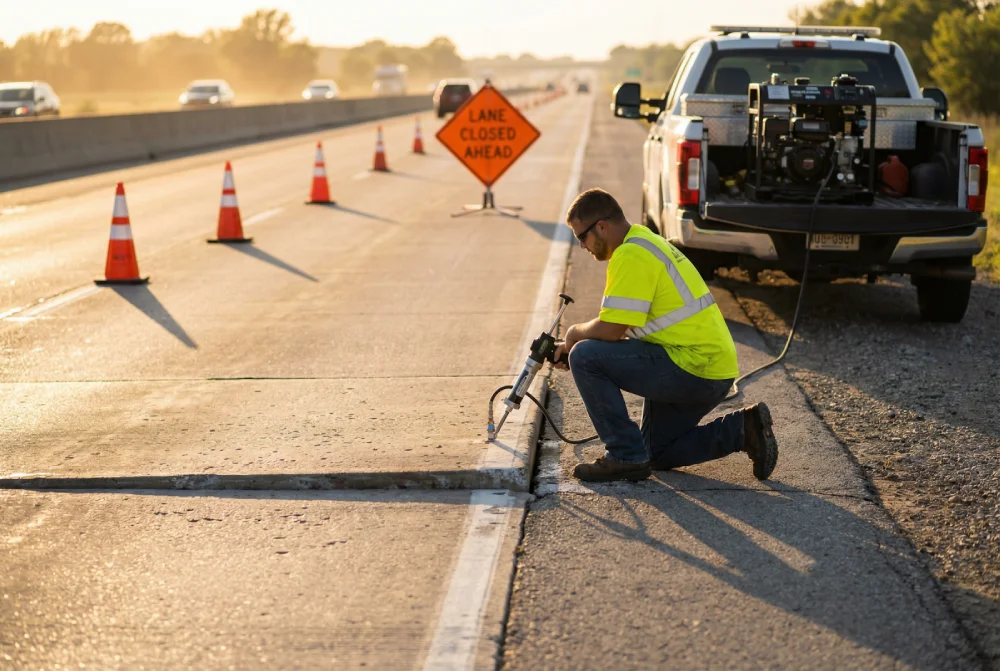
Transportation departments across the United States have adopted polyurethane foam injection as a standard repair method for highway and bridge infrastructure. Multiple state agencies document successful long-term results and now specify polyurethane injection as an approved method for critical transportation repairs.
Highway and Interstate Slab Panels
Concrete highway pavements develop voids beneath slab panels from pumping action, where traffic loads force water through joints and progressively erode the base material. These voids cause slab rocking, faulting at joints, and eventually cracking that compromises the road surface and creates hazardous driving conditions.
PU grouting addresses highway settlement with critical advantages over traditional methods. Repairs complete in hours with traffic restored the same day, minimizing the lane closures that cost transportation agencies millions in delays and congestion. The foam's lightweight composition adds no dead load to already weakened subgrade, avoiding the re-settlement cycle that plagues cement-based repairs. The material also acts as a moisture barrier between the pavement surface and base layer, preventing the pumping action that caused the original void formation.
Bridge Approach Slabs
The transition between a road surface and a bridge structure is one of the most common settlement points in highway infrastructure. Bridge approach slabs settle as embankment fill compresses, creating the familiar bump at bridge ends that affects ride quality and vehicle safety. Polyurethane foam injection raises the approach slab back to grade and fills the voids causing the settlement. Multiple state DOTs now specify polyurethane injection as an approved method for bridge approach repair because of its fast return to service and long-term dimensional stability.
Railroad Crossings
Rail crossings experience extreme dynamic loading from train traffic combined with road vehicle impacts at the crossing surface. The surrounding concrete panels and approach slabs often settle, creating hazardous conditions for vehicles crossing the tracks. Polyurethane grouting stabilizes these crossings with fast return-to-service times that accommodate rail traffic within minutes of placement, avoiding the costly extended closures that traditional repair methods require.
Airport Runways and Taxiways
Airport pavement represents one of the highest-performance applications for polyurethane foam injection. Runways must support aircraft wheel loads exceeding 50,000 pounds on individual gear assemblies, and any surface irregularity creates safety risk for operations traveling at high speed.
High-density formulations at 6.0 to 8.0 PCF meet FAA load requirements for commercial aircraft. The rapid cure time minimizes runway closure, a major cost factor for airport operations where every hour of downtime represents significant revenue loss and scheduling disruption. Precision lifting achieves the tight surface tolerances required for safe aircraft operations, and the absence of excavation eliminates FOD (Foreign Object Debris) risk that would ground aircraft until the runway is certified clean. High pressure polyurethane injection techniques ensure complete void filling beneath runway slabs where any remaining gap could compromise the repair under extreme landing loads.
Soil Stabilization and Compaction Grouting
Beyond lifting concrete, polyurethane foam is increasingly used for direct soil improvement, stabilizing weak, loose, or eroded ground conditions to prevent future settlement rather than just treating its symptoms.
Shallow Soil Stabilization
Shallow soil problems including poor compaction, buried debris, organic decomposition, clay expansion, and drainage-related erosion are addressed by injecting polyurethane grout directly into the weak soil layer. The expanding foam fills voids, compacts loose soil particles, and binds them together. Research documents bearing capacity increases of 50 to 200% in treated soils, transforming unstable ground into a reliable foundation.
Common shallow soil issues that polyurethane grouting addresses include poorly compacted fill from original construction, tree root intrusion and decomposition that leaves voids as root material breaks down, organic material decomposition in fill soil, clay soil expansion and contraction from seasonal moisture changes, and drainage-related erosion from concentrated water flow beneath slabs. PU foam injection for shallow stabilization uses medium-density formulations that balance expansion volume with compaction force.
Deep Soil Injection
For settlement originating at depth beneath roadways, parking lots, and large commercial slabs, deep soil injection drives injection rods through the concrete and into the soil at specific target depths. High-density polyurethane foam is injected at depth where it expands and forms a branching, root-like structure that compacts soil from within and binds loose particles into a stable base.
This technique is particularly effective for roadway subgrade stabilization, parking lot base reinforcement, areas with loose soil from poor construction compaction, and regions with excess groundwater affecting soil stability. Deep injection addresses the root cause of settlement rather than just raising the surface, providing a permanent solution in situations where shallow lifting alone would result in re-settlement.
Slope and Embankment Stabilization
Roadway slopes and bridge abutments are vulnerable to erosion and soil movement from weather exposure and groundwater flow. Polyurethane foam improves slope stability through its lightweight consistency that reduces pressure on sublayers, its structural rigidity, and its ability to bind and compact soil in place. Multiple injection points along the slope's incline ensure stability from peak to base.
Void Filling
Void filling is a distinct application category from concrete lifting. The goal is to fill underground cavities rather than raise a surface, and the approach, foam density, and injection technique all differ accordingly.
Abandoned Tanks and Pipes
When underground storage tanks or pipes are decommissioned but cannot be economically removed, they must be filled with an inert material to prevent collapse. Filling voids with polyurethane offers significant advantages over traditional sand or concrete fill. It requires only small access holes with no excavation, fills the entire volume uniformly through expansion, cures quickly, and is chemically inert once set. Polyurethane grout injection for tank abandonment eliminates the soil disturbance and heavy equipment requirements that traditional demolition and backfill demand.
Mine Voids and Natural Cavities
Abandoned mine workings, natural solution cavities, and other subsurface voids threaten surface structures with sudden collapse. Low-density, slow-reacting foam formulations are designed to flow long distances through complex void networks before expanding to fill the space. This controlled flow characteristic allows a single injection point to treat large irregular cavities that would require dozens of access points with non-expanding fill materials.
Utility Trench and Annular Space Filling
Gaps around pipes, conduits, and utility penetrations create pathways for water infiltration and soil migration that progressively undermine surrounding structures. Foam injection seals these annular spaces, providing both structural support and waterproofing in a single application. Foam grouting in utility trenches is particularly valuable in urban environments where excavation would disrupt roads, sidewalks, and adjacent utilities.
Sinkhole Remediation
In karst terrain, regions with limestone bedrock susceptible to dissolution, sinkholes pose serious threats to structures and infrastructure. Polyurethane grouting addresses sinkholes through a multi-stage approach that treats the void, the surrounding soil, and the water pathways that caused the problem.
The first stage fills the sinkhole cavity and surrounding dissolution channels with low-viscosity foam that flows into irregular spaces before expanding. The second stage compacts and binds the disturbed soil surrounding the sinkhole using expanding foam that stabilizes the ground against further movement. The third stage blocks the water pathways that caused the dissolution in the first place, leveraging the foam's hydrophobic properties to create a permanent barrier against the water flow driving continued erosion.
High-density formulations at 4.75 PCF and above are typically specified for sinkhole work due to the need for maximum bearing capacity over unpredictable subsurface conditions. In Florida and other regions where karst sinkholes are prevalent, specialized polyurethane injection contractors combine chemical grouting with compaction grouting techniques to address both shallow and deep sinkhole risks.
Water Leak Sealing and Curtain Grouting
Polyurethane grouts serve a fundamentally different function in leak sealing compared to concrete lifting. In these applications, the material's reaction with water and its ability to form watertight barriers are the primary assets rather than its lifting force.
Crack Injection
Water-activated polyurethane resins are pressure-injected directly into active cracks in concrete structures. The resin reacts with the water present in the crack, expanding to form a flexible, watertight seal. This technique addresses leaks in basement walls and floors, parking garage structures, elevator pits, water treatment tanks, and retaining walls. Polyurethane injection grouting waterproofing provides a permanent solution that moves with the crack rather than rigid patches that break free as the crack continues to shift.
Curtain Grouting
When multiple leaks or diffuse water infiltration affects a structure, curtain grouting creates a continuous waterproof barrier behind the leaking wall or lining. The polyurethane grout is injected in a pattern through drilled ports, forming an interconnected curtain of cured resin that blocks water pathways.
Curtain grouting applications include tunnels and underground transit infrastructure, dam abutments and spillways, manholes and storm sewers, box culverts, and below-grade vaults. The technique can stop water leaks flowing at extreme rates and does not require excavation, making it viable for situations where digging is prohibitively expensive or physically impossible. For large-scale waterproofing projects requiring pressure grouting method expertise, curtain grouting represents one of the most effective subsurface water management techniques available.
Hydrophobic vs. Hydrophilic Grouts
The leak sealing industry uses two distinct polyurethane grout categories tailored to different water conditions. Hydrophobic grouts react quickly and expand without absorbing water, making them best for stopping high-flow leaks and creating rigid, dimensionally stable seals. Hydrophilic grouts absorb moisture and cure into a flexible gel that maintains contact with irregular crack surfaces, excelling at sealing slow seeps and providing long-term flexibility in joints that experience thermal movement.
Seawall and Marine Structure Repair
Coastal and waterfront structures face unique deterioration challenges from tidal action, wave impact, and saltwater exposure that accelerate soil loss and structural degradation beyond what inland structures experience.
Seawall Soil Stabilization
Seawalls lose stability when tidal action pulls saturated backfill soil through cracks and joints in the wall, creating expanding voids behind the structure. As voids grow, the wall loses the lateral support it needs to resist hydrostatic and wave pressure, becoming susceptible to rotation, settlement, or collapse.
Polyurethane grout injection addresses this by filling voids behind the seawall, binding remaining soil particles together to prevent further erosion, creating a closed-cell barrier that blocks water infiltration through repaired joints, and restoring the lateral support the wall needs to function structurally. Specialty formulations designed for saturated marine environments ensure the foam performs in conditions where it remains submerged or tidally exposed indefinitely.
Foundation Stabilization
While deep foundation repair typically involves steel push piers or helical piers for severe structural movement, polyurethane grouting plays a complementary role in foundation stabilization by addressing the void-filling and soil compaction components of foundation problems.
When soil settles beneath a foundation, voids develop that leave sections of the footing unsupported. Polyurethane foam injection fills these voids, restoring continuous bearing support. The foam expands to contact both the underside of the footing and the remaining soil surface, distributing loads across the full footprint rather than concentrating them on the supported sections. Polyurethane foam foundation repair at the foundation level works best for settlement caused by soil erosion or poor compaction rather than extreme structural movement.
Structural polyurethane grout can also be injected into foundation cracks to restore integrity. The grout fills gaps with a strong adhesive bond, reinforcing the concrete and extending the building's serviceable lifespan. This technique has been used successfully on foundations over 100 years old.
Application Selection Guide
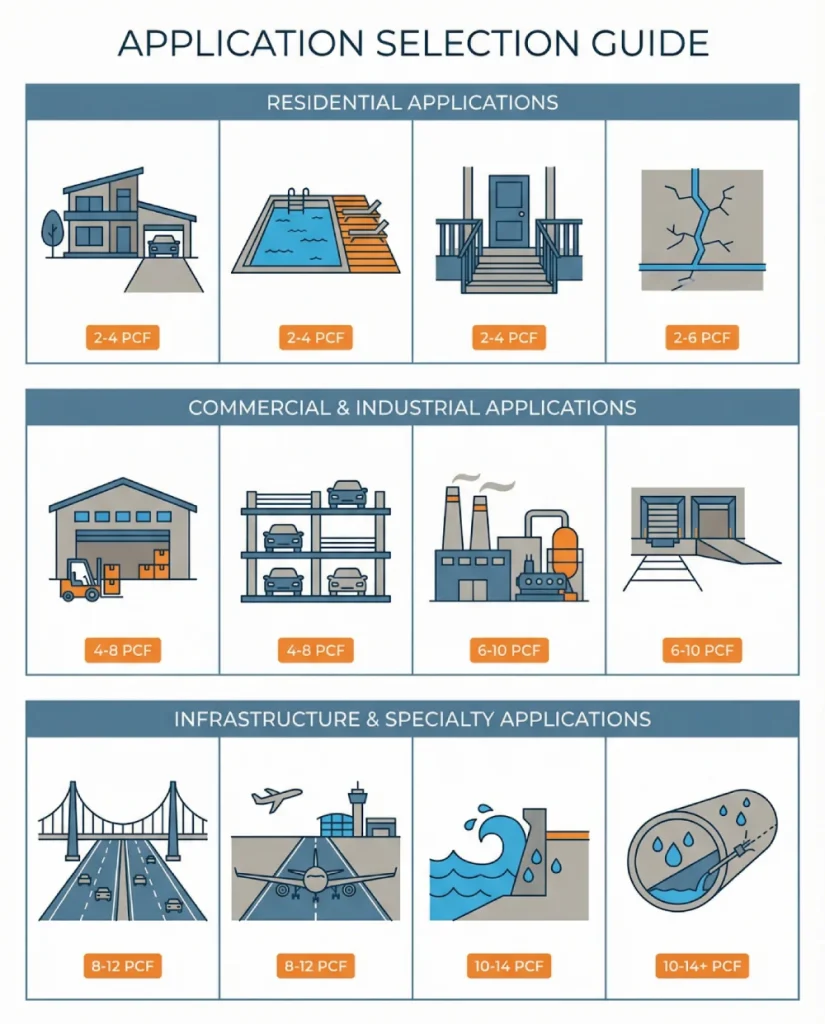
| Application | Primary Function | Typical Density (PCF) | Key Selection Factor |
| Residential sidewalk or patio | Lifting | 2.0 to 3.0 | Pedestrian loads, budget sensitivity |
| Driveway or garage floor | Lifting | 2.5 to 3.0 | Passenger vehicle loads |
| Pool deck | Lifting | 3.0 to 4.0 | Persistent moisture exposure |
| Warehouse floor | Lifting and stabilization | 4.0 to 5.0 | Forklift and racking loads |
| Highway slab panel | Lifting and under-sealing | 4.0 to 6.0 | DOT specifications, traffic volume |
| Airport runway | Lifting | 6.0 to 8.0 | FAA specifications, aircraft loads |
| Deep soil stabilization | Compaction grouting | 4.0 to 5.0 | Settlement originating at depth |
| Abandoned tank or pipe | Void fill | 2.0 to 3.0 | Volume fill, no excavation |
| Sinkhole remediation | Void fill and stabilization | 4.75+ | Unpredictable subsurface conditions |
| Active water leak | Leak sealing | Resin-based | Flow rate and crack movement |
| Seawall repair | Void fill and stabilization | Application-specific | Saturated marine environment |
| Foundation stabilization | Void fill | 2.5 to 3.0 | Distributed loads, soil compaction |
Longevity Across Applications
Geotechnical polyurethane grouts demonstrate exceptional long-term durability across every application category. Industry data indicates that the half-life of geotechnical polyurethanes exceeds 150 years, meaning the material retains more than 50% of its structural properties for well over a century.
This longevity stems from the cured foam's chemical inertness, resistance to water absorption, and immunity to biological degradation. Once cured, polyurethane foam does not wash out, shrink, or decompose under normal environmental conditions. Unlike cement-based grouts that absorb moisture and deteriorate in wet environments, polyurethane foam grout maintains its compressive strength, dimensional stability, and hydrophobic properties indefinitely. This makes it a permanent solution across virtually all application types, from residential driveways to airport runways.
Key Takeaways
- Polyurethane foam injection spans residential, commercial, industrial, infrastructure, geotechnical, and waterproofing applications through formulations ranging from 2.0 PCF lightweight residential foam to 8.0 PCF infrastructure-grade material supporting 14,000 pounds per square foot
- Residential applications including driveways, sidewalks, patios, pool decks, and stoops use low-density foam that avoids the re-settlement caused by heavy mudjacking slurry on already weakened soil
- Commercial and industrial applications require medium- to high-density formulations that support forklift traffic, heavy racking, manufacturing equipment, and concentrated point loads exceeding 100 PSI
- Transportation departments specify polyurethane injection for highway slabs, bridge approaches, and railroad crossings because repairs complete in hours with same-day traffic restoration and no added dead load to weakened subgrade
- Soil stabilization, void filling, sinkhole remediation, and leak sealing extend polyurethane grouting beyond concrete lifting into geotechnical and waterproofing applications that address subsurface problems at their source
- Geotechnical polyurethane grouts have a documented half-life exceeding 150 years, maintaining structural properties indefinitely through chemical inertness, water resistance, and immunity to biological degradation
Conclusion
Polyurethane foam injection's versatility across applications, from a homeowner's settled patio to an airport runway supporting commercial aircraft, reflects the fundamental adaptability of the underlying chemistry. By formulating foams at different densities, reaction speeds, and performance characteristics, the technology addresses virtually every scenario where concrete has settled, soil has weakened, voids have formed, or water has infiltrated.
The common thread across every application is the material's core advantages: lightweight composition that avoids re-settlement, rapid cure that minimizes disruption, closed-cell structure that resists water indefinitely, and a documented service life measured in decades rather than years. Whether the project is residential, commercial, industrial, or infrastructure-grade, the right polyurethane formulation exists to deliver a permanent, structurally sound repair.
Ready to determine which polyurethane grouting application fits your project? Contact our team for a professional assessment that matches the right formulation to your specific structural, environmental, and budgetary requirements.