Polyurethane Grouting Equipment: Understanding the Injection Systems Behind Precision Concrete Lifting
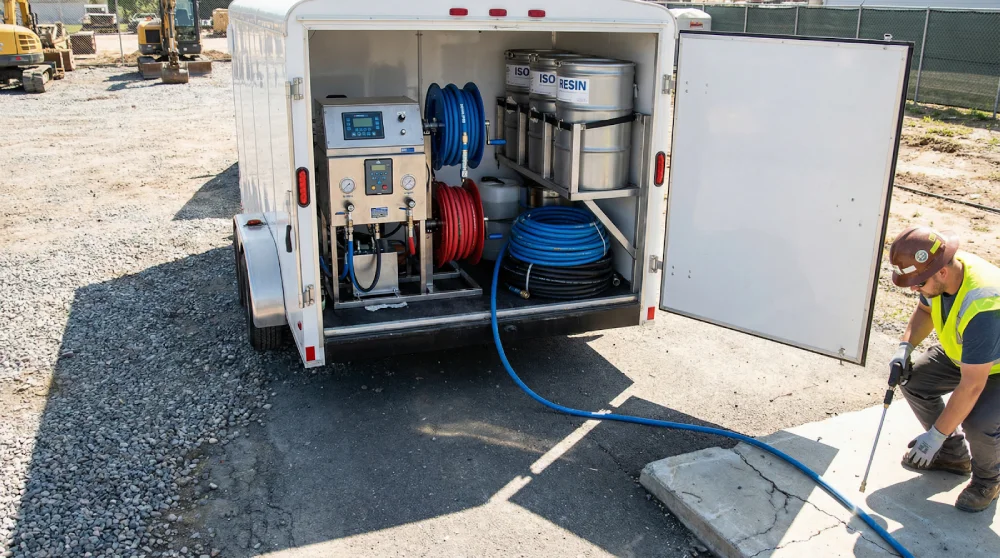
Precision concrete lifting depends on a tightly integrated equipment chain that heats, meters, mixes, and delivers two reactive liquid components at exact temperature, pressure, and ratio until they combine at the injection gun nozzle. Professional proportioners pump both components at calibrated 1:1 ratios through heated hoses at up to 2,000 PSI, with output capacities ranging from 28 to 55 pounds per minute depending on project scale.
The equipment behind polyurethane foam injection matters as much as the foam chemistry itself. A temperature drop in the hose, a ratio imbalance at the pump, or a clogged gun nozzle compromises the foam's cell structure, expansion rate, and ultimate compressive strength. Every component in the system exists to maintain precise control over the two chemicals until the exact moment they combine beneath the slab.
Understanding how this equipment works helps property owners and project managers evaluate contractors and recognize what separates a professional polyurethane injection operation from a cut-rate setup. The difference between a successful lift that lasts 15 years and a failed repair that requires rework often comes down to equipment quality, calibration, and the operator's ability to read the feedback the system provides.
System Overview: How the Components Work Together
A polyurethane concrete lifting system moves two separate liquid chemicals, isocyanate (A-side) and polyol resin (B-side), from bulk storage through a proportioner, along heated hoses, and into an injection gun where they mix for the first time at the nozzle. The foam reaction begins immediately upon mixing, so the two components must remain completely isolated from each other until the moment of injection. Every component in the chain serves one core purpose: keeping the materials at the right temperature, pressure, and ratio until they combine at the point of delivery.
The typical equipment chain follows this sequence: bulk material supply from drums or totes feeds into transfer pumps, which supply the proportioner for heating and metering. The proportioner delivers both components through heated hoses to the injection gun, which connects to an injection port or packer seated in the concrete slab. The foam enters the subsurface void and begins expanding immediately.
Each link in this chain directly affects the quality of the lift. Professional polyurethane foam injection contractors invest heavily in equipment because they understand that the technology is only as reliable as the weakest component in the system. A proportioner running at incorrect temperature, hoses losing heat over long runs, or a gun failing to clear its mixing chamber between shots all produce foam with compromised structural properties.
| System Component | Primary Function | What Happens When It Fails |
| Proportioner | Heats, meters, and pressurizes both components at calibrated ratios | Off-ratio mixing produces foam with incorrect density and reduced strength |
| Heated hoses | Maintains material temperature during transport to the gun | Temperature drops increase viscosity, reducing mix efficiency and foam quality |
| Injection gun | Combines components at the nozzle, clears mixing chamber between shots | Crossover or clogging produces inconsistent foam and blocks flow |
| Injection ports/packers | Creates sealed connection between gun and subsurface void | Backflow wastes material and prevents controlled foam placement |
| Monitoring tools | Tracks slab elevation during lifting | Over-lifting or uneven results without real-time feedback |
The Proportioner: The Heart of the System
The proportioner, also called a plural-component hydraulic pump, is the central piece of equipment in any concrete lifting operation. It stores, heats, meters, and pressurizes both the A-side and B-side chemicals simultaneously, delivering them at precisely calibrated ratios through separate heated hose lines to the injection gun.
How Proportioners Work
Proportioners use opposed-piston metering pumps driven by a hydraulic motor to deliver both components at a fixed volumetric ratio, typically 1:1 for concrete lifting foams. The hydraulic drive ensures that both pistons move in lockstep, so when one side pumps a given volume of isocyanate, the other side pumps an identical volume of polyol. This mechanical coupling is what guarantees ratio accuracy.
If one side encounters resistance such as a clogged filter or a partially blocked hose, the system compensates or alerts the operator rather than allowing off-ratio material to reach the gun. This fail-safe design is critical because even small ratio deviations produce foam with incorrect cell structure, compromised compressive strength, and unpredictable expansion behavior. For pu injection grouting applications where material consistency determines whether a repair lasts 5 years or 15, proportioner accuracy is non-negotiable.
Key Proportioner Features
All professional-grade proportioners share several essential features that distinguish them from general-purpose pumping equipment.
Pressure Balance Control automatically maintains equal pressure on both the A and B sides, preventing one component from dominating the mix ratio. Without this feature, pressure differences between the two sides would cause one chemical to overpower the other at the mixing chamber, producing off-ratio foam.
Digital automatic temperature control monitors and adjusts the temperature of both chemical components independently. Temperature directly affects viscosity, which affects how thoroughly the components mix and how consistently the foam's cell structure forms. Professional systems maintain both components within a tight temperature window throughout the entire job.
Inlet monitoring detects low material levels or blocked supply lines before they cause problems. Running a proportioner dry damages the pump seals and can introduce air into the fluid lines, both of which require costly field repairs.
Point-to-point wiring uses relays and circuit breakers instead of circuit boards, drastically improving field reliability and simplifying troubleshooting. Equipment that runs on construction sites and bounces down highways in trailers needs electrical systems that tolerate vibration and dust.
Proportioner Models by Project Scale
The proportioner you choose determines the scale and type of projects you can handle. Output capacity, maximum working pressure, and hose length support all factor into which unit fits which application.
| Model | Max Output | Max Working Pressure | Max Hose Length | Best Application |
| PMC PH-2 | 28 lbs/min | 2,000 PSI | Standard | Small residential jobs, entry-level contractors |
| PMC PH-25 | 30 lbs/min | 2,000 to 3,000 PSI | 410 ft | Residential and light commercial |
| PMC PH-40 | 40 lbs/min | 2,000 PSI | 410 ft | High-output commercial and DOT work |
| PMC PH-55 | 55 lbs/min | 2,000 PSI | 410 ft | Large-scale industrial and infrastructure |
| Graco Reactor 3 | Variable | Variable | Variable | Combined spray foam and concrete lifting operations |
The PH-25 and PH-40 are the most widely used models in the concrete lifting industry. The PH-40 features 15,000 to 21,000 watt dual heaters capable of reaching maximum fluid temperatures of 190 degrees Fahrenheit, making it suitable for high-output commercial projects and DOT-grade highway work where material volume demands are highest.
For contractors running polyurethane grout injection operations that handle both residential driveways and commercial warehouse floors, the PH-25 offers the best balance of output capacity, portability, and cost. Larger operations handling infrastructure and industrial projects where filling voids with polyurethane at scale requires sustained high output gravitate toward the PH-40 or PH-55.
Injection Guns: Where the Chemistry Happens
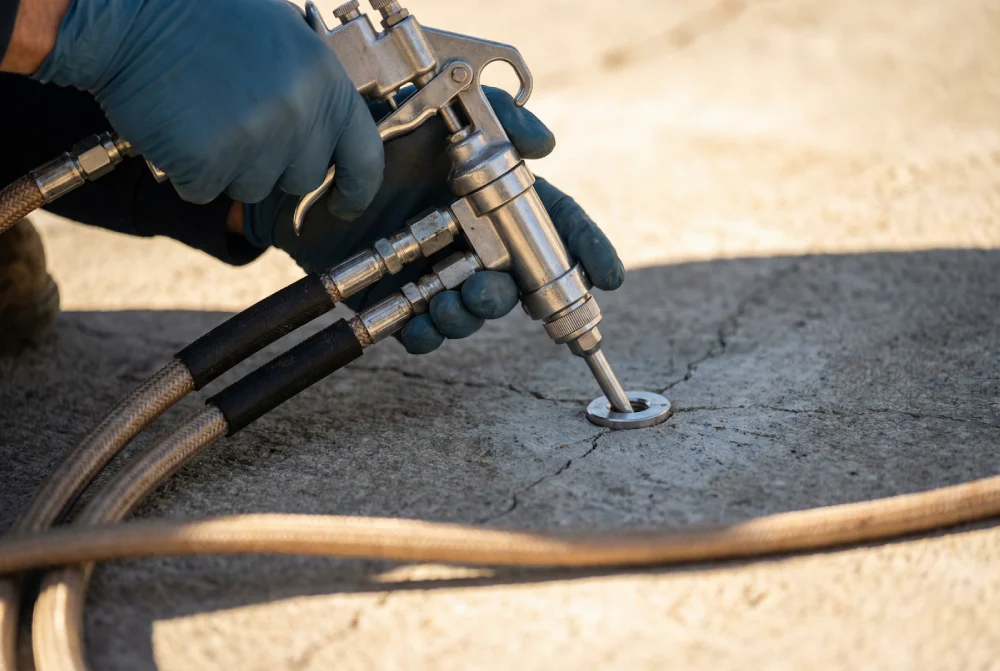
The injection gun is where the two components meet for the first time. Because the polyurethane reaction begins immediately upon mixing, the gun must combine the chemicals thoroughly and then clear the mixing chamber completely after each shot. Any residual mixed material left in the chamber cures inside the gun's passages, blocking flow and compromising subsequent shots.
Two gun types dominate the concrete lifting industry, each with distinct advantages that make them better suited to different project types and operator preferences.
Mechanical Purge Guns
Mechanical purge guns use a physical valving rod that slides through the mixing chamber when the trigger is released. The rod physically pushes all mixed material out and creates a mechanical barrier that prevents foam from traveling backward into the fluid lines. This physical clearing action virtually eliminates crossover, the condition where partially mixed foam cures inside the gun's passages and blocks flow.
The PMC PX-7 features a precision-machined coupling block made from high-strength steel and is widely considered the industry standard for concrete lifting. The Graco GX-7 offers similar mechanical purge reliability with a reputation for durability across thousands of injection cycles. The Alchatek MixMaster Pro is manufactured specifically for concrete leveling rather than general spray foam work, built with stainless steel construction to handle the high back-pressure encountered when injecting foam beneath heavy slabs.
Mechanical purge guns are preferred by the majority of concrete lifting professionals because the physical rod purge provides the highest certainty against crossover. For high pressure polyurethane injection applications where back-pressure from dense soil or heavy slabs pushes against the foam delivery, mechanical purge guns maintain consistent performance.
Air Purge Guns
Air purge guns use a blast of compressed air to clear the mixing chamber after each injection. Rather than a mechanical rod, a burst of air pushes residual mixed material out of the nozzle.
Air purge systems offer several advantages for precision lifting work. Operators can feather injections with precise, incremental shots as the slab approaches target elevation, making it easier to avoid over-lifts on sensitive projects. The gun moves from one injection port to the next without the mechanical reset that rod-purge guns require, increasing port-to-port speed on jobs with many injection points. The ability to deliver small, controlled shots provides more granular control near the end of a lift when the slab is within fractions of an inch of target elevation.
The historical concern with air purge guns was increased crossover risk. Purpose-built concrete lifting air purge guns address this with engineered safeguards, and independent studies have confirmed that air purge systems do not negatively affect foam quality, density, or cell structure formation when properly designed for concrete lifting applications.
Gun Selection Considerations
| Factor | Mechanical Purge | Air Purge |
| Crossover risk | Very low (physical rod barrier) | Low with purpose-built guns |
| Injection precision | Good | Excellent (feathering capability) |
| Port-to-port speed | Slower (mechanical reset between shots) | Faster (continuous operation) |
| Maintenance complexity | Moderate (rod and seal replacement) | Lower (fewer moving parts) |
| Back-pressure handling | Excellent | Good |
| Industry adoption | Majority of contractors | Growing, especially for precision work |
The mixing chamber size matters regardless of gun type. For concrete lifting, higher-output mixing chambers producing 15 to 25 pounds per minute are standard. Chamber size is selected based on the specific application. Larger voids and heavier slabs demand higher output rates, while smaller residential jobs benefit from lower output chambers that provide finer control. Polyurethane foam injection equipment selection at the gun level directly impacts both job quality and production speed.
Heated Hoses: Maintaining the Temperature Chain
Heated hoses transport the A-side and B-side chemicals from the proportioner to the injection gun while maintaining precise temperature control throughout the entire run. Temperature management is critical because polyurethane component viscosity is temperature-dependent. If the chemicals cool during transit, they become more viscous, mix less efficiently at the gun, and produce foam with inconsistent cell structure and reduced compressive strength.
Hose Construction
Professional heated hoses consist of multiple engineered layers, each serving a specific function in the temperature management chain.
The inner fluid tube is a high-strength, resin-reinforced pipe rated for 2,000 to 3,500 PSI that carries the chemical component. A heating element, either internal beneath the fluid lining or external wrapped around the outside, maintains material temperature along the entire hose length. A temperature sensing wire, typically a thermocouple or RTD, runs alongside the heating element and continuously monitors temperature, feeding data back to the proportioner's temperature controller. A thermal insulation layer reduces heat loss to the environment, and a protective outer jacket of extruded PVC shields against moisture, abrasion, and physical damage.
Internal vs. External Heating
Internally heated hoses place heating elements beneath the fluid lining, heating the chemical directly from the core outward. Modern internal designs heat up significantly faster, offer greater flexibility for maneuvering around jobsite obstacles, and have smaller diameters than traditional external designs. These advantages translate to faster setup times and easier handling, particularly on residential jobs where the technician works in tight spaces between buildings, fences, and landscaping.
Externally heated hoses wrap heating elements around the outside of the fluid tube under an insulated sleeve. This traditional design offers precise temperature control and is known for rugged durability that withstands years of daily use on construction sites. Many experienced concrete lifting foam contractors prefer external heating for its proven reliability over thousands of job cycles.
Standard hose lengths for concrete lifting range from 50 to 100 feet, with maximum supported lengths up to 410 feet depending on the proportioner model. Longer hoses require more heater wattage to maintain temperature across the full run. Whip hoses, the shorter and more flexible sections connecting the main heated hose to the gun, are typically rated at 3,500 PSI for the higher pressures near the injection point.
Injection Ports and Packers
Injection ports, also called packers, are the interface between the gun and the subsurface void. These small metal fittings are inserted into pre-drilled holes in the concrete slab and create a sealed connection that allows foam to flow downward while preventing backflow that would waste material and prevent controlled foam placement.
Standard hole sizes for polyjacking range from 3/8 inch to 5/8 inch in diameter, significantly smaller than the 2-inch holes mudjacking requires. The port is hammered or threaded into the drilled hole, and the injection gun's nozzle or fluid block is clamped to the port's entry side. Best practice calls for using a clamp to fasten the gun's fluid block to the injection port for a secure, leak-free connection that withstands the pressures generated during injection.
For deep-injection applications such as soil stabilization or void filling at significant depth beneath the slab, steel extension tubes are attached to the ports to direct the foam to the target zone. This capability extends polyurethane injection grouting beyond surface-level slab lifting into deeper geotechnical applications where voids or weak soil exist well below the concrete surface. PU grouting at depth requires precise port placement and extension tube routing to ensure material reaches the intended zone rather than migrating laterally.
Mobile Rig Configurations
The complete injection system must be mobile because contractors move between job sites daily. The rig configuration determines how efficiently a crew operates in the field and what scale of projects the operation can handle.
V-Nose Trailer Rigs
V-nose trailers in the 16 to 20 foot range are the most popular choice for dedicated concrete lifting contractors. A typical trailer rig contains the proportioner, a generator sized to power the proportioner, hose heat, compressor, lights, and climate control, an air compressor for tools and air purge gun operation where applicable, drum storage racks for A-side and B-side material drums, heated hose reels, tool storage and safety equipment, and climate control systems to keep materials in the proper operating temperature window.
Climate control inside the trailer is often overlooked but critically important. Polyurethane components have specific storage temperature requirements. If material drums freeze overnight in winter or overheat in a Texas summer, the chemicals can degrade or change viscosity beyond the proportioner's ability to compensate. Professional rigs maintain interior temperature year-round.
Box Truck Build-Outs
Larger operations or combined spray foam and concrete lifting businesses use box trucks in the 16 to 28 foot range. Box trucks offer more interior space for additional material storage, weather-protected workspace for equipment maintenance, and the ability to carry multiple gun setups for projects requiring different foam densities or simultaneous injection at multiple points.
Compact Systems
Compact systems like the Alchatek PolyBadger represent the entry-level end of the spectrum. The entire lifting system fits in the back of a pickup truck, making it accessible for new contractors, side operations, and tight-access residential jobs where a full trailer cannot maneuver. Despite its compact size, the PolyBadger features an auto-calibrator that maintains precise A/B component ratios, eliminating the crossover risk that comes with less sophisticated equipment.
Monitoring and Leveling Tools
Precision concrete lifting requires real-time monitoring to ensure the slab reaches exact target elevation without over-lifting, which is harder to correct than under-lifting. The monitoring tools a contractor uses directly affect the accuracy and consistency of every lift.
Traditional bubble levels remain in use for basic residential work where tolerances are measured in fractions of an inch. Professional operators increasingly rely on laser-guided leveling systems that establish a reference plane across the entire work area. Rotating laser transmitters project a level line, and receivers mounted near the slab detect elevation changes in real time as foam injection proceeds. Some advanced systems integrate with digital sensors to provide continuous feedback on slab position, enabling sub-millimeter precision on commercial and industrial projects.
Before injection begins, assessing soil conditions beneath the slab helps determine the correct foam density, injection volume, and port placement. The Dynamic Cone Penetrometer (DCP) is a portable soil-strength testing device that provides data on soil bearing capacity at various depths. This information feeds directly into the injection plan, helping contractors estimate material usage and identify areas of particularly weak or eroded soil. Many municipalities and state agencies recognize DCP testing as a valid soil assessment method, which helps contractors meet specification requirements on public infrastructure projects where a grouting company must demonstrate compliance with engineering standards.
Accessories and Consumables
Beyond the core system, several accessories are essential for professional poly injection operations that deliver consistent results across every job.
Surface guard products create a water-based barrier on the concrete surface to prevent polyurethane resin stains during injection. Staining is a common complaint on residential jobs where homeowners expect a clean finished appearance, and prevention is far easier than removal after the fact. These products typically double as flushing agents for cleaning the gun's mixing block between shots.
Manual lifting frames provide mechanical leverage for precise physical slab positioning during injection. A triangular steel frame with an 8,000-pound jack allows operators to supplement foam lift with mechanical force, particularly useful for small to medium slabs where exact alignment is critical.
Drill bits and core equipment include carbide-tipped or diamond-core bits sized to 3/8 to 5/8 inch for drilling injection holes through concrete slabs. Bit quality matters because clean, consistent holes create better port seals and reduce the risk of surface chipping that affects finished appearance.
Non-shrink patching material fills injection holes after the lift is complete. Cement or epoxy patches are color-matched to the existing slab surface to minimize visual impact. Professional patching is what makes the repair nearly imperceptible on finished surfaces like driveways, pool decks, and commercial entryways.
Parts and rebuild kits for gun mixing chambers, check valves, rod seals, and O-rings are consumable items that require regular replacement. Having rebuild kits on-hand at every job minimizes downtime when routine wear requires component swaps.
Equipment Investment and Entry Points
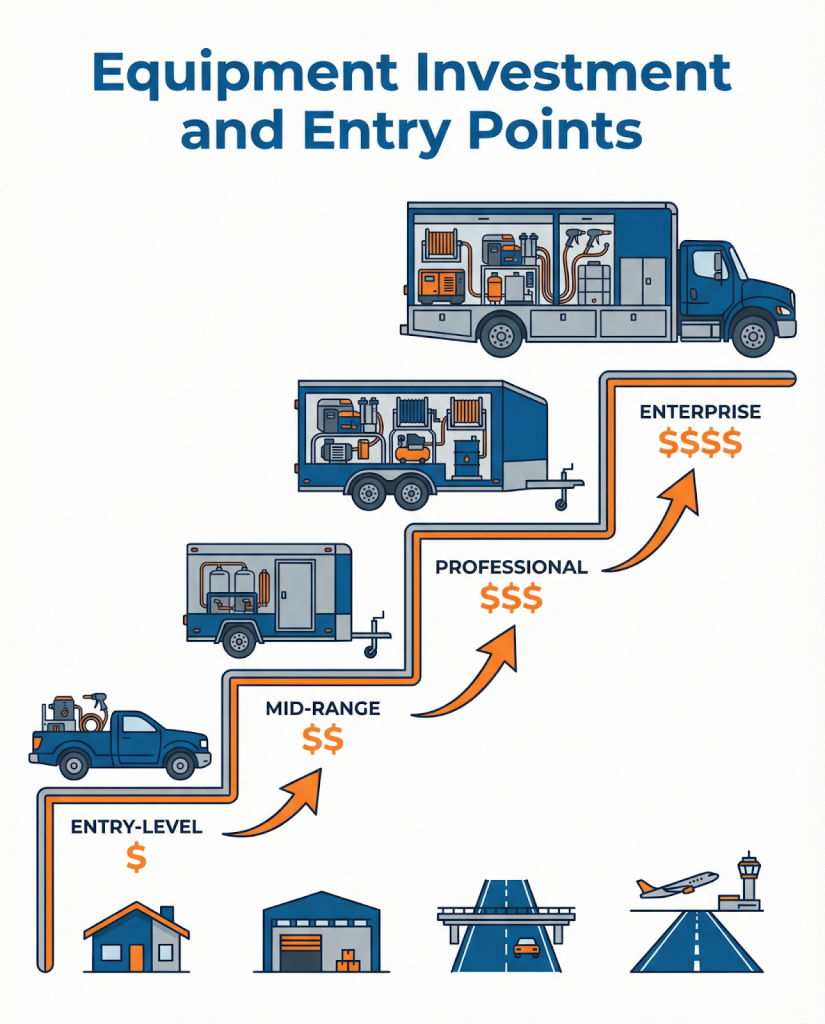
The capital investment required to enter the concrete lifting business varies significantly based on the rig configuration and proportioner selected. Understanding the investment tiers helps both contractors evaluating the business and property owners understanding what separates a professional operation from an underfunded one.
| Setup Level | Configuration | Best Application |
| Entry-level | Compact system plus pickup truck | New contractors, tight-access residential, side operations |
| Mid-range | PH-2 or PH-25 plus 16 ft trailer | Dedicated residential and light commercial contractors |
| Professional | PH-40 plus 20 ft V-nose trailer with full accessories | Full-service commercial and DOT contractors |
| Enterprise | PH-55 plus 28 ft box truck with multiple gun setups | Large-scale industrial and infrastructure operations |
Training is a critical component of the investment that goes beyond equipment operation. Manufacturers and foam suppliers offer structured programs covering equipment maintenance, foam chemistry, injection technique, and the diagnostic skills needed to read the feedback the equipment provides. Pressure fluctuations, temperature deviations, and flow rate changes all communicate important information about what is happening beneath the slab. Operators who understand these signals make better real-time decisions about injection volume, port placement, and foam density selection.
For property owners evaluating contractors, the equipment a company runs is a reliable indicator of their capability and commitment. A contractor operating a fully equipped professional rig with current-generation proportioners, proper heated hoses, and calibrated monitoring tools has made the investment to do the job right. A contractor working with outdated or undersized equipment may deliver inconsistent results regardless of their intentions.
Maintenance and Troubleshooting
Consistent equipment maintenance directly impacts job quality and long-term profitability for concrete lifting contractors. For property owners, a contractor's maintenance practices affect whether their repair performs as expected for the full projected lifespan.
Daily gun cleaning is the most critical maintenance task. Whether mechanical or air purge, the mixing chamber and nozzle must be thoroughly cleaned after each day's work to prevent buildup and crossover. A gun that starts the next job with residual cured material in its passages produces compromised foam from the first shot.
Hose inspection should occur before every job. Technicians check heated hoses for kinks, abrasion damage, and proper temperature readings along the entire length. A damaged thermocouple wire can cause undetected temperature drops that degrade foam quality without any visible indicator at the gun.
Filter and strainer cleaning on the 60-mesh inlet strainers for both the isocyanate and polyol supply lines prevents blockages that starve the proportioner and cause pressure imbalances. Contaminated material or crystallized isocyanate particles are the most common causes of strainer clogging.
Hydraulic fluid monitoring keeps the proportioner's drive system operating within specification. The hydraulic system requires periodic fluid checks and changes per the manufacturer's schedule, and neglecting this maintenance accelerates pump wear.
Pressure calibration verification ensures both A-side and B-side pressures remain balanced. Imbalanced pressure results in off-ratio mixing that produces foam with incorrect density and compromised structural properties. Professional contractors verify pressure balance at the start of every workday.
The most common field issue is gun crossover, where cured foam blocks the gun's internal passages. With mechanical purge guns, this typically results from worn rod seals that allow material to seep past the purge rod. With air purge guns, it can result from insufficient air pressure or delayed trigger release. Having spare mixing chambers and rebuild kits on-site allows operators to swap components and continue working with minimal downtime, keeping concrete lifting projects on schedule.
Key Takeaways
- The proportioner is the central component that heats, meters, and pressurizes both chemical components at calibrated 1:1 ratios, with professional models ranging from 28 to 55 pounds per minute output and featuring pressure balance control, digital temperature management, and inlet monitoring
- Mechanical purge guns use a physical valving rod to clear the mixing chamber and are preferred by the majority of contractors for their near-zero crossover risk, while air purge guns offer superior feathering control for precision lifting near target elevation
- Heated hoses maintain material temperature throughout transport because viscosity is temperature-dependent, and cooling chemicals produce foam with inconsistent cell structure and reduced compressive strength regardless of how well the proportioner and gun perform
- Mobile rig configurations range from compact pickup-mounted systems to 28-foot box truck build-outs, with V-nose trailers in the 16 to 20 foot range being the most common setup for dedicated concrete lifting contractors
- Real-time monitoring using laser-guided leveling systems enables sub-millimeter precision on commercial and industrial lifts, while Dynamic Cone Penetrometer testing before injection provides soil bearing capacity data that guides foam density selection and port placement
- Equipment quality is the most reliable indicator of contractor capability, and property owners evaluating quotes should consider the proportioner model, gun type, hose condition, and monitoring tools as signals of a contractor's investment in doing the job correctly
Conclusion
The equipment behind polyurethane foam injection is what transforms chemistry into precision concrete repair. Every component in the system, from the proportioner's ratio-controlled pumps to the gun's mixing chamber to the heated hoses maintaining material temperature, plays a direct role in determining whether the foam beneath your slab reaches its full structural potential. When any link in this chain operates below specification, the foam suffers and so does the repair's longevity.
Understanding how these systems work helps property owners ask the right questions when evaluating contractors and helps project managers specify the right equipment for their application. The difference between a concrete lift that lasts 15 years and one that fails in 3 often comes down to the equipment used to deliver the foam, not just the foam itself.Ready to discuss the right polyurethane injection approach for your concrete lifting project? Contact our team for a professional assessment backed by industry-leading equipment and trained operators.