Polyurethane Grouting vs. Compaction Grouting: Selecting the Right Pressure Grouting Method
Polyurethane grouting and cement-based compaction grouting are complementary pressure injection techniques that serve different depth ranges and project profiles. Polyurethane injection is 5 to 8 times less expensive, treats problems from 0 to 14 feet deep, cures in minutes, and fits on a trailer. Compaction grouting reaches 30 to 100+ feet, achieves comprehensive soil densification through physical displacement, and is the standard for deep sinkhole remediation and seismic liquefaction mitigation. Choosing the wrong method for a given set of conditions wastes money at best and fails to solve the problem at worst.
Both methods inject material under pressure to stabilize soil, fill voids, and support structures. But they operate through fundamentally different mechanisms. Compaction grouting uses brute-force displacement with heavy cement grout to densify soil from the bottom up. Polyurethane grouting uses chemical expansion to fill voids, flow into cracks, and compact adjacent soil from the inside out.
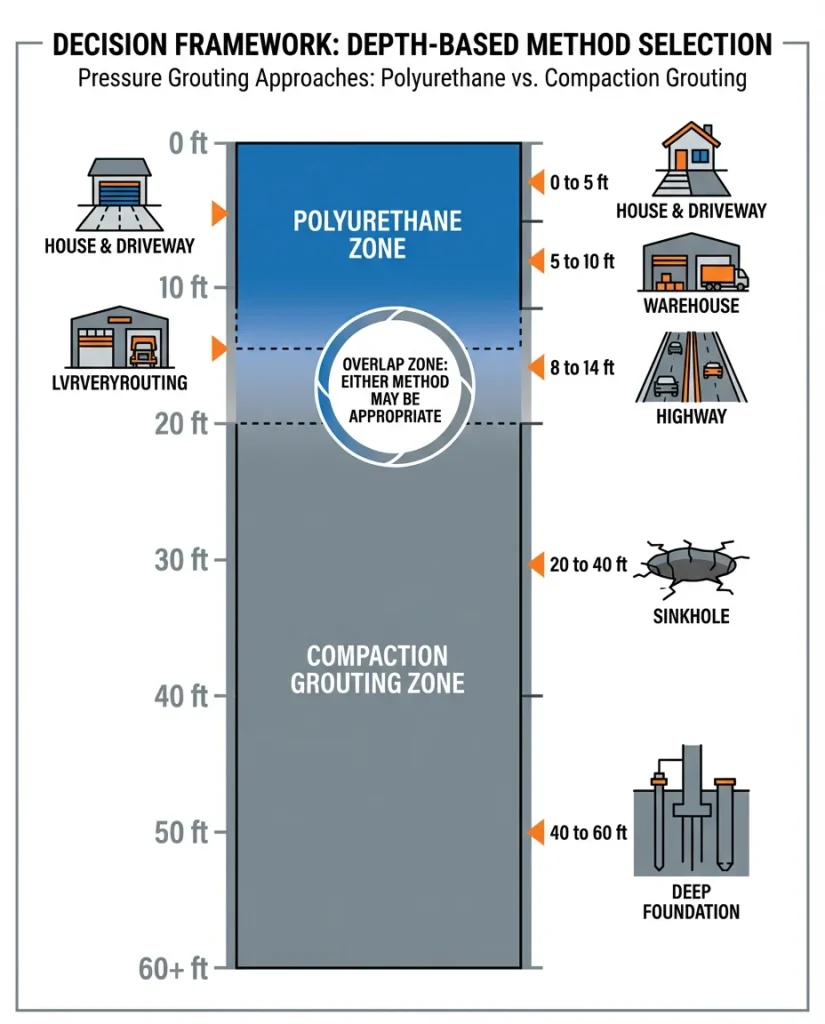
The decision between them hinges primarily on depth. Problems originating within 14 feet of the surface fall squarely in polyurethane's effective range at a fraction of the cost. Problems originating at 15 to 60+ feet require compaction grouting's ability to reach and treat soil at depth. The most sophisticated projects use both methods in combination, with compaction grouting addressing deep conditions and polyurethane injection finishing the shallow stabilization and precision slab lifting.
How Each Method Works
Compaction Grouting: Displacement Through Brute Force
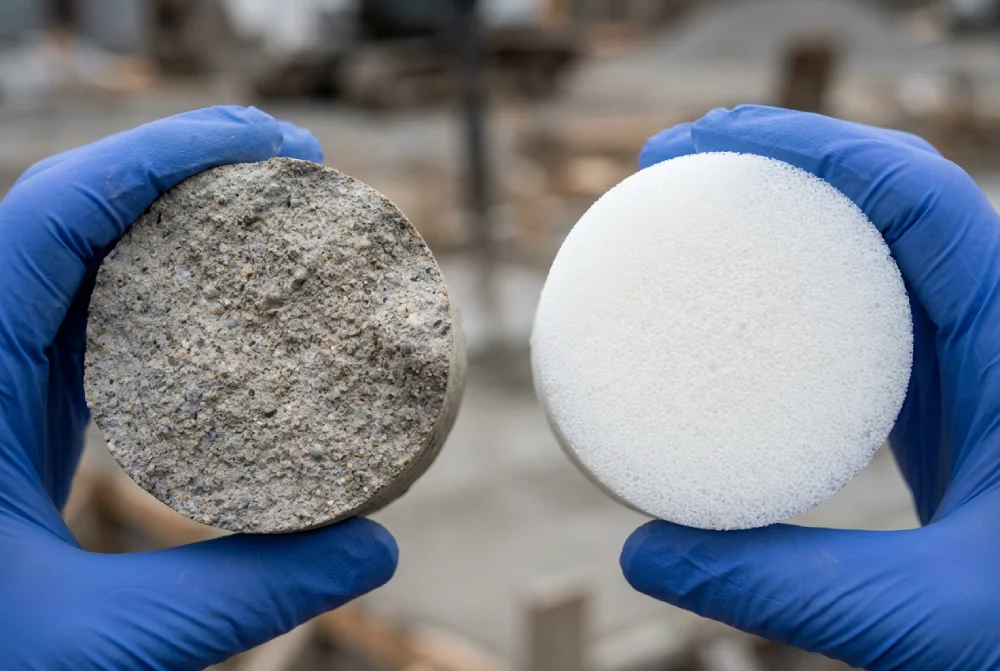
Compaction grouting, also called low-mobility grouting, involves driving steel casing pipes into the ground to a target depth, then injecting a very stiff, low-slump cement-based grout under high pressure. The grout is too viscous to flow through soil pores. Instead, it forms a dense, solid bulb at the end of the casing that grows as more material is injected.
As each bulb expands, it displaces the surrounding soil outward and downward, physically compacting it into a denser arrangement. The casing is then raised in controlled increments, typically 2-foot lifts, and the process repeats at each level, creating a column of overlapping grout bulbs from the bottom up. The result is both a reinforced grout column and densified soil surrounding each bulb.
The grout mixture consists of Portland cement, silty sand, sometimes fly ash, and water, with a slump of just 1 to 2 inches making it extremely stiff and low-mobility. Injection rates are carefully controlled at 0.1 to 2.0 cubic feet per minute to prevent hydraulic fracturing of the soil, which would cause the grout to travel along fracture planes rather than forming controlled compact bulbs.
Polyurethane Grouting: Expansion Through Chemistry
Polyurethane grouting injects a two-component liquid polymer through small holes at 3/8 to 5/8 inch diameter drilled in concrete or through injection rods driven into the ground. The two components, isocyanate and polyol, mix at the injection gun nozzle and undergo a rapid exothermic chemical reaction that causes the material to expand 15 to 25 times its original liquid volume.
The expanding foam fills voids, flows into cracks and crevices in its liquid phase, then solidifies into a rigid closed-cell structure within minutes. The expansion mechanism exerts controlled pressure on surrounding soil, compacting it outward in a process analogous to compaction grouting but driven by chemical expansion rather than hydraulic pump pressure.
For deeper applications, polyurethane deep injection uses steel extension rods driven through the concrete to target depths of 4 to 14 feet, allowing the foam to be placed at specific subsurface levels. PU foam injection at depth creates branching, root-like structures that compact soil from within and bind loose particles into a stable base.
Mechanics Comparison
| Characteristic | Compaction Grouting | Polyurethane Grouting |
| Soil improvement mechanism | Physical displacement via expanding grout bulb | Chemical expansion filling voids and compacting adjacent soil |
| Grout mobility | Very low (1 to 2 inch slump) | Starts as liquid, expands into rigid foam |
| Void penetration | Does not penetrate voids, displaces around them | Flows into voids as liquid before expanding to fill completely |
| Soil types improved | Granular soils (sands, silts, loose fills) | Most soil types including clay, sand, and mixed fills |
| Treatment pattern | Column of overlapping bulbs from bottom up | Expanding mass with branching lenses throughout void network |
Depth Capabilities: The Decisive Differentiator
Depth is the single most important factor in choosing between these two methods. Each technique has a clear effective range, and attempting to use either method outside its optimal depth creates subpar results.
Compaction Grouting: Deep Reach
Compaction grouting excels at depth. Steel casings can be driven or drilled to 30, 50, or even 100+ feet below the surface. This capability makes it the method of choice when settlement or soil instability originates at significant depth.
Deep fill deposits on reclaimed land, karst terrain with dissolution cavities at depth, liquefiable soil layers in seismic zones, deep foundation underpinning, and major sinkhole remediation requiring treatment through multiple geologic layers all fall within compaction grouting's domain. Major geotechnical contractors routinely perform compaction grouting to depths exceeding 60 feet for commercial and infrastructure projects.
Polyurethane Grouting: Shallow to Moderate Depth
Polyurethane injection is most effective from 0 to 14 feet below the surface. Standard slab lifting works at the immediate slab-soil interface from 0 to 2 feet. Deep injection extends this to 4 to 14 feet using steel extension rods driven through the slab.
The method's practical effectiveness diminishes at greater depths because the expanding foam cannot generate sufficient pressure to compact soil against high overburden pressures, injection rod installation becomes more difficult at depth, and material volume requirements increase significantly for deep treatment zones. For problems originating below 14 to 15 feet, compaction grouting is generally the more reliable solution.
Equipment and Site Impact
The equipment difference between the two methods is dramatic and often determines feasibility before cost or technical considerations even enter the discussion.
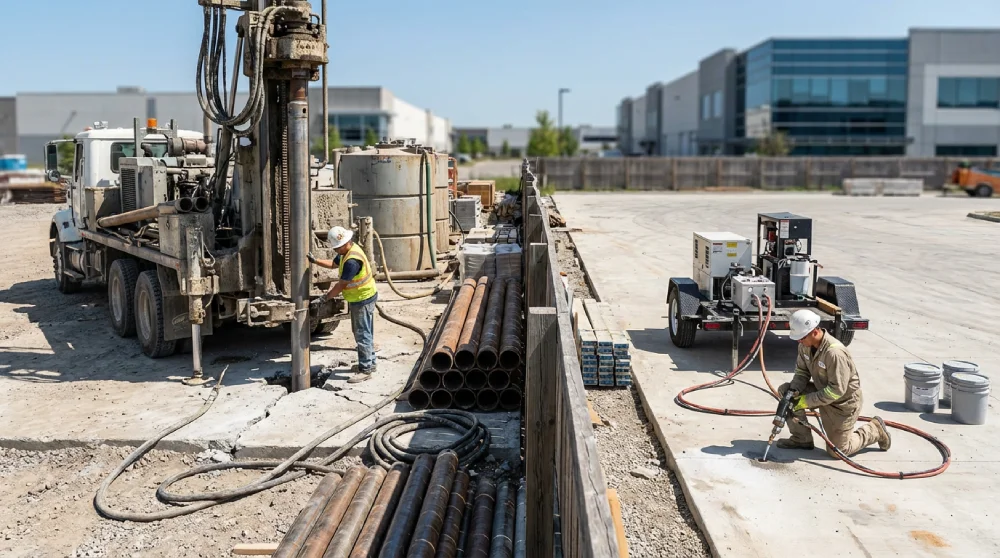
Compaction grouting requires a drill rig capable of advancing steel casing through concrete, asphalt, soil, and sometimes rock. The rig needs a stable working platform and adequate headroom of 10 to 20+ feet depending on the model. Steel casing, grout mixers, grout pumps, casing extractors, and monitoring equipment all contribute to a substantial equipment footprint. Mobilization costs alone typically run $25,000 to $50,000 per project.
Polyurethane grouting uses a proportioner that fits on a trailer or in a truck bed, flexible heated hoses and an injection gun that reach around obstacles and through tight access, a small drill for dime-sized holes, and injection rods for deep work. The entire system fits on a standard utility trailer. There is no heavy drill rig, no large mixing equipment, and minimal site disruption. Mobilization costs typically run $500 to $2,000.
| Equipment Factor | Compaction Grouting | Polyurethane Grouting |
| Primary equipment | Large drill rig | Trailer-mounted proportioner |
| Access requirements | Wide path, stable ground for rig | Through gates, basements, tight spaces |
| Headroom needed | 10 to 20+ feet | Standard ceiling height |
| Mobilization cost | $25,000 to $50,000 | $500 to $2,000 |
| Noise level | High (drilling and hydraulics) | Low to moderate |
| Vibration | Significant during drilling | Minimal |
| Site restoration | 2 to 4 inch casing holes | Dime-sized holes, minimal patching |
For indoor projects like warehouse floors, basement foundations, or spaces with limited overhead clearance, the equipment constraints alone can eliminate compaction grouting as an option. Polyurethane injection's compact setup works in spaces where no drill rig can operate.
Cost Comparison
Cost differences between the two methods are substantial and often the deciding factor for residential and light commercial projects.
Compaction Grouting Costs
Compaction grouting pricing includes multiple pay items that accumulate quickly. Mobilization runs $25,000 to $50,000 as a lump sum. Drilling costs $25 to $75 per linear foot. Grouting material and placement runs $75 to $750 per cubic yard. All-in costs reach $100 to $200 per cubic foot.
A typical residential sinkhole remediation in Florida requiring treatment at 30 to 40 feet depth across a 1,500 square foot footprint can easily reach $30,000 to $80,000 or more. Commercial and infrastructure projects range higher.
Polyurethane Grouting Costs
Polyurethane grouting is significantly more affordable for projects within its effective depth range. Mobilization runs $500 to $2,000. Material and installation costs $5 to $25 per square foot of slab area. Deep injection to 14 feet costs more per foot than standard lifting but remains far below compaction grouting rates.
Polyurethane injection is consistently cited as 5 to 8 times cheaper than compaction grouting for equivalent scope within its depth range. This cost advantage stems from lower equipment costs, smaller crew requirements, faster completion, and less material consumption. For a pressure grouting project where the problem exists within 14 feet of the surface, polyurethane delivers comparable soil improvement at a fraction of the investment.
Soil Type Suitability
Compaction Grouting
Compaction grouting is most effective in granular, non-cohesive soils including sands, silts, gravels, and loose fills. These soil types respond well to displacement compaction because the particles can rearrange into denser configurations when pushed by the expanding grout bulb.
Compaction grouting is less effective in cohesive soils like clays because clay particles resist rearrangement under displacement pressure. Instead of compacting, clay soils may fracture hydraulically, allowing grout to escape along fracture planes rather than forming controlled bulbs. This limitation is particularly relevant in Houston and Gulf Coast regions where expansive clay is the dominant soil type.
Polyurethane Grouting
Polyurethane grouting is effective across a broader range of soil types because its primary function is void filling and stabilization rather than pure displacement compaction.
In sandy soils, the foam fills voids and binds loose particles. In clay soils, it expands into shrinkage cracks and fills voids created by clay expansion and contraction cycles. In mixed fills, it conforms to irregular void shapes that stiff cement grout cannot reach. In saturated soils, hydrophobic formulations maintain full performance in wet conditions where cement-based grouts degrade.
However, polyurethane cannot achieve the same degree of deep soil densification that compaction grouting delivers in granular soils. Its soil improvement effect is limited to void filling and moderate compaction of immediately adjacent material. For projects where comprehensive soil densification at depth is the primary objective, compaction grouting remains the superior method.
Application-Specific Comparison
Sinkhole Remediation
Sinkholes, particularly in Florida's karst terrain, represent one of the most demanding grouting applications and the scenario where the distinction between methods matters most.
Compaction grouting is the primary method for sinkhole remediation because sinkholes often involve soil loss at significant depth of 20 to 60+ feet where limestone dissolution creates cavities. The method's ability to reach these depths, displace soil into denser columns, and fill large cavities with durable cement grout makes it the standard of care.
Polyurethane grouting serves as a complementary treatment, often used in conjunction with compaction grouting rather than as a replacement. It addresses shallow void filling, seals water infiltration pathways with its hydrophobic structure, and stabilizes the upper soil layers after compaction grouting has addressed the deep problem. The most effective approach in karst regions uses a staged methodology: compaction grouting for deep stabilization followed by polyurethane injection grouting for shallow soil improvement and precision slab lifting.
Foundation Repair
Compaction grouting is preferred when foundation settlement originates from deep soil failure at 15 to 30+ feet, loose fill, deep organic layers, or collapsible soils below the footing level. The grout columns act as soil reinforcement elements that transfer loads to more competent strata at depth.
Polyurethane grouting is preferred when settlement results from shallow void formation directly beneath the footing or slab, including eroded soil, poor compaction in the top 10 feet, or voids from plumbing leaks. It is also the better choice when the footing-slab interface needs releveling because polyurethane provides the precision lifting control within 1/8 inch that compaction grouting cannot match. Polyurethane foam foundation repair addresses the void-filling and stabilization components of foundation problems efficiently when the cause is within its effective depth range.
DOT and Highway Applications
Both methods are approved by state DOTs for highway work but serve different roles within the transportation maintenance framework.
Compaction grouting handles deep subgrade improvement beneath highway embankments, bridge abutments, and approach fills where settlement originates at depth. Polyurethane grouting handles slab panel lifting, joint stabilization, under-sealing, and shallow void filling where the pavement structure needs releveling with minimal lane closure and fast return to service.
Multiple state DOT specifications including Texas, California, North Carolina, and Tennessee include provisions for both methods, allowing engineers to select the appropriate technique based on the specific subsurface conditions identified during investigation.
Advantages and Limitations Summary
Compaction Grouting Strengths
Compaction grouting reaches depths of 30 to 100+ feet that no other method can match. It achieves comprehensive soil densification through physical displacement that improves the soil itself rather than just filling voids. It provides grout columns that serve as long-term soil reinforcement elements transferring loads to competent strata. It is the standard of care for deep sinkhole remediation in karst terrain and can address liquefaction risk in seismic zones.
Compaction Grouting Limitations
High cost with mobilization alone at $25,000 to $50,000 puts it beyond reach for most residential projects. Large equipment requires wide access paths and significant headroom. Execution takes days to weeks for large projects. The method is less effective in cohesive clay soils. Heavy cement grout adds significant load to soil. It cannot provide precision slab lifting, and the grout is porous and susceptible to water degradation over time.
Polyurethane Grouting Strengths
At 5 to 8 times less expensive than compaction grouting, polyurethane injection is accessible for residential through commercial projects. Compact equipment with minimal site disruption fits spaces where drill rigs cannot operate. Execution completes in hours with same-day return to service. Precision slab lifting within 1/8 inch uses laser monitoring. The hydrophobic, closed-cell foam is immune to water damage with a half-life exceeding 150 years. Lightweight material at 2 to 8 PCF doesn't stress weak soils. The method works across diverse soil types and is re-injectable if conditions change.
Polyurethane Grouting Limitations
Effective depth is limited to approximately 14 feet. It cannot achieve deep soil densification comparable to compaction grouting. It does not form structural columns that transfer loads to depth. It may not be sufficient as a sole treatment for deep sinkhole remediation. Higher material cost per cubic foot than cement grout applies, though lower total project cost offsets this for most applications.
Decision Framework
| If Your Project Involves | Recommended Method | Why |
| Settled slab needing precision releveling | Polyurethane | Laser-guided lift control, fast cure, cost-effective |
| Shallow voids 0 to 10 feet beneath concrete | Polyurethane | Complete void penetration, lightweight, immediate strength |
| Deep soil failure 15 to 60+ feet | Compaction grouting | Only method that reaches and treats soil at depth |
| Active sinkhole with deep cavity | Compaction grouting primary, polyurethane complementary | Deep treatment with shallow finishing |
| Loose granular soil densification | Compaction grouting | Physical displacement most effective in sands and silts |
| Wet or saturated conditions (shallow) | Polyurethane | Hydrophobic formulations designed for water exposure |
| Budget-constrained residential repair | Polyurethane | 5 to 8 times less expensive, adequate for most residential depths |
| Seismic liquefaction mitigation | Compaction grouting | Comprehensive densification to seismic standards |
| Highway slab panel lifting | Polyurethane | DOT-approved, minimal lane closure, fast return |
| Deep bridge embankment stabilization | Compaction grouting | Deep treatment of fill and subgrade layers |
| Indoor warehouse or basement | Polyurethane | Compact equipment works under standard ceilings |
The two methods are not competitors so much as complementary tools for different depth ranges and problem types. The most sophisticated geotechnical contractors maintain capability in both methods and deploy them in combination when a project's subsurface conditions demand treatment at multiple depth levels.
Key Takeaways
- Depth is the primary decision factor: polyurethane grouting treats 0 to 14 feet effectively while compaction grouting reaches 30 to 100+ feet, making depth of the problem the single most important variable in method selection
- Polyurethane injection costs 5 to 8 times less than compaction grouting for equivalent scope within its depth range, with mobilization at $500 to $2,000 versus $25,000 to $50,000 and total project costs proportionally lower
- Compaction grouting achieves comprehensive soil densification through physical displacement that improves the soil itself, while polyurethane fills voids and moderately compacts adjacent material without forming structural columns at depth
- Equipment constraints often determine feasibility before cost or technical factors, with compaction grouting requiring large drill rigs and significant headroom while polyurethane fits on a trailer and works through gates, in basements, and under standard ceilings
- Sinkhole remediation typically requires both methods in combination, with compaction grouting addressing deep cavities and soil loss at 20 to 60+ feet and polyurethane finishing with shallow stabilization and precision slab lifting
- Both methods are DOT-approved for highway work but serve different roles, with compaction grouting handling deep embankment stabilization and polyurethane handling slab lifting, under-sealing, and joint stabilization with minimal lane closure
Conclusion
Polyurethane grouting and compaction grouting are not competing methods but complementary tools designed for different depth ranges and problem types. Selecting the right one, or the right combination, starts with understanding where the problem originates beneath the surface.
For the vast majority of residential, commercial, and highway projects where settlement, voids, and soil instability exist within 14 feet of the surface, polyurethane injection delivers faster results, precision lifting, and dramatically lower cost. For deep geotechnical challenges including sinkholes, liquefiable soils, and settlement originating at 15 to 60+ feet, compaction grouting's ability to reach and treat soil at depth makes it irreplaceable. The best outcomes come from matching the method to the depth and deploying both when the project demands it.Ready to determine which pressure grouting method fits your project? Contact our team for a professional subsurface assessment that identifies the problem depth and recommends the right approach for your specific conditions.