Polyurethane Grouting vs. Mudjacking: Why Foam Injection Outperforms Traditional Slab Lifting
Polyurethane foam injection outperforms mudjacking across every performance metric that determines long-term repair success. Foam weighs 95% less than mudjacking slurry, cures in 15 minutes versus 24 to 72 hours, achieves precision within 1/8 inch, lasts 10 to 20+ years compared to 2 to 5, and delivers lower total cost of ownership despite higher upfront pricing because a single polyurethane repair outlasts 3 to 4 mudjacking treatments within the same timeframe.
Mudjacking has been the standard method for lifting sunken concrete for over 70 years. It works. But working and working well for the long term are two fundamentally different things. Polyurethane foam injection was developed specifically to address mudjacking's inherent shortcomings: material degradation, excessive weight, imprecise control, and short service life.
The comparison between these two methods is the most common question property owners ask when facing settled concrete. Understanding the differences across every dimension, from material science to total cost of ownership, helps you make an informed decision that accounts for long-term performance rather than just first-invoice price. A qualified concrete lifting service evaluates your specific conditions and recommends the approach that delivers the best outcome over the life of the repair.
How Each Method Works
Mudjacking drills 1.5 to 2 inch holes through the settled slab and pumps a slurry of cement, water, soil, and sometimes sand or limestone beneath it. The heavy slurry fills voids and pushes the slab upward through hydraulic pressure from the pump. The slurry cures into a solid mass over 24 to 72 hours, after which the surface can support light traffic.
Polyurethane foam injection drills 3/8 to 5/8 inch holes and injects a two-component expanding polymer that fills voids, compacts soil, and lifts the slab through controlled chemical expansion. The foam cures to 90% strength in approximately 15 minutes, and the surface supports vehicle traffic the same day.
The methods share the same goal but differ in every aspect of execution. The material, the hole size, the cure time, the precision, and the long-term durability all favor polyurethane, while mudjacking's advantage is limited to upfront cost.
The Five Fundamental Problems with Mudjacking
1. Material Weight Creates a Self-Defeating Cycle
The cement-and-soil slurry used in mudjacking weighs approximately 100 to 150 pounds per cubic foot. This is a critical problem because the most common cause of concrete settlement is weak, eroded, or poorly compacted soil beneath the slab.
Pumping material that weighs 100+ pounds per cubic foot onto soil that already couldn't support the original slab adds significant new load to an already failing subgrade. A standard 4-inch concrete slab weighs roughly 50 pounds per square foot. Adding mudjacking slurry beneath it increases the total load the compromised soil must support, accelerating further settlement and creating a cycle where each repair contributes to the conditions that necessitate the next one.
Concrete lifting foam weighs just 2 to 8 pounds per cubic foot, 95% lighter than mudjacking slurry. This negligible weight addition means polyurethane foam injection doesn't stress weak soils further. The foam's expansion mechanism actually compacts and stabilizes surrounding soil, improving bearing capacity rather than degrading it.
2. The Slurry Erodes, Shrinks, and Breaks Down
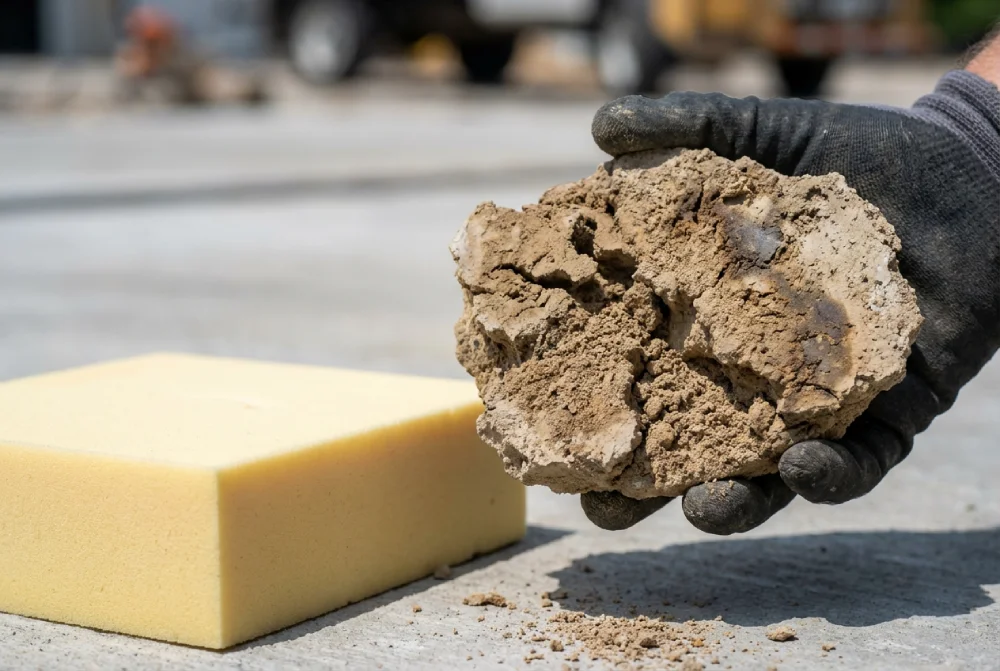
Mudjacking slurry is a porous, water-permeable material. Over time, the same water infiltration that caused the original settlement attacks the repair material itself.
Water flowing through joints and cracks in the slab reaches the slurry and gradually washes away fine particles, creating new voids within the repair material. As water evaporates from the cured slurry, the material contracts. This shrinkage alone can allow the slab to settle again even without soil erosion. In cold climates, water absorbed by the porous slurry freezes and expands, breaking apart the material's internal structure. Over repeated freeze-thaw cycles, the slurry disintegrates from the inside out.
Polyurethane foam is a closed-cell, hydrophobic material that does not absorb water. It cannot erode because there are no fine particles to wash away. It doesn't shrink because there is no water content to evaporate. Freeze-thaw cycles have no effect because water cannot penetrate the sealed cellular structure. The polyurethane foam grout is chemically inert once cured, impervious to water, chemicals, insects, rodents, and biological degradation, with a documented half-life exceeding 150 years.
3. Large Holes Damage the Slab and Its Appearance
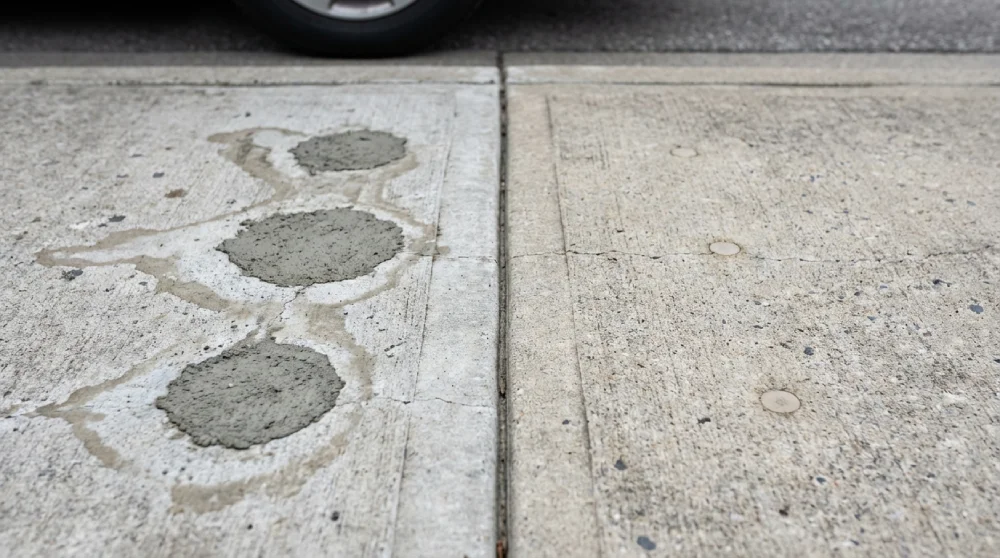
Mudjacking requires drilling holes 1.5 to 2 inches in diameter, roughly the size of a soda can, into the concrete surface. Multiple holes spaced 3 to 6 feet apart are needed per slab section. Even when patched, these large holes are conspicuous because the patch material rarely matches the surrounding concrete in color or texture, leaving a polka-dot appearance across the surface.
When holes are drilled too close together or near existing cracks, they can cause the slab to crack further. In some cases, the drilling itself cracks the concrete, requiring replacement rather than repair. Over time, patches crack, chip, and break away from the surrounding concrete, creating new entry points for water that accelerates the deterioration cycle.
Polyurethane injection requires holes just 3/8 to 5/8 inch in diameter, about the size of a dime. These tiny holes are easily filled with concrete grout or matching sealant and become nearly invisible after patching. The minimal hole size means less structural disruption to the slab and a clean finished appearance, particularly important for decorative concrete, stamped surfaces, and stained finishes.
4. Imprecise Lift Control
Mudjacking relies on hydraulic pressure from a pump to push liquid slurry beneath the slab. The heavy, viscous slurry doesn't distribute evenly. It tends to pool in low spots and follow paths of least resistance rather than filling uniformly. The operator cannot precisely predict how much lift a given volume of slurry will produce since the slurry fills voids of unknown size before any lifting occurs. Once the slurry is pumped, there is no way to remove excess material if the slab is over-lifted. The mistake is permanent.
Polyurethane foam injection provides dramatically superior lift control. The expanding foam generates predictable, gradual upward pressure monitored in real time with laser levels. Operators routinely achieve precision within 1/8 inch of target elevation. The foam's expansion rate is chemically controlled and well-understood. With air-purge injection guns, operators can feather the injection with small incremental shots as the slab approaches its target, providing sub-millimeter control near the end of the lift.
5. Inability to Reach All Voids
Mudjacking slurry is a thick, gravity-dependent material that flows along the path of least resistance. It cannot penetrate narrow cracks, small crevices, or tight gaps between the slab underside and the soil. Some voids remain unfilled even after the slab appears level, meaning the slab sits on an incomplete repair with unsupported areas that can settle later.
Polyurethane foam enters the void as a low-viscosity liquid before the chemical reaction begins. In its liquid phase, it flows into hairline cracks and narrow crevices that mudjacking slurry cannot reach. The foam then expands to fill the remaining space from within, creating comprehensive, continuous contact between the slab and its support. This complete void penetration through polyurethane grout injection is a primary reason foam repairs last significantly longer.
Head-to-Head Performance Comparison
| Factor | Polyurethane Foam Injection | Mudjacking |
| Material weight | 2 to 8 lbs per cubic foot | 100 to 150 lbs per cubic foot |
| Injection hole size | 3/8 to 5/8 inch (dime-sized) | 1.5 to 2 inches (soda can-sized) |
| Cure to 90% strength | 15 minutes | 24 hours minimum |
| Vehicle traffic | 15 to 30 minutes | 24 to 72 hours |
| Typical lifespan | 10 to 20+ years | 2 to 5 years |
| Material half-life | 150+ years (chemically inert) | Not applicable (material degrades) |
| Water resistance | Hydrophobic, closed-cell, zero absorption | Porous, absorbs water, erodes over time |
| Freeze-thaw resistance | Unaffected | Severely degraded |
| Lift precision | Within 1/8 inch with laser monitoring | Imprecise, difficult to control |
| Void penetration | Flows into hairline cracks before expanding | Cannot reach narrow gaps |
| Aesthetic result | Dime-sized holes, nearly invisible patches | Soda can-sized holes, conspicuous patches |
| Equipment footprint | Compact trailer or pickup truck | Large pump truck and mixing equipment |
Longevity: The Defining Difference
The service life gap between the two methods is the single most important factor in the comparison and the primary reason concrete lifting professionals, state DOTs, and informed property owners increasingly choose polyurethane.
Polyurethane foam repairs typically last 10 to 20+ years. The foam itself does not break down. It is closed-cell, hydrophobic, and chemically stable. When re-settlement does occur after a polyurethane repair, it is almost always because the underlying soil continued to move, not because the foam failed. The material maintains its compressive strength, cellular structure, and dimensional stability indefinitely once cured.
Mudjacking's shorter lifespan of 2 to 5 years stems from the material itself degrading over time. Even in favorable conditions with good drainage and stable soil, the slurry's porosity and susceptibility to moisture make it a temporary fix by nature. Each of the degradation mechanisms, erosion, shrinkage, and freeze-thaw damage, operates continuously from the day the repair is completed.
| Longevity Factor | Polyurethane Foam | Mudjacking Slurry |
| Material degradation | None, closed-cell and chemically inert | Erosion, shrinkage, freeze-thaw damage |
| Re-settlement cause | External soil movement only | Material breakdown plus soil movement |
| Re-treatment frequency | Rarely needed over 15+ years | Often needed within 3 to 5 years |
| Material half-life | 150+ years | Not applicable |
Cure Time and Return to Service
Speed matters for driveways, commercial entries, and roadways where extended closure is disruptive or dangerous. The cure time difference between the two methods is dramatic and often decisive for commercial and infrastructure projects.
Polyurethane foam reaches approximately 90% of its final compressive strength within 15 minutes of injection. Foot traffic is possible immediately after patching. Vehicle traffic is safe within 15 to 30 minutes. Full cure to 100% strength completes within 24 hours.
Mudjacking requires a minimum of 24 hours before light traffic and 24 to 72 hours before vehicle traffic. Full cure takes 3 to 5 days. For commercial and DOT applications, polyurethane's rapid cure is often the decisive factor. Warehouse floors, retail entries, and highway panels return to full-load service the same day, sometimes within the same hour. Poly injection eliminates the multi-day closure that mudjacking requires.
Environmental Resistance
The environment beneath a concrete slab is hostile: saturated soil, fluctuating water tables, freeze-thaw cycling, and chemical exposure from fertilizers, de-icing salts, and petroleum products. How each material handles these conditions determines whether the repair survives years or decades.
Polyurethane foam repels water with zero absorption, is unaffected by freeze-thaw cycling because no water penetrates its sealed cellular structure, resists de-icers, fertilizers, and petroleum products, is chemically inert and not a food source for any organism, performs normally in high water table environments, and can be injected in saturated soil conditions using specialty hydrophobic formulations.
Mudjacking slurry absorbs water and erodes over time, is severely degraded by repeated freeze-thaw cycles, is susceptible to chemical breakdown, can support mold and organic growth, degrades significantly in high water table conditions, and cannot be injected effectively into standing water.
In climates with harsh winters, freeze-thaw resistance is particularly critical. Mudjacking slurry in northern regions has a documented tendency to break down within 2 to 3 years as repeated freeze-thaw cycles pulverize the porous material.
Cost Analysis: Upfront vs. Total Cost of Ownership
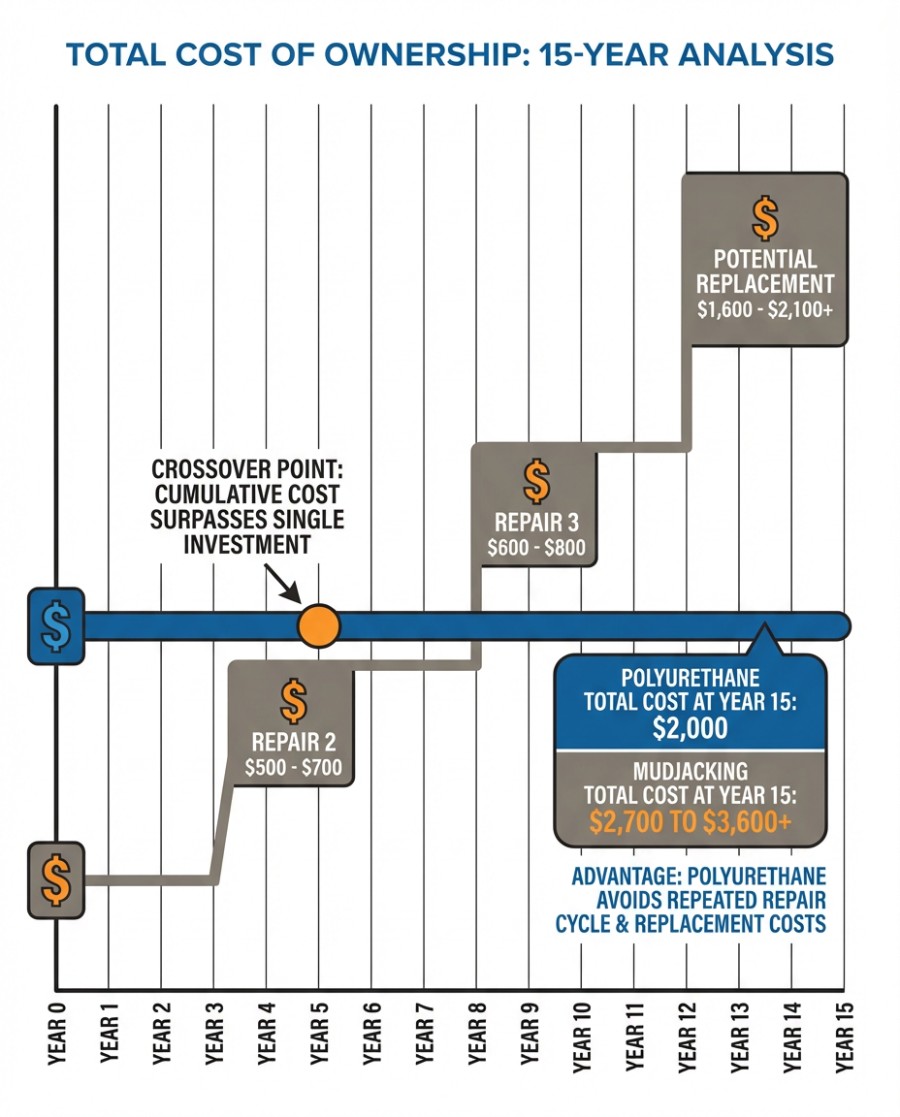
Mudjacking wins on upfront cost. Polyurethane wins on total cost of ownership. Understanding this distinction is essential for making an informed decision.
Upfront costs: Polyurethane foam injection runs $5 to $25 per square foot. Mudjacking runs $3 to $6 per square foot. For a typical 200 square foot driveway section, polyurethane costs approximately $1,000 to $5,000 while mudjacking costs $600 to $1,200.
Total cost over 15 years for a 200 square foot driveway:
Mudjacking scenario: Initial repair at $900. Re-settlement in 3 to 5 years requires re-treatment at $900. Another re-treatment at year 8 to 10. Possible third re-treatment or replacement by year 12 to 15. Total 15-year cost: $2,700 to $3,600 for three treatments, or $4,000+ if replacement becomes necessary.
Polyurethane scenario: Initial repair at $2,000. Foam maintains structural integrity for 15 to 20+ years. No re-treatment needed in typical conditions. Total 15-year cost: $2,000.
The polyurethane repair costs more on day one but costs less over any multi-year horizon. For commercial properties with larger slab areas and higher stakes including operational downtime and liability risk, the economics tilt even more heavily toward foam injection. A pressure grouting contractor experienced in both methods can provide site-specific cost projections that account for your soil conditions, drainage, and load requirements.
Warranty Comparison
Warranty structures reflect each method's expected performance and the industry's confidence in each material.
Most reputable polyurethane foam lifting contractors offer 2 to 5 year warranties covering re-settlement beyond 1/2 inch. Some offer extended coverage up to 10 years or lifetime warranties on the material itself. Warranties typically require the property owner to maintain proper drainage and seal cracks and joints.
Mudjacking warranties are less common and typically shorter at 1 to 2 years when offered. Many mudjacking contractors provide no formal warranty because the material's susceptibility to erosion and freeze-thaw damage makes re-settlement likely within the warranty period. The warranty gap reflects industry confidence in each method's durability.
Equipment and Accessibility
Mudjacking requires a large pump truck, mixing equipment, bulk slurry materials, and wide hoses that must be maneuvered to each injection point. The equipment footprint is substantial, requiring clear access paths for the truck and workspace around the repair area.
Polyurethane injection equipment is significantly more compact. A complete system fits on a trailer or in the back of a pickup truck. Heated hoses are flexible and can reach around obstacles, through gates, and into tight spaces that mudjacking equipment cannot access. This makes polyjacking viable for backyard patios behind narrow gates, indoor warehouse floors, enclosed pool decks, and other restricted-access locations where a mudjacking truck simply cannot maneuver.
When Mudjacking Still Makes Sense
Intellectual honesty requires acknowledging mudjacking's legitimate advantages in specific scenarios.
Budget-constrained minor repairs on low-priority slabs with light foot traffic, stable soil, and good drainage represent mudjacking's strongest use case. When the slab supports minimal load and the property owner accepts a shorter repair lifespan, mudjacking's lower upfront cost delivers acceptable results.
Temporary fixes for properties being prepared for sale or slabs scheduled for replacement in the near future benefit from mudjacking's lower cost as an interim solution that improves appearance and safety without the full investment of a long-term repair.
Ideal soil conditions occasionally allow mudjacking to perform well beyond its typical lifespan. When the soil is stable, drainage is excellent, and the climate doesn't subject the slurry to freeze-thaw damage, mudjacking repairs can last longer than average. The challenge is that conditions beneath a settled slab are, by definition, not ideal. The slab settled because the soil failed. Adding 100+ pounds per cubic foot of material to that failed soil is a calculated risk that doesn't always pay off.
The Verdict: Why Foam Injection Wins
| Advantage | Impact |
| 95% lighter material | Doesn't stress weak soils, breaks the re-settlement cycle |
| Hydrophobic, closed-cell structure | Immune to erosion, shrinkage, and freeze-thaw damage |
| 15-minute cure | Same-day return to service for all traffic types |
| Dime-sized holes | Minimal aesthetic disruption, preserves decorative concrete |
| Complete void penetration | Reaches cracks and gaps that slurry cannot fill |
| Real-time laser monitoring | 1/8-inch precision lift control |
| 10 to 20+ year service life | Fewer re-treatments, lower total cost of ownership |
| Compact equipment | Access to restricted spaces mudjacking cannot reach |
The higher upfront cost is the only metric where mudjacking holds an advantage, and that advantage evaporates within one re-treatment cycle. For any application where durability, precision, speed, aesthetics, or heavy-load support matters, polyurethane foam injection is the superior choice. When you're ready to evaluate which method fits your specific situation, an experienced concrete lifting solutions provider assesses your soil conditions, load requirements, and budget to recommend the approach that delivers the best long-term value.
Key Takeaways
- Polyurethane foam weighs 2 to 8 pounds per cubic foot versus mudjacking's 100 to 150, eliminating the self-defeating cycle where heavy repair material accelerates re-settlement on already compromised soil
- Closed-cell hydrophobic foam is immune to the three mechanisms that destroy mudjacking slurry: water erosion, curing shrinkage, and freeze-thaw disintegration, with a documented material half-life exceeding 150 years
- 15-minute cure versus 24 to 72 hours means polyurethane returns surfaces to vehicle traffic the same day, eliminating the multi-day closures that mudjacking requires for driveways, commercial entries, and roadways
- Dime-sized injection holes versus soda can-sized holes deliver a dramatically cleaner aesthetic with nearly invisible patches that preserve decorative, stamped, and stained concrete surfaces
- Complete void penetration through liquid-phase flow before expansion means polyurethane reaches hairline cracks and narrow crevices that thick mudjacking slurry cannot fill, creating comprehensive support that prevents future settlement
- Total cost of ownership over 15 years favors polyurethane at $2,000 versus $2,700 to $3,600+ for mudjacking because mudjacking's 2 to 5 year lifespan requires 3 to 4 re-treatments within a single polyurethane repair's service life
Conclusion
The comparison between polyurethane foam injection and mudjacking comes down to a simple question: are you paying for a repair or paying for a solution? Mudjacking delivers a repair at lower upfront cost, but the material's inherent vulnerability to water, shrinkage, and freeze-thaw damage means it's working against itself from day one. Polyurethane delivers a solution that addresses the root cause of settlement with a material engineered to resist every degradation mechanism the subsurface environment throws at it.
The 95% weight reduction, 15-minute cure, 1/8-inch precision, complete void penetration, and 10 to 20+ year service life make polyurethane foam injection the clear choice for any property owner who evaluates concrete repair as a long-term investment rather than a short-term expense.Ready to compare options for your settled concrete? Contact our team for a professional assessment that evaluates your soil conditions, load requirements, and budget to recommend the approach that delivers the best long-term value.