How Polyurethane Foam Injection Works: The Science Behind Modern Concrete Lifting
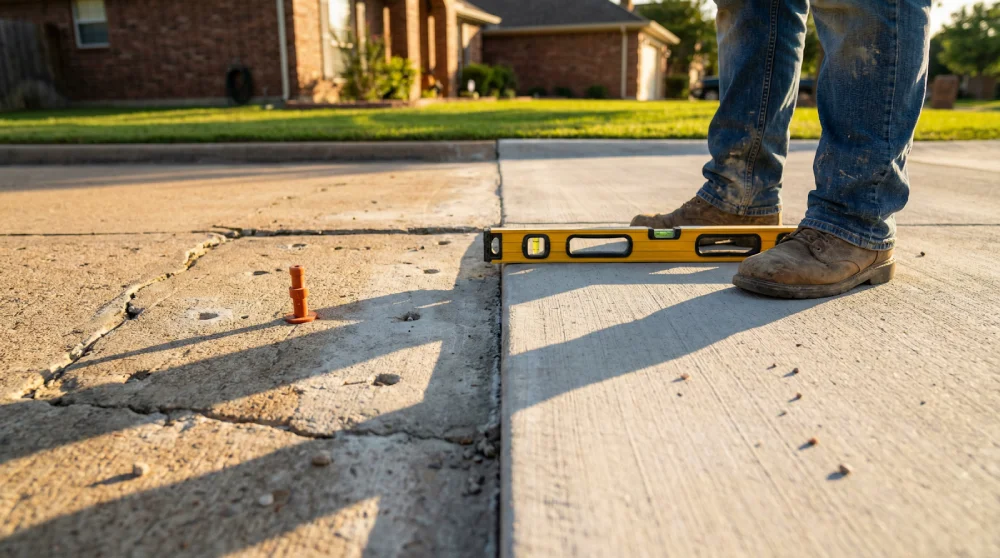
Polyurethane foam injection uses a rapid exothermic chemical reaction between isocyanate and polyol to generate a high-density, closed-cell foam that fills subsurface voids, compacts loose soil, and exerts controlled hydraulic pressure to raise sunken concrete slabs with precision within 1/8 inch of target elevation. The foam cures to 95% strength in 15 to 20 minutes and supports loads up to 14,000 pounds per square foot.
Concrete slabs settle when the supporting soil beneath them shifts, erodes, or compresses, leaving voids that gravity continuously exploits. The result is cracked surfaces, uneven walkways, and tripping hazards that worsen over time. Traditional repair methods like full slab replacement are expensive, disruptive, and time-consuming, often taking days to complete and weeks to fully cure.
Polyurethane foam concrete lifting, also called polyjacking or foam jacking, offers a faster, lighter, and longer-lasting alternative. By injecting an expanding two-component polymer beneath the slab through dime-sized holes, trained technicians can raise heavy concrete back to its original level in hours rather than days. If your property has settled concrete causing safety or structural concerns, a concrete leveling company can assess the damage and determine whether polyurethane injection is the right solution.
Why Concrete Settles in the First Place
Before understanding the fix, it helps to know the problem. Concrete slabs are only as stable as the soil beneath them. When that soil shifts, washes away, or compresses, voids form that leave the slab unsupported and gravity does the rest.
Soil erosion is the most common culprit. Water movement from heavy rainfall, poor drainage, or leaking pipes washes away fine soil particles beneath the slab, creating gaps that grow wider over time. In regions like Houston and the Gulf Coast where clay soils dominate and rainfall is heavy, erosion-driven settlement is particularly aggressive.
Poor compaction during original construction catches up with properties years after they're built. If fill soil wasn't adequately compacted before the slab was poured, it gradually compresses under the concrete's weight, creating the slow, steady sinking that property owners often don't notice until cracks appear.
Freeze-thaw cycles affect properties in colder climates where water in the soil freezes and expands, pushing soil apart. When temperatures rise and the ice melts, voids remain where the displaced soil used to be. Over repeated seasons, these voids accumulate and deepen.
Biological activity and organic decay create underground spaces that undermine slab support. Burrowing animals, decaying tree roots, and decomposing organic fill material all leave gaps that the slab eventually settles into.
Soil composition plays a defining role in how quickly and severely settlement occurs. Clay soils expand and contract dramatically with moisture changes. Sandy soils erode easily under water flow. Silty soils compact significantly under sustained weight. Each type presents different challenges for long-term slab stability.
| Settlement Cause | How It Creates Voids | Most Common Environments |
| Soil erosion | Water washes away fine particles beneath the slab | High-rainfall areas, properties with poor drainage |
| Poor compaction | Fill soil compresses under slab weight over time | New construction, backfilled areas |
| Freeze-thaw cycles | Ice expansion displaces soil; voids remain after thaw | Cold climates with seasonal temperature swings |
| Biological activity | Burrowing animals and decaying roots leave gaps | Properties near wooded areas, older developments |
| Clay soil movement | Expansion and contraction with moisture changes | Gulf Coast, Texas, and high-clay-content regions |
Once voids form beneath a slab, the problem only accelerates. Water follows the path of least resistance into the void, eroding surrounding soil and enlarging the gap. The unsupported section of concrete flexes under traffic loads, cracking the surface and creating entry points for more water. Without intervention, minor settling becomes major structural failure.
The Chemistry: Isocyanate Meets Polyol
At the heart of polyurethane foam injection is a two-part chemical reaction that transforms liquid components into a rigid, load-bearing structural mass in minutes. Understanding this chemistry explains why the technology works so effectively for concrete lifting and void filling.
The foam is produced from two liquid components stored separately and mixed only at the point of injection.
Component A (Isocyanate) is typically methylene diphenyl diisocyanate (MDI), the more reactive component responsible for the curing process. It contributes to the foam's rigidity and structural integrity. MDI is preferred over toluene diisocyanate (TDI) in modern formulations because it produces lower vapor pressure during application, improving jobsite safety.
Component B (Polyol Blend) is usually a polyester or polyether polyol mixed with catalysts, surfactants, and blowing agents that control the foam's expansion rate and cell structure. The polyol blend determines how fast the foam expands, how dense the final product becomes, and how the cellular structure forms.
When the two components combine, they undergo a rapid exothermic polymerization reaction. The reaction produces carbon dioxide gas, which creates thousands of tiny gas-filled cells within the foam. These closed cells give the material its expansive lifting power and its resistance to water absorption.
The reaction proceeds through distinct stages:
The two liquid components mix at the injection gun nozzle under pressure, combining in milliseconds. The exothermic reaction begins immediately, generating heat that accelerates polymerization. Carbon dioxide forms rapidly within the mixture, causing the foam to expand to 15 to 25 times its original liquid volume. The foam flows into voids and crevices as a liquid before expanding and solidifying, creating a rigid structural mass that conforms to the exact shape of the void it fills.
By adjusting the ratio of polyols, isocyanates, and additives, manufacturers produce foams with different densities, reaction speeds, and performance characteristics tailored to specific applications. Lightweight residential formulations at 2.0 to 3.0 PCF work for driveways and sidewalks. Heavy-duty commercial formulations at 4.0 PCF and above handle warehouse floors, highways, and airport runways.
The Step-by-Step Polyurethane Concrete Lifting Process
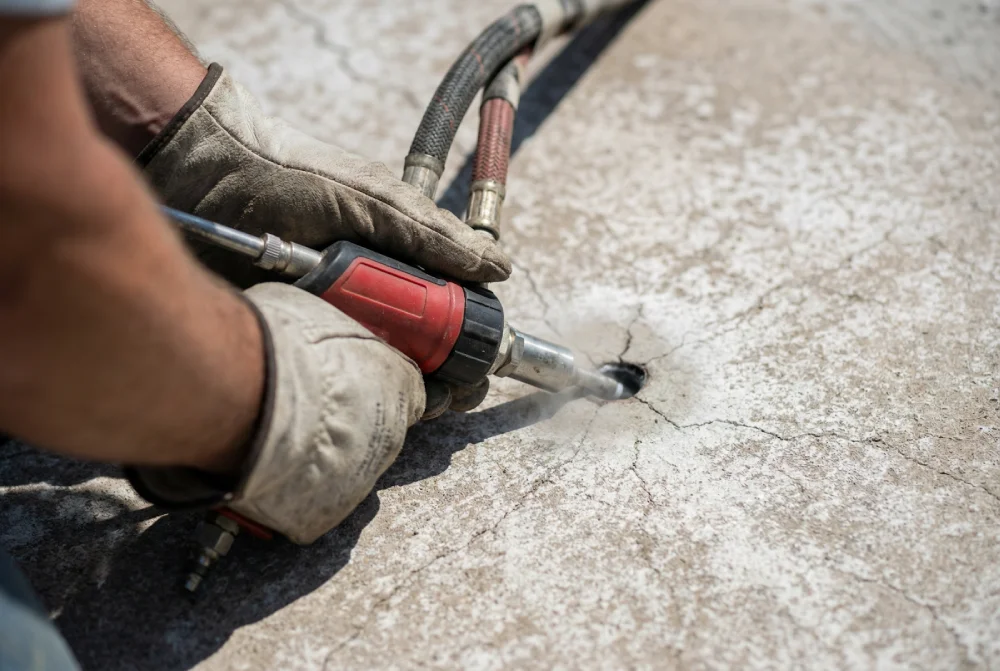
The polyurethane injection grouting process is remarkably streamlined compared to traditional repair methods. Most residential projects complete in a couple of hours, and the surface can support foot and vehicle traffic almost immediately after the job is done.
Assessment and Planning
A technician inspects the concrete surface to determine the extent of settling, identify problem areas, and map the best injection points. This assessment establishes the lift plan that guides the entire job. The technician evaluates slab thickness, the degree of settlement, the condition of surrounding soil, and any factors that could affect the injection process. For commercial and industrial applications, this assessment may include ground-penetrating radar or other subsurface imaging to map void locations precisely.
Drilling Injection Holes
Small holes, typically 5/8 inch in diameter and roughly the size of a dime, are drilled into the concrete slab at predetermined strategic locations. Injection ports are then installed into the holes. These ports serve as access points for foam delivery and provide backup protection against backflow.
The small hole size is a significant advantage over mudjacking, which requires holes approximately 2 inches in diameter, roughly the size of a soda can. Smaller holes mean less surface disruption, faster patching, and a cleaner finished appearance.
Foam Injection
Dual-component polyurethane foam is injected through the ports using specialized high-pressure equipment. The two components travel through separate heated hoses and mix inside the injection gun at the nozzle, reacting immediately upon entering the void beneath the slab.
The foam initially enters the void in liquid form, flowing easily into small gaps and crevices that heavy cement slurry used in mudjacking could never reach. As the chemical reaction proceeds, the foam rapidly expands to fill the space. The expanding foam compacts loose soils beneath the slab and generates upward hydraulic pressure that gradually raises the concrete. Throughout injection, pressures, material flow rates, and mix ratios are closely monitored to maintain structural integrity.
Precision Leveling
As foam expansion lifts the slab, the technician monitors the rise using levels or laser sensors to ensure accurate positioning, often achieving precision within 1/8 inch of the target elevation. Once the slab reaches the desired height, injection stops. This level of control is what makes polyurethane foam injection suitable for precision applications like warehouse floors where equipment operation depends on perfectly level surfaces.
Finishing
After lifting is complete, the small injection holes are patched with concrete grout or a matching sealant that hardens to become nearly imperceptible. The foam cures to approximately 95% of its final strength within 15 to 20 minutes, meaning the surface can typically support foot and vehicle traffic almost immediately. A typical residential poly jacking project takes just a couple of hours to complete, compared to days for traditional methods.
Equipment and Technology
The equipment used in polyurethane concrete lifting is purpose-built for precision and reliability. Each component in the system plays a specific role in delivering the right material at the right pressure to the right location.
Proportioners are the workhorses of the operation. These plural-component hydraulic pumps store and heat the A and B components separately, then pump them at calibrated ratios through heated hoses to the injection gun. Models range in output from 28 to 55 pounds per minute and feature temperature sensors, pressure gauges, and auto-calibrators that maintain exact flow ratios throughout the job.
Injection guns come in two main types: air-purge and mechanical-purge. Mechanical-purge guns are preferred because a valving rod physically clears the mixing chamber after each shot, preventing crossover and clogging that would compromise foam quality.
Injection ports and packers are small fittings inserted into the pre-drilled holes that create a sealed connection between the gun and the subsurface void. The seal prevents backflow and ensures all material reaches the target area beneath the slab.
Some systems are compact enough to fit in the back of a pickup truck, making the technology accessible for smaller contractors and tight residential jobsites where large equipment cannot maneuver.
| Equipment Component | Function | Key Specifications |
| Proportioner | Stores, heats, and pumps A and B components at calibrated ratios | 28 to 55 lbs/min output, temperature sensors, auto-calibration |
| Mechanical-purge injection gun | Mixes components at nozzle, clears mixing chamber between shots | Valving rod prevents crossover and clogging |
| Heated hoses | Maintains material temperature during delivery | Separate hoses for each component |
| Injection ports/packers | Creates sealed connection between gun and subsurface void | Prevents backflow, fits 5/8-inch drilled holes |
| Laser levels/sensors | Monitors slab elevation during lifting | Precision within 1/8 inch |
Material Properties and Strength
Despite being lightweight, cured polyurethane foam demonstrates structural properties that make it suitable for applications ranging from residential sidewalks to airport runways. The material's performance comes from its closed-cell structure, where each cell is a sealed, gas-filled unit that provides both compressive strength and water resistance.
| Property | Specification |
| Compressive strength | 30 to 200+ PSI depending on density |
| Density range | 2.0 to 8.0 PCF (pounds per cubic foot) |
| Load capacity | 5,000 to 14,000 lbs per square foot |
| Expansion ratio | 15 to 25x original liquid volume |
| Cure time to 90% strength | Approximately 15 minutes |
| Water absorption | Less than 1% (closed-cell formulations) |
Standard 4 PCF foam achieves approximately 100 PSI compressive strength, while premium 6 PCF formulations reach around 150 PSI. For heavy industrial applications such as warehouses, airport runways, and highways, specialized high-density foams support up to 14,000 pounds per square foot.
The closed-cell structure is critical to long-term performance. Because each cell is sealed and gas-filled, the foam blocks water infiltration, making the cured material effectively hydrophobic. This means it maintains structural integrity even in high water table environments or saturated soils where traditional cement-based grouting methods would absorb moisture and deteriorate. For properties dealing with water-related soil issues, polyurethane grout injection provides a permanent solution that won't wash away or break down over time.
Polyurethane Foam Injection vs. Mudjacking
Property owners evaluating concrete repair options frequently compare polyurethane foam injection against mudjacking, the older and less expensive alternative. While both methods raise sunken concrete, the materials, process, and long-term outcomes differ significantly.
Material weight is the most consequential difference. Mudjacking pumps a heavy cement, water, sand, and soil slurry beneath the slab at over 100 pounds per cubic foot. Polyurethane foam weighs just 2 to 8 pounds per cubic foot. Adding heavy material to already weakened soil is the primary reason mudjacked slabs frequently re-settle within 2 to 5 years, the added mass further compresses the compromised soil beneath. Concrete lifting foam avoids this problem entirely by providing structural support without significant weight.
Precision and control favor polyurethane injection. Foam expansion can be monitored and controlled to achieve leveling within 1/8 inch, while mudjacking's heavy slurry is significantly harder to control with the same accuracy. For commercial applications where equipment operation requires perfectly level floors, this precision matters.
Cure time and disruption differentiate the two methods dramatically. Polyurethane foam cures to usable strength in 15 to 20 minutes, allowing foot and vehicle traffic the same day. Mudjacking requires up to 24 hours of cure time before the surface can bear load.
Longevity tilts toward polyurethane. Because the foam is hydrophobic, lightweight, and chemically inert, it maintains its structural properties for 10 to 15 years or more. Mudjacking's cement slurry absorbs moisture, can erode over time, and typically lasts 2 to 5 years before re-settlement occurs.
Upfront cost is mudjacking's primary advantage. The materials and equipment are less expensive, making the initial price point lower. However, when factoring in mudjacking's shorter lifespan and the likelihood of repeat repairs, polyurethane foam injection often delivers lower total cost of ownership over a 10-year horizon.
Environmental Considerations
Polyurethane foam concrete lifting aligns with several sustainability principles that matter for environmentally conscious property owners and commercial operators managing corporate sustainability goals.
Many modern foam formulations contain 39 to 49% renewable and recycled materials. Some manufacturers use biobased raw materials certified by the USDA as alternatives to petroleum-derived components, reducing the product's environmental footprint at the manufacturing level.
Repairing existing concrete rather than demolishing and replacing it significantly reduces construction waste sent to landfills. A typical driveway replacement generates thousands of pounds of concrete rubble. Polyurethane injection generates virtually zero demolition waste while achieving equal or superior structural results.
Once fully cured, polyurethane foam is chemically inert. It does not leach into groundwater and is VOC-exempt, meaning it poses no ongoing environmental risk to surrounding soil or water systems. The small injection holes and absence of heavy excavation equipment mean surrounding landscaping, gardens, and structures remain largely undisturbed during the repair process.
The process also generates minimal carbon emissions compared to full concrete replacement. Manufacturing new concrete is one of the most carbon-intensive industrial processes in construction. Avoiding replacement by lifting existing slabs with polyurethane foam represents a meaningful reduction in the project's overall carbon footprint.
Common Applications
Polyurethane foam injection is used across residential, commercial, and industrial settings. The versatility of the technology comes from the ability to formulate foams at different densities and reaction speeds for each specific application.
Residential applications include driveways, sidewalks, patios, pool decks, garage floors, and front stoops. These projects typically use lightweight 2.0 to 3.0 PCF formulations that provide adequate support for pedestrian and passenger vehicle traffic while keeping costs reasonable.
Commercial applications cover warehouse and retail floors, loading docks, parking garages, and building foundations. These projects demand higher-density formulations at 4.0 PCF and above to support heavy equipment, forklift traffic, and sustained commercial loads.
Infrastructure and industrial applications include highway and road slab stabilization, airport runways and taxiways, bridge approach slabs, and DOT-grade projects. These applications require the highest-density formulations and the most precise injection control, often involving ground-penetrating radar and engineering oversight.
Void filling and soil stabilization extends beyond slab lifting to include filling voids beneath structures, abandoned pipes, tanks, and tunnels. Filling voids with polyurethane prevents further soil migration and provides permanent structural support in locations where traditional excavation and backfill would be impractical or prohibitively expensive. For projects requiring pressure grouting methods beyond polyurethane, a range of grouting techniques exists to address different subsurface conditions.
Limitations and Considerations
While polyurethane foam injection is highly effective for most concrete settling scenarios, it does have practical boundaries that property owners should understand before committing to the method.
Higher upfront cost compared to mudjacking reflects the advanced materials and specialized equipment involved. However, the longer lifespan and reduced likelihood of repeat repairs often make poly injection the more cost-effective choice over a 10-year period.
Expansion control requires skilled operators. Because the foam reaction produces heat and rapid expansion, there is a risk of over-lifting if too much material is injected. Experienced technicians carefully monitor and control the injection process to prevent this, but the margin for error is smaller than with slower-reacting materials.
Severely damaged slabs may not be candidates for lifting. If the concrete is crumbled, heavily cracked through multiple sections, or structurally compromised beyond surface-level settling, full replacement may be the only viable option. A professional assessment determines whether the slab's condition allows for successful lifting.
Professional expertise is essential. While DIY kits exist, proper polyurethane concrete lifting demands commercial-grade equipment and trained operators to ensure correct mixing ratios, injection control, and leveling accuracy. Improper application can cause over-lifting, uneven results, or material waste. Working with an experienced concrete lifting service ensures the job is done safely and correctly the first time.
Key Takeaways
- Polyurethane foam injection uses a two-component chemical reaction between isocyanate and polyol that generates a closed-cell, hydrophobic foam expanding 15 to 25 times its liquid volume, curing to 95% strength in 15 to 20 minutes
- The process requires only 5/8-inch holes compared to mudjacking's 2-inch holes, and most residential projects complete in hours with the surface ready for foot and vehicle traffic the same day
- Foam weighs 2 to 8 pounds per cubic foot versus mudjacking's 100+ pounds, eliminating the re-settlement risk caused by adding heavy material to already weakened soil
- Material properties range from 30 to 200+ PSI compressive strength and 5,000 to 14,000 pounds per square foot load capacity, making it suitable for everything from residential sidewalks to airport runways and DOT-grade highway projects
- Closed-cell structure absorbs less than 1% water, maintaining structural integrity in saturated soils and high water table environments where cement-based methods would deteriorate
- Formulations containing 39 to 49% renewable and recycled materials combined with zero demolition waste and minimal carbon emissions make polyurethane injection the most sustainable concrete repair option available
Conclusion
Polyurethane foam injection represents a significant leap forward from traditional concrete repair methods. By harnessing a precise chemical reaction to generate controlled expansion and lift, this technology delivers faster repairs, longer-lasting results, and less environmental disruption than mudjacking or full slab replacement. The combination of lightweight material, hydrophobic closed-cell structure, and precision leveling capability makes it the leading method for modern concrete stabilization and leveling across residential, commercial, and industrial applications.
Whether you're dealing with a settled driveway, an uneven warehouse floor, or a highway slab that needs stabilization, the science behind polyurethane injection provides a solution that addresses the root cause of settlement rather than just masking the symptoms. The foam fills the voids, compacts the soil, and lifts the concrete, all in a process that takes hours instead of days and lasts years instead of months.Ready to restore your settled concrete with proven polyurethane foam technology? Contact our team for a professional assessment and lift plan tailored to your property.