

How Strong is Cellular Concrete for Houston Projects?
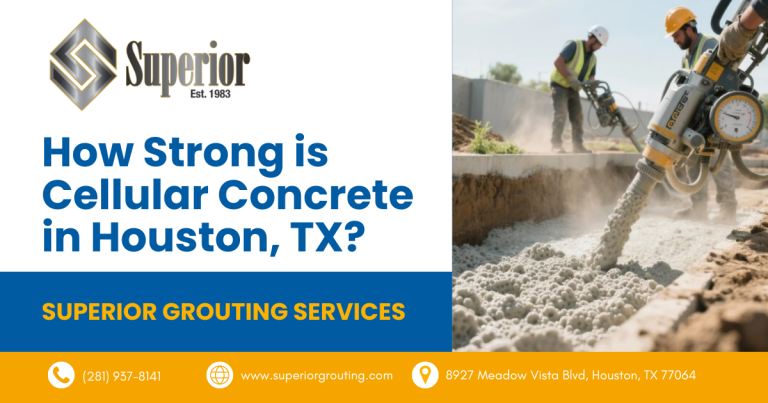
Cellular concrete delivers compressive strength from 0.5 MPa at ultra-light 400 kg/m³ density up to 15-25 MPa at 1,400-1,600 kg/m³ density, with a near-linear relationship between density and strength. For Houston geotechnical applications including void filling, soil stabilization, pipeline support, and concrete leveling, formulations between 2 and 5 MPa cover most project requirements. Site-specific design must account for subsurface conditions, groundwater contact, and the Gulf Coast's chloride exposure.
Cellular concrete is a lightweight material made from Portland cement, water, and preformed foam that is increasingly used for geotechnical applications like void filling, soil stabilization, and infrastructure repair. If you are considering it for a project in Houston, you are probably wondering whether it is strong enough to handle the demands of subsurface work, how it holds up in our humid climate with occasional freeze-thaw cycles, and what strength trade-offs you will face compared to traditional concrete.
This article breaks down the compressive strength ranges cellular concrete can achieve, how density affects performance, and what makes it suitable, or not, for your specific infrastructure needs. The framework below reflects what Superior Grouting has learned across four decades of cellular concrete placement on Gulf Coast projects.
Understanding Cellular Concrete Compressive Strength
Cellular concrete strength varies widely depending on its density and formulation. Compressive strength ranges from 0.5 MPa for ultra-lightweight mixes at 400 kg/m³ to 15-25 MPa for high-density formulations at 1,400-1,600 kg/m³. This inverse relationship between density and strength gives engineers flexibility to design solutions that balance load-bearing capacity with weight constraints.
For concrete lifting and leveling applications common in Houston's industrial facilities, formulations achieving 2-5 MPa provide effective performance. These medium-strength mixes deliver adequate structural support without adding the significant dead load that traditional concrete would introduce.
Strength development follows a similar pattern to conventional Portland cement, with rapid gains during the first 7-28 days and gradual increases over longer curing periods. Houston specifications generally lean on documented mix designs from established cellular grouting services rather than untested field formulations.
The American Concrete Institute's ACI 523.3R-14 guide for cellular concretes above 50 lb/ft³ documents the typical density range of 20 to 120 lb/ft³ (320 to 1,920 kg/m³) and the design parameters that govern strength outcomes. ACI 523.1R-06 covers cast-in-place low density cellular concrete below that threshold. Both documents are starting points for any Houston specification work.
Table 1: Compressive Strength by Density Range
| Density (kg/m³) | Density (lb/ft³) | Typical Compressive Strength | Common Houston Applications |
| 400-600 | 25-37 | 0.5-2 MPa | Annular fill, abandonment grouting, ultra-light fills |
| 600-1,000 | 37-62 | 2-5 MPa | Void filling, concrete lifting, settlement remediation |
| 1,000-1,400 | 62-87 | 5-15 MPa | Structural fills, load-bearing applications |
| 1,400-1,600 | 87-100 | 15-25 MPa | Heavy structural fills, foundation applications |
| Traditional concrete (reference) | 145-150 | 20-40 MPa | Heavy structural, abrasion-critical surfaces |
Beyond Compressive Strength: Other Mechanical Properties
While compressive strength receives the most attention, other mechanical properties matter for specific applications. Tensile strength runs 0.3-1.0 MPa for medium-density formulations, which limits suitability for applications with bending stresses or thermal cycling. Flexural strength reaches 0.5-2.0 MPa depending on density and reinforcement strategies.
Modulus of elasticity falls in the 3-10 GPa range for lower-density mixes, increasing to 10-15 GPa for high-density (compared to 25-35 GPa for conventional concrete). Shear strength is 1-3 MPa for medium-density applications, adequate for fill and stabilization work.
The lower modulus of elasticity compared to traditional concrete actually provides an advantage in certain scenarios. This flexibility allows the material to accommodate dimensional changes and differential movement without cracking, particularly useful in Houston's challenging subsurface conditions where expansive clays and groundwater fluctuations cause measurable movement over time.
How Houston's Climate Affects Performance
Houston's subtropical environment creates unique challenges for construction materials. Hot, humid summers exceeding 35°C, mild winters with occasional freezing, annual rainfall exceeding 1,300mm, and average humidity of 65-75 percent all impact long-term durability.
The high porosity of foam concrete creates greater surface area exposure for moisture ingress compared to conventional concrete. This necessitates protective barriers, quality sealants, and thoughtful drainage design in most applications. Salt-laden coastal environments introduce additional chloride exposure risks for infrastructure near marine areas, including ship channel facilities, port terminals, and refinery operations along the Gulf Coast.
Temperature cycling creates differential thermal stresses, though the material's lower modulus of elasticity permits greater dimensional accommodation than rigid alternatives. Houston's thick quaternary sediment deposits, compressible clay formations, and extensive groundwater systems require careful consideration of sustained moisture contact during design and installation. Sites near Buffalo Bayou, the Houston Ship Channel, or San Jacinto River drainages face the most demanding moisture conditions.
Key Applications in Houston Infrastructure
Underground Utilities and Tunneling
Rapid tunnel backfilling and void remediation beneath active infrastructure benefit from cellular concrete's lightweight nature. The material reduces structural loads on existing underground infrastructure, critical in Houston's complex subsurface utility network. This controlled density approach prevents excessive overburden pressures while still providing structural support.
Oil and Gas Pipeline Infrastructure
Post-grout systems for subsurface voids or settlement threats around pipelines require careful material selection. Controlled density formulations, typically 600-1,200 kg/m³, provide adequate load support while minimizing dense overburden pressures that could create differential loading and pipeline stress. Proper material selection prevents costly pipeline damage and service interruptions across the energy corridor.
Concrete Leveling and Lifting
Self-leveling characteristics and controlled density enable accurate final elevations for industrial facilities experiencing settlement problems. Rapid 24-48 hour production capacity minimizes operational downtime, a critical factor for manufacturing and processing facilities. Lower heat generation during hydration proves advantageous in industrial environments where thermal shock could damage sensitive equipment or existing structures.
Soil Stabilization and Sinkhole Remediation
Shallow sinkholes from subsurface dissolution, collapsed utilities, or subsurface voids require effective remediation strategies. The material's controlled density, workability, and strength development enable efficient void filling. With proper interfacial preparation, the material bonds well with surrounding soils and existing infrastructure.
Void Filling Beneath Foundations
Foundations experiencing subsurface voids need support without additional loading that could worsen settlement. Controllable density enables engineers to specify materials that provide structural support while minimizing stress on already-compromised foundation systems. The low exothermic reaction reduces thermal shock risks on existing structures during installation. Cellular concrete is one of several methods used in subsurface void remediation, each suited to different geometries and load conditions.
Table 2: Application-to-Density Match
| Application | Recommended Density (kg/m³) | Target Strength | Why This Range |
| Pipeline annular fill / abandonment | 400-800 | 0.5-2 MPa | Minimal overburden, full void contact |
| Tunnel backfill | 600-1,000 | 2-4 MPa | Load support without surface heave |
| Sinkhole / void fill (shallow) | 600-1,200 | 2-5 MPa | Structural support without re-loading collapse zone |
| Pipeline support / soil stabilization | 800-1,200 | 3-7 MPa | Distributes load without inducing settlement |
| Concrete leveling under industrial slabs | 1,000-1,400 | 5-12 MPa | Bears equipment loads, restores grade |
| Heavy structural fill | 1,400-1,600 | 15-25 MPa | Approaches traditional concrete bearing capacity |
Comparing Cellular Concrete to Alternative Solutions
Understanding how lightweight foamed concrete compares to other materials helps engineers and facility managers make informed decisions. Traditional concrete delivers higher compressive strength (25-40 MPa) but at much higher density (2,300-2,400 kg/m³). This additional weight creates problematic loads in subsurface applications and can worsen settlement issues rather than resolve them.
Aggregate fill offers lower material costs but provides no strength contribution. It requires careful compaction, offers no self-leveling properties, and lacks the adhesive bonding that prevents future void formation. Polyurethane grout provides rapid setting and expansive properties useful in certain applications. However, substantially higher costs, limited compressive strength (1-5 MPa), and chemical sensitivity concerns restrict its use to specific scenarios.
Epoxy injection works well for precision applications but faces limitations from viscosity constraints. Achieving complete void fill in heterogeneous subsurface conditions proves challenging, and costs significantly exceed cement-based alternatives.
Table 3: Cellular Concrete vs. Alternative Methods for Subsurface Work
| Method | Density / Weight Impact | Compressive Strength | Best Use Case | Limitations |
| Cellular concrete | 400-1,600 kg/m³ | 0.5-25 MPa | Lightweight fill, void remediation, leveling | Moisture ingress, requires protective coatings |
| Traditional concrete | 2,300-2,400 kg/m³ | 25-40 MPa | High-load surfaces, abrasion zones | Adds load, can worsen settlement |
| Aggregate / engineered fill | Variable | None (compacted only) | Bulk fill where compaction is feasible | No bonding, requires compaction effort |
| Polyurethane grout | Low | 1-5 MPa | Rapid leveling, leak control | High cost, chemical sensitivity |
| Epoxy injection | Low | 30-100 MPa (cured) | Precision crack and joint repair | Viscosity limits void filling, very high cost |
Long-Term Durability and Performance Expectations
Properly installed cellular concrete systems maintain structural and physical integrity across decades of service. Field performance data from Houston and the Gulf Coast demonstrates that well-designed systems maintain integrity across 10, 20, and 30+ year service periods.
Susceptibility to moisture ingress requires protective coatings, typically epoxy or polyurethane sealers, for exposed surfaces. Freeze-thaw durability strategies, including air-entrainment techniques, address Houston's occasional freezing temperatures. Sulfate-resistant Portland cement (Type V) can be specified for sulfate-prone soil conditions common in certain Gulf Coast areas, particularly near abandoned saltwater disposal zones and along coastal terraces with marine sediment exposure.
Subsurface elements in stable, anaerobic conditions show minimal chemical degradation over time. The material's performance in Houston's challenging environment, when properly designed and installed, rivals or exceeds conventional solutions while offering significant weight and installation advantages. Closeout documentation should include mix design records, density verification logs, compressive strength test results from cast specimens, and post-placement elevation verification where applicable.
Key Takeaways
- Cellular concrete delivers compressive strength from 0.5 to 25 MPa depending on density. Medium-strength formulations (2-5 MPa) handle most Houston geotechnical applications like void filling and soil stabilization without adding excessive weight to compromised subsurface structures.
- The material weighs 400-1,600 kg/m³ compared to traditional concrete at 2,300-2,400 kg/m³, making it ideal for subsurface work where additional loading could worsen settlement or stress existing infrastructure like pipelines and foundations.
- Houston's humid climate (65-75 percent humidity, 1,300mm+ rainfall) requires protective sealants and proper drainage design since the material's high porosity allows moisture ingress that can compromise long-term durability without proper barriers.
- Moisture management determines success. Specify sulfate-resistant cement for Houston's soil conditions, ensure proper curing protocols in warm temperatures, and use protective coatings on exposed surfaces to achieve the 20-30+ year service life the material can deliver.
- Rapid strength development (24-48 hours) minimizes downtime for industrial facilities, but lower tensile and flexural strength (0.3-2.0 MPa) means careful engineering is essential for applications with bending stresses or significant thermal cycling.
- Site-specific evaluation matters. Groundwater levels, soil chemistry, placement depth, and exposure conditions all require customized mix designs and installation protocols to prevent premature failure in Houston's variable subsurface conditions.
Critical Factors for Successful Applications
Selecting and installing the right mix design requires careful consideration of multiple factors. Subsurface conditions including soil stratigraphy, groundwater levels, chemical composition of pore fluids, and existing bearing capacity all influence formulation decisions. Houston's variable geology, ranging from Beaumont clay to Lissie Formation sands, demands site-specific evaluation rather than off-the-shelf specifications.
Placement depth affects performance requirements. Shallow applications (5-10m) experience different stress and moisture conditions than deep subsurface installations, requiring adjusted density and strength specifications. Environmental exposure varies significantly between coastal and inland locations, and between contaminated and clean subsurface environments. Chemical barriers and protective measures must match the specific exposure conditions.
Mix optimization balances water-cement ratio for strength while maintaining workability. Foam quality and stability ensure uniform pore distribution throughout the placement. These technical details separate successful long-term installations from premature failures. Curing protocols must account for Houston's warm ambient temperatures (25-35°C), which accelerate hydration but require careful moisture management. Proper curing prevents premature drying and ensures full strength development.
Quality verification at the placement is non-negotiable on agency and corporate projects. Wet-cast density readings at the discharge point, plastic and hardened compressive strength specimens, and continuous documentation of pump pressures and flow rates create the audit trail that engineers of record require for acceptance.
Attention to these critical selection factors ensures reliable, long-lasting results for government agencies and large corporations across Houston and the Gulf Coast. Engagement with a specialty contractor early in design, not at bid time, generally produces both better technical outcomes and better cost outcomes.
Conclusion
Cellular concrete strength is not a single number. It is a design range that competent engineering matches to subsurface conditions, load requirements, and exposure environment. For most Houston geotechnical applications, the 2-5 MPa range covers void filling, leveling, and soil stabilization. Higher-strength applications (15-25 MPa) approach traditional concrete bearing capacity at a fraction of the dead load. Lower-strength applications (0.5-2 MPa) handle annular fill and abandonment grouting where minimal overburden matters most.
Superior Grouting in Houston brings four decades of geotechnical expertise to the Gulf Coast, helping commercial, industrial, and government clients match material strength to real-world performance needs. Call 281-937-8141 to request a project consultation and get a custom solution designed for long-term reliability.
Schedule an estimate today.
Match cellular concrete density to project demands.