

How to Fix No Vapor Barrier Under Concrete Slab in Beaumont, TX?
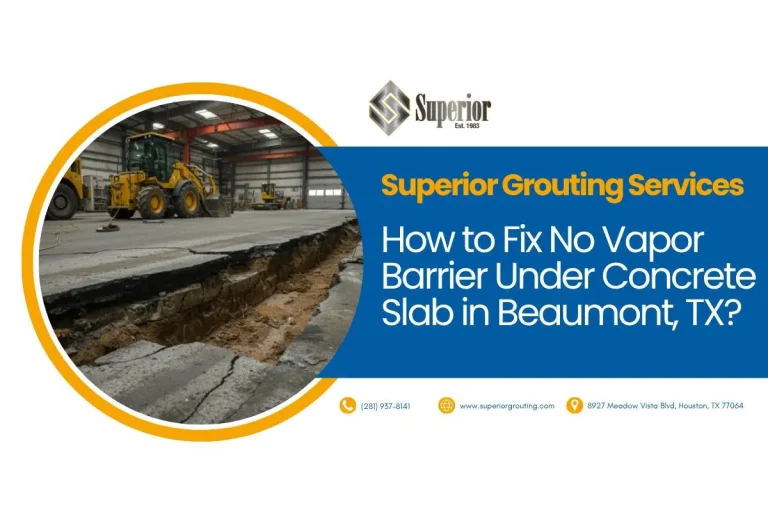
Commercial and industrial slabs poured without a vapor barrier allow ground moisture to wick continuously upward through the concrete, damaging flooring systems, adhesives, coatings, and indoor air quality. In Beaumont, TX, where clay soils, high groundwater, and year-round humidity create aggressive moisture conditions, a missing underslab vapor barrier virtually guarantees long-term facility damage. Several retrofit solutions exist, ranging from surface sealers to full perimeter drainage systems, each matched to specific moisture severity levels.
If you manage a commercial or industrial facility in Beaumont, TX, persistent moisture problems beneath your concrete slab represent both a structural and operational risk. Warped flooring, coating delamination, adhesive failure, and mold growth all trace back to the same root cause: moisture migrating upward through unprotected concrete. This guide covers how to identify the problem, measure its severity, and select the right void fill and moisture management solution for your facility's specific conditions.
Key Takeaways
- Beaumont's humid subtropical climate, expansive clay soils, and high groundwater make facilities without underslab vapor barriers especially vulnerable: Consistent dew points above 70°F create aggressive vapor pressure gradients, while clay soils actively pump moisture toward slab bases during wet periods.
- Proper moisture testing (ASTM F2170 RH test) costs $200 to $600 but is essential before choosing a remediation solution: Most flooring and coating warranties require documented testing. A slab that feels dry on the surface can harbor moisture levels of 80 to 95% RH at mid-depth.
- Sheet-applied polyethylene barriers ($1.00 to $2.00/sq ft) offer the best moisture protection at the lowest cost: They raise floor height slightly, which may create transition issues in facilities with tight clearance requirements or adjacent equipment.
- Liquid-applied epoxy or polyurea barriers ($4.00 to $7.00/sq ft) avoid elevation changes but require surface preparation that represents 30 to 50% of total project cost: Skipping or shortcutting surface prep is the single most common cause of coating delamination and project failure.
- Exterior moisture management is a critical complement to any interior barrier system: Proper site grading, functional drainage, and downspout control cost $500 to $3,000 but determine long-term barrier performance. Without addressing exterior water sources, interior solutions will underperform.
- Reactive remediation after coating or flooring failure costs 4 to 10 times more than proactive installation: For a 5,000 square foot industrial floor, reactive repair costs can reach $85,000 compared to $25,000 to $35,000 for a proactive moisture barrier installed correctly the first time.
How Moisture Moves Through Unprotected Concrete
Concrete is a fundamentally porous material containing interconnected capillaries, the microscopic channels through which water naturally travels. When no vapor barrier separates the concrete from the soil below, moisture moves through the slab via two distinct mechanisms.
Capillary action allows liquid water to wick upward through the pores, much like a sponge absorbing water from below. Vapor diffusion occurs simultaneously, with water vapor migrating from areas of higher moisture concentration in the soil toward drier areas above the slab. These two processes work together to create a continuous moisture pathway from the ground into the facility.
Why Beaumont's Conditions Accelerate the Problem
Beaumont sits in a humid subtropical climate with consistent dew points exceeding 70°F for much of the year. This raises the vapor pressure gradient that forces water vapor into concrete pores, creating more aggressive moisture migration than facilities in drier climates experience.
The underlying soil consists largely of expansive clay deposits that expand and contract with seasonal moisture changes. These clay soils actively pump ground moisture toward the base of slabs during wet periods, creating additional upward pressure on the concrete. Beaumont's intense spring and summer rainfall keeps the effective water table high even in years when the static water table measurement is well below the slab, meaning facilities are exposed to moisture stress for extended periods throughout the year.
Identifying Moisture Problems in Commercial and Industrial Slabs
Before selecting a remediation strategy, confirm that moisture is actively migrating through the slab and measure the severity. Visual indicators alone are insufficient for specifying the correct solution.
Field Assessment Methods
The plastic sheet test is a reliable first-pass field indicator. Place a clear 2-foot by 2-foot sheet of plastic directly on the slab surface, tape all edges securely, and observe after 24 to 48 hours. Condensation on the underside indicates active moisture migration.
Efflorescence, the white powdery or crystalline residue that appears on slab surfaces or at wall-slab junctions, represents mineral salts deposited as moisture wicks through the concrete and evaporates at the surface. In industrial settings, efflorescence under coated or tiled floors causes progressive delamination that worsens under traffic.
Other field indicators relevant to commercial and industrial facilities include:
- Coating or epoxy floor system delamination, bubbling, or blistering
- Adhesive bond failure beneath flooring systems or equipment pads
- Musty odors in enclosed facility areas with concrete floors
- Visible mold or mildew growth along baseboard and wall-slab junctions
- Joint sealant failure at control joints and saw cuts
ASTM Moisture Testing Standards
Two ASTM-standardized test methods quantify slab moisture levels before remediation or flooring installation.
The Calcium Chloride test (ASTM F1869) measures Moisture Vapor Emission Rate (MVER) in pounds per 1,000 square feet per 24 hours. Most coating and flooring manufacturers specify a maximum MVER of 3 pounds per 1,000 square feet over 24 hours. However, this test measures only the top 0.5 to 0.75 inch of the slab and can be misleading when surface conditions differ from mid-slab moisture levels.
The In-Situ Relative Humidity test (ASTM F2170) places probes within the concrete at a specified depth and measures the equilibrium moisture condition that will exist once flooring or coatings are installed. Most industrial coating systems require RH below 75 to 80%. This test is the gold standard for specifying commercial and industrial moisture remediation because it measures the moisture level that actually predicts long-term coating and flooring performance.
Testing costs typically range from $200 to $600 depending on facility size and the number of test locations required.
Testing Method Comparison
| Test Method | Standard | Measures | Depth | Best Use Case |
| Calcium Chloride | ASTM F1869 | MVER (lbs/1,000 sf/24 hr) | Top 0.5 to 0.75 in | Initial screening |
| In-Situ RH | ASTM F2170 | % Relative Humidity | Mid-slab depth | Specification and warranty compliance |
| Visual/Plastic Sheet | Field method | Active moisture presence | Surface | Preliminary field assessment |
Remediation Solutions
Once moisture levels are measured and the severity is confirmed, the appropriate remediation solution can be selected. Match the solution to the measured moisture level, not to the lowest-cost option.
Sheet-Applied Polyethylene and HDPE Vapor Barriers
A 10 to 20 mil thick polyethylene or HDPE sheet is rolled out over the existing slab, with seams overlapped by at least 6 to 8 inches and sealed with vapor barrier tape. This creates a continuous moisture barrier between the slab and the new flooring or coating system.
Sheet barriers deliver the lowest water vapor permeance (0.01 perms or lower), act as both a moisture barrier and a crack isolation layer, and can be installed with minimal surface preparation. The primary drawback for industrial applications is the elevation increase of approximately 0.25 inch, which may create clearance issues at equipment connections, dock levelers, or adjacent floor transitions.
Cost: $1.00 to $2.00 per square foot for materials and installation labor.
Liquid-Applied Epoxy and Polyurea Moisture Barriers
Thick-film epoxy or polyurea coatings are sprayed or rolled onto the slab surface at 20 to 30 mils dry thickness. These systems meet ASTM F3010 standards and create a moisture barrier without raising the floor elevation, which is critical in most industrial and commercial settings.
Polyurea-based barriers cure in as little as 6 hours compared to 12 to 24 hours for epoxy, which is a meaningful operational advantage for facilities that cannot sustain extended floor downtime. Seamless coverage eliminates the joint vulnerability that sheet-based systems present at seam locations. For facilities also dealing with sub-slab voids alongside moisture issues, polyurethane grouting can address both problems in a coordinated treatment sequence.
Surface preparation is non-negotiable for liquid-applied systems. The concrete must be mechanically profiled to Concrete Surface Profile (CSP) #2 via grinding or CSP #3 via shot blasting to remove sealers, curing compounds, laitance, and contaminants. Surface preparation alone costs $0.75 to $1.50 per square foot and represents 30 to 50% of total project cost.
Cost: $4.00 to $7.00 per square foot installed, including surface preparation, primer, and barrier application.
Silicate-Based Penetrating Sealers and Crystalline Systems
Penetrating sealers based on lithium or potassium silicates chemically react with calcium hydroxide and free lime in the concrete to form calcium silicate hydrate crystals within the concrete pores, densifying the concrete structure and reducing moisture transmission.
Crystalline waterproofing systems offer a self-healing characteristic: when micro-cracks develop in the concrete over time, water entering those cracks reactivates remaining crystalline chemicals, which continue forming new crystals to seal the crack. This makes them suitable for slabs subject to thermal cycling or minor movement.
These systems are the most economical option for mild to moderate moisture problems (below 85% RH) and require no floor elevation change. They are not appropriate for high-moisture industrial applications above 90% RH.
Cost: $0.50 to $1.50 per square foot for materials and application.
Solution Selection by Moisture Severity
| Moisture Level (RH) | Recommended Solution | Typical Cost Range |
| Below 75% | Penetrating sealer | $0.50 to $1.50/sq ft |
| 75 to 85% | Sheet barrier or enhanced sealer | $1.00 to $2.50/sq ft |
| 85 to 95% | Liquid-applied epoxy or polyurea | $4.00 to $7.00/sq ft |
| Above 95% | Interior drainage + liquid barrier | $8.00 to $15.00/sq ft |
Interior Drain Tile Systems for Severe Moisture Conditions
For industrial facilities with severe moisture problems, including active water infiltration or exterior drainage that cannot be improved, an interior perimeter drain system may be required before any barrier installation will be effective.
An interior perimeter drain consisting of perforated PVC or corrugated pipe is installed along the base of the foundation wall, typically by cutting a 12-inch wide trench around the interior perimeter, installing drain pipe, and connecting to a sump pump. A dimple membrane installed between the foundation wall and the drain system captures moisture and directs it into the drain rather than allowing it to migrate through the slab.
Interior drainage combined with a sump pump system can reduce moisture infiltration into the slab by 40 to 60%. For heavily loaded industrial floors subject to hydrostatic pressure, this perimeter control is a prerequisite for long-term barrier performance.
Cost: $3.00 to $8.00 per linear foot plus sump pump installation at $800 to $2,000. For a facility with 150 linear feet of perimeter, total investment ranges from $5,000 to $15,000.
Exterior Moisture Management
Even the most robust interior barrier system will underperform if the exterior moisture load is not controlled. Exterior moisture management is a critical and often underbudgeted component of commercial and industrial moisture remediation.
Proper site grading directs surface water away from the building at a slope of at least 1% (approximately 1 foot of drop per 100 feet of horizontal distance). Industrial facilities with paved perimeters should ensure surface drainage routes water to catch basins rather than allowing it to pond at foundation edges.
Gutters and downspouts serving the facility roof must be functional and maintained. Clogged gutters discharge thousands of gallons of water directly against the foundation perimeter during Beaumont's intense rainfall events. Downspout extensions should direct discharge at least 6 to 10 feet from the building.
Additional exterior improvements for industrial and commercial facilities include perimeter French drains, surface swales directing water away from the building footprint, exterior crack sealing along the foundation, and sump pump discharge lines positioned well away from the building. A qualified pressure grouting contractor can assess exterior conditions alongside interior moisture remediation to develop a comprehensive treatment plan. These exterior improvements typically cost $500 to $3,000 depending on site conditions and scope.
Common Mistakes That Cause Remediation Failures
The most expensive moisture remediation failures share a small set of preventable causes. Understanding them before starting a project prevents the 4 to 10x cost multiplier that comes with doing the job twice.
Skipping Surface Preparation
Inadequate surface preparation is the leading cause of liquid-applied barrier delamination. Grinding or shot blasting to the specified CSP profile is not optional. A smooth, sealed, or contaminated surface prevents the coating from bonding to the concrete. Systems installed without proper prep may perform for 30 to 90 days before delaminating under traffic, voiding the manufacturer's warranty and requiring complete removal and reinstallation.
Relying on Surface Appearance
A slab surface that appears and feels dry is frequently wet at depth. The moisture gradient that develops in drying concrete concentrates moisture at mid-depth even when the surface is dry to the touch. The top 0.5 to 1 inch may measure at acceptable moisture levels while mid-slab RH exceeds 85 to 95%. RH probe testing is the only reliable method for specifying the correct system.
Choosing the Wrong Solution for Measured Moisture Levels
Penetrating sealers are appropriate for mild moisture conditions and will fail in high-moisture industrial applications. Sheet barriers provide excellent protection but may be impractical in facilities with tight floor clearance requirements. Liquid-applied systems at high RH may not bond if moisture levels exceed manufacturer specifications. Match the system to the measured data, not to cost preference or prior experience with different site conditions.
Cost Summary for Beaumont Commercial and Industrial Projects
| Remediation Component | Typical Cost Range | Notes |
| ASTM moisture testing | $200 to $600 | Required before specification |
| Surface preparation (grinding/shot blast) | $0.75 to $1.50/sq ft | Required for liquid-applied systems |
| Penetrating crystalline sealer | $0.50 to $1.50/sq ft | Mild moisture only |
| Sheet polyethylene barrier | $1.00 to $2.00/sq ft | Raises floor elevation 0.25 in |
| Liquid epoxy barrier | $4.00 to $7.00/sq ft | Includes surface prep |
| Liquid polyurea barrier | $4.50 to $8.00/sq ft | Faster cure than epoxy |
| Interior perimeter drain | $3.00 to $8.00/linear ft | Severe moisture only |
| Exterior grading and drainage | $500 to $3,000 | Site-dependent |
Conclusion
Moisture migration through unprotected concrete slabs is a managed problem in Beaumont's commercial and industrial sector, not an inevitable condition. The combination of proper ASTM testing, an appropriately specified remediation system, thorough surface preparation, and exterior moisture control produces durable results that protect flooring systems, coatings, and facility operations for decades.
The critical decision point is matching the solution to the measured moisture level. Over-specifying wastes budget. Under-specifying guarantees failure. Professional moisture testing before remediation specification is the investment that makes every subsequent dollar spent on the remediation itself effective.
To discuss moisture barrier options for your Beaumont commercial or industrial facility, call (281) 937-8141 or contact us to schedule an assessment with Superior Grouting.
Schedule your Beaumont moisture barrier assessment today.
Call Superior Grouting to protect your facility floors from slab moisture damage.