

How Long Does Foam Lift Concrete Last in Houston, TX?
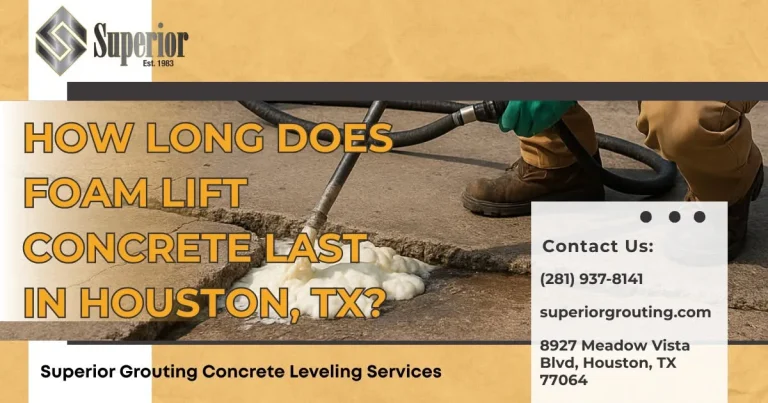
Foam concrete lifting in Houston typically lasts 20 to 40 years or longer when properly installed. High-density polyurethane foam resists water, maintains compressive strength underground, and performs well in commercial and industrial environments when drainage and soil conditions are addressed.
Concrete lifting solutions offer Houston facility managers a reliable way to restore settled slabs without full replacement. The longevity of foam jacking depends on installation quality, site drainage, and underlying soil conditions. A concrete leveling company that understands Houston's unique challenges can help you achieve lasting results.
Houston's demanding environment presents specific challenges for concrete raising services. Expansive clay, frequent saturation cycles, and active subgrade movement all influence how long a leveling job stays true. Understanding these factors helps you plan maintenance budgets and set realistic expectations.
Key Takeaways
- Foam Lifting Delivers Long-Term Performance: High-quality concrete lifting solutions using high-density polyurethane foam commonly deliver durability in the 20–40 year range when installed over stable base layers with proper site management.
- Site Conditions Matter More Than the Material: Although polyurethane foam is waterproof and erosion-resistant, most failures result from subgrade movement, unmanaged runoff, or ongoing soil erosion, not material degradation.
- Installation Quality Determines Success: Proper port layout, controlled injection sequencing, precise lift control, and confirmation of full slab support determine long-term performance.
- Drainage Multiplies Performance: Foam resists washout and remains stable, but water migration beneath the slab can weaken adjacent soils and cause future settlement if drainage issues persist.
- Load Requirements Affect Outcomes: Commercial traffic and heavy loads require uniform support and complete void filling, rather than lifting only the lowest section of the slab.
- Compare Repair Methods Carefully: Mudjacking and foam jacking address similar settlement issues, but in wet Houston subgrades, slurry-based materials can deteriorate over time while polyurethane foam maintains structural integrity.
What Foam Lifting Longevity Means in Houston
When facility managers ask how long concrete lifting lasts, they need a planning number for budgets and maintenance schedules. In Houston, concrete leveling services can last 20 years or more when the slab remains structurally serviceable and subgrade issues receive proper attention.
Understanding longevity requires separating two distinct lifespans. Foam lifespan refers to how long the polyurethane material remains stable beneath the concrete. Quality foam maintains compressive strength for decades because it does not dissolve or soften like cement-based slurry mixtures. Slab stability describes how long the lifted concrete stays at grade without renewed settlement.
A slab lifted with foam can still move again if the site experiences ongoing void formation, cyclic swelling in expansive clay, or continued runoff problems. This means concrete raising foam performs best when subgrade behavior stabilizes and water receives proper management.
Typical Lifespan Ranges and Contributing Factors
| Lifespan Range | Conditions | Common Scenarios |
| 10 to 20 years | Moderate moisture cycling, partial drainage limitations | Sites with seasonal water issues, older drainage systems |
| 20 to 40+ years | Good slab integrity, well-compacted base, corrected drainage | Properly managed commercial facilities |
| Variable (shortened) | Ongoing washout, repeated ponding, poorly compacted fill | Sites with unresolved water intrusion |
Project scope must match the problem for optimal results. A localized depression might require straightforward foam lifting. A slab affected by widespread soil conditions and recurring saturation needs broader stabilization plus a drainage plan.
How Polyurethane Foam Performs Underground
Modern foam jacking uses expanding polymers designed to densify and support concrete without adding excess weight. High-density polyurethane foam provides durability under load, supporting industrial slabs without the added weight of cementitious fills. Its lightweight nature reduces stress on sensitive subgrades. Fast cure times allow stabilization within minutes, reducing downtime and water intrusion risk.
The closed-cell structure makes polyurethane foam waterproof for practical underground exposure. Water can move around the foam through soil pathways, but the material itself does not wash out like some slurry materials. This resistance to water damage contributes significantly to long-term concrete raising services performance.
During injection, foam expands to fill gaps and develop uplift following controlled patterns guided by port layout and injection rate. When properly executed, foam fills voids, improves slab contact, stabilizes zones where support was lost, and raises concrete back toward target elevation.
Houston Soil Conditions and Concrete Leveling Challenges
Houston's mix of soft deposits, clay layers, and high seasonal moisture makes every concrete lifting solution a geotechnical problem. Effective grouting services treat foam injection as targeted stabilization informed by field assessment and local soil behavior.
Expansive clay creates recurring movement challenges throughout the Houston area. These soils swell with moisture and shrink during dry periods, creating voids, edge drop, or isolated settlement over time. Concrete leveling services can mitigate symptoms by filling voids and improving support, but highest longevity occurs when repair scope matches soil behavior.
| Soil Challenge | Impact on Concrete | Mitigation Strategy |
| Expansive clay | Cyclic swelling creates voids | Broader void filling, moisture management |
| Soil erosion | Progressive void formation at joints | Drainage correction, joint sealing |
| Loose fill | Ongoing consolidation beneath slabs | Deep stabilization, load distribution |
| High water table | Persistent subgrade saturation | Improved drainage, waterproof materials |
Soil erosion and washout present another major challenge. When water flows repeatedly along joints or slab edges, it carries fines away and creates enlarging voids. Foam can fill these cavities and stay in place, but site configuration must prevent repeat washout.
Drainage and Water Control for Lasting Results
Foam resists water and does not wash out, but surrounding soil changes dramatically in wet conditions. Runoff entering joints, edges, or low points can soften the subgrade and consolidate soils, leading to new differential settlement around the stabilized zone.
Practical drainage actions protect concrete leveling services investments. Maintain or improve gutter and surface collection systems. Ensure runoff routes do not direct flow toward slab edges. Prevent chronic ponding at low points. Address upstream sources that feed repeated saturation. Managing water preserves the long-lasting results you paid for with your concrete lifting service.
Installation Quality Makes the Difference
A slab can look level yet still have unsupported zones that create future settlement. The best concrete lifting solutions accomplish two goals: raising the slab and restoring uniform contact throughout the affected area.
High-quality foam jacking includes elevation assessment and target lift planning, port layout designed to fill voids rather than just chase the lowest point, controlled injection so expanding foam distributes support rather than creating pressure points, and verification that stabilization extends beyond the visible dip.
Early re-settlement after foam lifting usually indicates unstable conditions rather than foam failure. Common causes include unaddressed void networks, persistent poor drainage, ongoing consolidation in deep loose fill zones, and nearby excavation that changes support conditions.
Foam Jacking Versus Traditional Mudjacking
Both methods fall under concrete repair categories but perform differently in Houston's moisture and soil environment. Traditional mudjacking uses a slurry or grout blend pumped beneath the slab. This mixture can be effective but carries more weight and may be vulnerable to washout paths.
| Factor | Foam Jacking | Traditional Mudjacking |
| Material weight | Lightweight, reduces subgrade stress | Heavier, may compress weak soils |
| Water resistance | Closed-cell foam resists saturation | Slurry can erode in wet conditions |
| Cure time | Minutes to functional strength | Hours to days for full cure |
| Return to service | Same day in most cases | Extended downtime typical |
Foam jacking advantages include lighter material with strong compressive strength, improved performance in wet conditions, reduced risk of adding weight that compresses weak soils, and faster return to service. These benefits make concrete lifting solutions using polyurethane foam compelling for commercial concrete applications.
When Foam Lifting Works Best
Many industrial projects treat slab stabilization as part of broader foundation repair planning. Concrete lifting services using foam provide strong solutions for appropriate applications but do not address every situation.
Foam concrete lifting works ideally when dealing with sunken concrete caused by voids or localized consolidation, when the slab remains intact enough to lift without creating new fractures, when fast return-to-service matters, and when you need a long-term solution resisting water exposure.
Some settlement problems extend beyond slab issues and reflect deeper ground movement. In these cases, broader foundation repair evaluation may indicate structural support systems such as pier solutions. Consider involving geotechnical review when settlement patterns appear widespread or movement recurs despite previous repairs. This improves concrete leveling cost effectiveness by targeting actual problems.
Conclusion
Foam concrete lifting in Houston can last 20 years or more when site water receives proper control and the subgrade achieves stabilization. The durability of closed-cell polyurethane foam typically proves excellent, with the real variables being Houston's active soils and moisture cycles.
For genuinely long-lasting performance, focus on controllable factors. Select the right repair methods, ensure the slab suits lifting, fill voids broadly rather than just the low point, and correct drainage pathways that triggered settlement.
Contact Superior Grouting to discuss your concrete lifting needs and receive a professional assessment of your Houston facility.
Get a concrete lifting assessment today.
Request your free consultation now.