


Polyurethane Foam Curing Time and Reaction Rates: What Determines Project Speed
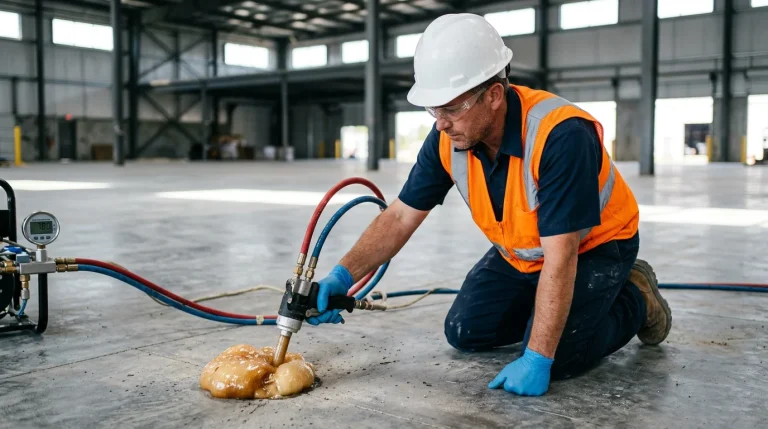
Polyurethane grout cure time is governed by four variables: resin chemistry (hydrophilic or hydrophobic), catalyst ratio, substrate temperature, and ambient moisture. Cream time typically runs 5 to 30 seconds; rise completes in 30 seconds to 3 minutes; a tack-free surface develops within 5 to 15 minutes; and full chemical cure is reached between 1 and 24 hours, depending on formulation and field conditions.
The most common question from project managers scheduling a polyurethane grouting operation is not about injection pressure, port spacing, or material cost. It is about time. How long before traffic can return? How long before the equipment is repositioned? How long before the next lift can begin? The answer determines the critical path of the entire rehabilitation.
The curing time of polyurethane foam is not a single number. It is a sequence of chemical milestones (cream, rise, tack-free, full cure), each triggered by conditions that the field crew can partially control and partially only measure. This article translates the reaction chemistry into the scheduling decisions that actually matter: when a lane can reopen, when a structural load can be reapplied, and when the injection sequence can advance to the next stage. The scope is written for project managers, design engineers, owners, and contractors specifying polyurethane grouting services on commercial and industrial work. Every parameter discussed here assumes specification-aligned installation and must be validated against the product technical data sheet and the engineer of record for the project.
Why Cure Time Governs Project Schedule
Polyurethane grout is valued on infrastructure projects for a specific reason: it reaches structural cure in minutes, not days. A cementitious grout generally requires 24 to 72 hours before design loads can be reapplied. A polyurethane system, correctly formulated and correctly installed, allows controlled loading within the same work shift. That difference is the entire business case for the material class.
The cure profile, however, cuts both ways. The same chemistry that allows rapid return-to-service also narrows the margin for error. A miscalculated gel time produces either unfilled voids (reaction too fast, resin cures in the delivery line) or uncontrolled expansion (reaction too slow, resin migrates beyond the target zone). Neither outcome is recoverable without re-work. Understanding the reaction profile is therefore not an academic exercise. It is the difference between a billable return-to-service and a failed injection sequence.
For commercial and industrial clients evaluating polyurethane grouting on slab rehabilitation work, cure time directly translates into downtime costs. A refinery slab, a logistics dock, or a DOT approach slab cannot remain out of service indefinitely. The value proposition of the method is measurable only in the hours saved relative to excavation and replacement.
The Four Reaction Phases in Polyurethane Grout Chemistry

Polyurethane grout cures through a controlled exothermic reaction between an A-side component (isocyanate) and a B-side component (polyol resin, catalyst, and, where applicable, water). The reaction progresses through four distinguishable phases. Each phase has a specific operational meaning for the field crew, and each gates a different scheduling decision.
| Phase | Definition | Typical Range | Operational Significance |
| Cream time | Interval from mix to first viscosity change | 5 to 30 seconds (fast); 20 to 90 seconds (slow) | Working window for injection |
| Rise time | Period during which foam expands to final volume | 30 seconds to 3 minutes | Controls lift magnitude or seal depth |
| Tack-free time | Surface no longer adheres to contact | 5 to 15 minutes | Allows port removal and pedestrian access |
| Full cure | Specified compressive strength reached | 1 to 24 hours | Permits design-load return-to-service |
Cream Time
Cream time is the interval between component mixing and the first visible color or viscosity change. During cream time, the resin remains injectable. This is the field crew's working window. The time available to pump the mixed material into the target substrate before viscosity rises beyond equipment capacity. Typical cream times range from 5 to 30 seconds for fast-reactive leak-sealing formulations and 20 to 90 seconds for slower-reacting void-fill or lifting formulations.
Rise Time
Rise time is the interval between cream time and the moment expansion completes. In a hydrophobic lifting system, rise time controls both the magnitude and rate of uplift force development. In a hydrophilic leak-sealing system, rise time controls how deep into a joint defect or annular space the foam travels before it becomes rigid. Typical rise times range from 30 seconds to 3 minutes, with lifting foams generally holding longer rise profiles to allow controlled elevation adjustment.
Tack-Free Time
Tack-free time is the point at which the cured foam surface no longer adheres to tools, gloves, or foot traffic. In practical terms, this is the milestone that allows pedestrian access, port removal, and surface preparation for the next lift. Tack-free generally occurs between 5 and 15 minutes after injection for standard industrial formulations.
Full Cure
Full cure is the point at which the material reaches its specified compressive strength, tensile strength, and dimensional stability. Full cure should not be confused with tack-free. A foam can be dry to the touch while still gaining strength internally. Depending on formulation and conditions, full cure occurs between 1 hour (high-exotherm lifting foams at warm temperatures) and 24 hours (slower-reacting low-density foams at cool temperatures). Design loads, including restored vehicle traffic and reactivated process equipment, should be applied only after full cure is verified against the product technical data sheet.
Reaction Rate Variables: What the Field Crew Actually Controls

Five variables determine where a given injection falls within the ranges above. The first four are measurable and partially controllable in the field. The fifth is a design decision made during material selection and specification.
Table 2: Reaction Rate Variables
| Variable | Typical Influence on Cure Time | Field Control | Reference / Standard |
| Substrate temperature | Every 18 °F change approximately halves or doubles the reaction rate | Partial. Via material preconditioning. The substrate is fixed | Product TDS; ASTM D7487 |
| Ambient humidity | Accelerates hydrophilic cure; minor effect on hydrophobic cure | None in field; dictates system selection | Product TDS; hydrophilic TDS specifies RH range |
| Catalyst ratio | Higher catalyst = faster cream and rise, narrower working window | Full. Adjusted at the proportioner | Manufacturer ratio tables; EOR-approved mix design |
| Material temperature | Pre-heated A and B sides react faster and more uniformly | Full. Via heated hose and drum warmers | Product TDS; typical range 70 to 110 °F |
| Component chemistry | Hydrophilic, hydrophobic, single-component, two-component | Design. Selected during specification | Project specification; governing standard |
Substrate and Ambient Temperature
Temperature is the dominant variable. The chemical rule of thumb (the Arrhenius relationship) holds that reaction rate roughly doubles for every 18 degree Fahrenheit increase and halves for every 18 degree drop. In practical terms, a formulation that cures in 90 seconds at 75 degrees F may require 3 to 4 minutes at 40 degrees F and less than 45 seconds at 100 degrees F.
This matters for two reasons. First, the substrate temperature, not the air temperature, governs the reaction. A concrete slab at 45 degrees F on a 70 degree F morning will still cure as a cold substrate. Second, temperature gradients inside a large void or annular space can produce uneven cure: foam in contact with warmer surfaces cures faster than foam in contact with cold or saturated surfaces.
Ambient Humidity and Moisture Exposure
Hydrophilic polyurethane reacts with water during cure. Higher ambient humidity or direct contact with water in the substrate accelerates cream and rise time. For active infiltration sealing, the classic below-grade application, this reactivity is the entire point of specifying a hydrophilic system. The same property, however, makes a hydrophilic formulation unsuitable for applications where ambient or substrate moisture cannot be tolerated, such as certain slab-lifting operations on dry subgrade.
Hydrophobic polyurethane is less moisture-dependent. It cures by a different mechanism and maintains its reaction profile within a wider humidity range, which is why hydrophobic systems are the default class for controlled lifting, void fill, and soil stabilization, where exothermic expansion rather than water reactivity is the objective.
Catalyst Ratio and Accelerator Adjustment
The catalyst ratio is the primary field-adjustable control in a two-component polyurethane system. Within the manufacturer-specified range, the crew can tune the reaction to match conditions: increase catalyst for cold substrates or high-flow leak control; decrease catalyst for deep voids that require resin migration before gel. The adjustment must stay within the TDS-approved range. Exceeding the specified ratio can produce brittleness, incomplete cure, or an uncontrolled exotherm.
Component Preconditioning and Equipment Temperature
Both the A-side and B-side components should be conditioned to the temperature range specified in the TDS before injection begins. Drum warmers, heated transfer lines, and temperature-controlled hose packs are standard equipment on industrial grouting rigs for this reason. Component temperature governs viscosity, mix quality, and reaction consistency. A cold A-side and a warm B-side will produce a poor mix and an unpredictable cure, even if the bulk ratio is correct.
Hydrophilic vs Hydrophobic Cure Profiles Side by Side
Both classes have a place in the specialty grouting toolkit. The difference in cure profile drives the difference in application. Municipal engineers specifying polyurethane for infiltration control and geotechnical consultants specifying polyurethane for lifting are selecting for fundamentally different chemistry, even though both are labeled polyurethane grout.
Table 3: Hydrophilic vs Hydrophobic Cure Profiles
| Property | Hydrophilic Polyurethane | Hydrophobic Polyurethane | Typical Application |
| Reaction trigger | Water contact (hydrolysis) | Internal catalyst (hydrogen abstraction) | Leak control vs lifting |
| Cream time range | 3 to 30 seconds | 10 to 60 seconds | Active infiltration vs void fill |
| Rise time range | 30 seconds to 2 minutes | 30 seconds to 3 minutes | Rapid seal vs controlled expansion |
| Tack-free time | 3 to 10 minutes | 5 to 15 minutes | Same-shift surface access |
| Full cure time | 1 to 12 hours | 1 to 24 hours | Same-day return-to-service |
| Final form | Flexible, water-activated gasket seal | Rigid closed-cell foam | Joint movement vs load support |
| Governing standard | Manufacturer TDS; NSF/ANSI 61 where potable-adjacent | Manufacturer TDS; ASTM D7487 reactivity | Project specification |
How Cure Time Translates to Return-to-Service
Full cure is a chemistry milestone. Return-to-service is a structural decision. The two are related but not identical. A slab supporting a passenger vehicle can be reloaded at a different cure threshold than a slab supporting a 60,000-pound forklift, and both are different from a slab supporting a loaded highway truck on a bridge approach.
Return-to-service loading should reference the compressive strength development curve in the product TDS, not a single time stamp. A typical hydrophobic lifting foam reaches approximately 70 percent of its 28-day compressive strength within 15 minutes, 90 percent within 1 hour, and full design strength within 24 hours. Light vehicle traffic may be permitted at 1 hour. Heavy industrial loading typically waits the full 24-hour cycle unless accelerated formulations are specified. These thresholds belong in the project specification and on the daily injection log as an explicit sign-off gate.
What Cure Time Does Not Tell You
A fast cure does not guarantee a complete fill. A slow cure does not guarantee a complete seal. Cure time is a chemistry metric. Fill quality is a field-control metric. The verification methods (pressure decay monitoring during injection, volume reconciliation against theoretical annular space, CCTV or borescope inspection after cure, elevation survey for lifting work) are the actual evidence that the polyurethane grouting operation produced the intended outcome.
On every specification-compliant project, Superior Grouting records cream time, rise time observed at the port, and tack-free verification on the daily injection log. These entries are paired with volume, pressure, and temperature readings to produce the QA/QC documentation the engineer of record and the owner's representative will require at closeout.
Specification and Documentation Checkpoints
Every polyurethane injection scope of work should capture the cure-time variables as explicit documentation items. A minimum viable submittal package includes the following entries, traceable back to the product TDS and the project specification.
- Product technical data sheet (TDS) identifying reaction class, catalyst range, and TDS-referenced cure times
- Manufacturer-specified temperature range for substrate, ambient, and component conditioning
- Catalyst ratio approved by the engineer of record for the specified conditions
- Daily injection log capturing cream, rise, and tack-free observations at each port
- Return-to-service criteria stated as a compressive strength threshold or a TDS-referenced time
- Confined-space entry plan per OSHA confined-space requirements where applicable
- Chemical handling protocol per SDS and OSHA hazard communication standard
Key Takeaways
- Polyurethane grout cures in four measurable phases: cream time, rise time, tack-free time, and full cure. Each phase gates a different operational decision in the field.
- Hydrophilic polyurethanes react with water and tend to cure faster under saturated conditions. Hydrophobic systems react via hydrogen abstraction and are less moisture-dependent.
- Substrate and ambient temperature drive reaction rate more than any other field variable. Every 18 degree Fahrenheit change can roughly halve or double the cure time.
- Catalyst ratio is the primary field-adjustable control. A higher catalyst ratio reduces cream and rise time but narrows the working window for injection.
- Full cure does not equal full load capacity. Design load is typically applied only after the material has reached its specified compressive strength, verified against the manufacturer's technical data sheet.
- All cure-time values are advisory. Actual performance must be confirmed against the project specification, the product technical data sheet, and the engineer of record's judgment.
When Cure Time Becomes the Constraint
On most industrial rehabilitation projects, polyurethane cure time is an advantage. Return-to-service is measured in hours rather than days, lane closures are short, and downtime is a line item rather than a project risk. The schedule benefit is so consistent that polyurethane has become the default class for rehabilitation work where downtime is the binding constraint.
On a small subset of projects, cure time is the constraint rather than the advantage. Deep annular spaces in cold subgrade, large void fill grouting services in saturated conditions, and staged lifting operations that require resin migration before gel all push the cure profile toward its slower boundary. In those scenarios, material class selection, catalyst tuning, and component preconditioning are not optional refinements. They are the project plan.
For Superior Grouting field teams serving Houston, Gulf Coast industrial corridors, and the broader Texas and Louisiana service area, the cure-time conversation begins during the pre-construction walk and ends with a signed, specification-compliant QA/QC package. Every recommendation in this article is advisory. Final design parameters, material selection, catalyst ratios, and load-reapplication thresholds must be validated against project-specific conditions and confirmed by the engineer of record before implementation.
Conclusion
Polyurethane grout cure time is the operational hinge of every polyurethane injection project. Shorter than cementitious alternatives by an order of magnitude, and predictable when material class, temperature, humidity, and catalyst ratio are controlled and documented. The cure profile is the reason the method exists as a category. It is also the reason specification discipline matters. Every interval described in this article is advisory. Every project requires validation by the engineer of record against site conditions, the governing standard, and the manufacturer technical data sheet. To scope a polyurethane grouting operation for a commercial or industrial facility in Texas or Louisiana, including cure-time planning tied to the project schedule, request a project estimate from Superior Grouting.