


What to Expect During Polyurethane Grouting: The Project Execution Process
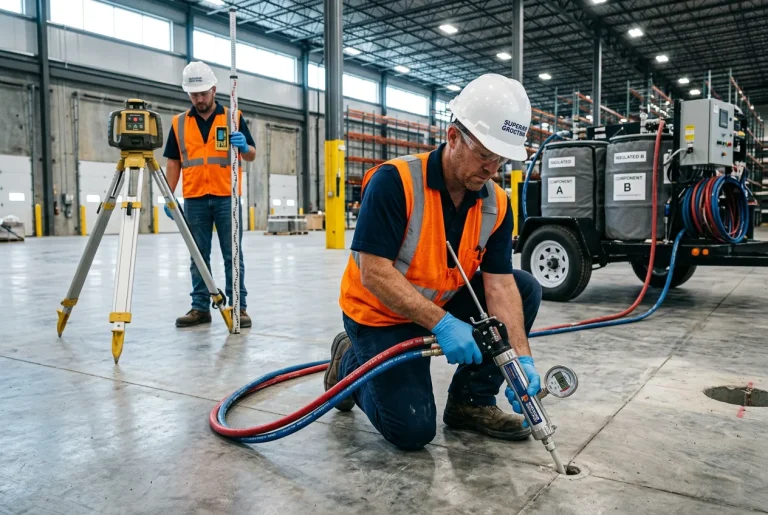
A polyurethane grouting project on a commercial or industrial slab follows six phases: pre-construction walk and submittal, mobilization and site setup, port layout and drilling, staged injection with elevation monitoring, verification and finishing, and closeout documentation. A typical 5,000-square-foot scope completes within one to three work shifts, with same-shift return-to-service for most load classes. Owner involvement is concentrated in the first phase (scope confirmation) and the last (closeout acceptance); the middle phases proceed under engineer-of-record approved procedures.
For facility managers and procurement officers who have approved a polyurethane grouting services scope but have not previously hosted one, the project unfolds faster and with less disruption than most other rehabilitation methods. The crew arrives, executes a measured sequence of operations, documents each step, and leaves the slab restored to design profile within a defined work window. There is no excavation, no demolition debris, and minimal area closure.
This article walks through what actually happens on site from the day the contract is signed to the day the closeout package is delivered. It is written for commercial and industrial owners, plant maintenance teams, and general contractors managing polyurethane grouting subcontracts on warehouse floors, loading docks, manufacturing facilities, public works projects, and similar commercial scopes. Every parameter and timeline is advisory and project-specific; final execution sequence and acceptance criteria are governed by the project specification and the engineer of record.
Why Owners Ask "What Happens Next"
The polyurethane grouting category is engineered, but for most commercial owners it is also unfamiliar. The procurement decision is made (often correctly) on the basis of references, qualifications, and the specifying engineer's recommendation, but the execution itself is novel. Facility teams who have never hosted a polyurethane grouting project sometimes assume the disruption will be similar to demolition and replacement, and they over-prepare. Conversely, teams who have only seen residential foam-jacking on a sidewalk underestimate the engineering rigor of a commercial scope and under-prepare.
The actual experience sits between those assumptions. The work is light on disruption, heavy on documentation, and faster than most owners expect. Understanding what to expect at each phase allows the owner team to integrate the project into operations without surprises, to support the contractor with the information and access required, and to evaluate the closeout submittal against the original scope.
The Six Phases of a Polyurethane Grouting Project

Every polyurethane grouting project on a commercial or industrial slab proceeds through the same six phases regardless of scale. The duration of each phase scales with project size, but the sequence is fixed.
| Phase | Duration (Typical) | Owner Involvement | Documentation Output |
| 1. Pre-construction and submittal | 1 to 4 weeks before mobilization | High (scope confirmation) | Approved submittal package |
| 2. Mobilization and site setup | 1 to 2 hours on the day of work | Low (site access only) | Safety briefing record |
| 3. Port layout and drilling | 1 to 3 hours | Low | Port map and as-drilled record |
| 4. Staged injection | 4 to 12 hours per shift | Low (observation optional) | Daily injection log |
| 5. Verification and finishing | 1 to 2 hours | Low to medium (acceptance walk) | Post-injection survey, volume reconciliation |
| 6. Closeout documentation | 5 to 10 business days after final shift | High (submittal review and acceptance) | Complete closeout package |
Phase 1: Pre-Construction and Submittal
Pre-construction is the phase where engineering substance is locked in. It begins as soon as the contract is signed and concludes when the engineer of record approves the contractor's submittal package.
The submittal package typically includes:
- Product technical data sheet (TDS) for the polyurethane resin system, with reactivity class documented per ASTM D7487
- Injection procedure with pressure range, port spacing, lift increment, and gel-time approach
- QA/QC plan with verification triggers and acceptance criteria
- Equipment list with serial numbers and calibration records
- Traffic control or operational access plan
- OSHA-compliant safety plan including confined-space entry procedures if applicable
- Certificate of Insurance and updated workers compensation documentation
The owner's role in this phase is scope confirmation. Walk the contractor through the operational constraints (work windows, access paths, adjacent active equipment, drainage features, embedded utilities), confirm the elevation tolerance the slab must meet, identify any operational items that cannot be disturbed, and provide the engineer of record with any project-specific specifications that govern the work. Owners who skip this phase or treat it as a paperwork formality frequently encounter change orders, scope creep, or scheduling conflicts in later phases.
A structured pre-construction walk on-site, with the contractor, the engineer of record, and the owner's representative, is the highest-value 90-minute investment in the entire project.
Phase 2: Mobilization and Site Setup
Mobilization is light. A polyurethane foam injection crew is typically two to four technicians plus a field supervisor. The equipment footprint is one trailer-mounted injection rig, paired heated hose packs, drum warmers, laser level on tripod, port-drilling rig (small handheld or wheeled), portable lighting, and a service truck. The full footprint occupies an area roughly the size of two parking spaces.
On the day of work, the crew arrives at the scheduled start time, completes a site safety briefing with the owner's representative, walks the work area to confirm conditions match the pre-construction documentation, and stages the rig in the agreed location. Material drums are conditioned to the manufacturer-specified temperature range using drum warmers or heated hose packs (typically 70 to 110 degrees F for the A-side and B-side components).
Owner involvement in this phase is limited to providing site access, confirming the safety briefing is delivered to any owner personnel who will be in the work zone, and verifying the work area is clear of obstructions.
Phase 3: Port Layout and Drilling
Port layout follows the engineer-approved submittal. Ports are typically drilled at 2-foot to 4-foot spacing along the work area, deeper at locations with documented voids and shallower in zones requiring controlled lift. Port diameter is typically five-eighths of an inch for standard industrial work.
Drilling produces a small volume of concrete dust and core material, captured by the contractor with shop-vac or dust-suppression equipment. The slab surface around each port is wiped clean before injection begins. The port map (a printed diagram showing exact port locations and depths) is recorded as part of the QA/QC documentation.
The owner can verify that the port pattern matches the approved submittal. Variances should be flagged immediately; significant deviation from the engineer-approved layout warrants a pause for review before injection proceeds.
Phase 4: Staged Injection
Injection is the longest phase and the one most defining of the polyurethane grouting category. The crew injects the two-component resin through each port in measured volume, monitors elevation continuously with a laser level, and advances port-by-port across the work area in a pattern that matches the slab's structural support priority.
For lifting applications, injection proceeds in 1/8-inch to 1/4-inch staged lifts per port to avoid surface cracking, with the lift verified at the laser receiver before the next stage. For void fill grouting applications, injection continues until refusal pressure indicates the void is filled or until the calculated volume matches the documented void extent.
A daily injection log is recorded at each port. Entries capture port number, depth, injection pressure observed at the manifold, volume injected, cream time and rise time as observed, the technician's initials, and any notes (refusal, migration, surface heave). The log becomes the primary record of work performed.
Owner involvement during injection is optional. Most owners walk the work area once or twice during the shift, observing technique and progress. The crew is not slowed by observation, and questions are welcome. Owners who prefer not to observe can rely on the daily injection log as the work record.
Phase 5: Verification and Finishing
Verification confirms the work performed against the approved scope. The crew conducts a post-injection elevation survey using the same laser level setup as pre-injection, comparing the new profile to the documented baseline and to the elevation tolerance in the project specification. Volume reconciliation compares the injected material volume against the calculated theoretical void volume; significant variance is investigated and noted in the daily log.
Post-cure boroscope inspection at representative port locations is conducted where access allows, confirming the cured foam has filled the target zone. The slab surface around each port is checked for cleanliness, and each port is sealed with a non-shrink grout or finished to match the existing slab surface as required by the project specification.
The owner's acceptance walk happens at the end of this phase. The crew supervisor walks the owner through the work area, identifies each port location, presents the elevation survey results, and confirms the scope is complete. Any owner-identified concerns are documented and addressed on-site if possible or scheduled for return work if not.
Phase 6: Closeout Documentation
The closeout submittal is the deliverable that proves the work was performed to specification. It is typically delivered to the owner within 5 to 10 business days of the final work shift and includes:
- Pre-injection and post-injection elevation surveys
- Daily injection logs for all work shifts
- Volume reconciliation worksheet
- Photographs of port locations before, during, and after injection
- Product technical data sheets and manufacturer certifications
- Material lot numbers and traceability records
- Engineer-of-record sign-off on as-built conditions
- Warranty document with measurable performance triggers
The owner reviews the submittal as part of formal acceptance. Insist on this deliverable as a contract requirement; review it against the original scope; flag any gaps or inconsistencies; and retain the submittal as part of the slab's permanent record. The closeout package is the document that protects the owner in any future inspection, insurance claim, or property due diligence.
What Happens After the Crew Leaves

Same-shift return-to-service is the normal expectation for polyurethane grouting on standard slabs. For commercial concrete leveling and industrial scopes, the timeline typically is:
| Load Class | Wait Time After Injection | Reference |
| Pedestrian traffic | 15 minutes to 1 hour | Cure profile, product TDS |
| Light vehicle traffic (passenger cars) | 1 hour | Cure profile, EOR approval |
| Forklift traffic (loaded) | 1 to 4 hours | Cure profile, EOR approval |
| Heavy industrial loading (>20,000 lb) | 4 to 24 hours | Project specification |
| Full design load | 24 hours typical | Compressive strength curve in TDS |
These windows are advisory; the project specification and engineer of record establish the controlling threshold. Most polyurethane lifting foams reach 90 percent of design compressive strength within 1 hour and full cure within 24 hours, which is why same-shift return-to-service is realistic for most load classes.
For warranty purposes, owners should document conditions at the time of full load reapplication: ambient and slab temperature, observed load classes, and any concurrent events that could affect performance. This documentation supports any future warranty review.
Communication During the Project
Polyurethane grouting projects benefit from short, structured communication touchpoints rather than constant updates. A typical communication pattern is:
- Pre-construction kickoff (in person or video) confirming scope, schedule, and access
- Day-of confirmation 24 hours before mobilization (email or call)
- End-of-shift summary on each work day (verbal or short written update)
- Acceptance walk after final shift (in person, on site)
- Submittal delivery within 5 to 10 business days
- Submittal review session if requested (video or in person)
The contractor's field supervisor is the primary point of contact during execution. The owner's representative should have authority to make scope clarifications on-site without waiting for higher approval; minor scope variances are common and resolve quickly when the right person is available.
What Can Go Differently Than Expected
Most polyurethane grouting projects execute close to the planned scope. The variances that do occur fall into a few recognizable categories:
- Larger-than-documented voids: GPR or boroscope investigation underestimated the void extent. The contractor injects more material than calculated; volume reconciliation captures the variance; the engineer of record reviews whether the scope or budget needs revision.
- Resin migration outside the work area: The foam reaches an unexpected drainage path or void connection. The contractor pauses, investigates, and adjusts the injection sequence or material class.
- Surface heave above tolerance: Injection pressure or lift increment was too aggressive for the substrate. The contractor pauses, allows relaxation, and resumes with smaller increments.
- Subgrade saturation discovered: A drainage defect not identified in pre-construction is found during port drilling. The work pauses until the drainage defect is addressed or the scope is adjusted.
- Adjacent operational disturbance: Vibration or noise concerns from adjacent active equipment require schedule adjustment.
A qualified specialty grouting contractor responds to these variances by documenting them in the daily log, communicating to the owner's representative within the shift, and proposing a corrected approach. Variances that are documented and resolved are not failures; variances that are concealed or ignored are.
Owner Pre-Work Checklist
Before the contractor mobilizes, the owner should confirm:
- Work area is clear of inventory, equipment, vehicles, and racking
- Operational schedule has been adjusted so the work window is uninterrupted
- Personnel in adjacent areas have been notified of work activities and any noise or odor expectations
- Adequate access for the contractor's service truck and trailer-mounted rig
- Site contact with decision authority is available throughout the work shift
- Engineer of record has been notified of the work date and is reachable during the shift if questions arise
- Insurance certificate, contract, and approved submittal package are on file
- Owner's representative knows the acceptance walk protocol and the closeout submittal deliverable expectation
This pre-work discipline is what allows the project to execute on the planned schedule without scope friction.
Key Takeaways
- A polyurethane grouting project proceeds through six defined phases, each producing a documentation artifact that becomes part of the closeout submittal.
- Pre-construction (phase 1) is the highest-value owner involvement window; scope confirmation here prevents 90 percent of execution surprises.
- Equipment mobilization is light. A typical two-person to four-person crew with one trailer-mounted injection rig services most commercial scopes.
- Injection proceeds in staged 1/8-inch to 1/4-inch lifts with continuous laser-level monitoring; the slab moves under controlled, measurable conditions.
- Same-shift return-to-service is normal. Most hydrophobic lifting foams reach 90 percent of design compressive strength within one hour of injection.
- Closeout documentation is the deliverable that proves performance. Insist on it as a contract requirement and review it as part of acceptance.
- Every parameter and timeline in this article is advisory. Final execution must be validated by the engineer of record against project-specific conditions and the governing specification.
Conclusion
A polyurethane grouting project on a commercial or industrial slab is a defined, documented, six-phase process: pre-construction and submittal, mobilization and site setup, port layout and drilling, staged injection with elevation monitoring, verification and finishing, and closeout documentation.
The work executes in hours rather than days, produces measurable verification at each step, and leaves the slab restored to design profile without excavation or demolition. Owner involvement is highest at the pre-construction and closeout phases; middle phases proceed under engineer-of-record approved procedures with minimal operational disruption.
Every parameter and timeline described is advisory and project-specific; final execution must be validated by the engineer of record against the project specification and site conditions. To scope polyurethane grouting services for a commercial or industrial facility in Texas or Louisiana, schedule an estimate with Superior Grouting.