


Chemical Grout Selection Framework: Polyurethane, Acrylamide, and Acrylate Compared
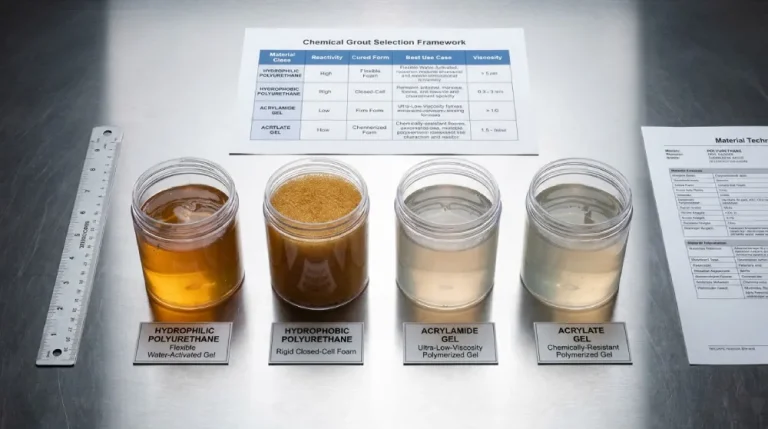
Chemical grout selection is governed by four decision variables: defect type (active infiltration versus void fill), water condition at the injection point (saturated versus dry), soil grain size or crack width (coarse versus fine), and application context (permanent structural versus flexible sealing). Four material classes cover the vast majority of commercial and municipal applications: hydrophilic polyurethane for active leak control in saturated conditions, hydrophobic polyurethane for high-volume inflow and annular space fill, acrylamide gel for permeation in fine soils and micro-cracks, and acrylate gel for permeation applications requiring chemical resistance. Selecting the wrong material class does not just underperform; it can produce visible failures within one to two wet-dry cycles that require re-injection at higher cost.
Chemical grouting projects fail more often from material class selection than from execution. A properly executed injection of the wrong material class produces the wrong outcome: a hydrophilic gel that dries and shrinks in an application where dry cycling occurs, a hydrophobic foam that fails to permeate a fine soil that needed a gel, an acrylamide gel injected where structural strength was needed rather than flow control. Each of these mistakes has a signature failure mode and a recognizable field consequence.
This article presents the systematic material selection framework used by qualified specialty grouting contractors and consulting engineers to match chemical grout material class to project conditions. The audience is specifying engineers, project engineers, procurement teams, and utility owners writing chemical grouting specifications. Every parameter and recommendation is advisory and project-specific; final material class selection must be validated by the engineer of record against site conditions, product technical data sheets, and the applicable owner specification.
Why Material Class Selection Matters More Than Contractor Preference
Chemical grouting has four common material classes in commercial and municipal work. Each material has a distinct chemistry, cure profile, and long-term performance envelope. The four are not interchangeable, and a contractor's preference for one class is not sufficient justification for its use on a project where a different class fits the conditions better.
The reason selection matters more than execution is that a correctly selected material forgives modest execution imperfections, but an incorrectly selected material fails predictably regardless of execution quality. The chemical grouting services available for commercial and municipal projects proceed through a material selection review at the specification phase precisely because the downstream consequences of a wrong selection are much greater than the marginal cost of the review.
The Four Chemical Grout Material Classes
The four material classes below cover the vast majority of commercial and municipal chemical grouting applications. Each has a defined chemistry, a documented cure profile, and a specific range of applications where it is the correct choice.
Class 1: Hydrophilic Polyurethane
Hydrophilic polyurethane grouts react with water as part of their cure chemistry. Water is not a contaminant to the reaction; it is a reactant. When the resin contacts water at the injection point, the reaction triggers, the resin expands rapidly to fill the available space, and the cured product is a flexible water-activated gel.
Key properties:
- Cream time: 3 to 30 seconds (fast, water-activated)
- Rise time: 30 seconds to 2 minutes
- Cured form: Flexible water-activated gel
- Expansion ratio: 2 to 8 times injected volume
- Best pre-cure viscosity: 100 to 500 centipoise
- Movement tolerance: Excellent (flexible gel accommodates joint movement)
- Wet-dry cycling: Requires sustained moisture (fails if the substrate dries out)
Best applications: Active infiltration sealing at pipe joints and lateral connections, manhole infiltration control, sewer main crack sealing under active water inflow, moving joints where flexibility is required, sanitary sewer applications where the substrate remains wet in service.
Class 2: Hydrophobic Polyurethane
Hydrophobic polyurethane grouts cure by internal catalyst reaction with reduced water dependency. The reaction is triggered by the catalyst system rather than by contact with water, and the cured product is a rigid closed-cell foam. Water contamination during cure does not prevent the reaction, but the material does not require water to cure and does not shrink when the substrate dries.
Key properties:
- Cream time: 10 to 60 seconds (catalyst-controlled)
- Rise time: 30 seconds to 3 minutes
- Cured form: Rigid closed-cell foam
- Expansion ratio: 10 to 30 times injected volume
- Best pre-cure viscosity: 100 to 500 centipoise
- Compressive strength: 25 to 150 psi depending on density
- Wet-dry cycling: Excellent (unaffected by drying)
Best applications: Annular space fill behind CIPP liners, structural void fill in tunnel and pipeline rehabilitation, high-volume inflow events where fast rigid seal is needed, void fill beneath slabs and pavements, applications where the substrate may dry over the service life.
Class 3: Acrylamide Gel
Acrylamide-based chemical grouts have viscosity near that of water (approximately 1 centipoise pre-cure) and react through a polymerization catalyst system to form an impermeable gel in place. The extremely low viscosity allows the pre-cure material to permeate soil pore spaces and micro-cracks that any polyurethane cannot enter due to particle geometry and viscosity constraints.
Key properties:
- Pre-cure viscosity: Approximately 1 centipoise (near water)
- Cream time: 5 seconds to 10 minutes (catalyst-adjustable)
- Cured form: Impermeable flexible gel
- Permeation depth: Extensive in fine soils and micro-cracks
- Chemical resistance: Good against water and mild wastewater
- Environmental profile: Regulated in some jurisdictions due to uncured component toxicity
Best applications: Permeation grouting in fine soils (silts, fine sands, sandy clays), curtain grouting around manholes and below-grade structures, micro-crack sealing in concrete structures, sanitary sewer applications where fine-grained soils surround the pipe, permeation in tight soil matrices where polyurethane cannot penetrate.
Regulatory note: Acrylamide chemical grouts have specific handling and use protocols due to the toxicity of the uncured monomer component. A qualified specialty contractor manages these protocols; the cured gel is inert and does not release the monomer.
Class 4: Acrylate Gel
Acrylate-based chemical grouts are similar in permeation performance to acrylamide but with different chemistry and different long-term durability characteristics. Pre-cure viscosity is comparable to acrylamide (1 to 5 centipoise), and the cured gel is a flexible impermeable barrier. Acrylate gels are commonly specified where chemical resistance is important or where the environmental profile of acrylamide is a concern.
Key properties:
- Pre-cure viscosity: 1 to 5 centipoise (near water)
- Cream time: 5 seconds to 20 minutes (catalyst-adjustable)
- Cured form: Impermeable flexible gel
- Permeation depth: Extensive in fine soils and micro-cracks
- Chemical resistance: Excellent, including against many industrial chemicals
- Environmental profile: Preferred where regulatory or owner criteria restrict acrylamide
Best applications: Permeation grouting where chemical resistance to industrial wastewater or process fluids is required, curtain grouting in fine soils where acrylamide use is restricted, sanitary sewer applications with variable chemistry, applications where long-term durability against chemical exposure is a specification requirement.
Why Viscosity Is the Governing Property
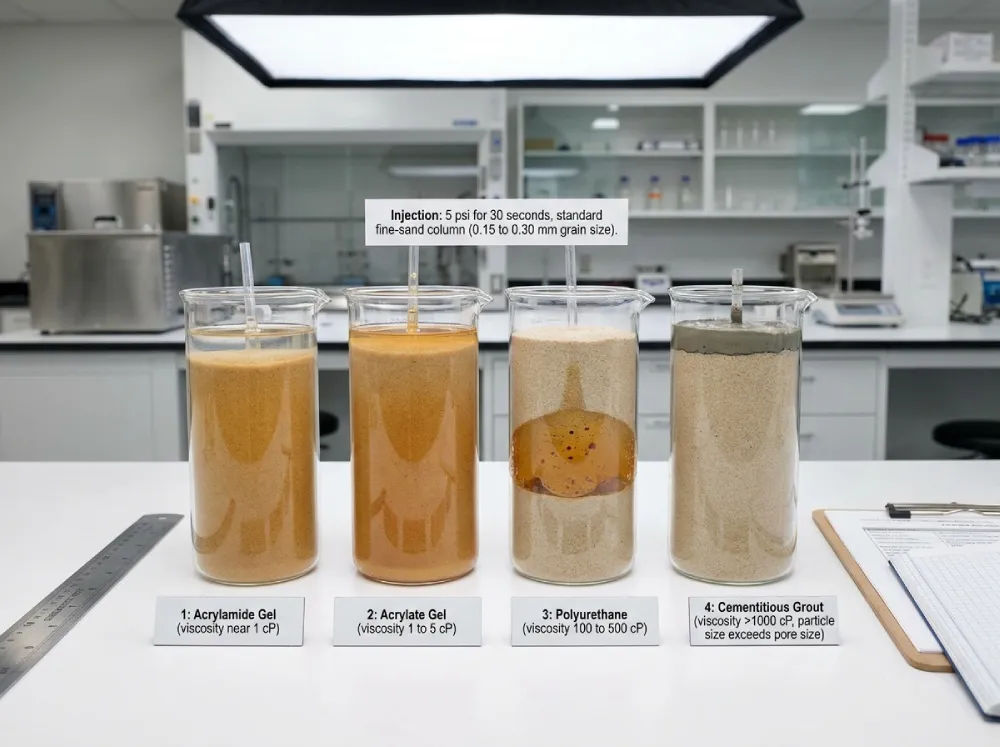
Chemical grouts differ from cementitious grouts in one critical property: viscosity. Cementitious grouts carry solid particles (Portland cement, fly ash, ultrafine cement) that cannot pass through fine pores and micro-cracks where much of the target infiltration lives. Chemical grouts, in their pre-cure liquid form, have viscosities between 1 and 500 centipoise, spanning three orders of magnitude within the chemical grout category itself.
The practical consequence is that not every chemical grout fits every application. Acrylamide and acrylate gels at approximately 1 centipoise permeate soil pore spaces and micro-cracks with grain sizes down to fine silts. Polyurethane grouts at 100 to 500 centipoise permeate coarser soils (sands and gravels) and larger cracks, but cannot enter the fine pore matrix where gel grouts operate. The polyurethane grouting services and gel-based chemical grouting deliver different performance envelopes precisely because the viscosity difference determines what pore space each material can reach.
For engineering specifications, the viscosity-particle-size relationship translates to a clear rule: fine soil or micro-crack applications require gel-class chemical grouts; larger void or coarser soil applications can use polyurethane; and cement-based methods are reserved for applications where particle-size and structural strength requirements permit.
The Four Decision Variables That Drive Material Selection
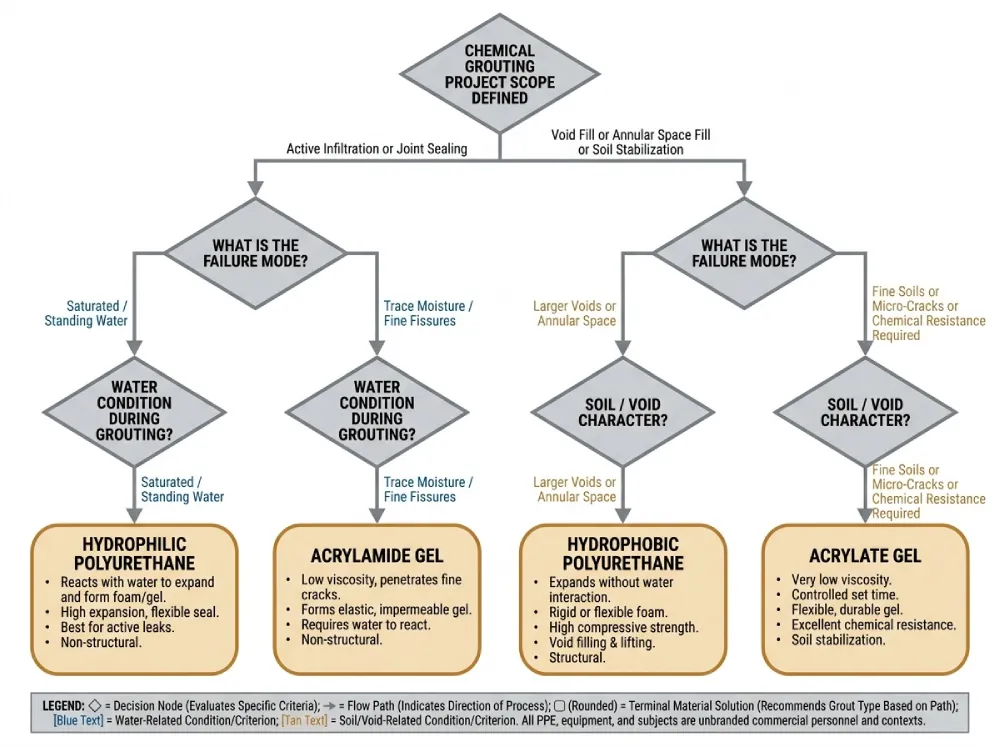
A systematic material selection follows four decision variables. Each variable narrows the material class options, and the intersection of all four typically identifies a single correct material class for the specific application.
Variable 1: Defect Type
The failure mode being addressed governs the fundamental material requirement.
- Active infiltration or joint sealing (water actively flowing into the pipe or structure): favors hydrophilic polyurethane (rapid water-activated cure) or gel classes (permeation-based sealing of the surrounding soil)
- Void fill or annular space fill (space between structural elements or in the surrounding soil): favors hydrophobic polyurethane (rigid closed-cell fill) or cementitious methods (for larger volume and higher strength)
- Soil stabilization (strengthening a soil mass to prevent settlement or increase bearing): favors gel classes for permeation-based stabilization, or specialty cementitious methods for structural fill
Variable 2: Water Condition at the Injection Point
The presence of water at the injection point affects material class selection materially.
- Saturated (standing water, active inflow, high groundwater): favors hydrophilic polyurethane (leverages the water reactively) or gel classes (which polymerize independent of water presence)
- Trace moisture or intermittent water: favors gel classes (independent cure) or hydrophobic polyurethane (catalyst-driven cure)
- Dry substrate: hydrophilic polyurethane is contraindicated (may fail to cure completely); hydrophobic polyurethane and gel classes both perform
Variable 3: Soil Grain Size or Crack Width
The physical geometry of the target zone determines what material can actually reach it.
- Coarse soils (sands, gravels), larger cracks or voids (>1 mm): polyurethane classes can permeate and expand; gel classes work but are more expensive than needed
- Medium soils (fine sands, sandy silts), moderate cracks (0.1 to 1 mm): gel classes and low-viscosity polyurethane can both permeate; selection driven by other variables
- Fine soils (silts, clays), micro-cracks (<0.1 mm): only gel classes with near-water viscosity can permeate; polyurethane classes cannot reach the pore space
Variable 4: Application Context
The service environment and regulatory context shape the final material class selection.
- Potable water adjacent: NSF/ANSI 61 compliant formulations required (available in polyurethane and acrylate classes; acrylamide use is restricted in potable-adjacent applications)
- Food processing or healthcare adjacent: food-grade or medical-grade formulations required (specialty subclasses of polyurethane and acrylate)
- Industrial chemical exposure: chemical resistance is a specification requirement (favors acrylate gel)
- Regulatory jurisdiction restricting acrylamide: use acrylate gel or polyurethane alternatives
- Cold weather or narrow temperature envelope: material technical data sheet defines the allowable temperature range for each class; some classes have narrower envelopes than others
The Systematic Selection Framework
Putting the four decision variables together produces a systematic selection framework. The following matrix shows the intersection of variables and the appropriate material class for common combinations.
| Defect Type | Water Condition | Soil / Crack Size | Recommended Material Class |
| Active infiltration at pipe joint | Saturated | Coarse (sand, gravel) | Hydrophilic polyurethane |
| Active infiltration at pipe joint | Saturated | Fine (silt, sandy silt) | Acrylamide or acrylate gel |
| Active infiltration at manhole | Saturated | Any | Hydrophilic polyurethane or acrylate gel |
| Void fill in annular space | Dry or trace moisture | Void, not soil | Hydrophobic polyurethane |
| Structural void fill under slab | Dry | Void, not soil | Hydrophobic polyurethane |
| Soil stabilization for foundation | Trace to saturated | Coarse | Polyurethane (permeation) |
| Soil stabilization for foundation | Trace to saturated | Fine | Acrylamide or acrylate gel |
| Curtain grouting around manhole | Saturated | Fine soils typical | Acrylamide or acrylate gel |
| Sealing under industrial chemical exposure | Any | Any | Acrylate gel |
| Sealing potable water adjacent | Any | Any | NSF/ANSI 61 compliant polyurethane or acrylate gel (not acrylamide) |
| Sealing under freeze-thaw cycling | Trace moisture | Any | Hydrophobic polyurethane or acrylate gel |
| Sealing in permanent submersion | Saturated | Any | Hydrophilic polyurethane or acrylate gel |
For a specific project, the engineer of record applies the framework against the documented conditions, produces a recommended material class in the project specification, and validates the selection with the specialty grouting contractor during the submittal review phase.
The Comparison Matrix
The direct side-by-side comparison of the four material classes captures the trade-offs across all variables.
| Property | Hydrophilic PU | Hydrophobic PU | Acrylamide Gel | Acrylate Gel |
| Pre-cure viscosity (cP) | 100 to 500 | 100 to 500 | ~1 | 1 to 5 |
| Cream time | 3 to 30 sec | 10 to 60 sec | 5 sec to 10 min | 5 sec to 20 min |
| Cured form | Flexible gel | Rigid closed-cell foam | Impermeable gel | Impermeable gel |
| Reactivity | Water-activated | Catalyst-driven | Catalyst polymerization | Catalyst polymerization |
| Movement tolerance | Excellent | Poor | Moderate | Moderate |
| Fine soil permeation | Poor | Poor | Excellent | Excellent |
| Coarse soil permeation | Good | Good | Good | Good |
| Wet-dry cycle tolerance | Poor (needs moisture) | Excellent | Good | Excellent |
| Chemical resistance | Moderate | Moderate | Good | Excellent |
| NSF/ANSI 61 availability | Yes (specific formulations) | Yes (specific formulations) | Limited | Yes (specific formulations) |
| Cost per gallon (relative) | Lower | Lower | Higher | Higher |
The economic considerations follow directly from the property differences. Polyurethane classes are typically lower cost per gallon and cover the majority of typical applications. Gel classes are higher cost per gallon but essential for fine-soil or micro-crack applications where polyurethane cannot perform. A properly executed project uses the least expensive material class that meets all four decision variables for the specific application.
Common Selection Mistakes
Three mistakes recur in chemical grout selection. Recognizing them improves outcomes.
- Using hydrophilic polyurethane in dry or intermittently wet conditions. Hydrophilic gel shrinks and can fail when the substrate dries out. Applications with wet-dry cycling need hydrophobic polyurethane or acrylate gel.
- Using polyurethane in fine-grained soils where permeation is required. Polyurethane viscosity prevents permeation into silts and fine sands. Applications requiring true permeation (curtain grouting in fine soils, micro-crack sealing) require gel-class materials.
- Using acrylamide in restricted jurisdictions or potable-adjacent applications. Regulatory restrictions on acrylamide use have expanded over the past decade. Applications in potable-adjacent or restricted-use environments require acrylate gel or compliant polyurethane alternatives. Product selection during specification review confirms compliance before installation. The National Association of Sewer Service Companies (NASSCO) hydrophilic versus hydrophobic grout selection guidance provides authoritative reference for the polyurethane class selection question.
Product Technical Data Sheet Review
Beyond material class selection, product-specific technical data sheet (TDS) review confirms the specific formulation meets project requirements. Key TDS items to review:
- Documented cream time, rise time, tack-free time, and full cure time at project-relevant temperatures
- Compressive strength or gel strength at cure
- Chemical resistance data if applicable to the service environment
- NSF/ANSI 61 certification documentation if potable water adjacent
- Temperature range for injection (some products have narrow envelopes)
- Shelf life and storage requirements
- Safety data sheet (SDS) and personal protective equipment requirements
- Compatibility with other materials in the injection system (packers, hoses, mixing equipment)
The TDS is the authoritative source for product-specific parameters. A qualified specialty grouting contractor provides TDS documentation as part of the submittal package for engineer of record review before injection proceeds.
Selection Validation Through Testing
For high-value or specialized applications, laboratory testing on samples from the actual project site validates the material class selection before full-scale mobilization. Common validation tests:
- Permeation testing in a soil sample from the project site to confirm the selected material class actually penetrates the target soil
- Cure profile testing at the specific ambient temperature expected at the project site
- Adhesion testing against the specific pipe or structure material at the project site
- Chemical resistance testing against the specific fluid chemistry (for industrial applications)
Validation testing adds specification-phase cost but reduces execution-phase risk by confirming the material class selection empirically rather than by reference alone. For complex applications, this investment is standard practice.
Key Takeaways
- Four material classes cover most commercial and municipal chemical grouting: hydrophilic polyurethane, hydrophobic polyurethane, acrylamide gel, and acrylate gel. Each has a distinct performance envelope.
- Material class selection is governed by four decision variables: defect type, water condition, soil grain size or crack width, and application context.
- Viscosity is the governing physical property. Polyurethane classes at 100 to 500 centipoise cannot permeate the fine pore space where gel classes at approximately 1 centipoise operate.
- Hydrophilic polyurethane leverages water as a reactant and suits active infiltration in saturated conditions and moving joints; hydrophobic polyurethane suits void fill and applications with wet-dry cycling; acrylamide and acrylate gels handle fine-soil permeation and micro-crack sealing.
- Common selection mistakes: hydrophilic in dry conditions, polyurethane in fine soils, acrylamide in restricted jurisdictions or potable-adjacent applications. Each has a predictable failure mode.
- Product-specific TDS review and validation testing confirm the specific formulation meets project requirements beyond material class selection.
- Every recommendation in this article is advisory and project-specific. Final material class selection must be validated by the engineer of record against site conditions, product technical data sheets, and the applicable owner specification.
Frequently Asked Questions
What are the four common chemical grout material classes?
The four common chemical grout material classes in commercial and municipal work are hydrophilic polyurethane (flexible water-activated gel used for active leak control in saturated conditions), hydrophobic polyurethane (rigid closed-cell foam used for high-volume inflow and annular space fill), acrylamide gel (ultra-low-viscosity gel used for permeation in fine soils and micro-cracks), and acrylate gel (chemically-resistant low-viscosity gel used for permeation applications requiring chemical resistance). Each has a distinct chemistry, cure profile, and performance envelope.
What is the difference between hydrophilic and hydrophobic polyurethane grout?
Hydrophilic polyurethane grouts react with water as part of their cure chemistry, forming a flexible water-activated gel; they are preferred for active leak control in saturated environments and moving joints where flexibility matters. Hydrophobic polyurethane grouts cure by internal catalyst reaction with reduced water dependency, forming a rigid closed-cell foam; they are preferred for high-volume inflow and void filling and for applications with wet-dry cycling where dry cycles would fail a hydrophilic system.
When should I use acrylamide gel instead of polyurethane?
Acrylamide gel is preferred over polyurethane when the application requires permeation into fine soils, silts, or micro-cracks that polyurethane cannot enter due to viscosity constraints. Acrylamide has viscosity near that of water (approximately 1 centipoise) and permeates pore spaces polyurethane at 100 to 500 centipoise cannot reach. Common applications include curtain grouting around manholes in fine-soil environments and micro-crack sealing in concrete structures.
When should I use acrylate gel instead of acrylamide?
Acrylate gel is preferred over acrylamide when the application requires chemical resistance to industrial wastewater, process fluids, or aggressive chemistries, or when regulatory or owner criteria restrict acrylamide use in the specific jurisdiction or application context. Acrylate has similar permeation performance to acrylamide (low viscosity, gel polymerization) but different long-term durability under chemical exposure. Potable water adjacent applications typically use acrylate over acrylamide.
Why is viscosity so important in chemical grout selection?
Viscosity is the governing physical property because it determines what pore space or crack width the pre-cure liquid grout can actually enter. Cementitious grouts at high viscosity with solid particles cannot enter fine pores at all. Polyurethane grouts at 100 to 500 centipoise permeate sands and gravels but cannot enter fine silts. Gel-class chemical grouts at approximately 1 centipoise permeate essentially any pore space that groundwater can move through. Applications targeting fine soils or micro-cracks require gel-class chemical grouts because no other material class can physically reach the target zone.
How do I know which material class matches my project?
Apply the four-variable selection framework: define the defect type (active infiltration versus void fill versus soil stabilization), the water condition at injection (saturated versus trace moisture versus dry), the soil grain size or crack width (coarse versus medium versus fine), and the application context (potable adjacent, industrial chemical exposure, wet-dry cycling, regulatory restrictions). The intersection of all four variables typically identifies a single correct material class. The engineer of record documents the selection in the project specification and validates it during submittal review.
What common mistakes should I avoid in chemical grout selection?
Three mistakes recur. First, using hydrophilic polyurethane in dry or wet-dry-cycling conditions: the gel shrinks and can fail when the substrate dries out. Second, using polyurethane in fine-grained soils where permeation is required: the viscosity prevents entry into fine pore space. Third, using acrylamide in restricted jurisdictions or potable-adjacent applications: regulatory restrictions have expanded, and compliant alternatives (acrylate, NSF-compliant polyurethane) are typically required. Each has a predictable failure mode when the wrong material is used.
Does chemical grouting need NSF/ANSI 61 certification for potable water applications?
Yes. Applications adjacent to potable water systems (water treatment facilities, water main rehabilitation, water storage tank surrounds, distribution system manholes) require NSF/ANSI 61 certified materials. Certification confirms the cured material does not leach unacceptable contaminants into drinking water under defined contact conditions. Certified formulations are available in polyurethane and acrylate classes; acrylamide use is generally restricted in potable-adjacent applications. The specifying engineer identifies the NSF requirement during design, and the contractor submits NSF documentation with the material submittal package.
How does chemical grouting compare to cementitious grouting for material selection?
Chemical grouting and cementitious grouting cover different application ranges. Cementitious grouts are lower cost per unit volume, have higher structural strength, and are appropriate for large-volume fills, structural applications, and coarse-soil permeation where the pore space accepts cement particles. Chemical grouts operate where cementitious cannot: fine soils and micro-cracks that reject cement particles, applications requiring low weight or minimal reconsolidation load, applications where rapid cure is required for return to service. Many projects use both classes in complementary roles.
Who validates the chemical grout material class selection for my project?
Material class selection is validated by the engineer of record against site conditions, product technical data sheets, and the applicable owner specification. The specifying engineer defines the material class in the project specification, the specialty grouting contractor confirms the selection matches contractor capability and proposes specific product technical data sheets in the submittal package, and the engineer of record reviews and approves the submittal before injection proceeds. For complex applications, laboratory validation testing on site samples confirms the selection empirically. To review a material class selection for a chemical grouting project in Texas or Louisiana, schedule an estimate with Superior Grouting.
Conclusion
Chemical grout selection is a four-variable engineering decision, not a contractor preference. Defect type, water condition, soil grain size or crack width, and application context together identify the appropriate material class from the four common options: hydrophilic polyurethane, hydrophobic polyurethane, acrylamide gel, and acrylate gel. Viscosity is the governing physical property, and different material classes cover different application ranges precisely because their viscosities differ by three orders of magnitude. Common selection mistakes (hydrophilic in dry conditions, polyurethane in fine soils, acrylamide in restricted jurisdictions) have predictable failure modes and are avoidable through the systematic framework. Every recommendation in this article is advisory and project-specific; final material class selection must be validated by the engineer of record against site conditions, product technical data sheets, and the applicable owner specification. To scope chemical grouting on a specific application in Texas or Louisiana with the appropriate material class selection, contact Superior Grouting.