


Chemical Grouting vs. Cementitious Grouting: When to Use Each Method
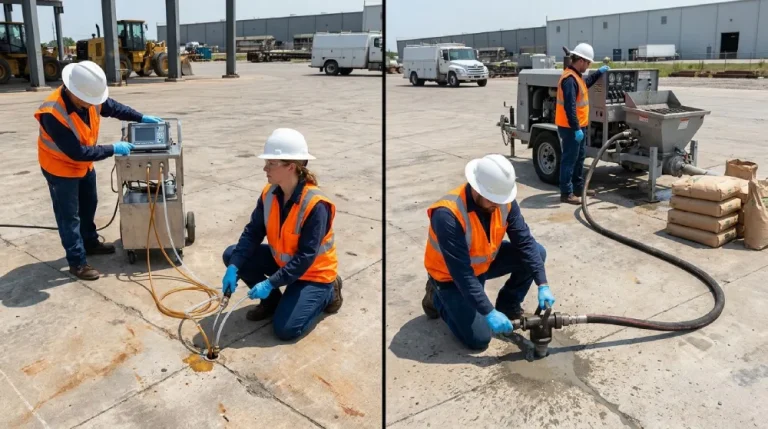
Chemical grouting and cementitious grouting are complementary specialty grouting methods, not competing alternatives. Chemical grouting uses low-viscosity liquid resins or gels (1 to 500 centipoise pre-cure) that permeate fine soils and micro-cracks where cementitious grouts cannot enter, ideal for joint sealing, infiltration control, and permeation of fine-grained soils. Cementitious grouting uses cement-based slurries (viscosity above 1000 centipoise, with particles that block fine pore space) at higher structural strength and lower material cost, ideal for larger voids, pipe abandonment, structural fill, and coarse-soil ground improvement. On many industrial and municipal projects, the correct scope uses both methods sequenced or layered to match the varying conditions across the project site.
Specifying engineers evaluating grouting options for industrial slabs, municipal infrastructure, or ground improvement projects routinely face a decision between chemical grouting and cementitious grouting. Both fall under the broader specialty grouting category. Both address soil defects and structural voids. Both have decades of documented performance and both are referenced within ASTM, ACI, and other engineering standards. The two methods, however, are not interchangeable, and the wrong selection produces predictable failures.
This article presents the systematic framework for selecting between chemical grouting and cementitious grouting on a given project. The audience is specifying engineers, project engineers, procurement teams, and utility owners writing grouting specifications. Every parameter and recommendation is advisory and project-specific; final method selection must be validated by the engineer of record against site conditions, material technical data sheets, and the applicable owner specification.
Why This Decision Is Often Made Incorrectly
Method selection between chemical and cementitious grouting is often made by default or by contractor preference rather than by systematic engineering evaluation. A contractor with primarily cementitious experience proposes cementitious methods; a contractor with primarily chemical grouting experience proposes chemical methods. Owners accepting these default proposals sometimes find that the selected method does not fit the actual project conditions.
The consequences of a wrong selection are predictable. Cementitious grout specified where chemical grout was needed cannot permeate the target pore space, leaving the infiltration or defect untreated. Chemical grout specified where cementitious grout was needed provides insufficient structural strength or is uneconomic for the material volume required. In both cases, the project delivers less than expected and the rehabilitation dollar is misspent.
The framework below eliminates the default-selection failure mode by requiring the engineer of record to evaluate the project against the specific parameters that distinguish the two methods. A qualified chemical grouting services provider and cementitious grouting contractor operating from the same evaluation framework arrive at the same method recommendation for a given set of conditions.
Viscosity: The Property That Divides the Two Method Classes
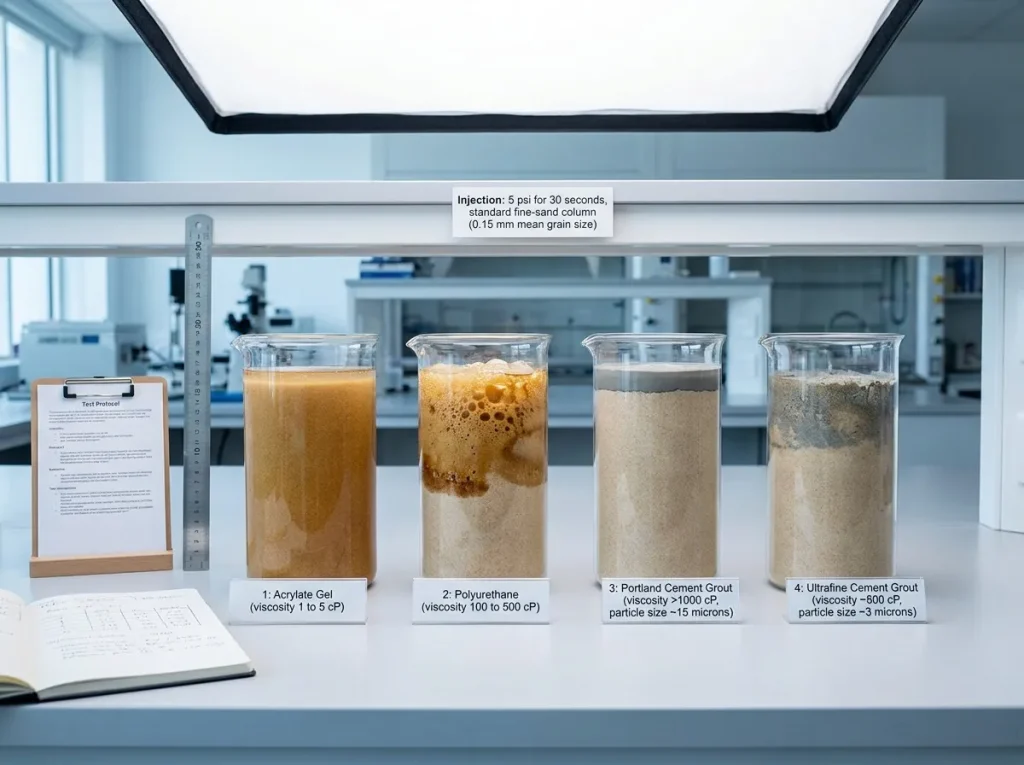
The single most important physical property distinguishing chemical grouting from cementitious grouting is viscosity of the pre-cure material. Everything else follows from this property.
Chemical Grout Viscosity Range
Chemical grouts in their pre-cure liquid form span viscosities from approximately 1 centipoise (acrylamide and acrylate gels, near water viscosity) to 500 centipoise (polyurethane resins). This viscosity range allows the pre-cure material to enter and permeate soil pore spaces and micro-cracks that solid-particle-carrying grouts cannot reach.
The chemical grout category includes hydrophilic polyurethane, hydrophobic polyurethane, acrylamide gel, acrylate gel, and specialty formulations. All share the low-viscosity, particle-free chemistry that enables permeation.
Cementitious Grout Viscosity Range
Cementitious grouts have viscosities from approximately 500 centipoise (ultrafine cement slurries at high water-to-cement ratios) to 5000 centipoise or higher (standard Portland cement slurries and structural mixes). More importantly, cementitious grouts carry solid particles: Portland cement particles average 15 microns; ultrafine cement particles average 3 to 5 microns; supplementary materials (fly ash, silica fume) span a range of particle sizes.
The particle-carrying nature of cementitious grouts sets a hard limit on what pore space they can enter. As a general rule, a cementitious grout particle cannot permeate a pore space smaller than 3 times the particle diameter. Standard Portland cement at 15-micron particles cannot enter pore spaces below about 45 microns; ultrafine cement at 3-micron particles cannot enter below 10 microns. Fine soils with sub-10-micron pore spaces are inaccessible to any cementitious grout.
What This Means in Practice
The viscosity-plus-particle-size difference translates to a clear practical rule: applications requiring permeation into fine soils, micro-cracks, or tight pore matrices require chemical grout. Applications with larger voids, coarser soils, or where structural strength and material volume matter more than permeation depth are candidates for cementitious grout.
Neither method is universally superior. The two operate in different application envelopes. Determining which envelope a specific project falls into is the core of the method selection decision.
Direct Comparison Matrix
The following matrix compares the two method classes across the key parameters that drive selection.
| Parameter | Chemical Grouting | Cementitious Grouting |
| Pre-cure viscosity | 1 to 500 cP | 500 to 5000+ cP |
| Particle size | None (liquid resin or gel) | 3 to 15 microns typical |
| Fine soil permeation | Excellent (gels), Good (polyurethane) | Poor (standard), Limited (ultrafine) |
| Coarse soil permeation | Good | Good |
| Compressive strength | 25 to 150 psi | Up to 8000+ psi |
| Material weight (cured) | 2 to 12 pcf (foam), 65 pcf (gel) | 90 to 140 pcf |
| Cure time | Seconds to minutes | Hours to days |
| Cost per cubic yard | Higher | Lower |
| Volume economics | Best for small volumes and targeted treatment | Best for large volumes and structural fill |
| Water-activated cure available | Yes (hydrophilic polyurethane) | No (some accelerated setting but not water-activated) |
| Flexibility of cured material | Excellent (gels), Moderate (polyurethane) | Rigid |
| Structural fill capability | Limited | Excellent |
| Best applications | Joint sealing, infiltration control, permeation grouting, low-weight fill | Pipe abandonment, structural fill, large-volume void fill, ground improvement |
| Governing standards | NASSCO packer injection, ASTM specialty tests | ASTM C476, C939, C940; ACI 229R |
The Method Selection Framework
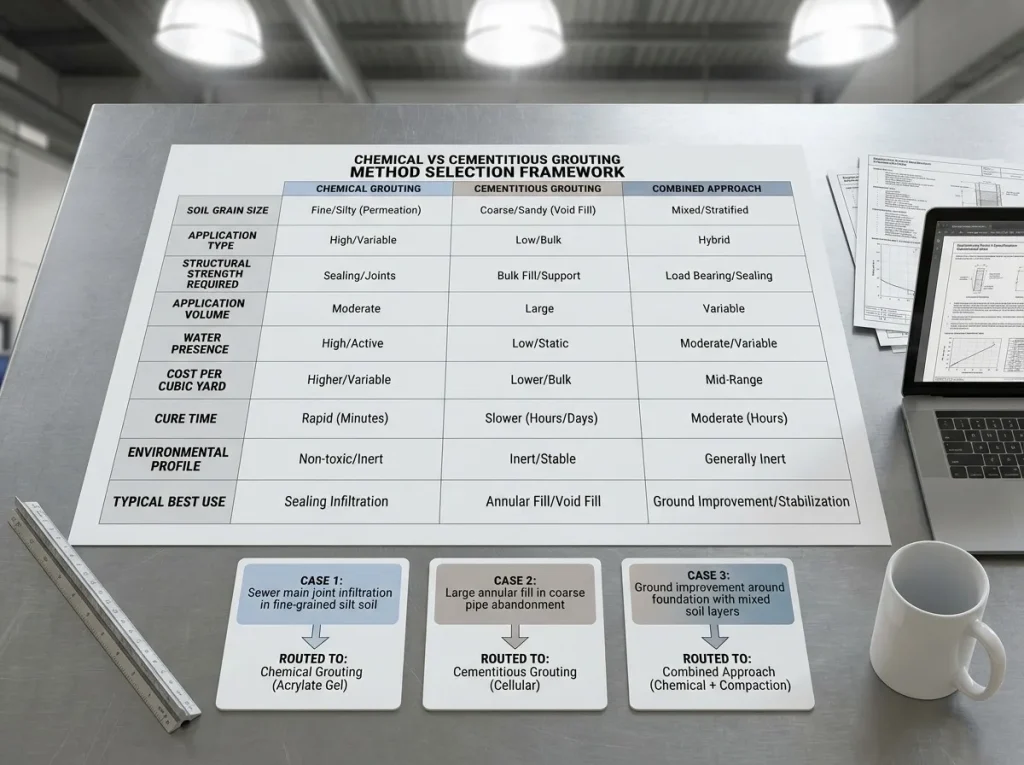
A systematic framework applies the parameters above to a specific project. The following decision variables identify which method fits.
Variable 1: What Is the Failure Mode Being Addressed?
- Infiltration through joints, cracks, or connections: chemical grouting (typically hydrophilic polyurethane or gel classes)
- Void fill in annular space or large cavity: chemical grouting (hydrophobic polyurethane for lightweight, cellular cementitious for heavier structural fill) or cementitious (standard or lightweight cellular) depending on volume and strength requirements
- Ground improvement through soil densification or strengthening: chemical grouting (permeation classes for fine soils) or cementitious (compaction grouting for coarser soils, chemical or cellular fill for structural applications)
- Pipe abandonment: cementitious (cellular grouting) with chemical for any residual sealing needs
- Structural rehabilitation with load-bearing requirements: cementitious (typically) with chemical for sealing components
Variable 2: What Is the Grain Size of the Target Soil or the Width of the Target Defect?
- Fine soils (silts, clays) or micro-cracks (<0.1 mm): chemical grouting only (gel classes typically)
- Medium soils (fine sands, sandy silts) or moderate cracks (0.1 to 1 mm): chemical grouting (any class) or ultrafine cement (borderline)
- Coarse soils (sands, gravels) or larger cracks or voids (>1 mm): both methods can permeate; selection driven by other variables
- Large voids (annular spaces, cavities >10 mm): cementitious for large volumes and structural fill; chemical for lightweight applications
Variable 3: What Volume of Grout Is Required?
- Small volumes (up to 100 cubic yards for a project): chemical grouting is often more economic due to setup efficiency at small scales
- Medium volumes (100 to 1000 cubic yards): both methods can be economic depending on other parameters
- Large volumes (over 1000 cubic yards): cementitious is typically more economic due to lower material cost per cubic yard
Variable 4: What Structural Strength Is Required?
- Sealing only (no structural load): chemical grouting is sufficient and often preferred
- Light structural fill (up to 150 psi compressive): chemical grouting (polyurethane foam) can meet the requirement
- Moderate structural fill (150 to 1000 psi): cementitious cellular grout or lightweight cementitious mixes
- High-strength structural fill (over 1000 psi): cementitious with structural mix design
Variable 5: What Cure Time or Return-to-Service Constraint Applies?
- Return-to-service in hours: chemical grouting (cure in minutes to hours)
- Return-to-service in days: either method, cementitious with accelerated setting agents
- Return-to-service extending beyond a week is acceptable: either method, cementitious with standard mixes
Variable 6: What Is the Water Condition at the Injection Point?
- Active water inflow or saturated conditions: chemical grouting (hydrophilic polyurethane or gels, which cure under water) preferred over cementitious (which may wash out before cure)
- Trace moisture or intermittent water: either method
- Dry substrate: either method, though hydrophilic polyurethane is contraindicated in dry conditions
Applications Where Chemical Grouting Is the Correct Choice
Chemical grouting is the appropriate method under the following conditions.
Joint and Connection Sealing
Sewer main joints, lateral connections, manhole penetrations, pipe joints, and structural connection defects. The application requires permeation and cure at the joint geometry, not structural fill. Chemical grouting delivers the seal without the heavy weight or long cure time of cementitious methods.
Active Infiltration Control
Active groundwater inflow into sewers, manholes, tunnels, or below-grade structures. Hydrophilic polyurethane leverages the water reactivity to cure rapidly under flowing water conditions. Cementitious grouts injected into active water flow can wash out or fail to cure properly.
Fine-Soil Permeation
Curtain grouting in fine silt or sandy silt soils, soil stabilization in fine-grained backfill, chemical barrier formation around utilities. Fine soils have pore spaces too small for cementitious particles; chemical grouts at low viscosity permeate the pore space and form the barrier.
Micro-Crack and Small-Defect Sealing
Cracks below 1 mm width, hairline defects in concrete structures, micro-fractures in bedrock treatment. Chemical grouts at near-water viscosity enter defects that cementitious grouts cannot reach.
Lightweight Void Fill Where Weight Matters
Void fill beneath sensitive structures, annular fill behind CIPP liners, void fill in abandoned pipes where the host pipe cannot support heavy weight. Chemical polyurethane foams at 2 to 5 pcf are 20 to 30 times lighter than cementitious grout, avoiding reconsolidation of weak subgrade or overloading of host structures.
The polyurethane grouting services SG delivers cover most of these chemical grouting applications, with additional gel-class chemical grouting available for the fine-soil permeation applications.
Applications Where Cementitious Grouting Is the Correct Choice
Cementitious grouting is the appropriate method under the following conditions.
Pipe Abandonment and Large Void Fill
Abandoned pipelines, tunnels being decommissioned, large annular voids in tunnel rehabilitation, and void filling in excavation zones. Cementitious cellular grouts at controlled density (25 to 80 pcf typically) fill large volumes economically without the material cost of chemical grouts.
Structural Fill Where Compressive Strength Matters
Structural fill supporting loads, encasement of buried utilities where strength is a specification requirement, structural mass fill in retaining walls or foundations. Cementitious mixes deliver compressive strength up to 8000+ psi where chemical grouts top out at approximately 150 psi.
Compaction Grouting for Soil Densification
Ground improvement through low-mobility grout displacement to densify surrounding soil. The compaction grouting method uses stiff cementitious mixes that would be classified as "cement mortars" rather than chemical grouts. Superior Grouting's compaction grouting services address this application.
Cementitious Contact Grouting
Grouting behind precast liners, tunnel segments, or shafts where a heavy structural bond is required between the liner and the surrounding rock or soil. Contact grouting behind steel liners in dam or tunnel projects is a specialized cementitious application.
Bulk Fill Applications Where Cost Governs
Large-volume applications where the material cost delta between chemical and cementitious grouts is substantial and the application parameters permit cementitious use. Chemical grout can cost 5 to 20 times cementitious per cubic yard; on a 1000-cubic-yard project, the cost differential becomes meaningful.
The cellular grouting services SG delivers cover most of the cementitious cellular grouting applications, with standard cementitious available for structural fill scopes.
The Combined-Method Approach
Many industrial and municipal projects benefit from a combined-method approach that uses chemical grouting and cementitious grouting in complementary roles on the same project.
Sewer Rehabilitation with CIPP Lining
CIPP structural liner installation (structural rehabilitation) followed by chemical grouting at annular space, lateral connections, and manhole terminations (residual infiltration sealing). Both methods on the same project scope.
Ground Improvement Around Utilities
Compaction grouting to densify surrounding soil (cementitious contribution to structural stability) followed by chemical curtain grouting to form the impermeable barrier around the utility (chemical contribution to water control). Layered methods for comprehensive protection.
Tunnel Rehabilitation
Structural void filling behind tunnel liners with cellular cementitious grout for the primary fill, followed by chemical grouting at joint defects and infiltration sources for the sealing function. Bulk fill plus targeted sealing.
Manhole Rehabilitation
Curtain grouting with chemical grout around the exterior for the soil-side infiltration barrier, combined with structural repair of the manhole interior using cementitious mortar or coating. Both methods addressing different aspects of the same rehabilitation objective.
A qualified specialty grouting contractor with capability in both method classes evaluates the project during specification development and proposes the combined-method scope where the parameters warrant it. The engineer of record validates the scope against the project specification.
Cost Economics of Method Selection
The cost economics of chemical versus cementitious grouting depend on the specific application. The comparison below captures typical relationships.
| Application Type | Chemical Grouting Cost | Cementitious Grouting Cost | Typical Winner |
| Sewer joint sealing (per joint) | $200 to $600 | $300 to $900 | Chemical |
| Manhole infiltration control (per manhole) | $1,500 to $5,000 | Not typical | Chemical |
| Annular space fill (per LF) | $5 to $20 | $8 to $25 | Slightly chemical |
| Structural void fill (per cubic yard) | $200 to $500 | $80 to $200 | Cementitious |
| Pipe abandonment (per LF) | $50 to $150 | $15 to $50 | Cementitious |
| Compaction grouting (per cubic yard) | Not applicable | $120 to $300 | Cementitious only |
| Fine-soil curtain barrier (per structure) | $3,000 to $8,000 | Not applicable | Chemical only |
| Bulk cellular fill (per cubic yard) | $200 to $500 (polyurethane foam) | $80 to $200 (cellular cement) | Cementitious for large volumes |
Method selection based on cost alone leads to wrong outcomes when application parameters are ignored. The cost comparison is meaningful only after the method is confirmed viable for the application. A cementitious grout that cannot permeate the target soil is not "cheaper"; it is unusable for the project.
Standards Alignment for Method Selection
Both methods are referenced within engineering standards, and specifications typically identify the standards that govern the selected method.
Chemical Grouting Standards
- ASTM D-series methods for chemical grout characterization
- NASSCO packer injection grouting specification for sewer applications
- NSF/ANSI 61 certification for potable water adjacent applications
- Manufacturer product technical data sheets for specific formulations
- OSHA 29 CFR 1910.146 for confined-space entry where applicable
- The National Association of Sewer Service Companies provides authoritative guidance through their grouting resource library covering chemical grouting standards in detail
Cementitious Grouting Standards
- ASTM C476 for grout for masonry
- ASTM C939 for flow of grout for preplaced-aggregate concrete
- ASTM C940 for expansion and bleeding of freshly mixed grouts
- ACI 229R for controlled low-strength materials (CLSM) which covers cellular and flowable cementitious grouts
- Manufacturer mix design specifications for specific applications
- ASTM C595 or C150 for the cement itself
Specifications that clearly identify which standards apply to which method reduce ambiguity during bid evaluation and construction.
Common Method Selection Mistakes
Three method selection mistakes recur in specifying engineer and owner decisions. Recognizing them improves outcomes.
Mistake 1: Specifying Cementitious for a Sealing Application
The specifying engineer selects cementitious grout for a sewer joint sealing scope based on cost or familiarity. The cementitious material at high viscosity and with solid particles cannot permeate the joint or the surrounding soil, and the infiltration continues. The project rehabilitation dollar is spent without effect. Correct selection would have been chemical grouting (hydrophilic polyurethane or gel class).
Mistake 2: Specifying Chemical for a Bulk Fill Application
The specifying engineer selects chemical polyurethane foam for a large pipe abandonment scope based on the fast cure and light weight properties. The material cost at 5 to 20 times cementitious cellular grout per cubic yard produces a project budget overrun with no engineering benefit relative to cellular grout. Correct selection would have been cementitious cellular grout with adjustment for host pipe considerations.
Mistake 3: Selecting a Single Method for a Multi-Component Project
The specifying engineer selects a single method for the entire project rather than evaluating each project component against the framework. Result: some components are treated with the correct method, others with the incorrect method, and overall project effectiveness is compromised. Correct approach would have been to evaluate each component and select methods per component, potentially producing a combined-method scope.
A structured method selection review during specification development catches these mistakes before procurement commits.
Key Takeaways
- Chemical grouting and cementitious grouting are complementary specialty grouting methods, not competing alternatives. Each operates in a specific application envelope defined by viscosity, particle size, structural strength, volume, and cost.
- Chemical grouts (1 to 500 centipoise pre-cure, no solid particles) permeate fine soils and micro-cracks that cementitious grouts cannot enter, and are appropriate for joint sealing, infiltration control, permeation applications, and lightweight void fill.
- Cementitious grouts (500 to 5000+ centipoise with 3 to 15 micron particles) provide higher structural strength at lower cost per cubic yard, appropriate for pipe abandonment, structural fill, large voids, compaction grouting, and bulk fill applications.
- The method selection framework applies six decision variables: failure mode, soil grain size or defect width, volume required, structural strength required, cure time constraint, and water condition at injection.
- Many projects benefit from a combined-method approach using both classes in complementary roles on the same scope (CIPP + chemical grouting, compaction + curtain grouting, structural fill + joint sealing).
- Common mistakes: specifying cementitious for sealing applications, specifying chemical for bulk fill, and selecting a single method for multi-component projects. Each has a predictable failure mode.
- Every recommendation in this article is advisory and project-specific. Final method selection must be validated by the engineer of record against site conditions, material technical data sheets, and the applicable owner specification.
Frequently Asked Questions
What is the main difference between chemical and cementitious grouting?
The main difference is viscosity and particle content of the pre-cure material. Chemical grouts are low-viscosity liquid resins or gels (1 to 500 centipoise) with no solid particles, allowing permeation into fine soils and micro-cracks. Cementitious grouts are higher-viscosity slurries (500 to 5000+ centipoise) containing solid cement particles (3 to 15 microns) that cannot enter pore spaces smaller than about 3 times the particle size. This difference determines what applications each method can address.
When should I use chemical grouting instead of cementitious?
Chemical grouting is preferred for joint and connection sealing (sewer joints, manhole penetrations), active infiltration control (hydrophilic polyurethane leverages water reactivity), fine-soil permeation (silts, sandy silts, micro-cracks), micro-crack sealing (below 1 mm width), and lightweight void fill where weight matters (behind CIPP liners, in abandoned pipes on weak subgrade). If the application requires permeation into fine pore space or targeted joint sealing, chemical grouting is the correct method.
When should I use cementitious grouting instead of chemical?
Cementitious grouting is preferred for pipe abandonment and large void fill (cellular grout economics), structural fill where compressive strength above 150 psi is required, compaction grouting for soil densification (a cementitious-only method), contact grouting behind liners in structural applications, and bulk fill applications where large material volumes make chemical grout cost prohibitive. If the application prioritizes structural strength, material volume economics, or ground densification, cementitious grouting is typically the correct method.
Can chemical and cementitious grouting be used together on the same project?
Yes. Combined-method approaches are common on complex rehabilitation projects. Sewer rehabilitation with CIPP lining pairs structural CIPP (cementitious-adjacent) with chemical grouting at residual infiltration paths. Ground improvement around utilities pairs compaction grouting (cementitious) with chemical curtain grouting. Tunnel rehabilitation pairs cellular fill (cementitious) with joint sealing (chemical). Many projects benefit from combined-method scope, evaluated by the engineer of record during specification development.
How do I know which grouting method fits my project?
Apply the systematic selection framework across six decision variables: failure mode (sealing versus structural fill), soil grain size or defect width (fine versus coarse), volume required (small versus large), structural strength required (sealing versus load-bearing), cure time constraint (hours versus days), and water condition at injection (active flow versus dry). The intersection of these variables identifies the correct method or combined-method approach. The engineer of record documents the selection in the project specification and validates it during submittal review.
Which method costs less, chemical or cementitious grouting?
Cementitious grout material cost per cubic yard is 5 to 20 times lower than chemical grout material cost. However, cost comparison is meaningful only after both methods are confirmed viable for the specific application. A cementitious grout that cannot permeate the target soil is not "cheaper"; it is unusable. Applications requiring fine-soil permeation, joint sealing, or active water sealing typically justify the higher chemical grout material cost by delivering the outcome the project needs. Bulk fill applications where either method can perform typically favor cementitious for the material cost advantage.
What are the strength differences between chemical and cementitious grout?
Chemical grouts typically deliver 25 to 150 psi compressive strength (polyurethane foams and gels). Cementitious grouts range from 100 psi (lightweight cellular mixes) up to 8000+ psi (structural cement mixes) depending on the mix design. If the application requires compressive strength above 150 psi, cementitious grouting is the appropriate method. For sealing applications where structural load is not a factor, chemical grout strength is more than adequate.
Can chemical grouting seal larger voids like cementitious can?
Chemical grouting can fill larger voids using hydrophobic polyurethane foam, which expands at 10 to 30 times the injected liquid volume. This makes chemical grout viable for void fill applications where the cured weight must remain light (typically 2 to 5 pcf). For large-volume void fills where weight is not a constraint and material cost per cubic yard governs, cementitious cellular grouting (25 to 80 pcf) is more economic. Both methods can address annular fill applications; selection depends on host structure loading and cost parameters.
Which grouting method has faster cure time?
Chemical grouting has substantially faster cure time. Hydrophilic polyurethane cures in seconds to minutes; hydrophobic polyurethane cures in 30 seconds to 3 minutes for the reaction and reaches full cure within 1 to 24 hours; acrylamide and acrylate gels cure in 5 seconds to 20 minutes depending on catalyst adjustment. Cementitious grouts require hours to days for meaningful cure and 7 to 28 days for full design strength. For applications requiring same-shift return-to-service, chemical grouting is typically the correct choice.
Who should decide between chemical and cementitious grouting for my project?
The method decision is made by the engineer of record, informed by the project specification and validated by the specialty grouting contractor's submittal. The specifying engineer applies the six-variable selection framework against the documented project conditions. The specialty contractor confirms the selection matches contractor capability and material availability. The engineer of record validates the final scope before procurement commits. For a Texas or Louisiana industrial or municipal project needing method-selection guidance, schedule an estimate with Superior Grouting.
Conclusion
Chemical grouting and cementitious grouting are complementary methods within the specialty grouting toolkit, each with a specific application envelope defined by viscosity, particle size, structural strength, volume, cure time, and cost. Chemical grouts operate where cementitious grouts cannot: fine soils, micro-cracks, active infiltration, and lightweight fill applications. Cementitious grouts operate where chemical grouts are uneconomic: bulk void fill, structural load-bearing applications, compaction grouting, and large-volume applications where material cost per cubic yard drives project economics. Many industrial and municipal projects use both methods in complementary roles on the same scope. The six-variable selection framework produces consistent method selection across projects and avoids the common mistakes of specifying the wrong method for the application. Every recommendation in this article is advisory and project-specific; final method selection must be validated by the engineer of record against site conditions, material technical data sheets, and the applicable owner specification. To scope a chemical grouting, cementitious grouting, or combined-method project in Texas or Louisiana, contact Superior Grouting.