


Selecting a Polyurethane Grouting Contractor: Qualification Criteria That Matter

Selecting a polyurethane grouting contractor comes down to verifiable qualifications: documented safety performance, calibrated dual-component injection equipment, trained applicators, project-specific injection logging, and references on comparable commercial or industrial work. Price ranks below process, because injection quality, not material choice, determines whether the repair performs for decades or fails early.
Polyurethane injection is unforgiving of improvisation. The resin reacts in seconds, the work is buried the moment it cures, and the difference between a stabilized structure and a wasted mobilization is decided by procedures no owner can inspect after the fact. That places unusual weight on contractor selection.
This guide defines the qualification criteria that separate a specialty injection contractor from a generalist with a foam rig. It is written for facility managers, project engineers, and owners procuring work on commercial, industrial, municipal, or pipeline assets.
What a Polyurethane Grouting Contractor Actually Does
A qualified contractor delivers a controlled injection program, not a product. The scope runs from investigation through verification, and each stage carries its own discipline. The market labels the same work several ways, polyurethane concrete lifting, poly jacking, or slab jacking, but the process underneath is identical: expanding polyurethane placed through staged injection points under monitored pressure.
Core scope elements include:
- Reviewing geotechnical data, structural drawings, and utility locates before any port is drilled
- Selecting the resin class, hydrophobic or hydrophilic, matched to the moisture condition and movement expected
- Executing polyurethane grout injection with staged ports, controlled pressures, and continuous monitoring
- Recording pressures, volumes, and elevations for every injection point
- Verifying results against acceptance criteria and documenting the completed work
Typical applications span concrete lifting and undersealing, void filling beneath pavements and structures, soil stabilization around utilities, leak sealing in below-grade structures, and curtain grouting where a barrier must be established in the soil itself. On slab settlement work, the objective is restoring uniform bearing capacity beneath the concrete slab, not simply pumping resin until sunken concrete moves. On settled floors and pavements, the same injection discipline supports concrete leveling services with lift tolerances measured in fractions of an inch.
The question is not what grout the contractor uses. The question is what process the contractor can prove.
Qualification Criteria That Separate Specialists from Generalists
Six criteria carry most of the predictive value. Each is verifiable before award, and a qualified contractor produces the documentation without hesitation.
| Criterion | What to Verify | Reference Standard |
| Safety performance | EMR, TRIR, and DART rates; written safety program; confined space procedures | OSHA 29 CFR 1910.146 / 1926 |
| Applicator training | Manufacturer or in-house certification records for injection crews; SDS training | OSHA HazCom 29 CFR 1910.1200 |
| Equipment condition | Calibrated pressure gauges, proportioning verification, heated hose maintenance logs | Manufacturer specs / project QA plan |
| Injection documentation | Sample injection logs from prior projects showing pressure, volume, and elevation records | Project spec / internal QA/QC |
| Comparable experience | References on commercial, industrial, municipal, or pipeline work of similar scope | Owner verification |
| Insurance and capacity | General liability, pollution coverage where applicable, bonding capacity | Contract requirements |
Safety metrics deserve emphasis. Injection work routinely involves confined spaces, chemical handling, and live facility operations. A contractor whose crews cannot produce confined space entry procedures aligned with OSHA 29 CFR 1910.146 has disclosed something more important than any brochure claim.
Experience must be comparable, not merely long. A crew that lifts settled slabs at retail pads has not necessarily sealed active infiltration in a wastewater structure or stabilized soils beneath a rail-served warehouse. Ask for references on the asset type in question.
Equipment and Materials: What to Verify Before Award
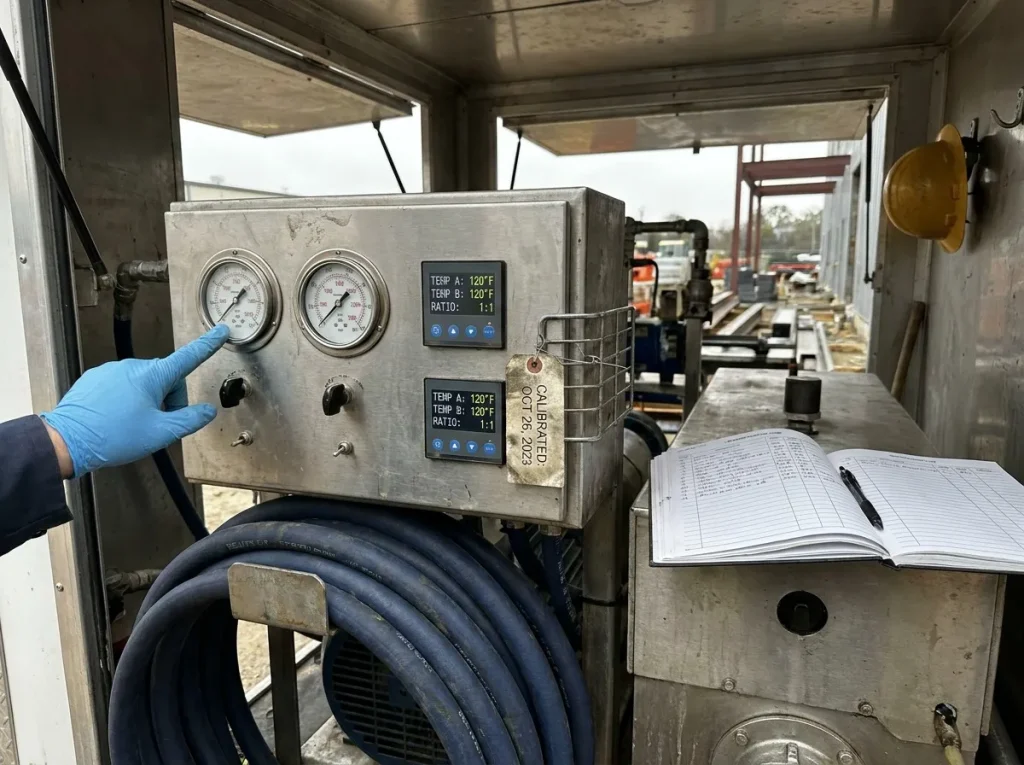
Polyurethane performance depends on precise metering. Dual-component resins must combine at the specified ratio, at the specified temperature, under controlled pressure. Equipment shortcuts surface later as off-ratio foam with compromised cell structure, and no surface repair fixes that condition.
Before award, a procurement review should confirm:
- Proportioning equipment with documented ratio verification, not single-line rigs adapted for two-component work
- Calibrated gauges with current calibration records, since injection pressure limits protect the structure and the utility corridor
- Heated hose systems capable of holding resin at the manufacturer's processing temperature through Gulf Coast summers and winter cold snaps
- Material handling controls: SDS availability on site, proper storage, and disposal procedures for containers and purge material
- NSF/ANSI 61 certified resins for any injection in contact with potable water infrastructure, with AWWA guidance governing the surrounding work
Material class selection is part of the same conversation. A contractor who proposes one resin for every condition, wet or dry, static or moving, is selling inventory rather than engineering. Expect a written basis for the resin class proposed, tied to the site's moisture condition, temperature, and movement expectation. The advantages of polyurethane, small ports, light weight, and rapid cure, only materialize when the material matches the mechanism.
A specialist also knows when polyurethane is the wrong answer. Deep densification problems belong to compaction grouting, permeation problems in granular soils to chemical grouting, and a contractor who never recommends either is selling what the truck carries. That judgment, more than any single credential, marks a firm you can trust with method selection.
Documentation and QA/QC Standards
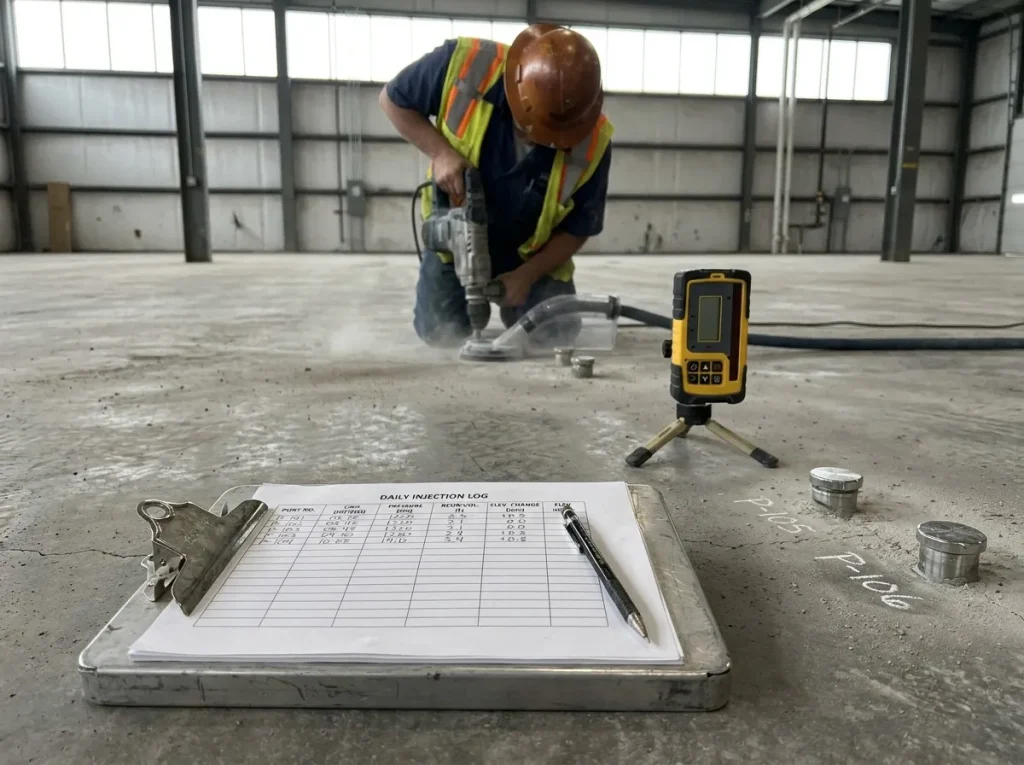
Injection work disappears from view at the moment of placement. Documentation is therefore not paperwork appended to the job. It is the only durable evidence the work was performed as specified.
A qualified contractor's QA/QC package includes, at minimum:
- A pre-injection plan defining port layout, injection sequence, pressure limits, and acceptance criteria
- Daily injection logs recording time, port, pressure, volume, and observations for every injection point
- Elevation monitoring during lifting work, with survey or laser records at defined intervals
- Post-injection verification: re-inspection, flow observation for infiltration work, or load and elevation checks for stabilization work
- A closeout submittal compiling logs, material certifications, and verification results for the owner's records
Pressure discipline threads through all of it. Injection pressure must stay below the overburden and structural capacity of the asset, and the log is the proof that it did. When a contractor cannot show you what their injection log looks like, the omission is the answer.
This documentation standard is the same discipline that governs engineering submittals: state the assumption, control the parameter, record the result. The engineer of record should review acceptance criteria before mobilization on any design-critical application.
Questions to Ask Before You Sign
A short procurement interview exposes most qualification gaps. Productive questions include:
- Which comparable facilities have you injected in the past three years, and who can we call?
- What resin class do you propose for our moisture and movement conditions, and why?
- What are your proposed injection pressure limits, and how were they derived?
- Who monitors elevations during lifting, and at what interval?
- What does your daily injection log capture, and when do we receive it?
- What is your EMR, and how do your crews handle confined space entry?
- How do you price: by pound of resin, by port, or by defined scope with verification?
Pricing structure is worth understanding closely. Per-pound pricing without volume controls creates an incentive misalignment on void-filling work. Defined-scope pricing tied to verified acceptance criteria aligns the contractor's interest with the owner's outcome.
Cost context helps calibrate bids. Mobilization, access conditions, resin class, and verification requirements drive more of the total than the resin unit price. The lowest bid on an underspecified scope is routinely the most expensive repair once rework is counted.
Local Experience and Ground Conditions
Ground behavior is regional. Gulf Coast expansive clays, high water tables, and hurricane-season moisture swings impose conditions that a crew from a different geology has not managed. A pressure grouting contractor working Texas and Louisiana daily carries calibrated expectations for how these soils take resin, how fast gel times run in August heat, and where infiltration pressure actually comes from.
Local presence also matters operationally: response time for urgent stabilization, familiarity with regional DOT and municipal specifications, and working relationships with area geotechnical firms. For owners comparing finalists, a site walk with each contractor is the cheapest verification step available. The specialist asks about soil data, utilities, and load history. The generalist asks where to park the rig.
Owners ready to evaluate a specific project can schedule a project consultation to review site conditions, scope, and verification requirements before committing to an approach. Superior Grouting has served commercial and industrial clients across Texas and Louisiana from Houston since 1983.
This guidance is advisory. Final method selection, pressure limits, and acceptance criteria should be confirmed by the engineer of record for design-critical applications.
Key Takeaways
- Contractor selection determines injection quality, and injection quality, not resin brand, determines whether polyurethane work performs long term.
- Verify safety metrics first: EMR, TRIR, confined space procedures, and chemical handling training are non-negotiable on industrial sites.
- Demand proof of process: sample injection logs, pressure controls, calibration records, and a written QA/QC plan before award.
- Comparable experience on the same asset type outweighs total years in business.
- Resin class must be justified in writing against site moisture, temperature, and movement conditions; one-resin-fits-all proposals are a warning sign.
- Regional ground experience with Gulf Coast clays and water tables reduces execution risk on Texas and Louisiana projects.
Conclusion
Hiring a polyurethane grouting contractor is a procurement decision about process control. The material is chemistry; the outcome is discipline. Owners who verify safety records, equipment calibration, documentation practice, and comparable experience before award consistently avoid the repeat mobilizations that follow price-only selection.
Superior Grouting has executed injection programs for commercial, industrial, and public infrastructure across Texas and Louisiana since 1983. Call (281) 894-4175 to discuss your project scope and verification requirements.
Request a qualification package today.
Scope your injection project with us.