


The Environmental Profile of Polyurethane Grouting: Eco-Friendly Concrete Repair Explained
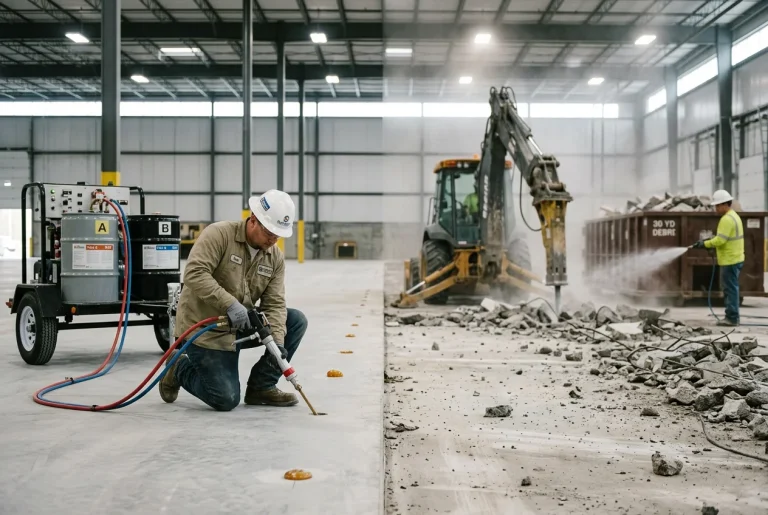
Polyurethane grouting reduces the environmental footprint of slab rehabilitation by 70 to 90 percent compared to full concrete replacement. The reductions come from three sources: lower embodied carbon per cubic yard of repair (a 2 to 5 pound-per-cubic-foot polyurethane foam replaces a 145 pound-per-cubic-foot reinforced concrete slab section); negligible demolition waste compared to multi-cubic-yard concrete debris streams; and substantially shorter operational downtime that eliminates the secondary energy cost of facility shutdown. The cured material is chemically inert under typical subgrade conditions, and NSF/ANSI 61 compliant formulations are available for applications adjacent to potable water systems.
Sustainability is no longer an aside in commercial and industrial procurement. Owners increasingly track embodied carbon in capital projects, waste generation against corporate sustainability targets, and operational disruption against business continuity goals. Polyurethane grouting performs well across all three dimensions, but the environmental case is rarely communicated with the same rigor as the cost and downtime case.
This article presents the environmental profile of polyurethane grouting in measurable terms suitable for sustainability reporting and procurement documentation. It compares the method against full concrete replacement, cementitious grouting, and traditional mudjacking on embodied carbon, waste generation, chemical profile, end-of-life considerations, and regulatory compliance. The audience is facility managers, sustainability officers, procurement teams, and the engineers who specify rehabilitation methods on commercial and industrial slabs. Every figure presented is advisory and project-specific; sustainability claims for any specific project should be validated against the actual product technical data sheet, the project specification, and the owner's sustainability reporting framework.
Why the Environmental Case Matters Now
Commercial and industrial owners increasingly report Scope 3 embodied carbon, construction waste diversion, and energy intensity to investors, regulators, and customers. Procurement teams who once selected on price and downtime alone now carry sustainability KPIs into the same decision. Specifying engineers face the question whether their default rehabilitation methods align with the owner's sustainability framework or quietly undermine it.
Polyurethane grouting services deliver a measurably lower-impact rehabilitation across the dimensions sustainability frameworks measure. The case is not abstract or aspirational; the figures below are derived from material specifications, demolition waste benchmarks, and operational impact data common to commercial slab rehabilitation. Each can be validated against the project's actual scope.
The Environmental Math of Polyurethane Grouting

The core driver of the polyurethane grouting environmental profile is the difference in material mass required to perform a comparable rehabilitation. A typical industrial slab settlement scope is rehabilitated by injecting polyurethane foam beneath the existing slab to fill voids and restore elevation. The replacement alternative removes and recasts the slab section using reinforced concrete. The material volumes involved are not comparable.
| Material Class | Density (Cured) | Mass per Cubic Yard | Approximate Embodied Carbon (kg CO2e per cubic yard) | Use Case |
| Polyurethane lifting foam | 4 to 8 pcf | 110 to 220 lb | 25 to 80 kg | Slab lifting and void fill |
| Polyurethane void-fill foam | 2 to 4 pcf | 55 to 110 lb | 15 to 50 kg | Lightweight void fill |
| Cementitious grout (CLSM) | 90 to 120 pcf | 2,430 to 3,240 lb | 200 to 400 kg | Heavyweight void fill |
| Traditional mudjacking slurry | 90 to 120 pcf | 2,430 to 3,240 lb | 250 to 450 kg | Slab lifting |
| Reinforced concrete (slab replacement) | 145 to 150 pcf | 3,915 to 4,050 lb | 350 to 600 kg | Full slab replacement |
Embodied carbon figures are approximate and depend on resin formulation, cement type, supplementary cementitious materials, and reinforcement ratio. A polyurethane grouting project that uses 5 cubic yards of lifting foam to restore a 5,000-square-foot slab section produces approximately 125 to 400 kg CO2e in material embodied carbon. The replacement alternative that removes and recasts the same slab section in 8-inch reinforced concrete produces approximately 30,000 to 50,000 kg CO2e in new material embodied carbon, plus the demolition energy and transport. The difference is two orders of magnitude.
Waste Generation and Site Cleanup

The second major environmental driver is construction and demolition waste. A polyurethane grouting project produces effectively no demolition waste because nothing is demolished. The work consists of drilling small ports, injecting resin, and finishing the ports flush with the slab. The slab itself remains in place and continues its service life.
A typical polyurethane grouting project on a 5,000-square-foot slab generates the following waste streams:
- Concrete dust from port drilling: approximately one to three quarts total, captured by shop-vac during drilling
- Empty resin drums: typically two to four 55-gallon drums, returned to the supplier or recycled
- Packaging materials and cleaning rags: approximately one contractor-grade trash bag
- Spent PPE: gloves and minor consumables, typical to any specialty trade work
The comparison with concrete replacement is dramatic. A 5,000-square-foot slab section at 8-inch thickness produces approximately 120 cubic yards of demolition debris, weighing roughly 180 tons. Disposal of construction and demolition (C&D) waste through landfill or recycling pathways carries energy, transport, and disposal costs that the U.S. Environmental Protection Agency tracks under its construction and demolition materials management framework. The polyurethane grouting alternative produces less than 0.1 percent of that waste mass.
For owners reporting against LEED, BREEAM, ENERGY STAR, or corporate ESG frameworks, the waste diversion comparison alone often justifies the method selection.
Operational Downtime and Secondary Energy Costs
Sustainability accounting beyond direct material impact captures the secondary energy cost of operational disruption. A facility that shuts down for slab replacement consumes ongoing utilities (HVAC, lighting, dehumidification, refrigeration) without generating output for the duration of the shutdown. Adjacent operations that must be relocated or paused carry the same secondary energy cost. For process facilities, the secondary energy cost of a multi-week shutdown can exceed the direct material impact of the rehabilitation itself.
Polyurethane foam injection eliminates most of this secondary cost. Same-shift return-to-service is normal for standard scopes; full design load is typically reapplied within 24 hours. A 5,000-square-foot industrial slab rehabilitation that would require 10 to 21 days of operational downtime for full replacement is typically completed in 1 to 2 days of polyurethane grouting work, with no extended facility closure.
| Project Element | Polyurethane Grouting | Concrete Replacement | Secondary Energy Impact |
| On-site work duration | 1 to 3 work shifts | 7 to 21 work days | 5x to 20x reduction with polyurethane |
| Facility shutdown required | None to partial | Often full or zone-level | Eliminates HVAC, lighting load during shutdown |
| Adjacent operations disruption | Minimal | Substantial | Avoids production loss on adjacent equipment |
| Worker travel and mobilization | One trailer-mounted rig, one or two service trucks | Multiple heavy equipment moves over project duration | Substantial fuel reduction |
| Return-to-service load reapplication | 1 to 24 hours | 7 to 28 days (concrete cure) | Faster productive capacity restoration |
For corporate sustainability reporting, downtime reduction is typically captured under Scope 1 and Scope 2 energy intensity metrics and can be calculated by multiplying the facility's daily utility consumption by the downtime delta.
Chemical Profile of Cured Polyurethane
Owner concerns about chemical safety of polyurethane materials are common and reasonable, and the answers are documented in product technical data sheets. The cured polyurethane foam used in industrial grouting applications is a closed-cell rigid polyurethane (or in some cases hydrophilic flexible polyurethane for active infiltration sealing). Both classes are chemically inert under typical subgrade conditions once cured.
Key chemical and environmental properties of cured industrial polyurethane grouting foams include:
- Chemically stable under typical subgrade pH (5 to 9)
- Resistant to biological degradation including mold, fungus, and bacterial action
- Non-leaching of significant compounds into surrounding soil or groundwater under typical conditions
- NSF/ANSI 61 compliant formulations available for applications adjacent to potable water systems
- Field-proven service life with installations from the 1990s remaining in service
During injection, the two-component resin system releases brief volatile organic compound (VOC) emissions until cure. A qualified specialty grouting contractor manages this with ventilation, product selection (low-VOC formulations where available), and personnel protective equipment per the safety data sheet. For sensitive applications such as food processing facilities, healthcare facilities, or potable water adjacent work, low-VOC formulations and NSF-compliant products are specified during the submittal phase.
End-of-Life and Long-Term Environmental Performance
A common environmental question is what happens to polyurethane foam at the end of the slab's service life. The cured foam remains in place beneath the slab indefinitely; it does not biodegrade and does not migrate. At eventual slab end-of-life, when the host concrete is removed for replacement or repurposing, the foam is removed with the demolition debris and routed through standard C&D waste pathways. Closed-cell polyurethane is not currently recycled at scale, but it is inert in landfill conditions and does not generate methane or leachate.
This end-of-life profile compares favorably with cementitious grouts (which contribute to high-volume C&D waste streams without offering structural performance gain) and with concrete replacement (where each rehabilitation cycle generates a full debris stream). For owners targeting C&D waste reduction over a multi-decade asset lifecycle, the cumulative effect of multiple void fill grouting cycles is dramatically lower than the same number of replacement cycles.
Regulatory and Compliance Considerations
Several regulatory frameworks intersect with polyurethane grouting environmental performance:
- OSHA 29 CFR 1910.1200 (Hazard Communication): Material Safety Data Sheets (SDS) are provided as part of every submittal package. Owner personnel exposed to the work area receive an SDS briefing during the site safety meeting.
- NSF/ANSI 61 (Drinking Water Contact): Required for polyurethane formulations specified in applications adjacent to potable water systems. Compliant products carry the NSF mark.
- EPA Construction and Demolition Materials Management: Polyurethane grouting projects generate negligible C&D waste compared to demolition alternatives, supporting owner reporting against EPA waste diversion targets.
- State and local water quality protections: For projects near regulated waters (the Texas Commission on Environmental Quality, EPA Section 404, USACE jurisdictional waters), the contractor's environmental management plan addresses spill prevention, contained mixing operations, and proper containment of any spilled material.
- Corporate sustainability frameworks: LEED, BREEAM, ENERGY STAR, GRESB, and similar frameworks credit material reduction, waste diversion, and operational continuity, all of which polyurethane grouting supports.
Comparison Against Other Rehabilitation Methods
A complete environmental comparison considers all reasonable alternatives, not just polyurethane vs. replacement. The matrix below positions polyurethane grouting against the realistic options for industrial slab rehabilitation.
| Method | Embodied Carbon (Per SF Repair) | Waste Generated | Downtime | Service Life Match | Best Use Case |
| Polyurethane grouting | Very low | Negligible | Hours | Matches host slab | Sound slab with subgrade settlement |
| Cementitious grouting | Moderate | Low | Days | Matches host slab | Heavyweight void fill |
| Mudjacking (cement slurry) | Moderate to high | Low | Days | Often shorter than host | Light residential or low-load only |
| Commercial concrete leveling by polyurethane | Very low | Negligible | Hours | Matches host slab | Industrial floor leveling |
| Slab replacement (partial) | High | Substantial | Weeks | Full new-slab cycle | Structurally compromised concrete |
| Slab replacement (full) | Very high | Very substantial | Weeks | Full new-slab cycle | Comprehensive rebuild |
For owners with a sustainability framework, the matrix supports a default preference for polyurethane grouting when the slab is structurally sound and the failure mode is subgrade. When the concrete itself is failing, replacement is the appropriate scope regardless of environmental considerations; the right answer is to address the actual failure rather than under-scope the work for the sake of carbon reduction.
How to Document Sustainability for a Polyurethane Grouting Project
Owners reporting on sustainability metrics can capture the relevant data from a polyurethane grouting project through the following documentation:
- Material volume injected (cubic yards, from the daily injection log) with manufacturer-supplied embodied carbon per unit
- Avoided concrete volume (slab section that would have been replaced under the alternative scope) with comparable embodied carbon
- Avoided C&D waste mass and disposal pathway data
- Operational downtime reduction with secondary energy cost calculation
- Worker travel and equipment fuel data for the actual project vs. the comparable replacement project
- NSF and other compliance certifications applicable to the specific application
The closeout submittal already documents the first three items as standard QA/QC content. The remaining items can be derived from contractor records on request, and a qualified contractor will provide them as part of the project closeout when the owner identifies the need during the pre-construction phase.
When Polyurethane Grouting Is Not the Environmental Best Choice
Sustainability claims should reflect engineering reality. Polyurethane grouting is the environmentally preferred scope when the slab is structurally sound and the failure mode is subgrade or void-related. When the slab itself has lost structural capacity (through-slab cracking, active reinforcement corrosion, delamination, or insufficient thickness for revised loading), polyurethane injection does not address the failure and may produce a more expensive remediation at a later date. The right environmental scope under those conditions is structurally appropriate replacement, with sustainability optimization through low-carbon concrete mixes, supplementary cementitious materials, and demolition debris recycling.
Likewise, when the underlying failure cause is an active drainage defect, an embankment instability, or a continuing source of subgrade saturation, polyurethane grouting alone treats the symptom rather than the cause. The environmental case for the method strengthens when paired with corrective scope addressing root cause; it weakens when used as a recurring band-aid.
Key Takeaways
- Polyurethane grouting injects a 2 to 5 pcf foam to perform a rehabilitation that would otherwise require a 145 pcf reinforced concrete pour. The material mass difference is the foundation of the embodied carbon reduction.
- Demolition waste from a polyurethane grouting project is negligible. Drilling produces a dustpan of concrete dust per work shift; the slab itself remains in place.
- Operational downtime is reduced by 80 to 95 percent on most scopes. Same-shift return-to-service eliminates secondary energy costs of facility shutdown.
- The cured polyurethane foam is chemically inert under typical subgrade conditions and resistant to biological degradation. Field installations from the 1990s remain in service.
- NSF/ANSI 61 compliant formulations are available for potable water adjacent applications. Brief volatile organic compound emissions during injection are managed by ventilation and product selection.
- The environmental case strengthens further when polyurethane grouting is paired with corrective scope addressing root causes (drainage repair, embankment correction) rather than as a standalone fix.
- Every figure and claim in this article is advisory. Project-specific sustainability metrics should be validated against the actual product technical data sheet and the owner's reporting framework.
Frequently Asked Questions
Is polyurethane grouting environmentally friendly?
Polyurethane grouting is environmentally preferable to most alternatives for slab rehabilitation under matched conditions. The method generates 70 to 90 percent less embodied carbon than full concrete replacement on comparable scopes, produces negligible demolition waste, and reduces operational downtime by 80 to 95 percent. The cured material is chemically inert under typical subgrade conditions and resistant to biological degradation. NSF/ANSI 61 compliant formulations are available for potable water adjacent applications. The environmental case strengthens further when the work addresses root cause (drainage repair, embankment stabilization) rather than functioning as a recurring band-aid.
How does polyurethane grouting compare to concrete replacement on carbon footprint?
A polyurethane grouting project on a 5,000-square-foot industrial slab typically generates 125 to 400 kg CO2e in material embodied carbon for the injection material alone. The full concrete replacement alternative for the same slab section in 8-inch reinforced concrete typically generates 30,000 to 50,000 kg CO2e for new material embodied carbon, plus demolition energy and transport. The difference is roughly two orders of magnitude. Project-specific figures should be validated against the actual product technical data sheet and the owner's sustainability framework for accurate reporting.
Is polyurethane foam safe for use near potable water?
NSF/ANSI 61 compliant polyurethane formulations are available and routinely specified for industrial applications adjacent to potable water systems including water treatment facility slabs, water main rehabilitation, and storage tank surrounds. NSF/ANSI 61 certification confirms the cured material does not leach unacceptable levels of contaminants into drinking water under defined contact conditions. The specifying engineer identifies the NSF requirement in the project specification, and the contractor's submittal package includes the product NSF certification documentation. Non-NSF formulations should not be used in potable water adjacent applications.
Does cured polyurethane foam leach chemicals into the soil?
Cured industrial polyurethane grouting foams are chemically stable under typical subgrade pH (5 to 9) and do not leach significant compounds into surrounding soil or groundwater under typical conditions. The closed-cell rigid structure used for lifting and void fill applications resists biological degradation including mold, fungus, and bacterial action. For projects near regulated waters or in environmentally sensitive areas, the contractor's environmental management plan documents containment of any spilled material during the injection phase and confirms the formulation's compatibility with the specific environmental setting.
How does polyurethane grouting affect a LEED or BREEAM project rating?
Polyurethane grouting supports multiple LEED credits including Materials and Resources (waste diversion, embodied carbon reduction), Innovation (verified embodied carbon savings vs. baseline alternatives), and Regional Priority Credits where they apply. For BREEAM, the method supports Materials and Waste categories. The contractor's closeout submittal can include the material volume, embodied carbon calculation, and avoided demolition waste documentation that the project's LEED or BREEAM consultant requires for credit substantiation. Owners pursuing certification should identify the sustainability framework during the pre-construction phase so the documentation is captured appropriately.
What VOCs are released during polyurethane grouting and how are they controlled?
Two-component polyurethane resin systems release brief volatile organic compound emissions during the injection and cure phase. The dominant compounds vary by formulation but commonly include reaction byproducts that dissipate within hours of cure. A qualified contractor manages VOC exposure through ventilation in the work area, product selection (low-VOC formulations where the application allows), and personnel protective equipment per the safety data sheet. For sensitive environments such as healthcare facilities or food processing, low-VOC and NSF-compliant products are specified during the submittal phase. Owner personnel in adjacent areas typically experience no measurable VOC exposure given normal ventilation.
How much waste does polyurethane grouting produce compared to slab replacement?
A polyurethane grouting project on a 5,000-square-foot slab generates approximately one to three quarts of concrete dust from port drilling (captured by shop-vac), two to four empty resin drums (typically returned or recycled), and minor packaging waste. The same slab section under full concrete replacement generates approximately 120 cubic yards of demolition debris weighing roughly 180 tons, which must be transported and disposed through C&D pathways. The polyurethane grouting alternative produces less than 0.1 percent of the demolition waste mass.
Can polyurethane foam be recycled at end of service life?
Closed-cell polyurethane foam used in industrial grouting applications is not currently recycled at commercial scale, but it is inert in landfill conditions and does not generate methane or leachate. At eventual slab end-of-life when the host concrete is removed, the foam is removed with the demolition debris and routed through standard C&D waste pathways. The end-of-life profile compares favorably with cementitious grouts (which contribute to high-volume C&D waste streams without structural gain) and with concrete replacement (which generates a full debris stream at every rehabilitation cycle). For owners targeting waste reduction over a multi-decade asset lifecycle, polyurethane grouting is the preferred recurring scope.
Is polyurethane grouting safe for food and beverage processing facilities?
Food-grade polyurethane formulations are available and routinely specified for food and beverage processing facility slab rehabilitation. The specifying engineer identifies the food-contact requirement in the project specification, and the contractor's submittal package documents the formulation's compliance with applicable FDA and food-safety standards. During execution, work is typically staged during production downtime, sanitation protocols are followed for equipment entering food-contact zones, and post-cure air quality verification confirms the work area is suitable for resumed operations. NSF certification programs cover several food-contact polyurethane formulations.
How do I report polyurethane grouting sustainability metrics for corporate ESG?
A polyurethane grouting project supports ESG reporting through documented embodied carbon (calculated from material volume and manufacturer-supplied per-unit data), avoided embodied carbon vs. the replacement alternative, avoided C&D waste mass, operational downtime reduction with secondary energy cost calculation, NSF and other compliance certifications, and supplier sustainability documentation. The contractor's closeout submittal documents the material volume and certifications; the owner's sustainability team applies the embodied carbon factors and calculates the avoided impact. For frameworks requiring third-party verification, the contractor can provide manufacturer-supplied EPDs (Environmental Product Declarations) where available.
Conclusion
Polyurethane grouting is the environmentally preferred rehabilitation scope when the slab is structurally sound and the failure mode is subgrade or void-related. The method reduces embodied carbon by roughly two orders of magnitude compared to concrete replacement on matched scopes, produces negligible demolition waste, eliminates extended operational downtime, and uses materials that are chemically stable and field-proven over multi-decade service.
The environmental case is rigorous and reportable against any major sustainability framework, and it strengthens further when the work is paired with corrective scope addressing root cause. Every figure and claim in this article is advisory and project-specific; final sustainability metrics for any project must be validated against the actual product technical data sheet, the project specification, and the owner's sustainability reporting framework. To scope polyurethane grouting services for a commercial or industrial facility in Texas or Louisiana and to receive sustainability documentation as part of the closeout package, schedule an estimate with Superior Grouting.