

What Is Chemical Grouting Used for in Houston, TX?
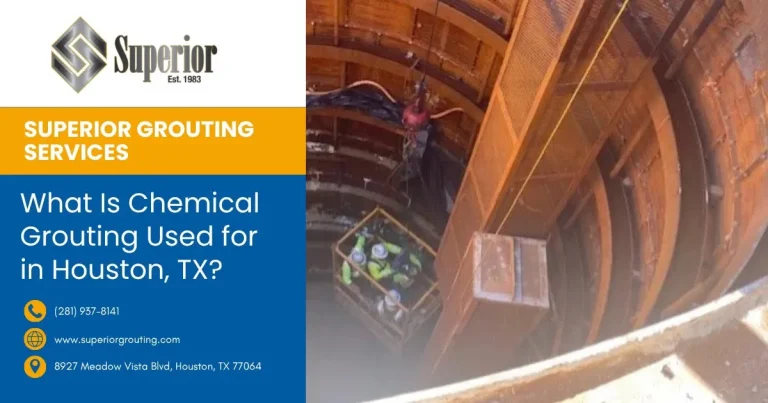
Chemical grouting is used to stabilize weak soils, underpin foundations, lift settled slabs, control machinery vibration, stop sewer infiltration, fill annular spaces around pipelines, seal culvert and tunnel leaks, and create groundwater cutoff barriers. Low-viscosity resins or gels are injected into soil voids and cracks, where they harden to bind particles or form watertight seals. In Houston, its trenchless nature makes it faster and less disruptive than excavation.
Houston's soft coastal clays, high groundwater, and flood-prone industrial corridors create serious challenges for foundations, underground utilities, and critical infrastructure, challenges that traditional excavation and replacement often can't solve quickly or affordably.
Chemical grouting offers a proven, trenchless solution by injecting specialized resins or gels into soil voids and cracks, where they harden to stabilize weak ground, lift settled slabs, seal leaking structures, and control water intrusion with minimal disruption to your operations. In this guide, you'll learn exactly what chemical grouting is, how it works in Houston's unique subsurface conditions, and the specific applications, from pipeline support to sewer rehabilitation, where it delivers the fastest, most cost-effective results.
How Chemical Grouting Works
Chemical grouting involves injecting low-viscosity liquid solutions into soil or around infrastructure to fill voids, bind particles, or create watertight barriers. Unlike traditional cement grouts, chemical grouts can permeate fine soils and tight spaces because of their water-like consistency.
The grouting process begins with drilling small-diameter access holes through slabs, foundations, or directly into the ground. Specialized grout is then injected under carefully controlled pressures, allowing it to flow into voids and pore spaces. Once in place, the grout hardens, sometimes within seconds, forming a solid mass that strengthens soil or seals leaks.
Different chemical grouts behave in different ways, and material selection is a core part of grouting practice. Some expand aggressively when they contact water, while others remain stable and form rigid barriers. The choice of material depends on soil conditions, project goals, and environmental factors specific to the Houston area. The table below summarizes the main applications covered in this guide.
| Application | What it accomplishes | Typical setting |
| Soil stabilization | Binds loose particles, increases bearing capacity | Sandy and silty soils under structures |
| Foundation underpinning | Supports existing footings without excavation | Slab-on-grade, limited-access sites |
| Slab lifting | Raises settled concrete to grade | Warehouse floors, docks, roadway panels |
| Vibration control | Increases soil stiffness and damping | Petrochemical plants, manufacturing |
| Sewer infiltration control | Seals joints and faults from inside the pipe | Municipal collection systems |
| Annular space filling | Fills voids between casings, liners, structures | Pipelines, utility structures |
| Culvert and tunnel sealing | Stops active leaks through cracks and joints | Drainage and transit infrastructure |
| Grout curtains | Creates subsurface water barriers | Embankments, manholes, foundations |
Soil Stabilization and Foundation Support
Strengthening Weak Soils
Chemical grouting increases the strength and stiffness of granular soils by filling voids with solutions that bind loose particles into stone-like masses. This technique is especially valuable in Houston, where sandy and silty soils often lack the bearing capacity needed for heavy structures.
The grouting technique works best in clean sands and gravels with adequate permeability. In cohesive clays and silts, solution grouts may not permeate well, limiting effectiveness. For these soil types, alternative ground improvement methods may be required.
Underpinning Existing Foundations
Chemical grouting is used for underpinning existing foundations where access is limited, such as beneath slab-on-grade buildings, pool decks, sidewalks, and lightly loaded structures. Small-diameter grout pipes are installed through slabs or near foundation edges, and solution grout is injected under controlled pressures to permeate cohesionless soils.
Microfine cement permeation grouting controls water seepage and provides temporary or permanent underpinning of foundations. This approach allows contractors to stabilize structures without excavation or major disruption to operations.
However, chemical grouting cannot fully compensate for severely undersized foundations or fundamental design flaws. When deep compressible layers cause large-scale settlement, deep foundations or other ground improvement techniques may be necessary.
Slab Lifting and Industrial Floor Repair
Polyurethane Grouting for Concrete Slabs
Polyurethane grouting is preferred for roadway slab jacking, port pavement repair, and industrial floor remediation throughout the Houston area. Contractors drill small holes through the slab and inject high-density polyurethane beneath it. The foam expands to fill voids, stabilize soil, and gently raise the slab to the desired elevation.
This method is used for highway panels, loading docks, warehouse floors, and critical industrial slabs where settlement affects operations. The lightweight foam imposes less additional load on stressed soils, and its closed-cell structure resists erosion and water penetration.
Advantages Over Traditional Methods
Polyurethane grouting offers several benefits over conventional mudjacking. The material cures quickly, often within minutes, allowing facilities to resume operations almost immediately. It also weighs significantly less than cement-based slurries, reducing the risk of further settlement.
Because polyurethane is preferred in Houston's hot, humid climate and soft coastal clays, it has become the go-to solution for many commercial and industrial applications across the Gulf Coast.
Vibration and Settlement Control
Reducing Machinery Vibration
Soil stabilization via grouting improves stiffness and damping characteristics of foundation soils, reducing vibration amplitudes that can damage sensitive equipment. This is particularly important in petrochemical facilities and manufacturing plants where vibration can cause structural damage and costly downtime.
A case example involves chlorinator structures vibrating beyond design limits in Gulf Coast chemical plants, causing structural damage and operational interruptions. Chemical grouting successfully stabilized the foundation soils, reducing vibration and extending equipment life.
Preventing Ongoing Settlement
Compaction grouting lifts, levels, stabilizes, and densifies soils while decreasing machinery vibration. By injecting thick grout into the subsurface, contractors create bulbs of compacted soil that increase bearing capacity and prevent future settlement.
Polyurethane injection beneath footings can increase bearing capacity and stop ongoing settlement without shutting down operations. This rapid-response capability is critical for industrial clients who cannot afford extended downtime.
Sewer System Infiltration Control
Stopping Groundwater Infiltration
Chemical grouting is one of the oldest trenchless technologies for stopping groundwater infiltration into sewer collection systems, engineered in the 1960s. Solution grouts are injected through pipe joints and faults using packer equipment positioned within the pipe.
Grouts with water-like consistency are forced through joints into adjacent bedding soil, where they displace air and water and rapidly gel in void spaces. This forms a watertight collar around the pipe or manhole, sealing leakage points and preventing groundwater percolation.
Packer Systems and Techniques
Mainline packers stop infiltration through pipe joints and circular cracks, while lateral packers seal leaks at lateral service connections. This targeted approach allows municipalities to address specific problem areas without replacing entire pipe sections.
Chemical grouting also seals the annulus between old pipes and new liners following CIPP installation. This ensures that rehabilitated pipes remain watertight and prevents soil migration into the annular space.
Pipeline and Annular Space Grouting
Grouting Utility Structures
Annular grouting is used to grout annular spaces within underground utility structures, between casings and carrier pipes, or between host structures and liners. Experienced contractors undertake long-distance pushes with minimal injection points using custom mix designs tailored to Houston's subsurface conditions.
Chemical grouts seal leaks in pipelines and conduits at joints, penetrations, and interfaces with structures. This is essential for oil and gas pipelines, water mains, and underground utilities that must remain leak-free to protect the environment and maintain service reliability.
Advantages of Polyurethane for Pipeline Sealing
Polyurethane resin can travel along leak paths, expand, and harden into watertight curtains more rapidly than traditional cement grouting. This rapid cure time minimizes downtime and allows critical infrastructure to return to service quickly.
For government agencies and large corporations managing extensive pipeline networks, this speed and reliability make polyurethane grouting a preferred solution across the Gulf Coast region.
Culvert and Tunnel Leak Sealing
Hydro-Active Grouts for Water Control
Hydro-active grouts, including polyurethane resins, seal water seepage through cracks and joints in culverts and tunnels. These materials react with water to form expanding foams that fill voids and stop active leaks.
Grouts may be directly injected into concrete structures to seal cracks or introduced into the soil behind the structure, creating a waterproof curtain. The choice depends on the source of the leak and accessibility.
Soil Permeation Around Culverts
Soil permeation grouting with low-viscosity polymer foam resins permeates loose soil around culverts, achieving stabilization and compaction. This dual benefit stops leaks while also preventing future settlement that could cause additional damage.
Polyurethane grouting can travel along leak paths, expand, and harden into watertight curtains nearly instantaneously compared with cement-based methods. This makes it ideal for emergency repairs during heavy rainfall events common in Houston.
Groundwater Control and Grout Curtains
Creating Subsurface Barriers
Low-viscosity chemical grouts penetrate permeable layers in embankments and foundations, forming subsurface barriers that reduce seepage and uplift pressures. These grout curtains protect structures from erosion and hydraulic forces.
Acrylic and acrylamide solution grouts create continuous, impervious barriers because they can permeate fine soils and maintain integrity under hydraulic stress. Their extremely low viscosity enables penetration of small pores and fissures, making them highly effective for creating water barriers.
Encapsulating Structures
Grout curtains are created around manholes by drilling holes through walls and injecting chemical grout into surrounding soil, encapsulating the structure in a watertight envelope. This prevents groundwater from entering the structure and protects against soil erosion around critical infrastructure.
This technique is widely used by public works departments and utility agencies throughout Houston and surrounding states to protect aging infrastructure from water intrusion.
Types of Chemical Grout Materials
Polyurethane Grouts
Polyurethane grouts are delivered as two liquid components that mix at the pump and expand aggressively upon reacting with water or air. They fill cracks, seek out water pathways, and bond to concrete or soil particles, forming closed-cell matrices.
Hydrophilic systems attract water and swell; hydrophobic systems repel water and form durable, low-permeability barriers. The choice between these systems depends on whether the goal is to seal active leaks or create long-term structural support.
Acrylamide and Acrylate Grouts
Acrylamide and acrylate grouts have extremely low viscosity that enables penetration of small pores and fissures, making them highly effective for creating impervious water barriers in fine soils.
However, acrylamide is toxic. The EPA proposed a ban that was later withdrawn, but safety precautions are required. NMA (N-methylolacrylamide) is used where acrylamide cannot be used due to toxicity concerns, such as in drinking water lines.
NMA may be less stable than acrylamide under constant groundwater head, particularly in acidic conditions. Contractors must carefully evaluate site conditions and regulatory requirements when selecting grout materials.
Limitations and Considerations
Soil Type Restrictions
Chemical grouting effectiveness is greatest in clean sands and gravels with adequate permeability. In cohesive clays and silts, solution grouts may not permeate well, limiting the technique's applicability.
Large-scale settlement problems caused by deep compressible layers may require deep foundations or other ground improvement techniques. A thorough geotechnical investigation is essential to determine whether chemical grouting is appropriate for a given site, and a site assessment is the practical first step.
Pressure Control and Risks
Excessive injection pressures can fracture soils or structures, causing heave or damage. Experienced contractors use real-time pressure monitoring and staged injection protocols to prevent these problems.
Chemical grouting cannot fully compensate for severely undersized foundations or fundamental design flaws. When structural issues stem from inadequate design rather than soil conditions, more comprehensive remediation may be necessary.
Working with a safety-first, technically proficient grouting company ensures that projects are executed with state-of-the-art equipment and rigorous quality control, minimizing risks and maximizing long-term performance.
Key Takeaways
- Chemical grouting injects low-viscosity resins or gels into soil voids and cracks to stabilize weak ground, lift settled slabs, and seal leaks, all without excavation or major disruption to your operations. It's especially valuable in Houston's soft coastal clays and high-groundwater conditions where traditional methods are slow or impractical.
- Polyurethane foam grouting is the preferred choice for slab lifting and leak sealing in Houston because it expands rapidly, weighs far less than cement, and cures within minutes so operations can resume almost immediately. It can save 40 to 70 percent compared to full replacement while extending service life by decades.
- The technique works best in clean sands and gravels with good permeability. In cohesive clays and silts, solution grouts may not penetrate well enough to be effective. Always start with a thorough geotechnical investigation to confirm that chemical grouting is appropriate for your soil conditions.
- Excessive injection pressures can fracture soils or damage structures, and chemical grouting cannot fix severely undersized foundations or fundamental design flaws. Work only with experienced contractors who use real-time pressure monitoring, staged injection protocols, and rigorous quality control to minimize risks.
- Chemical grouting complements other repair methods, such as CIPP lining for sewers or deep foundations for major settlement, rather than replacing them. For the best long-term results, pair grouting with proper drainage, regular monitoring, and maintenance tailored to Houston's flood-prone environment.
- The common thread across every application is access. Chemical grouting solves problems from inside a pipe, through a small hole in a slab, or from the surface, which is why it fits facilities that cannot afford excavation or extended shutdowns.
Conclusion
Chemical grouting earns its place in Houston because of what it does not require. There is no excavation, no extended shutdown, and no rebuilding of what already works. Injected through a small hole or from inside a pipe, low-viscosity resins and gels reach the voids, joints, and pore spaces where the actual problem lives, then harden into either a bound soil mass or a watertight seal.
That single capability covers a wide range of work: strengthening loose sands, underpinning slab-on-grade foundations, raising settled warehouse floors and roadway panels, damping vibration under petrochemical equipment, sealing sewer joints and CIPP annuli, filling pipeline annular spaces, and building grout curtains around manholes and embankments. The limits are equally clear. It performs best in clean, permeable soils, it will not fix an undersized foundation, and it demands controlled pressure and a geotechnical investigation up front. Matched to the right conditions, it is the fastest and least disruptive way to stabilize Gulf Coast infrastructure.
Stabilize Houston infrastructure without excavation or extended downtime.
Schedule a site assessment with the Superior Grouting team.