

What Is the Difference Between Chemical Grouting and Compaction Grouting in Houston, TX?
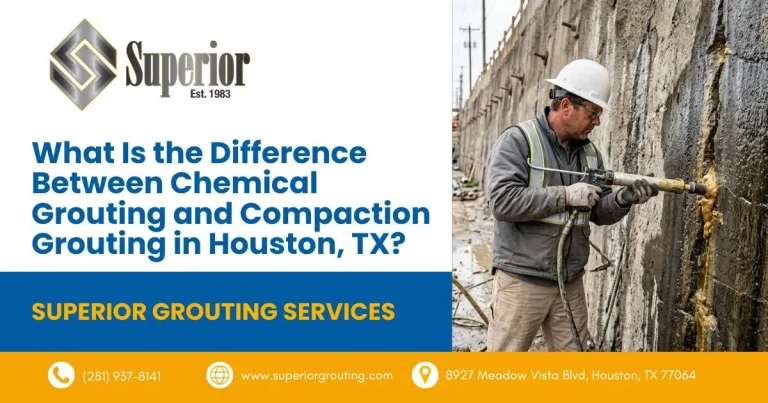
Chemical grouting uses low-viscosity liquid that flows into soil pores to seal leaks and strengthen ground without moving it, ideal near sensitive structures. Compaction grouting uses stiff, low-mobility grout that deliberately displaces and densifies loose soil, making it the choice for lifting settled structures and filling voids. Chemical grouting controls water; compaction grouting corrects settlement.
When soil beneath your Houston facility starts to settle, leak, or lose bearing capacity, choosing the right ground improvement method can mean the difference between a quick fix and costly downtime. Chemical grouting and compaction grouting are two powerful soil stabilization techniques that both inject material underground, but they work in fundamentally different ways and solve different problems.
If you're wondering whether to seal groundwater intrusion around a Ship Channel structure, densify loose fill beneath a pipeline, or correct settlement without disturbing operations, understanding when to use each grouting technique is essential. This guide breaks down how chemical grouting and compaction grouting differ in application, soil types, materials, and outcomes so you can make the right decision for your project.
Understanding Chemical Grouting and Compaction Grouting
Both chemical grouting and compaction grouting are proven soil stabilization techniques, but they work in fundamentally different ways and solve different problems. Choosing the right method depends on your soil conditions, project goals, and tolerance for ground movement.
How Chemical Grouting Works
Chemical grouting, also called permeation grouting, uses low-viscosity, liquid grouts that flow into existing pore spaces and fractures without significantly disturbing the soil skeleton. The grout penetrates the soil much like water, filling voids and bonding soil particles together as it cures.
This grouting technique is particularly well suited for applications beneath or adjacent to existing foundations, slabs, and structural elements where inducing heave or displacement would be unacceptable. The soil structure remains largely intact while gaining strength and reduced permeability.
Common chemical grout materials include:
- Sodium silicate solutions
- Acrylic gels
- Polyurethane resins (both hydrophobic and hydrophilic formulations)
Polyurethane grouts are widely used for leak sealing, void filling, and soil stabilization in saturated environments like seawalls or wet utility corridors.
How Compaction Grouting Works
Compaction grouting, sometimes called low-mobility grouting, takes the opposite approach. It relies on stiff, low-slump cementitious or aggregate grouts that form localized bulbs and deliberately displace surrounding soil.
The process involves inserting an injection pipe to the maximum treatment depth, then injecting grout as the pipe is slowly withdrawn in stages. This creates a column of overlapping grout bulbs that displace and densify the adjacent soil, increasing bearing capacity and correcting settlement.
Unlike chemical grouting, compaction grouting is designed to move soil. The stiff grout mixture remains in place and expands as a coherent mass rather than flowing through pore spaces.
Key Differences Between the Two Methods
Grout Material and Behavior
The most visible difference is the grout itself. Chemical grouting uses thin, pourable liquids similar in consistency to water or milk. These non-particulate chemical solutions can penetrate fine-grained soils and small fractures.
Compaction grouting uses a mortar-like mixture with the consistency of cookie dough or stiff concrete. This low-mobility grout cannot flow through soil. Instead, it pushes soil aside as it expands.
Soil Movement and Displacement
Chemical grouting produces very low ground movement because the soil skeleton is preserved. Grout simply fills the spaces between particles and bonds them together. This makes it ideal for sensitive sites where adjacent structures cannot tolerate settlement or heave.
Compaction grouting intentionally causes moderate to significant soil displacement. The expanding grout bulbs compress loose soil, increasing its density. This controlled displacement can be used to lift settled structures back to grade or densify weak zones.
Soil Type Compatibility
Chemical grouting works best in granular soils like sand and gravel with sufficient permeability, as well as fissured soils and some fractured rock. The soil must allow the liquid grout to flow through its pore structure.
Compaction grouting is effective in loose or collapsible soils, man-made fills, sands, silts, organic soils, and many clays capable of mechanical compaction. It works in a wider range of soil types because it doesn't rely on permeability.
Primary Objectives
The benefits of chemical grouting center on permeability control and minimally invasive strengthening. Common goals include:
- Reducing groundwater infiltration and sealing leaks
- Forming cutoff barriers and containment walls
- Strengthening soil beneath existing foundations
- Stabilizing tunnel faces and excavation walls
Compaction grouting focuses on densification and structural correction:
- Correcting settlement and lifting structures
- Densifying loose soils to prevent future settlement
- Filling voids and stabilizing sinkholes
- Mitigating liquefaction risk in seismic zones
The table below summarizes the core contrasts between the two methods.
| Factor | Chemical Grouting | Compaction Grouting |
| Grout consistency | Thin liquid, near water | Stiff, cookie-dough mortar |
| Soil interaction | Fills pores, preserves skeleton | Displaces and densifies soil |
| Ground movement | Very low | Moderate to significant, by design |
| Best soils | Permeable granular, fissured rock | Loose fills, sands, silts, many clays |
| Primary goal | Seal water, minimal-disturbance strengthening | Densify soil, lift and correct settlement |
Applications in Houston's Unique Soil Environment
Houston Soil Challenges
Houston sits atop a complex geological environment characterized by thick sequences of soft clays, interbedded sands and silts, man-made fills, and high groundwater levels. Geotechnical studies document very loose to loose sand fills with shell fragments and local clay lenses throughout the region.
These conditions create specific challenges: low-density granular soils prone to settlement, heterogeneous fills that behave unpredictably, and saturated zones where groundwater movement can erode soil and undermine structures.
When to Use Chemical Grouting in Houston
Chemical grouting excels in Houston applications where permeability reduction and minimal disturbance are priorities:
Foundation stabilization: Strengthen sandy soils beneath commercial and industrial properties without inducing movement that could damage the structure.
Waterfront and coastal structures: Polyurethane permeation grouting strengthens weakened soils beneath seawalls without excavation, seals leaks, and prevents further erosion or washout, critical along Houston's extensive ship channel and bayou network.
Utility and pipeline infrastructure: Secure annular spaces around culverts, seal leaks in manholes and vaults, and stabilize soils around buried lines serving Houston's oil and gas, petrochemical, and public works sectors.
Tunneling projects: Stabilize soil around tunnel break-ins and break-outs for Houston's expanding underground utility and transit infrastructure.
When to Use Compaction Grouting in Houston
Compaction grouting is the preferred solution when densification, void filling, or controlled lifting is required:
Settlement correction: Lift settled buildings and structures back to grade without excavation, especially valuable in Houston's expansive clay soils where differential movement is common.
Industrial facilities: Stabilize machinery pads, reduce vibration transmission, and level equipment foundations in Houston's extensive petrochemical and manufacturing corridor.
Pipeline infrastructure: Lift pipelines to grade without excavation, restore deformed pipes, and stabilize loose bedding materials, critical for Houston's vast network of oil, gas, and chemical pipelines.
Sinkhole stabilization: Fill subsurface voids and compress surrounding soils in karstic or void-prone formations, addressing localized collapse features that occasionally appear in Houston's geology.
Liquefaction mitigation: Densify loose, saturated sands to reduce earthquake liquefaction risk at critical infrastructure sites.
Choosing the Right Method for Your Project
Site Investigation Requirements
Proper method selection begins with thorough site characterization. Characterize soil stratigraphy, density, permeability, groundwater conditions, and existing voids through borings, cone penetration tests, geophysical surveys, and visual inspections.
Key data points include:
- Soil type, grain size distribution, and layering
- In-situ density and bearing capacity
- Permeability and groundwater flow patterns
- Presence of voids, loose zones, or collapsible layers
- Proximity and sensitivity of adjacent structures
Matching Method to Problem
Once you understand site conditions, match the grouting process to your primary concern.
Choose chemical grouting when:
- Groundwater infiltration or leakage is the main issue
- Soil permeability must be reduced
- Adjacent structures cannot tolerate any movement
- Working in permeable granular soils or fractured rock
- Creating cutoff barriers or containment zones
Choose compaction grouting when:
- Soil is too loose and settlement is occurring or expected
- Structures have already settled and need lifting
- Voids or sinkholes require filling and stabilization
- Liquefaction mitigation is needed
- Working in a wide range of soil types including clays
Regulatory and Specification Compliance
For public infrastructure projects in Texas, contractors must meet specific qualifications. The TxDOT Special Specification 4179 requires contractors performing compaction grouting to have at least three years of experience in soil-cement grouting involving pressures above 200 psi and to submit documentation of similar work and equipment.
As a preferred pressure and polyurethane grouting partner for government agencies and large corporations across Houston and the Gulf Coast, selecting a contractor with proven technical expertise, state-of-the-art equipment, and a safety-first approach ensures compliance and project success. A qualified specialty grouting contractor will document crew experience, submit equipment and mix-design records, and maintain the injection-pressure and volume logs that public agencies require for acceptance. These records matter because compaction grouting on public infrastructure is often tied to strict verification: agencies want evidence that grout takes, pressures, and heave monitoring stayed within design limits at every injection point. On active industrial sites, the same documentation supports warranty coverage and protects the owner if settlement recurs. To confirm scope, specifications, and qualifications before mobilization, it is worth taking time to schedule a project assessment so site conditions and agency requirements are built into the plan from the start. General background on grouting techniques is available through national engineering references.
Combined Approaches
Some complex projects benefit from using both methods in sequence or in different zones. For example, compaction grouting might first densify loose soils and fill large voids, followed by chemical grouting to reduce permeability and seal remaining pathways for water infiltration.
A qualified geotechnical grouting contractor can design a hybrid approach tailored to your site's specific challenges and performance requirements.
Key Takeaways
- Chemical grouting uses liquid solutions that flow through soil pores to seal leaks and strengthen without moving the ground, ideal when adjacent structures can't tolerate any settlement or heave. Compaction grouting uses stiff grout to intentionally displace and densify loose soil, making it the right choice for lifting settled structures or filling voids.
- Choose chemical grouting when groundwater infiltration is your main problem or when working near sensitive foundations; choose compaction grouting when soil is too loose, structures have already settled, or you need to fill sinkholes and stabilize collapsible fills.
- Houston's loose sand fills, high groundwater, and heterogeneous soils require careful site investigation, including soil type, permeability, density, and proximity to existing structures, before selecting a grouting method.
- Both methods work beneath existing buildings with minimal surface disruption, but compaction grouting requires careful monitoring to avoid over-heave, while chemical grouting demands environmental assessment due to potential groundwater interactions.
- For complex projects, using both methods together often delivers the best results: compaction grouting first densifies loose zones and fills large voids, then chemical grouting seals remaining pathways and controls water infiltration.
- The deciding question is whether you need to move soil or preserve it. Compaction grouting is built to displace and densify; chemical grouting is built to permeate and seal without disturbance, and that distinction usually points directly to the right method.
Conclusion
Chemical grouting and compaction grouting both inject material underground, but they are built for opposite purposes. Chemical grouting flows into the soil and seals it while leaving the ground undisturbed, which is exactly what sensitive sites and water-control problems demand. Compaction grouting displaces and densifies the soil on purpose, which is what settled structures, loose fills, and voids require.
For Houston's mix of soft clays, loose sand fills, and high groundwater, the deciding question is usually simple: do you need to preserve the soil or move it? Seal a leak near a sensitive foundation, and chemical grouting is the answer. Lift a settled slab or densify collapsible fill, and compaction grouting is. On the most complex projects, a properly sequenced combination of the two delivers what neither could alone, which is why the right first step is always a thorough site investigation with a contractor who runs both.
Match the right grouting method to your Houston project's conditions.
Contact Superior Grouting for a project consultation.