

Does Lifting Concrete With Foam Work in Houston, TX?
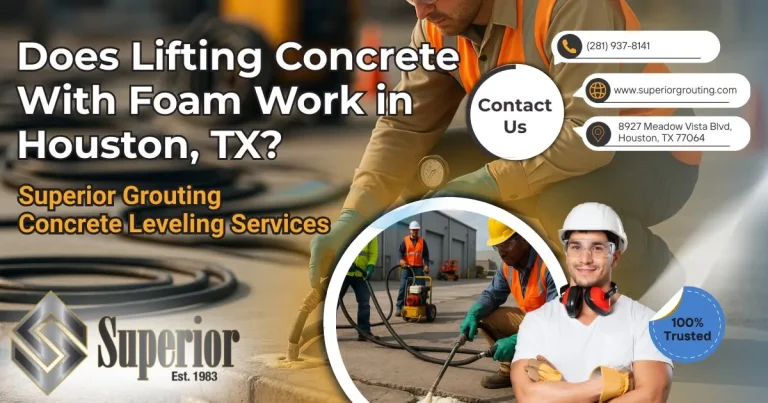
Yes, polyurethane foam concrete lifting works effectively in Houston. This proven method restores settled commercial and industrial slabs by filling voids, stabilizing subgrade, and lifting concrete to level with minimal demolition and downtime compared to full replacement.
Houston concrete faces constant challenges from soil movement, intense rain events, drought cycles, and heavy commercial traffic loads. When a concrete slab loses support, it can drop, rock, or separate at joints, creating uneven surfaces that disrupt operations and increase safety risk. A concrete leveling company using polyurethane foam injection can restore slab integrity while stabilizing conditions beneath the surface.
Unlike traditional concrete replacement, polyurethane foam concrete lifting focuses on restoring existing concrete while addressing what happens beneath the slab. The process uses controlled injection to fill voids, support the slab, and lift concrete with minimal disruption. For organizations seeking reliable concrete lifting solutions, foam offers an effective strategy that minimizes downtime while delivering durable results.
Key Takeaways
- Foam Lifting Works Well in Houston Conditions: Concrete lifting and leveling perform effectively in Houston because expanding polyurethane foam addresses voids and stabilizes the region’s unstable soils beneath concrete slabs.
- Polyurethane Injection Delivers Speed: The foam cures within minutes, allowing treated areas to return to service much faster than new concrete placement, which requires extended curing time.
- Controlled Injection Provides Precision: Polyurethane concrete raising enables staged lifting and stabilization, allowing precise elevation control rather than relying on heavier, less predictable methods.
- Lightweight Material Offers Strength: High-density polyurethane foam delivers strong compressive capacity without overloading weak subgrade, making it well-suited for Houston’s sensitive soil conditions.
- Foam Outperforms Traditional Mudjacking: Foam lifting provides a superior alternative to traditional mudjacking when erosion resistance, void filling, and long-term base stability are priorities for commercial facilities.
- Professional Services Ensure Results: Proper injection planning and execution help achieve lift targets while preserving the structural integrity of concrete slabs throughout the project.
Why Houston Sites Experience Sunken Concrete Slabs
Settlement at industrial and commercial properties typically traces back to conditions beneath concrete slabs where soil changes, water movement, and repeated loading create voids and compromise support.
Houston's expansive clays shrink and swell dramatically. Over time, this movement opens gaps under slabs, leaving sections unsupported. Once voids develop, heavy traffic pushes concrete downward. The result is uneven concrete that represents a support issue rather than simply a surface problem.
Drainage failures, leaking utilities, and uncontrolled runoff drive erosion. Fine soils migrate, leaving hollow pockets. If you only patch cracks on top but ignore voids, movement continues. Concrete raising services deliver superior outcomes when addressing the real problem with targeted injection.
Commercial and industrial operations produce repeated loads and vibration through forklift paths, loading lanes, equipment corridors, and staging areas. When slabs are weakened by voids, those loads accelerate settlement. Polyurethane concrete lifting offers stabilization that supports slabs rather than replacing them prematurely.
What Is Concrete Lifting with Polyurethane Foam?
Concrete lifting, also called concrete raising or leveling, returns sunken slabs to safer, more functional elevation. With polyurethane foam, high-density material is injected beneath concrete that expands, fills voids, and generates controlled lift.
| Method | Material | Weight | Cure Time | Water Resistance |
| Polyurethane foam | Closed-cell polymer | Lightweight | Minutes | High |
| Traditional mudjacking | Cement slurry | Heavy | Hours to days | Low |
Traditional mudjacking uses heavier slurry to lift concrete. While it works in some situations, it may add weight to sensitive soils and can be prone to washout under certain drainage conditions. Polyurethane foam is significantly lighter, and closed-cell foam is moisture-resistant, helping reduce washout risks and supporting longer-term stability in wet-prone environments.
How the Polyurethane Injection Process Works
A successful lift depends on process control. Experienced grouting services treat concrete leveling as an engineered procedure designed to protect concrete integrity while achieving measurable lift and support.
Before injection, contractors assess elevations, joints, slab thickness, load requirements, and risks to surrounding features. They identify water sources, erosion patterns, and likely void locations. This evaluation ensures the concrete raising solution addresses causes rather than just symptoms.
Small holes are drilled into concrete to place injection ports. These access points allow foam injection beneath the slab while keeping demolition minimal. The goal is lifting concrete evenly and avoiding stress concentrations that could damage repair areas.
A two-part polyurethane foam is injected. As materials combine, foam expands and performs void filling while consolidating weak zones. This stage combines lifting and stabilization: first support, then lift. Technicians monitor lift height carefully to achieve leveled transitions and reduce trip hazards. The process can be performed in small increments, allowing precise concrete leveling without overcorrection.
One major advantage is that foam cures quickly. In many cases, foam cures within minutes, allowing faster access than traditional concrete replacement which requires demolition, forming, pouring, and extended cure windows.
Why Polyurethane Foam Works Well in Houston
High-density polyurethane foam is engineered for performance. Once cured, it provides excellent compressive strength and creates a stable, lightweight support layer. This maintains existing concrete integrity while improving base conditions.
Because polyurethane foam is closed-cell, it does not readily absorb water. In areas where water movement contributes to erosion and void formation, foam solutions reduce pathways where soils wash out. While drainage corrections may still be needed, foam beneath concrete slabs endures wet conditions better than many traditional fill options.
Traditional concrete replacement typically requires major disruption including saw cutting, haul-off, subgrade work, new concrete placement, and curing time. Foam lifting uses small injection holes and compact equipment. For many sites, this minimal disruption means operations continue in phases without shutting down entire traffic zones.
Concrete Lifting vs. Traditional Replacement
When deciding between concrete lifting and replacement, the key question is whether the concrete slab remains structurally sound. If the slab has acceptable structural integrity and the main issue is settlement from voids or subgrade loss, polyurethane foam concrete lifting is often the best approach.
| Consideration | Choose Foam Lifting | Choose Replacement |
| Slab condition | Intact but uneven | Widespread breakage, major spalling |
| Timeline | Quick turnaround needed | Extended closure acceptable |
| Budget | Cost-effective solution | Full reconstruction warranted |
| Subgrade | Localized voids | Extensive failure requiring rebuild |
| Disruption tolerance | Minimal downtime required | Can accommodate major work |
Foam lifting is commonly selected when slabs are intact but uneven at joints or transitions, when sunken concrete creates operational hazards, when concrete leveling needs must be addressed quickly with limited site interruption, when preserving existing concrete avoids unnecessary new concrete work, and when the goal is restoring function while protecting operations.
Replacement may be necessary if slabs have widespread breakage or loss of structural integrity, if thickness or reinforcement is insufficient for operational loads, if subgrade failure is extensive and requires full reconstruction, or if correcting drainage slopes requires major regrading beyond what lift and level can achieve.
Where Concrete Lifting Delivers Most Value
Concrete leveling services in Houston are frequently used for distribution and logistics yards including travel lanes and staging areas, loading dock approaches and dock level transitions, industrial walkways and facility egress routes, equipment pads and structural support slabs, and parking decks and large-scale paved panels at commercial facilities.
These environments where shutdown time equals real cost benefit most from polyurethane foam concrete lifting. Because the process reduces downtime, it becomes the preferred concrete lifting solution for high-traffic sites that cannot tolerate long closures.
Risks and Limitations
Foam lifting is highly effective concrete repair when used appropriately, but it has limits. Qualified teams outline what can be achieved and what cannot.
Potential limitations include ongoing water intrusion that continues erosion under slabs, extremely weak soils requiring broader foundation repair strategies, slabs already compromised in structural integrity, and drainage design that constantly pushes water beneath concrete slabs.
Trusted concrete contractors mitigate risks by planning injection points to distribute lift forces, lifting in controlled stages to protect existing concrete integrity, selecting high-density polyurethane appropriate for load paths, and confirming slab response during injection while adjusting the process in real time.
Conclusion
Lifting concrete with polyurethane foam works effectively in Houston, particularly for commercial and industrial sites experiencing settlement from voids, erosion, and shifting soils. With controlled polyurethane injection, crews fill voids beneath concrete slabs, lift concrete, and deliver durable leveling with minimal disruption. When concrete integrity remains sound, polyurethane concrete raising is often the most efficient path to restore safe, level surfaces without extended impacts of traditional replacement.
Contact Superior Grouting to evaluate your settled slabs and determine the most effective concrete leveling approach for your Houston facility.
Get a concrete lifting assessment today.
Request your free consultation now.