Port Arthur, Texas
Specialty Grouting Services in Port Arthur, TX
Superior Grouting Services delivers commercial and industrial pressure grouting across Port Arthur and the Sabine-Neches industrial corridor. From compaction grouting beneath Motiva, Valero, and TotalEnergies refinery foundations to pipeline abandonment along petrochemical corridors that trace back to the 1902 Spindletop boom, our crews address the soil, infrastructure, and turnaround-window challenges that come with the highest concentration of refining capacity in the United States. Schedule a free on-site evaluation.

Industrial Grouting for America's Refining Capital
Superior Grouting Services has provided pressure grouting in Port Arthur, TX since 1983, supporting the refining, petrochemical, LNG export, and pipeline sectors that drive the Golden Triangle. As permeation grouting contractors texas refinery operators specify on Sabine-Neches projects, we deliver soil stabilization, structural rehabilitation, and pipeline decommissioning for some of the most demanding industrial environments in the United States.
Port Arthur sits on Gulf Coast alluvial clay similar to the Beaumont Formation, with a year-round high water table and subsidence pressure from refinery footprints spanning thousands of acres. Motiva (607,000 bpd, 3,600 acres, Saudi Aramco-owned), Valero (335,000 bpd, 4,000 acres), and TotalEnergies (238,000 bpd plus the BASF/TotalEnergies steam cracker and the $2 billion Baystar ethane cracker commissioned 2022) anchor 1.1+ million bpd combined. Sempra's Port Arthur LNG terminal is under construction, Huntsman and Eastman Chemical operate adjacent complexes, and the Sabine-Neches Waterway connects all of it to deep-water shipping.
Superior Grouting provides compaction, permeation, cellular, polyurethane, pipeline, and concrete leveling work for Golden Triangle foundations, settled slabs, and refinery, port, and highway subgrades. With 1,424,346+ linear feet grouted and 1,992,265+ square feet of concrete raised, we bring four decades of documented performance to every project.
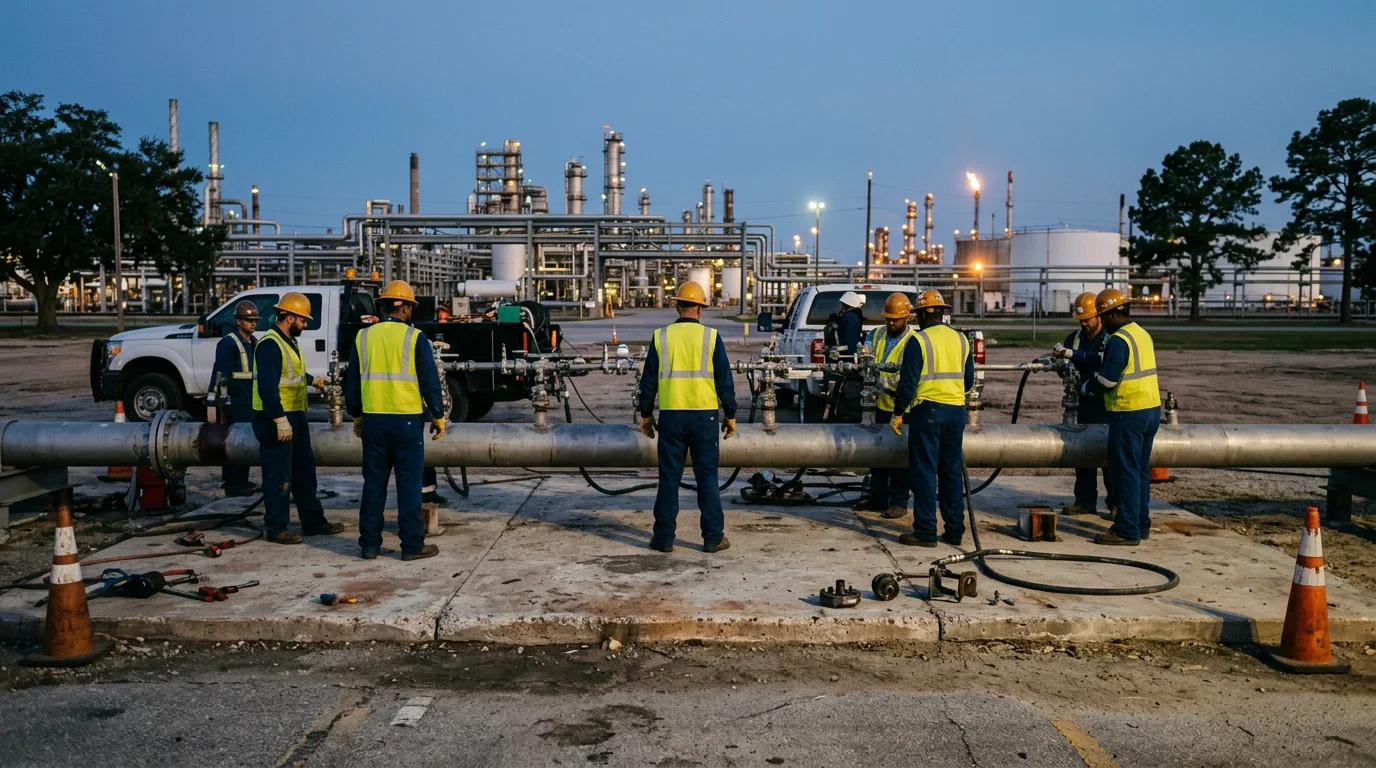

Compaction Grouting in Port Arthur, TX
Refinery and petrochemical loading in Port Arthur produces ground-improvement demand that no other U.S. market matches in scale. Heavy reactor pads at Motiva, towering crude storage tanks at Valero, BASF/TotalEnergies steam cracker foundations, and continuous truck and rail loading on access drives across thousands of acres of operating refineries drive subgrade settlement that has to be corrected without taking the unit offline. Our compaction grouting crews inject low-slump, low-mobility grout through small-diameter casings to densify weak Gulf Coast clay beneath these loads, often paired with permeation grouting where the soil profile calls for cement migration into a sand-and-gravel matrix rather than displacement. Bearing capacity is verified against engineer-specified post-treatment targets within hot-work permit windows and turnaround sequencing.
Densification beneath refinery infrastructure follows a sequencing discipline that is as much operational as geotechnical: hot-work permits, contractor lockouts, OSHA 29 CFR 1926 compliance, and turnaround windows govern when injection can occur. Work is staged beneath tank ringwalls, reactor pads, and pipe-rack foundations on outage schedules that allow the unit to return to service on time. Documentation goes to the owner for TCEQ Region 10 records and integrates with EPA air and water permit files where applicable.
Controlled lifting solves real problems on tank pads, rail spurs, and unit-access drives where settlement has produced operational hazards. Permeation grouting contractors texas refinery and pipeline operators trust deliver lift in measured increments tied to facility benchmarks, holding the work within tolerance and keeping the unit accessible. Process units stay online, operators stay at their panels, and the contractor walks off with a signed lift log.
Pre-construction grouting on new tank pads, expansion capex on petrochemical sites, and ground-improvement specs for process pipe support apply compaction or permeation grouting to bring the subgrade to design bearing capacity before construction. The Sempra LNG site, the Baystar $2B ethane cracker expansion, and ongoing Motiva modernization capital projects all use this as standard practice.
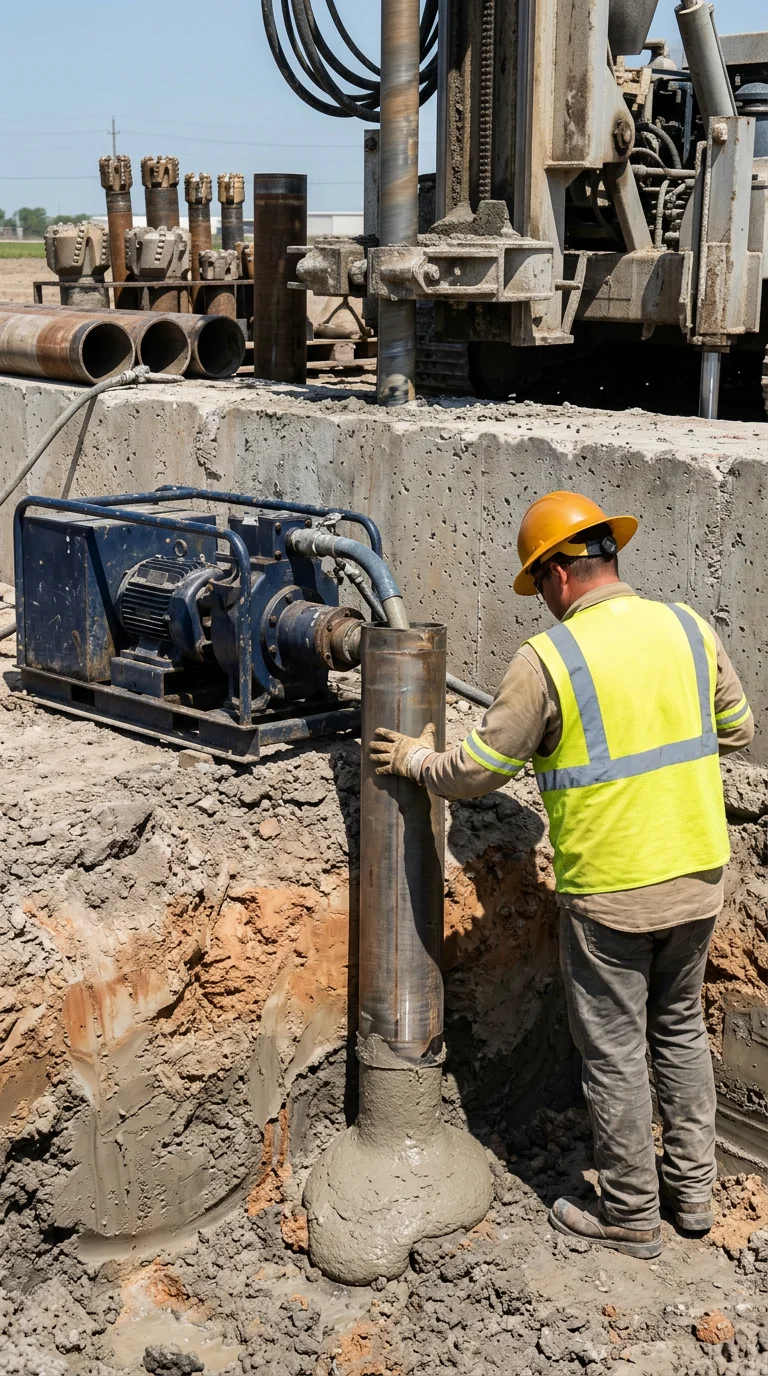
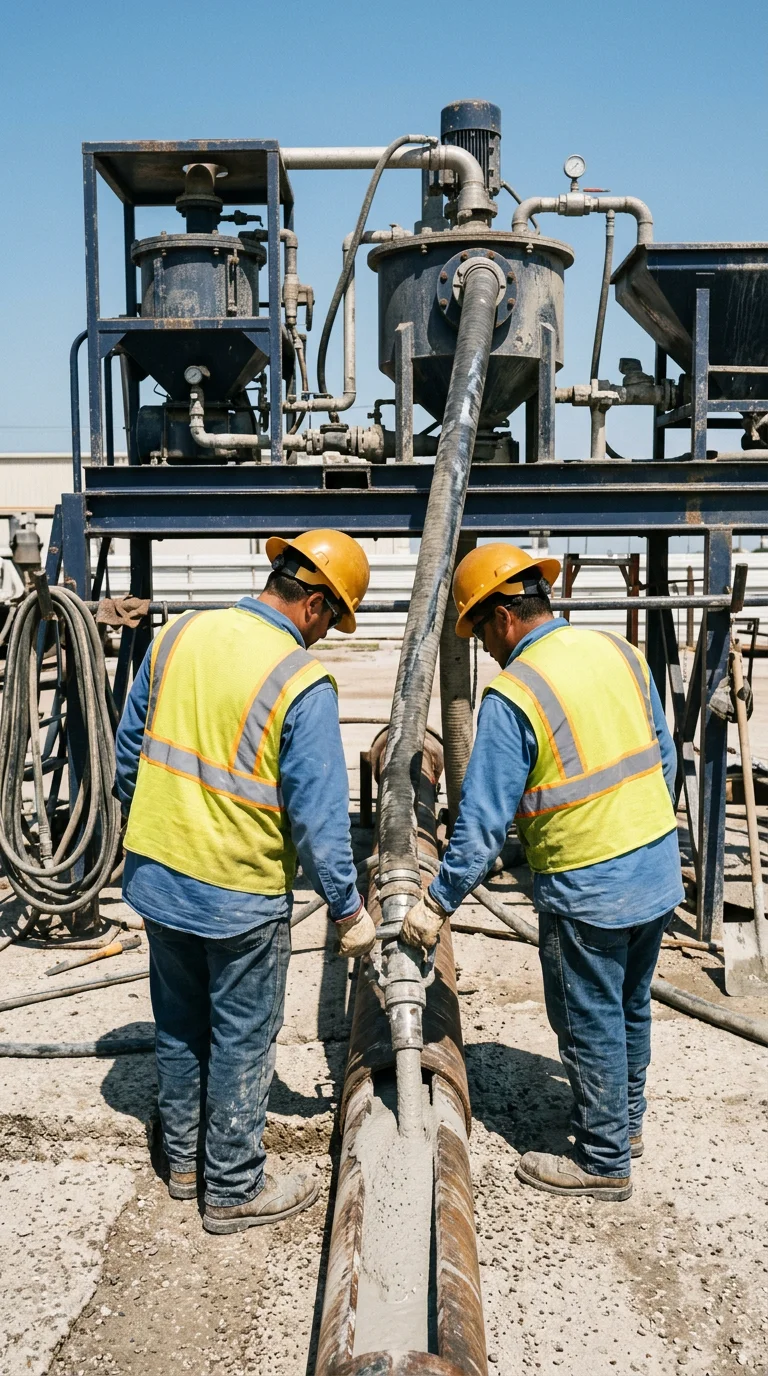
Cellular Grouting in Port Arthur, TX

Void-fill demand in Port Arthur is driven by decommissioned process tanks at Motiva and Valero, abandoned utility tunnels and pipeline annular spaces during refinery re-lining, the Port Arthur LNG construction site, and load-reducing backfill behind bulkheads on the Sabine-Neches Waterway. Cellular grout solves the heavy-overburden and high-water-table problem at once. Our CreteFoam-based mixes pump thousands of feet at low pressure inside a live refinery.
The cellular grouting cost in Port Arthur for a large-volume refinery fill usually beats conventional concrete the moment mobilization and ready-mix pricing is available. A 20 PCF wet-cast batched at a portable plant pumps across an active unit at Motiva or Valero into a decommissioned vessel foundation without staging dozens of loads. The low unit weight means the surrounding subgrade is not re-stressed, and self-consolidation eliminates vibration work in confined refinery excavations.
For annular fills behind re-lined refinery pipelines, load-reducing backfill against bulkheads along the Sabine-Neches Waterway, and decommissioned stormwater structures across the Jefferson County industrial grid, cellular foam is the default specification. Density is tuned at the plant against engineer's psi targets. In Port Arthur's shallow water table, we also push densities above the soil unit weight, where buoyancy would otherwise drive a lightweight mix back up through the saturated backfill.
Two mix families cover most of the Golden Triangle work: lightweight, neat mixes for load-reducing backfill and annular space, and sanded mixes near 70 PCF for structural backfill under reactor pads, tank ring foundations, and transfer lines. Concrete bulkhead construction port neches tx specifications are accommodated within the cellular scope where the project calls for combined fill and bulkhead work.
Polyurethane Grouting in Port Arthur, TX
Slabs settle on Port Arthur ground for reasons that are unique even within the Gulf Coast: 1.1 million bpd of combined refining loading, decades of cyclic moisture from refinery process water, hurricane saturation events compounding existing subsidence, and low-level industrial vibration from rotating equipment all conspire to pump fines out from under concrete flatwork. Polyurethane grouting injects expanding foam in minutes, restores grade, and clears the work zone in time for the next operations shift.
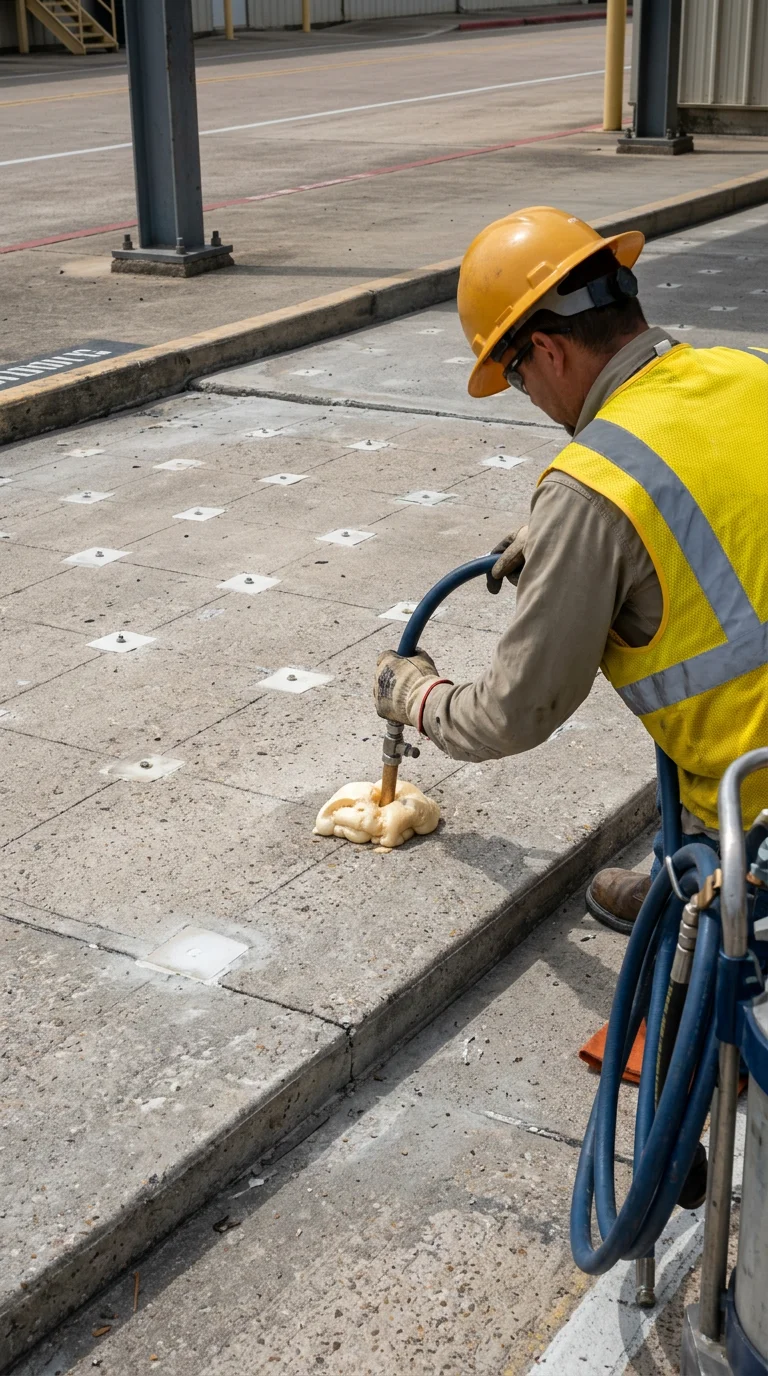
Refinery loading aprons at Motiva and Valero, BASF/TotalEnergies steam cracker access roads, warehouse floors along the Neches River corridor, and truck-scale approaches across Jefferson County share a common failure mode: heavy wheel paths that have rolled fines out of the saturated clay subgrade. Foam is staged across the affected aisle on a 3-to-5-foot grid and tied to a facility benchmark, and the closed-cell cure resists the cyclic refinery process water that moved the fines out in the first place.
Commercial and industrial foundations along the Port Arthur corridor carry hydrostatic pressure from a shallow water table, cyclic moisture from refinery process water, and low-level shock from rotating equipment. Polyurethane foundation repair in Port Arthur restores contact between concrete and subgrade by injecting beneath grade beams in staged lifts. Differential movement at the slab-and-footing joint resolves with the building still in service.
Refinery applications expose grout to salt air, hydrocarbon vapors, vibration, and continuous loading. Polyurethane stays chemically stable, dimensionally consistent under load, and waterproof against cycling groundwater — across Motiva, Valero, TotalEnergies, Huntsman, and Eastman Chemical, the choice over cement favors polyurethane in terms of cure time, cured weight, durability, and re-traffic schedule.
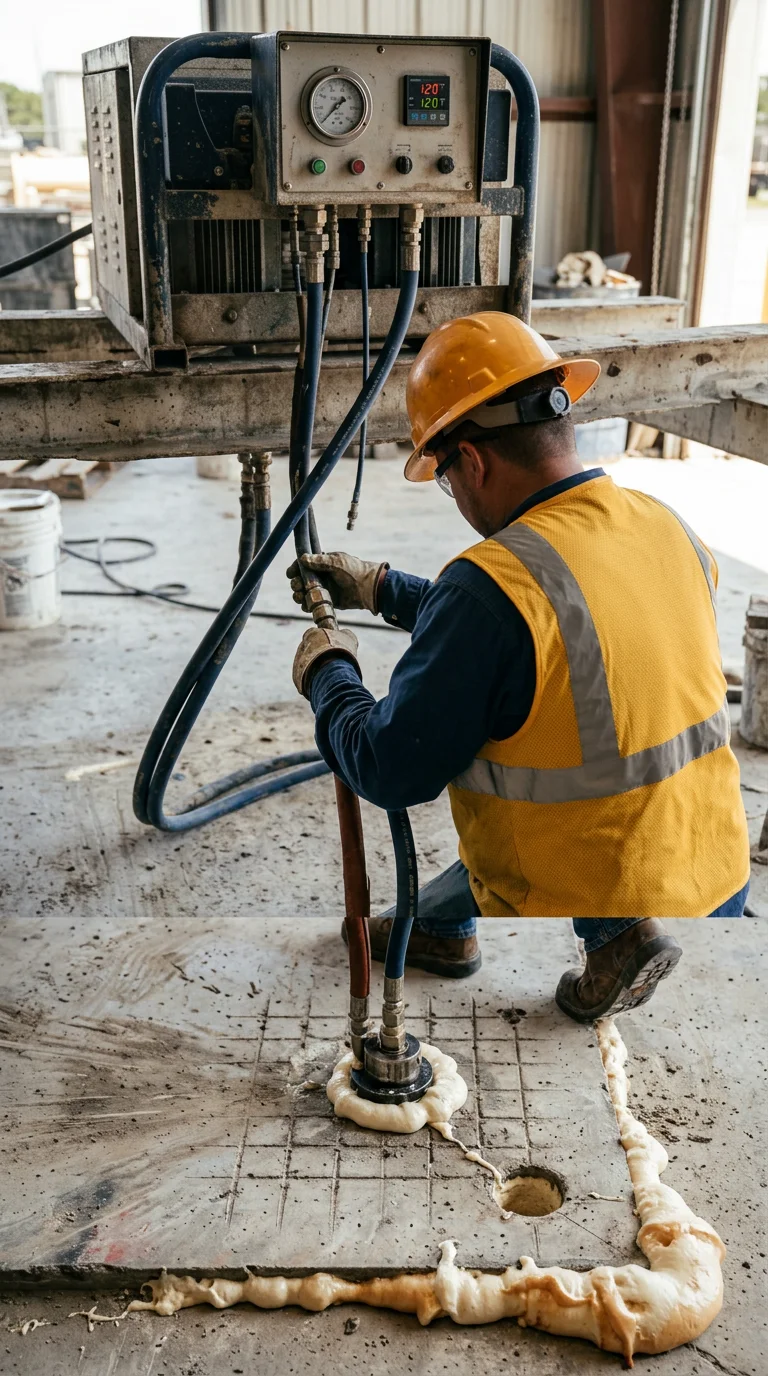
Pipeline Grouting, Utility Lines & Voids in Port Arthur, TX
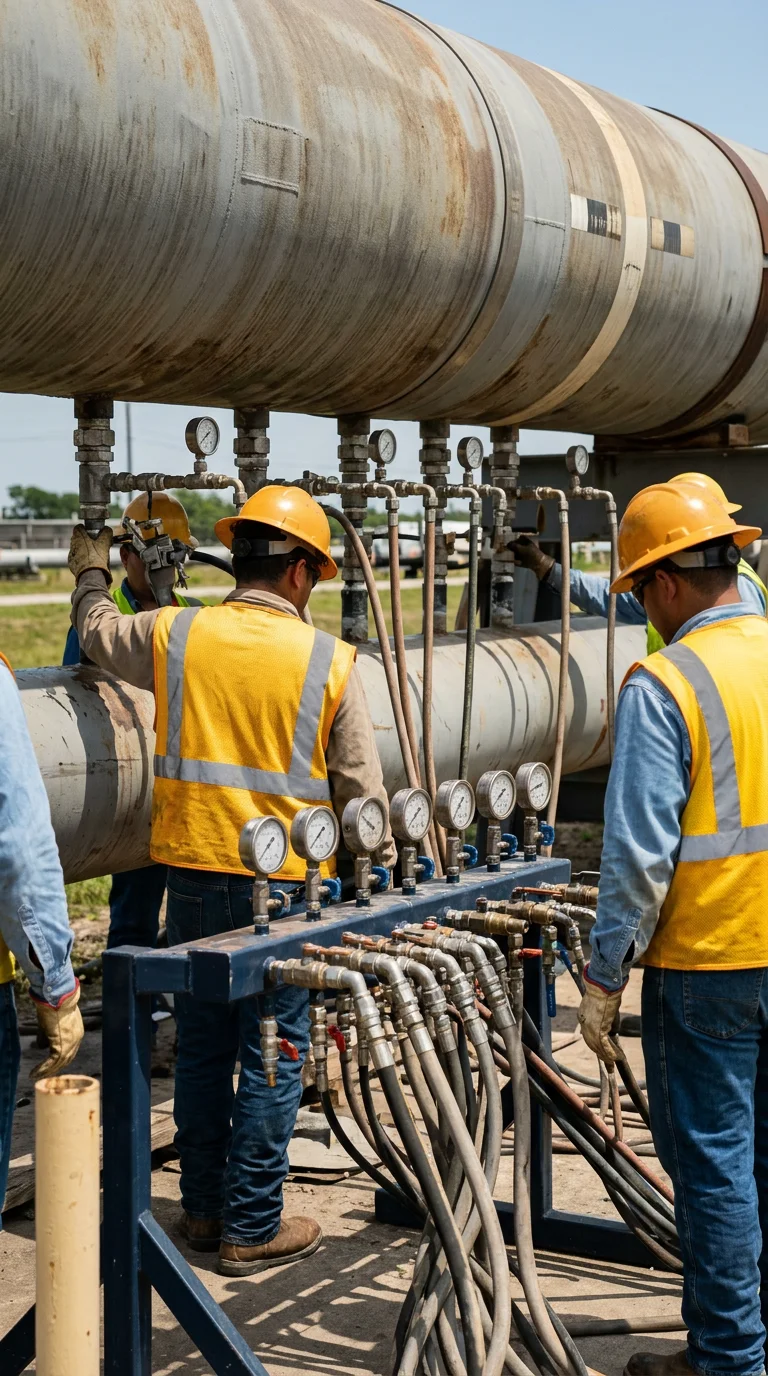
Pipelines in Port Arthur have been layered on top of each other since the original Texaco refinery opened in 1902. First-generation refinery crude lines, product manifolds from the 1950s, decommissioned wastewater laterals, and new petrochemical and LNG expansions share the same right-of-way along the Neches River and the Sabine-Neches Waterway. Every reroute leaves behind retired steel that must be permanently closed.
Refinery and midstream operators in Jefferson County cannot leave a retired large-diameter pipe empty: open lines are groundwater pathways, vapor risks, and settlement risks for everything above. Crews seal both ends, vent the high points, and place fill until return pressure on the discharge side confirms a continuous column tied to the engineer's pressure log. On large-diameter carriers where alignment matters, pipeline lifting frames hold the line true. The pressure grouting cost savings from leaving the line in place rather than excavating are a recurring driver for refinery and pipeline owners.
Annular grouting on the Sabine-Neches Waterway spans CIPP liner re-lining, slip-line operations on aging crossings, and pipeline rehabilitation under the channel. Work must satisfy USACE permit conditions for the federal waterway, TCEQ Region 10 standards, and refinery owner specs simultaneously. Cellular grout is batched on site at 20 to 35 PCF; the liner is monitored for lift and density, and grades up where the engineer's spec calls for structural backing.
Subsurface voids develop along three pathways: erosion along aging utility corridors, groundwater movement through sand lenses inside the alluvial clay, and post-hurricane saturation. Mix family is matched to failure mode — low-density cellular for large voids, cement slurry for localized pockets, sanded mixes near 70 PCF for structural fill under reactor pads and pipe rack footings.
Concrete Leveling in Port Arthur, TX
Slabs in Port Arthur take a beating from a stack of failure modes that rarely show up together anywhere else. Tanker and forklift loading hammers refinery loading docks at Motiva, Valero, and TotalEnergies; hurricane saturation opens voids under warehouse floors throughout Jefferson County; Gulf Coast clay consolidates under sustained 1.1-million-bpd refining loads; and a high water table keeps the whole subgrade soft. Chronic settlement follows across industrial flatwork, and polyurethane recovers grade without taking the unit offline.
SUPERIOR Polylift is our branded slab-lifting workflow built around high-density polyurethane foam. Two-component resin is injected beneath the slab, expands against the underside, and compresses loose soil as it lifts to elevation. For a refinery loading lane at Motiva or a process road at Valero, where every closed hour costs five figures, Polylift restores the slab in place during a standard production shift rather than rebuilding it during a turnaround.
There is a long history of mudjacking in the Golden Triangle, and most of it is on its second or third round of repair. Cement slurry at 100-plus PCF reloads already-saturated soil, and the lift settles. Concrete raising Port Arthur, TX, refinery and petrochemical operators specify uses raising foam at 4 PCF that sits lighter than the soil and cures closed-cell waterproof — no resettlement after the next storm cycle or refinery process water cycle.
Demolition and replacement of refinery concrete is logistically challenging once permits, hot-work coordination, contractor sequencing, and unit downtime are factored in. Leveling foam returns the slab to grade in a single mobilization at a fraction of the cost, with the unit operational throughout — the pressure grout company, Port Arthur, owners retain across multiple turnaround cycles makes the same calculation across loading docks, tank truck scales, and pipe rack walkways.
Refinery-Grade Safety Standards
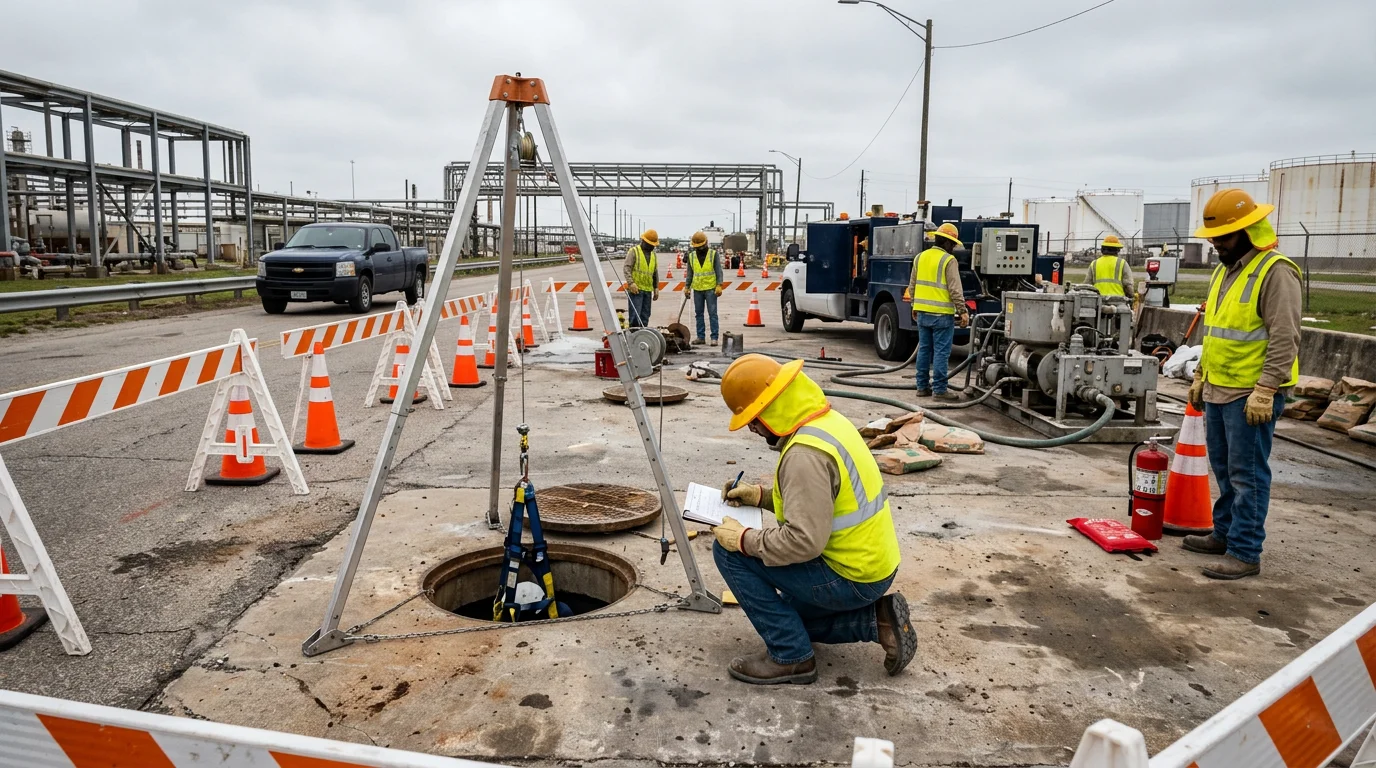
Superior Grouting maintains a zero-incident safety record across TRIR, DART, and fatality metrics. Our safety program is integrated into every phase of project planning and execution, from pre-mobilization hazard analysis through final demobilization. Crews complete ongoing safety training through the Houston Area Safety Council and additional facility-specific courses required by Motiva, Valero, TotalEnergies, BASF, Huntsman, Eastman Chemical, and Port Arthur LNG (Sempra), including hot-work, confined-space, and OSHA 29 CFR 1926 recertification.
Site-specific orientations are completed before any contractor enters the unit, lockout / tagout protocols are confirmed at the start of every shift, and all work runs against the facility's daily turnaround sequencing log so that grouting tasks do not interfere with active refinery operations.
Your Neighbor in Specialty Grouting Since 1983
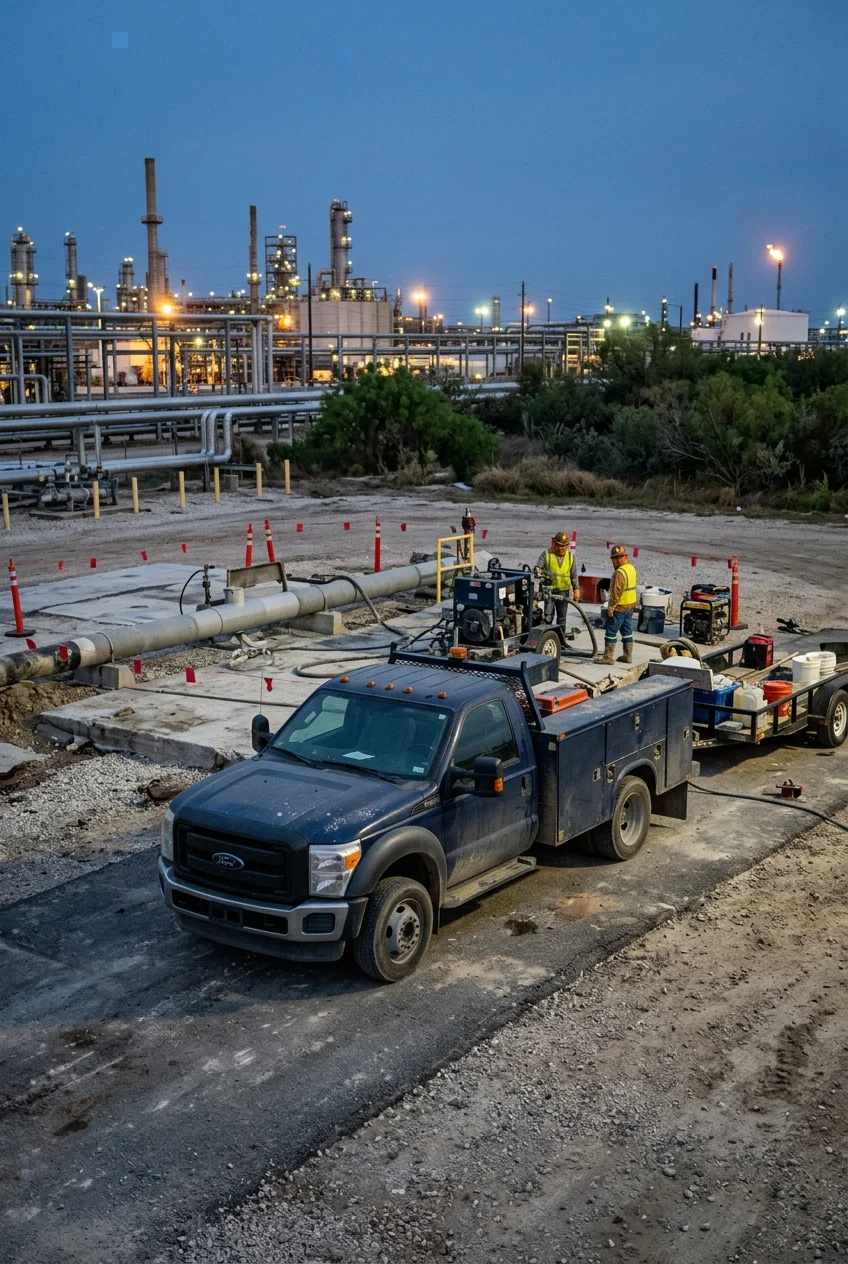
Superior Grouting Services is headquartered at 8927 Meadow Vista Blvd in Houston, TX, approximately 90 miles west of Port Arthur via TX-73 and I-10. Founder Ron Rumpza opened the business in 1983, and the Golden Triangle has been one of our most active service corridors ever since.
What we deliver to the Port Arthur market:
Refinery and petrochemical infrastructure — Motiva (607K bpd, 3,600 acres), Valero (335K bpd, 4,000 acres), TotalEnergies (238K bpd plus BASF steam cracker and the $2B Baystar ethane cracker), Huntsman, and Eastman Chemical, including grouting beneath reactor pads, tank ringwalls, and pipe-rack foundations.
Pipeline abandonment and re-lining — refinery pipeline networks and Sabine-Neches Waterway crossings, working to USACE, TCEQ Region 10, and refinery owner specifications.
LNG export and waterway infrastructure — Port Arthur LNG (Sempra) pre-construction ground improvement and capital project grouting, plus concrete bulkhead construction port neches tx specifications and dock work along the Sabine-Neches corridor.
TxDOT District 20 subgrade and bridge approach — TX-73, I-10, and the access network connecting refinery facilities to the freight corridor.
Tank pad and equipment foundation grouting — permeation grouting on sand-and-gravel subgrades and compaction grouting on layered marine clays similar to the Beaumont Formation.
Hurricane and storm-surge rehabilitation — industrial properties across Jefferson County after named storm events.
Our relationships with Port Arthur general contractors, refinery turnaround planners, midstream pipeline operators, and Jefferson County agencies have been built one project at a time over four decades.
“We have worked with Ron since 1997 helping him grow his business. Superior is a company that you know is going to be successful for the long haul. Their attention to customer service, quality of workmanship and their ability to find creative solutions to see that the job is done right the first time is what makes them a great company!"
“Thank you for a job well done, The attention to detail by Andy and Octavio is praise worthy. Companies build their name based on the quality of their people this is evident. The product performed as indicated, or better than expected, look forward to years of good performance and remaining leveled. To the entire staff, thank you for a job very well done”
“Superior Grouting used injectable foam to fix my cracked concrete. At the same time they lifted various parts of the concrete to even out the surfaces. They were FANTASTIC. On-time, hard-working, clean, precise – everything you want in a contractor. Their pricing was more than fair and their work speaks for itself. I highly recommend anyone using injectable foam for foundations, or lifting any kind of uneven surface to call Ron or Erica at Superior.”
Superior Grouting holds OSHA, ISNetworld, BROWZ, and CII credentials, which are commonly required for access to Motiva, Valero, TotalEnergies, BASF, Huntsman, Eastman Chemical, and Port Arthur LNG (Sempra) facilities. Our crews complete refinery-specific contractor orientations and operate within hot-work permits, lockout protocols, OSHA 29 CFR 1926 standards, and turnaround windows. Permeation grouting, Texas refinery operators specify, alongside compaction, polyurethane, and pipeline grouting, are routine scopes. Project access is coordinated through the prime contractor or facility owner.
Settlement beneath heavy industrial loading in Port Arthur is addressed primarily through compaction grouting and permeation grouting. Compaction grouting injects low-mobility grout to densify weak Gulf Coast clay through displacement; permeation grouting contractors in Texas operators specify use of cement migration into sand-and-gravel matrices instead. The choice is made by soil profile and load condition. Both restore bearing capacity beneath tank pads, reactor foundations, and process roads at Motiva, Valero, and TotalEnergies without facility shutdown beyond the immediate work zone.
Pipeline abandonment grouting fills decommissioned refinery and process lines in place rather than excavating them. The grout pumped into the line prevents groundwater migration into the abandoned segment, controls the accumulation of explosive gases trapped in residual product, and prevents future surface settlement caused by empty pipes. The pressure grouting cost is a fraction of full excavation, and the line satisfies TCEQ Region 10 closure requirements once verified and documented. The approach is routinely used across decommissioned segments at Motiva, Valero, and the broader Sabine-Neches corridor.
Superior Grouting holds OSHA compliance, Construction Industry Institute (CII) certification, ISNetworld registration, and BROWZ qualification, the credential set required for most refinery, petrochemical, and pipeline contractor work in Port Arthur. EMR ratings of 90, 91, 92, and 90 over the last four years place them in the top tier of U.S. specialty contractors. Crews complete site-specific orientations for Motiva, Valero, TotalEnergies, BASF, Huntsman, Eastman Chemical, and Port Arthur LNG as required by the project.
Yes. Polyurethane grouting is the standard solution for settled refinery access roads, tank ringwall walkways, loading slabs, and process roads in Port Arthur. The 4 PCF cured weight does not reload the failed Gulf Coast clay subgrade, the closed-cell waterproof structure resists groundwater migration, and the cure time is measured in minutes. The slab is typically traffic-ready within the same shift, allowing the lift to fit within a routine outage window rather than requiring an extended unit shutdown at Motiva, Valero, or TotalEnergies.
Polyurethane grouting uses a dual-component expanding foam with a cured density of approximately 4 PCF, sets in minutes, and produces a closed-cell, waterproof structure. Cement grouting uses cementitious slurry at far higher cured weight, sets over hours to days, and remains permeable to groundwater. For refinery and petrochemical applications where cycle time and chemical exposure matter, polyurethane outperforms cement on weight, cure time, and durability. Cement and cellular grout still have roles for high-volume structural fill and pipeline abandonment, where compressive strength and fill volume are the priorities.
Compaction grouting is the in-situ densification of weak or loose soil by injecting low-slump, low-mobility mortar-like grout that forms a bulb and displaces and densifies the surrounding soil. The result is increased bearing capacity and reduced settlement risk for foundations, slabs, and structural elements above. In Port Arthur, it is used heavily beneath tank pads and reactor foundations across Motiva (3,600 acres), Valero (4,000 acres), and TotalEnergies, and beneath process pipe-rack supports across the Sabine-Neches corridor.
In Port Arthur and across the Texas Gulf Coast, the foundations most often requiring grouting are refinery tank ringwalls and reactor pads where heavy loading has settled the Gulf Coast clay subgrade, equipment pads where vibration has consolidated the support, pipeline corridors where annular space or void fill is needed, and commercial slabs where storm saturation has driven settlement. The Golden Triangle sees particularly heavy demand because 1.1 million bpd of combined refining capacity, plus the BASF/TotalEnergies steam cracker and the Port Arthur LNG construction site, all sit atop layered alluvial clay prone to long-term settlement.
Superior Grouting serves commercial, industrial, and municipal clients across the Gulf Coast and Southeast, from Texas and Louisiana to Florida, New Mexico, and Arkansas.
Schedule Your Free Estimate in Port Arthur, TX
Contact Superior Grouting to discuss your refinery, petrochemical, pipeline, or commercial grouting project in the Port Arthur area. Our team will evaluate your site, recommend the right solution, and provide a detailed proposal.