


Waterproof Properties of Polyurethane Foam: Sealing and Stabilization Combined
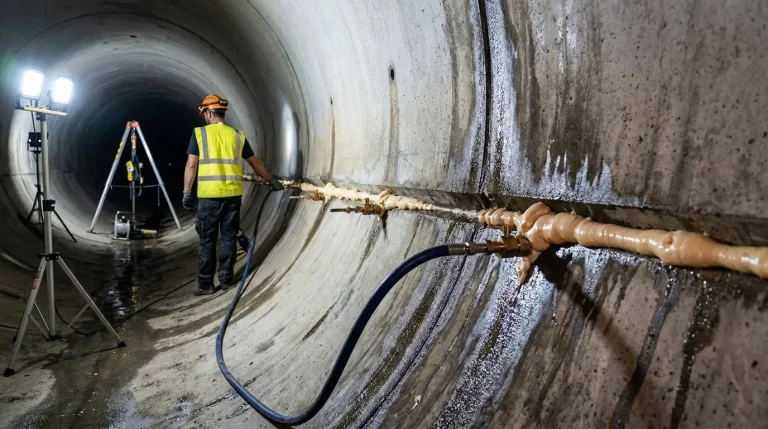
Closed-cell polyurethane foam is functionally waterproof: its sealed cell structure blocks water passage and absorbs less than 2 percent by volume in standard immersion testing. Open-cell foam is water resistant at best. In grouting applications, this distinction lets a single injection both seal active water infiltration and stabilize the surrounding soil or structure.
Few materials get asked to do two jobs at once. Polyurethane foam, correctly specified, does exactly that: it cuts off water and restores ground support in the same injection. That dual function is why the material occupies a permanent place in infrastructure rehabilitation, from wastewater structures to tunnel joints to warehouse slabs over wet subgrade.
The qualifier is the important part. "Correctly specified" means understanding which foam structures actually block water, which merely tolerate it, and where the waterproof performance of any foam reaches its limit. This article works through that engineering, in order.
Is Polyurethane Foam Waterproof? The Engineering Answer
The accurate answer is conditional: closed-cell polyurethane foam is functionally waterproof, and open-cell polyurethane foam is not. The difference is geometry, not chemistry. Closed-cell foam cures into millions of discrete sealed cells that water cannot pass between. Open-cell foam cures into an interconnected sponge-like matrix that air and water move through freely.
Engineering practice separates two terms that marketing language blurs:
- Waterproof means the material blocks water passage and maintains its properties under direct water exposure and hydrostatic pressure
- Water resistant means the material tolerates moisture and sheds incidental water but will absorb it under sustained exposure or pressure
Closed-cell foams earn the first term through low water absorption, typically under 2 percent by volume when tested to ASTM D2842, the standard test method for water absorption of rigid cellular plastics. Open-cell foams can absorb many times their weight in water, which is why they insulate and absorb sound well, selected on R-value per inch rather than water exposure, and why they are not sealing materials.
The confusion starts on the consumer side. One-part spray foam and expanding foam sealant products sold for filling gaps and cracks in a building envelope are chemistry cousins of injection resins, and spray-applied roof foam is a cousin again. A DIY PU foam spray can, however, is not engineered for hydrostatic pressure, and none of these product classes substitutes for a metered, dual-component injection system with verified placement.
For infrastructure work the practical conclusion is direct. Specifying a waterproof foam starts with cell structure: where the objective is stopping water, specify closed-cell or water-reactive resin systems and verify the durability data under wet-dry cycling. Where an open-cell product has been installed in a wet environment, plan for saturation.
Cell Structure, Density, and Water Absorption
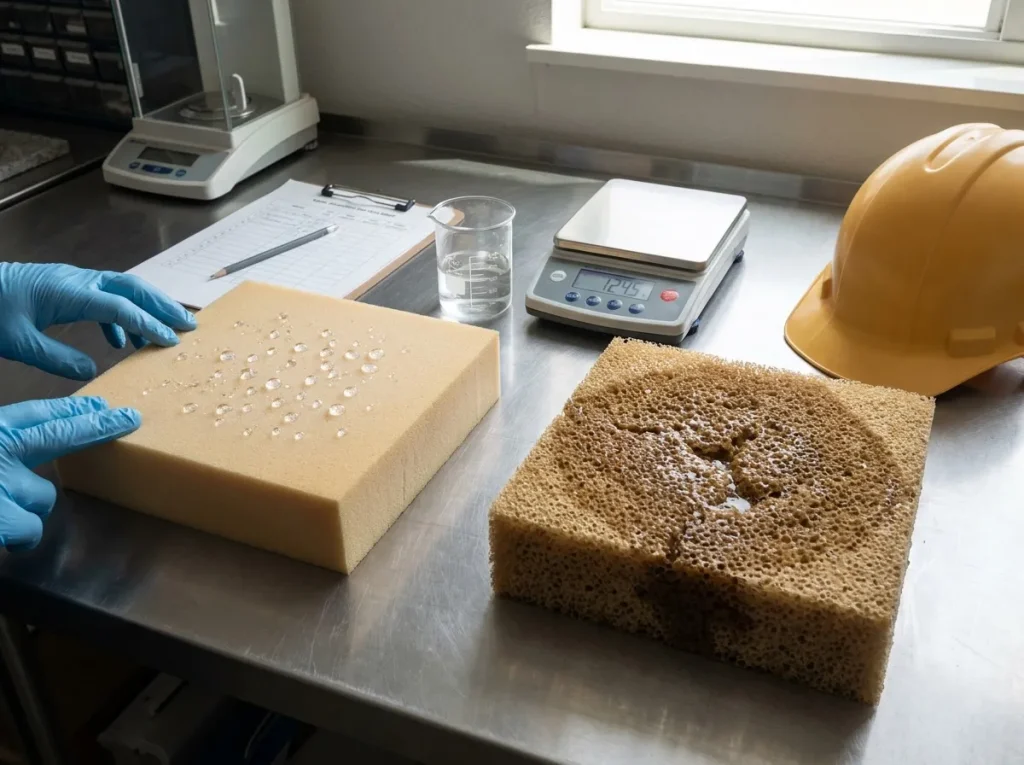
Density is the second variable governing waterproof performance, and it works together with cell structure. Higher-density closed-cell foams have thicker cell walls, higher compressive strength, and lower water absorption. Lower-density foams trade some of that performance for expansion volume and lighter weight.
| Property | Closed-Cell Foam | Open-Cell Foam | Reference Standard |
| Cell geometry | Sealed, discrete cells | Interconnected, porous matrix | ASTM D6226 (open cell content) |
| Water absorption | Typically <2% by volume | Can exceed 30% by volume; sponge behavior | ASTM D2842 |
| Typical density range (grouting) | 2-10+ lb/ft³ | 0.4-1.2 lb/ft³ | ASTM D1622 |
| Compressive strength | ~40-150+ psi, density dependent | Minimal structural contribution | ASTM D1621 |
| Vapor behavior | Low permeance at thickness | High permeance | ASTM E96 |
| Sealing role | Water cutoff and structural void fill | Not a sealing material | Project specification |
Two field implications follow from the table. First, a foam selected for waterproof performance must be verified by its data sheet values against these standards, not by the word "waterproof" on a label. Second, density selection is an engineering decision balancing water cutoff, strength, expansion, and cost, and it belongs in the specification rather than in the field truck.
Wet substrates during installation deserve a note. Quality closed-cell systems bond and cure against damp concrete and soil, but standing or flowing water during injection changes resin behavior and must be addressed in the injection plan through formulation choice and staging.
Hydrophobic and Hydrophilic Resins: Two Sealing Mechanisms
Injection-grade polyurethanes divide into two families, and the split determines how each interacts with water at the moment of placement.
Hydrophobic resins repel water. They react with a small amount of moisture as a catalyst, then expand and cure into dense closed-cell foam that pushes water out of the space it fills. Cured hydrophobic foam holds its dimensions regardless of subsequent wet-dry cycling, which suits permanent water cutoff, soil stabilization, and void filling in saturated ground.
Hydrophilic resins absorb water into the reaction, curing into a flexible gel or elastomer that bonds tenaciously to wet surfaces. They tolerate joint movement and reseal under compression, which suits active joints and cracks in structures that breathe. Their limit: in prolonged dry conditions some hydrophilic gels shrink, so they are specified where sustained moisture is guaranteed.
Selection follows the water condition, and the gel time of either family is adjusted to the flow encountered:
- Actively flowing infiltration: fast-set hydrophobic foam, gel time in seconds, staged injection to establish cutoff
- Damp or seeping joints in moving structures: hydrophilic gel for flexible, re-wettable seal
- Saturated soil requiring stabilization plus cutoff: hydrophobic structural foam placed under controlled pressure
- Dry voids ahead of anticipated water: closed-cell hydrophobic systems sized for the expected head
This is the same materials logic that governs chemical grout injection broadly: the ground condition selects the chemistry, and the chemistry sets the procedure.
Sealing and Stabilization in One Injection
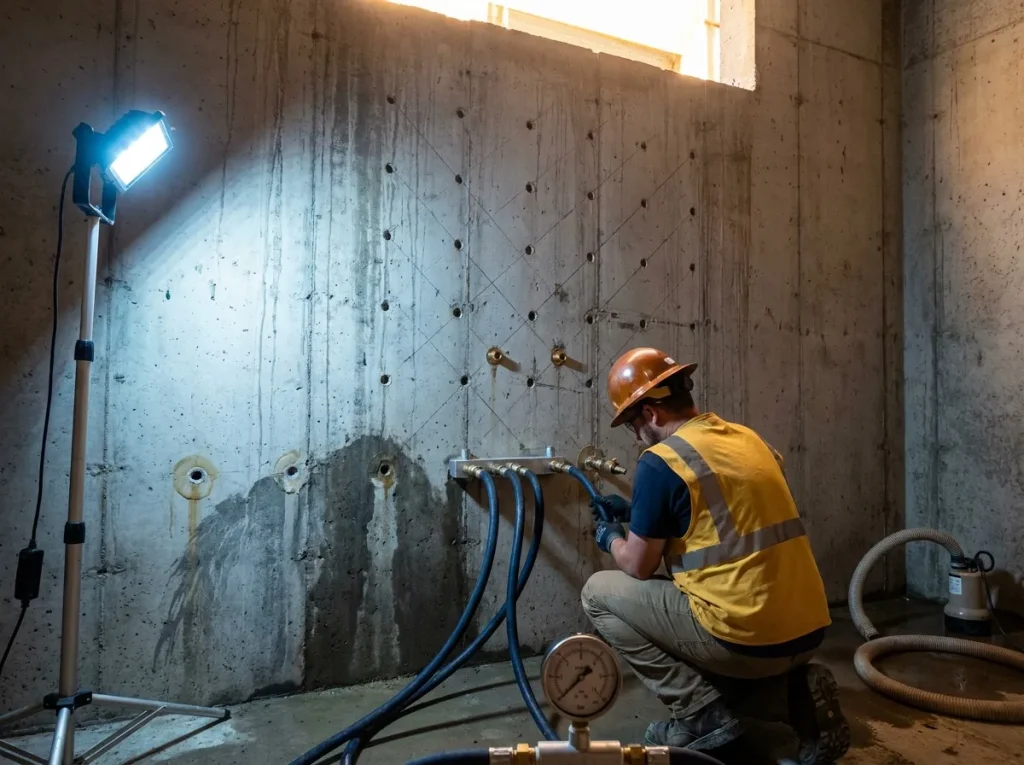
The combined effect is where polyurethane separates itself from surface-applied waterproofing. A membrane or coating addresses the wall. Injected foam addresses the wall and the ground behind it in the same operation.
The mechanism works in sequence. Resin injected through a structure or directly into the soil mass travels along the same paths the water uses: cracks, joints, bedding voids, and washed-out zones. As it expands and cures, it fills those paths, displaces the water, and locks the surrounding soil particles into a stabilized, water-cut-off matrix. Infiltration stops because the pathway no longer exists, and the ground stops moving because the voids that allowed movement are filled.
Commercial and industrial applications where this dual function carries the project:
- Sealing infiltration at joints, penetrations, and cracks in wastewater structures, tunnels, and below-grade walls while re-supporting disturbed backfill
- Curtain injection behind structure walls, establishing a waterproof barrier in the soil itself where negative-side access is the only option
- Stabilizing washed subgrade beneath slabs and pavements where water movement created the voids, using polyurethane foam injection to fill and seal in one pass
- Cutting off water migration along utility trenches and pipe bedding in saturated Gulf Coast soils
- Establishing a watertight seal at bulkheads and marine or waterfront structures where durable performance under permanent immersion is the design condition
Regional climate raises the stakes. Gulf Coast facilities operate in high humidity year-round with saturated soils for months at a time, conditions where a water-resistant material quietly fails and only a genuinely waterproof one holds.
A worked example makes it concrete. A distribution facility with slab settlement over a leaking storm line does not have two problems; it has one mechanism with two symptoms. Foam injection fills the erosion voids, restores uniform bearing, and seals the migration path, and the elevation log plus post-injection flow observation verify both outcomes in the same mobilization.
Confined space entries for interior injection work fall under OSHA 29 CFR 1910.146, and resin selection for any potable water contact requires NSF/ANSI 61 certified systems with AWWA guidance governing the rehabilitation.
Where Waterproof Performance Has Limits
Waterproof is not unconditional. Four boundaries define responsible specification, and each has a management strategy.
- Ultraviolet exposure. UV degrades exposed polyurethane surfaces over time. Buried and interior foam is unaffected; any foam left exposed at grade or at daylighted joints needs a protective coating or cover detail.
- Open-cell misapplication. The most common waterproofing failure is not material degradation but the wrong cell structure installed in a wet environment. Saturated open-cell foam holds water against the structure it was meant to protect.
- Joint movement beyond material class. Rigid closed-cell foam at a working joint will crack if movement exceeds its elongation. Moving joints belong to flexible hydrophilic systems or engineered joint details.
- Extreme chemical service. Strong solvents, concentrated acids, and some hydrocarbons attack certain formulations. Industrial containment applications require chemical compatibility review against the actual exposure list.
Verification closes the loop on all four. Post-injection flow observation, moisture monitoring, and documented injection records confirm that the waterproof performance specified is the performance delivered. Document the assumption. Verify the result.
Specifying Polyurethane Waterproofing for Commercial Projects
For owners and engineers, the specification path is short and repeatable:
- Characterize the water: source, head, flow rate, and seasonality, plus soil conditions and structural movement
- Select the resin family and cell structure to match, with data sheet values tied to ASTM test methods
- Define injection parameters: port layout, pressure limits below structural and overburden capacity, gel time targets
- Require verification: injection logs, post-injection observation, and closeout documentation
Execution quality determines whether the material meets its data sheet in the ground, which is why the grouting services partner matters as much as the resin selected. Owners dealing with active infiltration, wet settlement, or recurring void formation can request a site evaluation to define the water condition and the injection program it calls for. Superior Grouting has delivered combined sealing and stabilization programs across Texas and Louisiana infrastructure since 1983.
This guidance is advisory. Final material selection, injection pressures, and acceptance criteria must be confirmed by the engineer of record against project-specific conditions.
Key Takeaways
- Closed-cell polyurethane foam is functionally waterproof, absorbing under 2 percent water by volume per ASTM D2842; open-cell foam is water resistant at best and saturates under sustained exposure.
- Waterproof and water resistant are different engineering claims: verify data sheet values against ASTM test methods rather than label language.
- Hydrophobic resins expand into dense closed-cell foam for permanent cutoff and stabilization; hydrophilic resins cure into flexible gels for actively wet, moving joints.
- Injected foam seals the water path and stabilizes the surrounding ground in the same operation, which surface membranes cannot do.
- Waterproof performance has defined limits: UV exposure, misapplied open-cell foam, joint movement beyond material class, and aggressive chemical service.
- Specification should characterize the water first, then select chemistry, then set pressure limits and verification requirements with the engineer of record.
Conclusion
Polyurethane foam earns the word waterproof only when its cell structure, density, and resin family match the water condition it faces. Matched correctly, it delivers something surface systems cannot: the infiltration path sealed and the ground stabilized in a single, verifiable injection program.
Superior Grouting applies that specification discipline to commercial and industrial infrastructure across Texas and Louisiana. Call (281) 894-4175 to discuss the water condition your facility is managing.
Book a site evaluation this week.
Stop active infiltration at your facility.