

What Is Chemical Grouting for Waterproofing in Dallas, TX?
Key Takeaways
- Chemical grouting waterproofs by injecting low-viscosity resins and gels that cure in place into continuous impermeable barriers, sealing cracks, joints, and the soil interface where water actually enters.
- In Dallas, water typically arrives through fissures that expansive clay opens during drought rather than from a shallow water table, which means the barrier usually belongs where the fissure meets the structure.
- Blackland Prairie clay swells over 30 percent when saturated and drives four to eight inch seasonal movements, separating pipe joints and cracking vaults, so waterproofing here is often recurring maintenance rather than a one-time detail.
- Flexible hydrophilic polyurethane formulations matter more in this market than in stable ground, because a rigid seal at a joint that keeps moving is a seal that will eventually fail.
- Curtain grouting suits Dallas structures where clay movement has opened multiple unmapped fissures, since overlapping injections create redundancy that catches pathways individual crack injection would miss.
- Verification is what separates a completed injection from a durable repair, whether that is air-testing sewer joints or core sampling and permeability testing on structural work.
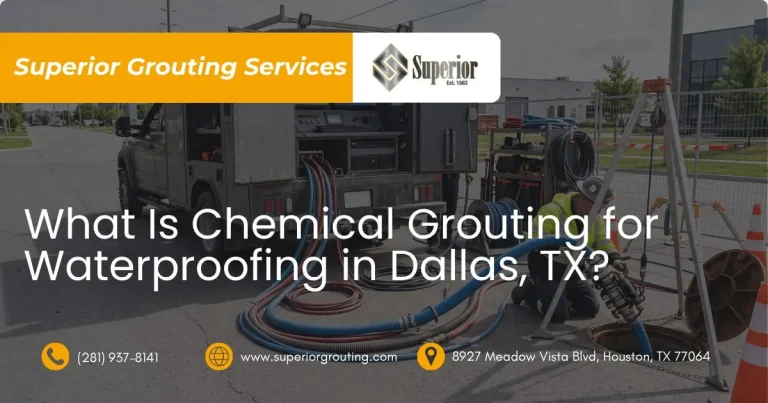
Chemical grouting for waterproofing means injecting low-viscosity resins and gels into cracks, joints, and the soil behind a structure, where they cure into continuous impermeable barriers. Many formulations are water-activated and expand on contact with moisture, chasing the leak path and sealing it. In Dallas, the water usually arrives through fissures that expansive clay opens rather than from a high water table, which shapes where the grout goes.
Water reaching a Dallas structure rarely comes from a shallow water table the way it does along the Gulf Coast. It arrives through pathways that expansive clay creates: deep fissures that open during drought, joints that separate as the ground moves, and voids left where clay pulled away from a wall or slab.
Chemical grouting seals those pathways from the inside, without excavation and usually without taking a facility offline. This guide explains how the method works, which grout types suit which problems, and how the Blackland Prairie's behavior shapes waterproofing strategy across the metroplex.
What Chemical Grouting Does for Waterproofing
Chemical grouting is a ground improvement and leakage-control process in which engineered chemical solutions or polymer resins are injected under pressure into soil, rock, or voids in and around structures to modify their hydraulic properties. The objective is to block or divert water infiltration by creating continuous, low-permeability barriers along joints, cracks, soil-to-structure interfaces, and zones of preferential flow.
Low-viscosity, non-particulate chemical grouts including polyurethane, acrylamide, acrylate gels, and sodium silicate are favored for waterproofing because they travel wherever water can reach, including very fine fissures, and then react in place to form an impermeable mass.
Many of these grouts are hydro-active, meaning the reaction is triggered or accelerated by the presence of water. Polyurethane leak seal resins expand rapidly on contact with moisture, allowing them to chase leak paths and fill voids while forming closed-cell foam barriers that resist further infiltration and erosion.
Why Dallas Water Problems Look Different
Fissures Rather Than a Water Table
Dallas sits within the Blackland Prairie, where Eagle Ford Shale, Austin Chalk, and Taylor Marl dominate the profile. Geotechnical engineers describe these as cracking clays because deep fissures open across them during dry weather.
Those fissures are the primary water pathway in this market. When rain follows a drought, water travels down through the cracks rather than rising from below, reaching foundation walls, utility structures, and buried infrastructure along preferential routes that did not exist a season earlier.
Movement Separates What Was Sealed
Blackland Prairie clay swells more than 30 percent when saturated and shrinks sharply when dry, producing documented ground movements of four to eight inches. That cycle separates pipe joints, opens cracks in vaults and manholes, and pulls soil away from structure walls.
A sealed structure does not stay sealed when the ground around it moves that much. This is why waterproofing in Dallas is frequently a recurring maintenance category rather than a one-time construction detail.
The Escarpment Adds Variability
The Austin Chalk shelf running north to south through the city creates transition zones where a structure may sit partly on competent rock and partly on deep clay. Water behaves very differently on either side, moving through fractured rock in one zone and through clay fissures in another.
Understanding which condition applies at a given wall or joint determines whether grout should be placed in the structure, in the soil behind it, or both. The table below summarizes the main techniques.
| Technique | What it does | Best applied when |
| Crack injection | Fills an identified crack or joint directly | Leak source is visible and accessible |
| Curtain grouting | Forms a continuous barrier behind the structure | Individual cracks cannot be located |
| Permeation grouting | Cements granular soil to cut permeability | Sand or fill seams carry the water |
| Annular space filling | Fills voids between casings, liners, structures | Water travels along a buried interface |
| Joint sealing | Seals separated pipe and structure joints | Ground movement has opened connections |
Grout Types Used for Waterproofing
Polyurethane Grouts
Polyurethane grouts are delivered as two liquid components that mix at the pump. They expand aggressively when exposed to water or air, filling cracks, chasing leak paths, and bonding to concrete or soil particles.
Hydrophobic polyurethanes repel water and form rigid, closed-cell foams that create durable seals resistant to chemical attack and long-term erosion. Hydrophilic formulations mix with water to form flexible foam gaskets or gels that accommodate slight movement while maintaining a watertight seal.
That flexibility matters considerably in Dallas. In ground that cycles seasonally, a rigid seal at a moving joint is a seal that will eventually fail, which is why formulation choice deserves genuine attention rather than defaulting to one product.
Acrylamide and Acrylate Gels
Acrylamide and acrylate gel grouts are ultra-low-viscosity reactive fluids that penetrate wherever water can reach, designed to crosslink and form stable gels with controllable curing times ranging from seconds to hours. Once cured, crosslinked acrylamide grouts form long-lasting water barriers with strong soil stabilization properties.
These are the standard choice for controlling groundwater in manholes, sewer mains, and tunnels where permeation into fine soils is essential. Modern formulations meet NSF/ANSI/CAN 61 standards for contact with potable water, which expands their use to water infrastructure.
Sodium Silicate and Microfine Cements
Sodium silicate solutions and microfine cements provide inorganic options for permeation grouting in fine sands and silts, offering low initial viscosity and induced gelling to reduce hydraulic conductivity. They remain useful where organic resins are unsuitable, though modern permeation grouts often deliver better penetration in complex soils.
Waterproofing Techniques
Crack Injection
Crack injection places resin directly into an identified crack or joint in concrete or masonry, allowing the grout to fill the defect and surrounding voids before curing into a watertight seal. Flexible polyurethane grouts are typically used because they accommodate minor structural movement without re-cracking.
The method suits situations where the leak source is visible and accessible. It requires surface preparation, installation of injection ports, and careful pressure monitoring to avoid damaging the structure.
Curtain Grouting
Curtain grouting forms an impermeable barrier around a leaking structure by injecting water-reactive resin in a grid pattern through walls or slabs. The resin reacts with water behind the structure and expands to form a continuous watertight plane, sealing infiltration even where individual cracks cannot be identified.
Crews drill small holes through the slab or wall in a diamond grid, then inject through each hole with injections overlapping like shingles on a roof. That overlap creates redundancy, so a missed pathway at one point is caught by the adjacent injection.
For Dallas structures where clay movement has opened multiple unmapped fissures, this redundancy is often the deciding advantage over chasing individual cracks.
Permeation Grouting
Permeation grouting injects low-viscosity, non-particulate grout into the pore spaces of granular soils such as sands and gravels without displacing the soil skeleton. When it hardens, the result is a cemented mass with increased strength and sharply reduced permeability.
Within the Dallas profile, this targets sand seams and fill layers rather than the clay matrix, which resists permeation. Trench backfill around utilities is a common target, since poorly compacted fill often becomes the route water follows to a structure.
Annular Space and Joint Sealing
Pressure grouting fills annular spaces between casings and carrier pipes, between host structures and liners, and around culverts. Annular grouting removes the void that water would otherwise travel along and stabilizes the surrounding ground.
Injection grouting for pipelines is a trenchless process performed from inside the pipe, driving grout out through defects into exterior voids. This seals weaknesses, prevents infiltration, and strengthens the soil envelope around the pipe in a single operation.
Applications Across Dallas Infrastructure
Underground Concrete Structures
Polyurethane chemical grouts seal leaks in tunnels, utility vaults, clarifiers, tanks, and manholes through crack injection or curtain grouting. The work relies on small-diameter injection holes and can often be performed from inside the structure.
That inside-out approach matters in dense urban and industrial corridors where excavating around an active structure would be expensive, disruptive, or simply impractical.
Sewer and Stormwater Infiltration Control
Chemical grouting is a mature technology for controlling infiltration into sanitary and storm sewers, stopping leaks and repairing joints without full pipe relining. Crews clean the line, inspect it with CCTV, and position a grouting packer at each leaking joint.
The packer isolates the area while grout is injected through the joint into the surrounding soil, forming a seal that prevents further infiltration. Given how reliably Blackland Prairie movement separates joints, this is among the most common waterproofing applications across the metroplex.
Below-Grade Walls and Utility Structures
Polyurethane systems respond well to water arriving through clay fissures, and are used for sumps, pits, and below-grade industrial structures via crack injection and curtain grouting. Sealing the exterior soil interface rather than only the interior surface resolves the leak at its origin.
Because water in this market travels down through cracks rather than up from a shallow table, placing the barrier where the fissure meets the structure is usually more effective than treating the interior face alone.
Culverts and Buried Utilities
Hydro-active grouts seal seepage through cracks and joints in culverts, and low-viscosity resins permeate the loose soil around them to achieve stabilization and compaction simultaneously. Where water has already washed soil out, the same injection stops the leak and fills the resulting void.
Design and Execution
Investigation and Assessment
Effective waterproofing begins with locating the actual pathway rather than the visible symptom. That typically includes cleaning and CCTV inspection for pipe work, plus assessment of cracks, joints, soil conditions, and drainage patterns around the structure.
Soil characterization guides whether permeation, curtain grouting, or direct crack injection will work at a given location. In Dallas it should also identify whether the structure crosses the escarpment transition, since water behaves differently in fractured rock than in clay.
Grout Selection and Reaction Time
Selection is driven by soil type, leak characteristics, mechanical requirements, environmental constraints, and reaction time. In potable water applications, only grouts meeting drinking water safety standards are acceptable.
Reaction time carries particular weight with active leaks. Fast-reacting grouts seal high-flow leaks quickly but travel less far into the soil, while slower formulations permeate more deeply but require temporary flow control. Matching that profile to the situation is a judgment call experienced crews make on site.
Pressure Control
Injection pressures and rates must be designed so grout permeates the intended zone without fracturing ground or causing heave or damage to adjacent structures. Excessive pressure can hydraulically fracture soil, creating new pathways instead of closing them.
Real-time monitoring of pressure, flow rate, and grout take allows technicians to adjust as they work. Automated pressure regulation and data logging provide the precision needed near sensitive or occupied structures.
Verification
Quality control confirms that injection actually sealed the pathway. In sewer systems, standard practice tests each joint or connection after grouting, typically with compressed air through packers, and any failure to hold triggers re-grouting until the criteria are met.
For structural applications, core sampling, permeability testing, or visual inspection verifies penetration and permeability reduction. Documented verification is what converts a completed injection into a warrantable repair.
General background on grouting methods is available through national engineering references. A specialty grouting contractor working across the metroplex can match technique and formulation to the specific pathway, and facilities dealing with active infiltration can schedule a site assessment before water compromises more soil. For work throughout the region, pressure grouting in Dallas covers the full range of waterproofing methods.
Conclusion
Chemical grouting waterproofs by putting a barrier exactly where water enters, using resins thin enough to travel the same routes moisture does and reactive enough to cure into an impermeable mass once they arrive. Injected through small holes, from inside a pipe, or in a grid pattern behind a wall, it seals cracks, joints, and soil interfaces without excavation and usually without taking a facility offline.
What makes Dallas distinctive is the pathway rather than the technique. Blackland Prairie clay opens fissures during drought and separates joints as it cycles four to eight inches through the year, so water descends through cracks instead of rising from below, and yesterday's sealed structure is not necessarily today's. That argues for flexible formulations at moving joints, curtain grouting where the fissures cannot be mapped, drainage correction alongside injection, and verification testing that proves the pathway actually closed.
Seal Dallas water infiltration at the pathway, not just the symptom.
Schedule a site assessment with the Superior Grouting team.