

Does Lifting Concrete With Foam Work in Beaumont, TX?
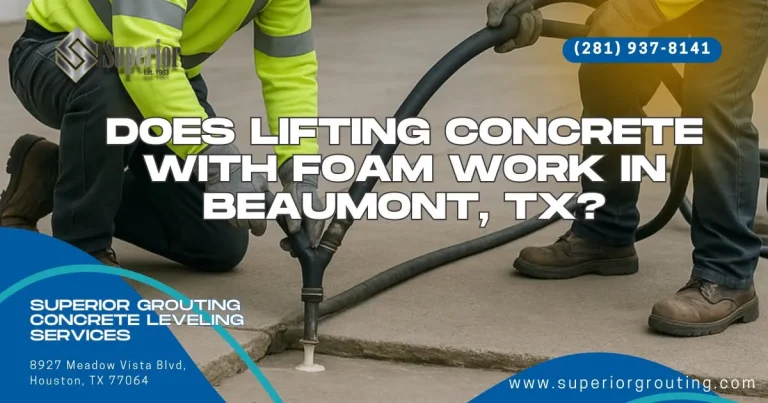
Yes. Polyurethane foam concrete lifting works effectively in Beaumont's expansive clay soil conditions and outperforms mudjacking in every metric that matters for commercial and industrial applications: weight, waterproofing, cure time, and service life. When properly installed with high-quality materials and correct drainage management, foam lifting repairs last 10 to 20 years or longer in Southeast Texas conditions.
If you manage a commercial or industrial facility in Beaumont and have noticed sunken loading docks, uneven warehouse floors, or tilting concrete slabs around your site, you've likely wondered whether concrete lifting services actually hold up in Southeast Texas, or whether the region's expansive clay soils and moisture levels will undermine the repair within a few years. This article explains how polyurethane foam lifting works, whether it performs in Beaumont's challenging conditions, how long repairs last, and how it compares to mudjacking and full replacement.
Key Takeaways
- Polyurethane foam concrete lifting works effectively in Beaumont's soil conditions and typically lasts 10 to 20 years or longer when properly installed: This significantly outlasts mudjacking's 5 to 7 year lifespan and is better suited to Southeast Texas's moisture-prone environment.
- Managing water drainage is the single most important factor for long-term success: Caulk all cracks and control joints, correct site grading, and ensure downspouts discharge well away from slabs. If water continues infiltrating beneath the slab after repair, soil erosion will continue undermining the foam support layer.
- Foam lifting costs $5 to $25 per square foot, approximately 50 to 70% less than full slab replacement: Surfaces are ready for industrial traffic within 30 minutes to one hour of injection with minimal facility disruption.
- Only use foam lifting if the concrete slab is structurally sound with minor cracking: If a slab has major structural damage, severe spalling, or completely compromised sub-base soil, replacement is the correct intervention and foam lifting will not produce a lasting result.
- Polyurethane foam weighs only 2 to 4 pounds per cubic foot versus 100 to 150 pounds per cubic foot for mudjacking slurry: In Beaumont's soft and expansive sub-base conditions, adding mudjacking's weight accelerates settlement rather than resolving it.
- Verify contractors have at least five years of documented experience, proper licensing, and manufacturer certifications: Request references from commercial or industrial projects in Southeast Texas specifically. Avoid contractors requesting more than 25% upfront before work begins.
How Foam Concrete Lifting Works
The foam lifting process begins when technicians drill small holes through the concrete surface at strategic locations. These holes typically measure five-eighths of an inch or smaller in diameter, making them far less noticeable than traditional mudjacking's 1 to 2 inch holes.
A two-part polyurethane foam system is injected beneath the concrete through specialized dual-component equipment. The two chemical streams combine at the injection point, triggering an immediate reaction that causes the foam to expand rapidly, filling void spaces beneath the slab and gently lifting it back to the target elevation.
The process moves quickly. Foam typically cures within 30 minutes to one hour after injection. Technicians patch the small drilling holes with concrete, and the surface returns to service with no extended waiting period. For industrial facilities where floor downtime creates direct operational impact, this same-day return to service is a decisive advantage.
Is Polyurethane Foam Strong Enough for Industrial Loads?
A common question from facility managers is whether foam can provide adequate structural support under industrial loading conditions. The compressive strength data is straightforward.
Polyurethane foam used for concrete lifting exhibits compressive strength between 50 and 100 PSI. A fully loaded semi-truck applies only 1 to 2 PSI of pressure to the support layer beneath concrete. Industrial forklifts with capacity loads apply comparable pressure. The foam's compressive strength far exceeds the demands placed on it under realistic commercial and industrial conditions.
Material weight is equally important in Beaumont's unstable sub-base environment. Polyurethane foam weighs only 2 to 4 pounds per cubic foot, compared to 100 to 150 pounds per cubic foot for traditional mudjacking slurry. This distinction is critical: adding mudjacking's weight to compromised Beaumont sub-base soil applies new load to already-weakened ground, accelerating the settlement it is intended to correct.
Foam Lifting vs. Mudjacking in Beaumont's Climate
How Mudjacking Works and Why It Underperforms Here
Mudjacking involves drilling larger holes and pumping a slurry of sand, cement, and water beneath the concrete. While it costs less upfront, it carries significant limitations that are particularly damaging in Beaumont's conditions.
The mudjacking slurry never completely hardens and remains vulnerable to water penetration and erosion. In Beaumont, where water management problems are a primary cause of concrete settlement, this means the repair material itself is susceptible to the same failure mechanism that created the original void. Mudjacking repairs typically last only 5 to 7 years, requiring repeat mobilization and cost.
Why Polyurethane Foam Performs Better
Polyurethane foam resists water infiltration after curing, does not erode under soil moisture, and maintains dimensional stability without shrinkage over time. The material is waterproof in its cured state, which directly addresses the root cause of slab settlement in Southeast Texas.
Method Comparison
| Factor | Polyurethane Foam | Mudjacking |
| Material weight | 2 to 4 lbs/cu ft | 100 to 150 lbs/cu ft |
| Waterproof after cure | Yes | No |
| Erosion resistance | High | Low |
| Injection hole size | 5/8 inch | 1 to 2 inches |
| Cure time | 30 to 60 min | 24 to 48 hours |
| Return to industrial service | Same day | 1 to 2 days |
| Expected lifespan in Beaumont | 10 to 20+ years | 5 to 7 years |
| Compressive strength | 50 to 100 PSI | Higher (up to 2,400 PSI) |
Why Beaumont's Soil Makes Concrete Lifting Necessary
Large portions of Southeast Texas, including Beaumont, sit on expansive clay sub-base that changes volume in response to moisture variations. When clay absorbs water, it expands. When it dries, it shrinks and contracts, creating gaps beneath concrete slabs. This repeated volumetric change places significant stress on facility floors and site concrete, causing slabs to shift, settle, and crack over time.
Water management problems compound this cycle. When water flows under or alongside concrete surfaces, it carries fine soil particles away and leaves voids beneath the slab. Common sources at commercial and industrial facilities include roof drainage directed toward paved areas, site grading that routes surface runoff under slabs rather than away from them, utility trench backfill settlement, and leaking underground lines.
How Long Does Foam Lifting Last in Beaumont?
When polyurethane concrete lifting is performed correctly using appropriate materials for Beaumont's moisture conditions, repairs last 10 to 20 years or longer. Several factors directly affect service life.
Sub-base stability beneath the slab is the primary structural variable. If the soil continues to shift or erode after repair, the foam support layer will eventually face renewed challenges. This is why addressing drainage and infiltration sources before or immediately after foam lifting is essential, not optional.
Water drainage management is the most controllable factor in long-term performance. Sealing cracks and control joints where water infiltrates beneath the slab, correcting site grading that routes runoff toward the slab perimeter, and ensuring storm drainage systems direct water well away from facility concrete all protect the foam investment.
What Does Foam Concrete Lifting Cost for Commercial Facilities?
Polyurethane foam concrete lifting typically costs $5 to $25 per square foot depending on project complexity, void depth, and accessibility. For a standard 300-square-foot commercial floor section, expect $1,500 to $7,500, with most projects averaging around $4,500. Labor accounts for 70 to 80% of total project cost.
Mudjacking costs less upfront at $3 to $8 per square foot but delivers a 5 to 7 year service life in Beaumont's conditions. When calculated over a 20-year period including repeat mobilizations, mudjacking accumulates higher total cost than a properly installed polyurethane repair.
Full slab replacement typically costs $5,000 to $15,000 for a 300-square-foot section, including demolition, removal, re-pour, and cure time. Foam lifting represents a cost-effective alternative when the existing slab is structurally sound. For facilities managing both settlement and sub-slab voids, consulting a pressure grouting company about combining concrete leveling and polyurethane grouting in a single mobilization reduces total project cost.
20-Year Cost Comparison
| Method | Initial Cost (per sq ft) | Lifespan (Beaumont) | Repairs Over 20 Years | Estimated 20-Year Total |
| Polyurethane foam | $5 to $25 | 10 to 20+ years | 0 to 1 | Lower total |
| Mudjacking | $3 to $8 | 5 to 7 years | 3 to 4 | Higher total |
| Full replacement | $16 to $50 | 20 to 30 years | 0 | Highest upfront |
When Foam Lifting Is the Right Choice
Foam lifting is appropriate when the concrete slab is structurally sound with minor cracking and the settlement is caused by sub-base issues, which is the typical scenario in Beaumont's clay soil environment. It delivers the correct result faster and at lower cost than replacement.
When Replacement Is Necessary
Replacement is the correct intervention when slabs have major structural damage such as large transverse cracks or severe spalling, when the sub-base is completely washed out with no bearing material remaining, or when the facility requires a layout change. Foam lifting restores elevation and support but does not repair the concrete itself.
Potential Performance Limitations
Chemical Mixing Precision
If the two foam components are not precisely proportioned, or if temperature deviates significantly from specification, the foam can develop inconsistent properties including reduced compressive strength or excessive brittleness. Experienced technicians adjust for ambient temperature and humidity. Less experienced operators may produce inconsistent results, particularly in Beaumont's summer heat.
Expansion Control
Foam expansion continues briefly after injection ceases, making precise elevation control a skilled operation. Contractors must account for this continued expansion and stop injection at the appropriate point to avoid over-lifting slabs beyond the target elevation. Real-time elevation monitoring during injection is the standard technique for managing this variable.
Void Coverage
Foam follows the path of least resistance and can create isolated support pillars rather than a fully unified support layer if injection port spacing or technique is inadequate. Strategic port placement at appropriate intervals, combined with injection pressure monitoring, ensures complete void coverage rather than point support.
Finding a Qualified Contractor for Beaumont Industrial Projects
Credentials to Verify
Verify that contractors hold current applicable licenses, carry comprehensive liability and workers' compensation coverage, and hold manufacturer certifications for the specific foam products they use. For commercial and industrial projects, request documentation of training with the specific polyurethane system being specified.
Experience with commercial and industrial projects in Southeast Texas specifically matters because Beaumont's clay behavior, groundwater conditions, and seasonal moisture patterns differ from other Texas markets. Request references from comparable commercial or industrial projects in the region, not residential examples.
Red Flags
Contractors requesting more than 25% upfront before work begins, contractors who do not perform a site inspection before quoting, and contractors without documented references from commercial projects in the region all represent selection risks. Quality contractors quote based on site conditions and can explain exactly how they plan to address the specific void pattern at your facility.
Contractor Evaluation Criteria
| Criteria | What to Verify |
| Licensing | Current applicable state and local licenses |
| Insurance | Liability and workers' compensation certificates |
| Manufacturer certification | Specific to the foam product being used |
| Commercial experience | References from industrial or commercial projects in Southeast Texas |
| Site inspection | Required before any quote is issued |
| Payment terms | No more than 25% upfront |
Conclusion
Polyurethane foam concrete lifting works in Beaumont, TX, and it works better than mudjacking in every category relevant to commercial and industrial operations: service life, weight, moisture resistance, cure time, and return to service speed. The conditions that make Beaumont challenging for concrete, expansive clay and persistent moisture, are the exact conditions that favor foam over cement-based alternatives.
The most important factor beyond material selection is addressing the water infiltration and drainage conditions that created the original void. Foam lifting restores elevation and sub-base support. Drainage correction protects that investment over the facility's operational life.
To discuss concrete lifting options for your Beaumont commercial or industrial facility, call (281) 937-8141 or contact us to schedule an assessment with Superior Grouting.
Schedule your Beaumont concrete lifting assessment today.
Call Superior Grouting for foam lifting solutions built for Southeast Texas conditions.