

What Is the Difference Between Chemical Grouting and Compaction Grouting? | Dallas, TX
Key Takeaways
- Chemical grouting permeates soil pores with a very low viscosity grout and seals or binds the grains without moving them. Compaction grouting displaces and densifies the soil with a stiff grout bulb.
- Compaction grout has a slump of 2 inches (50 mm) or less and is pumped at about 100 to 400+ psi. Bulbs typically grow from about 1 foot to about 3 feet across.
- Chemical grouting is typically chosen for water paths such as sewer joint and manhole infiltration or groundwater at an excavation. Compaction grouting is typically chosen for settlement, voids, sinkholes, lifting and liquefaction mitigation.
- Chemical grout needs sands and gravels with connected voids to penetrate. Compaction grout suits granular, collapsible and unsaturated fine-grained soils, silts and well-graded sands.
- Published sources describe both methods as less suited to clay, so Blackland Prairie clay alone does not decide the method. The borings, the groundwater and the failure mode do.
- A single project can need both methods in different zones, such as infiltrating pipe joints near a void or settlement zone. The engineer of record sets the order, the treatment zones and the injection records to keep.
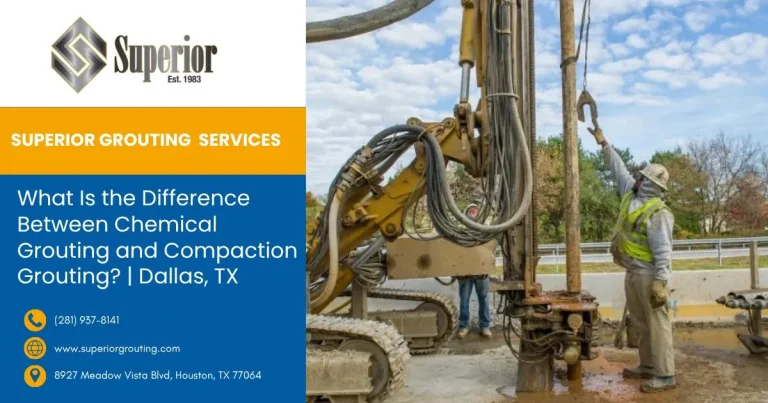
Chemical grouting injects a low viscosity liquid grout that flows into soil pores and cures to seal or bind the grains without moving the soil. Compaction grouting pumps a stiff, low-slump grout at about 100 to 400+ psi to form a bulb that displaces and densifies the soil. Chemical grout typically suits water paths; compaction grout suits loose ground.
Dallas projects sit on Eagle Ford Shale overlain by highly expansive Blackland Prairie clay, which can swell as much as 12 percent by volume in a wet cycle and push with swelling pressures above 10,000 PSF. A Nature Cities study also found more than 70 percent of DFW land subsiding at 3 mm or more per year, so ground movement and water intrusion are practical questions for owners, agencies and engineers across the metro.
Chemical grouting and compaction grouting are both forms of pressure grouting, and both are placed through small injection points rather than open excavation. They still treat the ground in very different ways, because one grout travels through the soil while the other pushes the soil aside, and that difference decides which site problems each method can address.
In this guide, you'll learn how each method works, which site problems each one is typically used for, which soils limit each method (including the Blackland Prairie clay under Dallas), when a project can call for both, and what Superior Grouting Services provides for each method on commercial, industrial and public-works sites.
How Chemical Grouting Treats Soil Without Moving It
Chemical grouting treats soil by injecting a very low viscosity liquid grout, often close to water in consistency, that flows into the pores between soil grains and then cures. Because the grout travels through voids that already exist, it seals or binds the grains in place without disturbing the soil structure, which is why the method is also called permeation grouting.
The grout families used for this work include sodium silicate, acrylate, acrylamide and polyurethane, and each is chosen partly for its gel time, the period between mixing and setting. On our chemical grouting work the grouts are set to cure in seconds to minutes, so a treated zone can begin holding back an active water flow shortly after the injection is complete.
Permeation grouting is used to raise bearing capacity, reduce settlement, control groundwater, support excavations and underpinning, and pre-treat ground ahead of piles. In sewer work, a two-part low viscosity grout is applied from inside the pipe and forced through a leaking joint or manhole wall into the surrounding soil, where it gels and stops the inflow without digging up the line.
How Compaction Grouting Densifies Soil by Displacement
Compaction grouting densifies soil by pumping a stiff, low mobility grout, with a slump of 2 inches (50 mm) or less, into the ground at pressures of about 100 to 400+ psi. The grout does not mix with or permeate the soil, so it forms an expanding bulb that pushes the surrounding soil aside and compacts it, raising its density, shear strength and bearing capacity.
Grout is typically pumped at 0.5 to 1 cubic foot per minute, and each bulb grows from about 1 foot to about 3 feet across as injection continues. Our compaction grouting services follow that pattern, pumping a very low slump, mortar-like grout through a small casing to densify soil beneath building sites, foundations, machinery pads, drilled piers, pipelines and tunneling work.
The side-by-side comparison below sets the two methods against the same criteria, so you can see where the mechanism, the grout and the soil response part ways.
| Criterion | Chemical (permeation) grouting | Compaction grouting |
|---|---|---|
| Mechanism | Grout flows into soil pores, then seals or binds the grains | Grout bulb displaces the soil and densifies it |
| Grout consistency | Very low viscosity, often close to water | Stiff, low mobility, slump of 2 inches (50 mm) or less |
| Effect on soil structure | Left in place, undisturbed | Pushed aside and compacted |
| Injection figures | Gel time set by the grout family, seconds to minutes | About 100 to 400+ psi at 0.5 to 1 cu ft per minute |
| Grout materials | Sodium silicate, acrylate, acrylamide, polyurethane | Mortar-like cementitious grout |
| Soils it suits | Sands and gravels with connected voids | Granular, collapsible and unsaturated fine-grained soils, silts, well-graded sands |
| Key limit | Fine silts and clays restrict penetration | Pore pressure buildup in fine-grained soils; less suited to clays |
Which Site Problems Each Method Is Typically Used For
Chemical grouting is typically used where water is moving through soil or through a joint, while compaction grouting is typically used where the ground is loose, voided or settling under load. The table below matches common commercial and public-works problems to the method usually considered first, and the engineer of record confirms the final choice from site data.
| Site problem | Method typically considered | Why it fits |
|---|---|---|
| Infiltration at a sewer pipe joint or manhole | Chemical grouting | A two-part low viscosity grout passes through the joint, gels in the soil and stops the inflow |
| Groundwater control at an excavation | Chemical grouting | Permeation fills and seals pores in sands and gravels |
| Excavation support and underpinning | Chemical grouting | Bound granular soil holds together and gains strength |
| Pre-treatment ahead of piles | Chemical grouting | Permeation binds granular soil before the piles are installed |
| Settlement under a structure | Compaction grouting, or chemical grouting in permeable sand and gravel | Compaction grout arrests settlement by densifying; permeation reduces settlement by binding grains |
| Lifting a foundation back toward grade | Compaction grouting | Bulb growth displaces soil and can raise the load above it |
| Voids, sinkholes and abandoned mine workings | Compaction grouting | Low mobility grout fills the void and densifies the ground around it |
| Liquefaction mitigation | Compaction grouting | Densification by displacement is a listed use in granular soils |
Downtown Dallas still carries early-1900s brick sewers, and joint or manhole infiltration in a network of that age is a water-path problem, which generally points toward chemical grouting rather than displacement. A void beneath a machinery pad or a settling footing is a different kind of problem, because the ground has lost density or volume, and that generally points toward compaction grouting.
Soil Conditions That Limit Each Method, Including Dallas Clay
Soil grain size is the main condition that limits each method, because chemical grout needs connected voids to travel through, while compaction grout needs soil that can be squeezed denser without trapping water pressure. Published guidance lists compaction grouting as less suitable in clays and in poorly graded sands and gravels, and it notes that pore pressure can build up when compaction grout is pumped into fine-grained soils.
Permeation grouting has its own limits: fine silts and clays restrict how far the grout can penetrate, the materials cost more than traditional methods, and the work needs proper design and quality control to perform. Quality control for compaction grouting is still developing as a practice, and the ASCE 53-19 Compaction Grouting Consensus Guide is the published consensus document engineers can refer to for that method.
The table below is general guidance drawn from published sources, not a result from any Dallas site, and it shows where each method gains or loses effectiveness by soil type.
| Soil type | Chemical grouting | Compaction grouting |
|---|---|---|
| Sands and gravels with connected voids | Well suited, grout permeates the pores | Suited when well graded; less suited when poorly graded |
| Silts | Fine silts limit penetration | Suited |
| Collapsible soils | Not listed as a typical use | Suited |
| Unsaturated fine-grained soils | Generally ineffective | Suited |
| Saturated fine-grained soils | Generally ineffective | Risk of pore pressure buildup |
| Clays | Clay limits penetration | Less suited |
Both methods are described as less suited to clay, so neither one is a blanket answer for the Blackland Prairie clay under much of Dallas, and any claim that the clay settles the choice on its own is not supported. What decides the method is what the borings show within the clay profile, such as granular fill, sand layers, voids or a leaking structure, together with the groundwater level and the failure mode you are trying to correct.
Where the borings show water moving through granular fill or through a joint, a chemical option such as polyurethane injection in Dallas, TX may be the fit for the engineer of record to review. Where they show loose or voided ground under a load, compaction grouting is usually the method evaluated, with the pore pressure risk in fine-grained layers checked first.
When a Project Uses Chemical Grouting, Compaction Grouting or Both
A project uses chemical grouting when the problem is water moving through soil or a joint, compaction grouting when the problem is loose, voided or settling ground, and both when a site has each problem in a different place. A pipeline corridor, for example, can have infiltrating joints that call for sealing and a void or settlement zone nearby that calls for densification.
When both are used, the engineer of record sets the order and the treatment zones, because sealing a water path and densifying ground change the site conditions in different ways. You should expect that decision to rest on borings, groundwater readings and the structures and utilities close to each injection point, not on a general rule.
Whichever pressure grouting method the engineer selects, the injection records (pressure, volume, pumping rate and, for chemical grout, the gel time) give the engineer a record to check against the design. Those records carry extra weight on compaction grouting, where quality control procedures are still developing as a practice and fine-grained layers carry a pore pressure risk.
If you are weighing both methods for a Dallas project, share your boring logs and site conditions with our team so the options can be set out for your engineer of record. A soil report, the groundwater level and a clear description of the leak, void or settlement are the inputs that make that review useful.
Chemical and Compaction Grouting at Superior Grouting Services
Superior Grouting Services has provided specialty pressure grouting since 1983, when founder Ron Rumpza started the company, and it works for municipal, state and federal agencies, industrial owners, general contractors and engineers. The company's approach rests on efficient delivery, extensive experience and an exceptional safety record, and every method recommendation is framed for the engineer of record to confirm.
Chemical Grouting. Superior Grouting performs trenchless chemical grouting with four grout families: hydrophobic polyurethane, hydrophilic polyurethane, acrylamide and acrylate. Crews use injection and curtain methods, grouts meeting ANSI/NSF 61 are available for potable water contact, and the company cites a 10 to 20 year service record for its chemical grouting in sewer environments.
Compaction Grouting. Superior Grouting pumps a very low slump, mortar-like grout through a small casing to form a bulb that displaces and densifies the surrounding soil. The method is applied at building sites, foundations, machinery pads, tunneling, drilled piers and pipelines, where the goal is denser ground rather than a sealed water path.
Conclusion
Chemical grouting and compaction grouting differ at the most basic level: chemical grout travels through the soil and seals or binds it in place, while compaction grout stays together as a bulb and pushes the soil denser. That single difference explains why one is typically matched to water paths and the other to loose, voided or settling ground.
On Dallas sites, the Blackland Prairie clay limits both methods, so the borings, the groundwater and the failure mode are what point to one method, the other or both. Bring your soil report and a clear description of the problem when you ask us to compare chemical and compaction grouting for your engineer of record.
Call (281) 937-8141 to scope Dallas soil treatment.
Send your boring logs for a grouting method review.