Superior Grouting Services, Inc. has performed specialty pressure grouting since 1983, and lists the Fayetteville West Transmission Main for the City of Fayetteville among its projects. Large-diameter municipal water infrastructure is the kind of work Northwest Arkansas calls a specialty grouting contractor in for, alongside abandonment of lines taken out of service as a system expands and void closure where ground loss threatens pavement or structures.
Fayetteville lies in the Springfield Plateau region of the Ozarks, at its southern boundary with the Boston Mountains. The Mississippian Boone Formation is the most extensive single bedrock unit at the surface in Washington County and dominates the northern part of the county. The Arkansas Geological Survey describes the Boone as probably the most widespread and karst-susceptible formation in the Ozark Plateaus: a cherty limestone containing abundant sinkholes, pits, springs, and caves. That geology changes the job. Void volume is difficult to bound from boring logs alone, grout take can run well past theoretical, and a cementitious mix can be carried away from the target zone before it sets.
Superior Grouting provides compaction grouting, cellular grouting, polyurethane foam injection, pipeline and abandonment grouting, and concrete leveling for Fayetteville's municipal, commercial, and industrial clients. With more than 3,624,247 linear feet of pipeline grouted and 2,837,498 square feet of concrete raised, we bring four decades of documented performance to every Northwest Arkansas project.
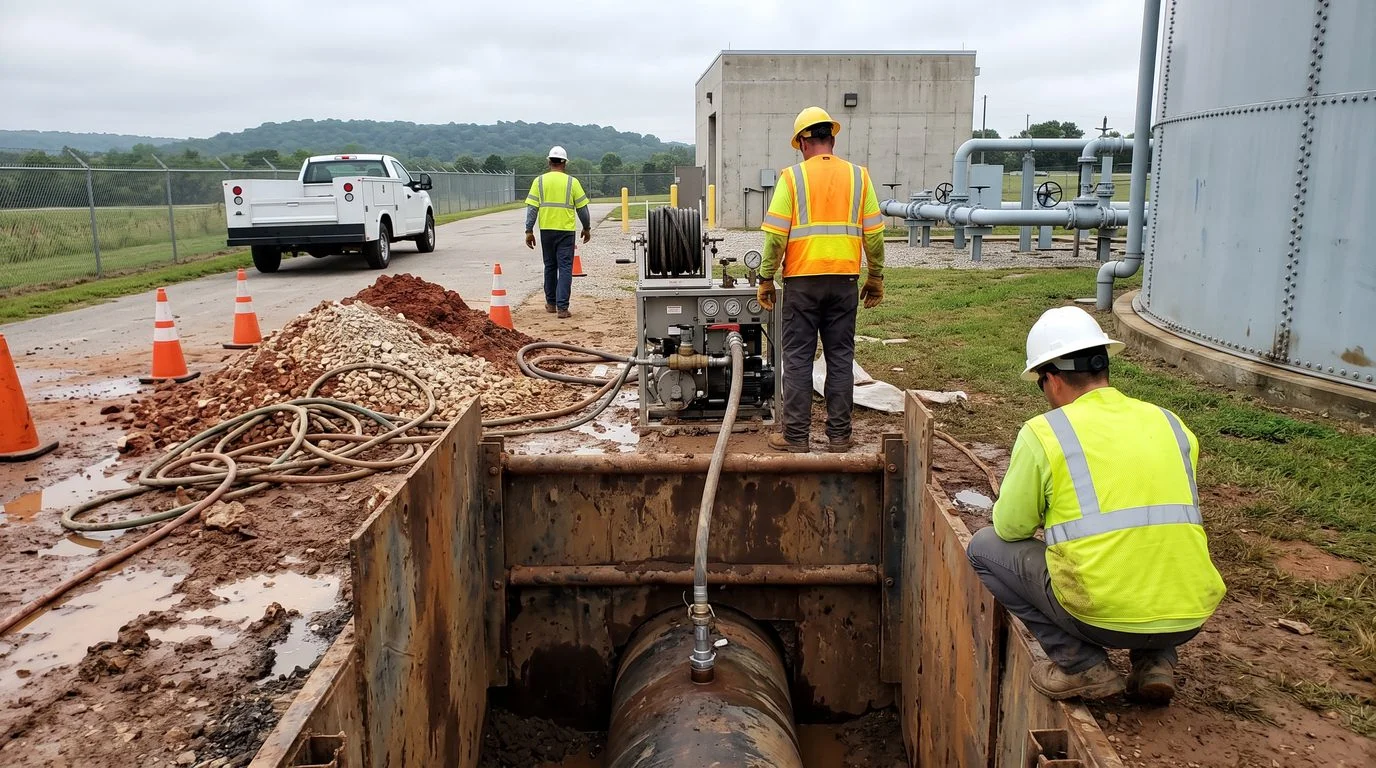
Karst country asks a different question of a grouting contractor than clay country does. In Fayetteville, the problem is rarely a soil that swells and shrinks. It is soil quietly raveling downward into solution features in the Boone Formation below, leaving loose, low-density zones above bedrock pinnacles that only announce themselves when something settles. Compaction grouting answers that by injecting low-mobility grout through small-diameter casings, densifying the raveled soil in place and restoring bearing capacity without excavation.
The Boone Formation is a cherty limestone with an irregular top of rock. In cutter-and-pinnacle karst, solution-widened vertical joints called cutters separate remnant bedrock ridges called pinnacles, so the soil-to-rock contact is anything but flat. Overburden soil ravels into those openings over decades, producing soft zones that boring logs can miss entirely between test holes. Compaction grouting densifies that raveled material and bridges the low-density pockets, which is why it is the primary tool for soil stabilization on Northwest Arkansas commercial sites where excavation is not an option.
Where a solution feature sits beneath an existing footing or slab, the grout program has to do two things at once: fill the loose zone and avoid over-pressurizing into an open channel that will simply accept material indefinitely. Superior Grouting works to a written pressure limit established against overburden and structural capacity before mobilization, and monitors take against theoretical volume port by port. When a port begins accepting far past theoretical, that is information about the void, not a reason to keep pumping.
Fayetteville, Springdale, Rogers, and Bentonville are absorbing distribution, cold chain, and commercial construction at a pace that puts new loads on ground that was never characterized for it. Pre-construction compaction grouting densifies the subgrade before concrete is poured, which is materially cheaper than remediating a settled slab later. On sites where boring logs show erratic strength between holes, a denser grout pattern is warranted precisely because the variability is the finding.
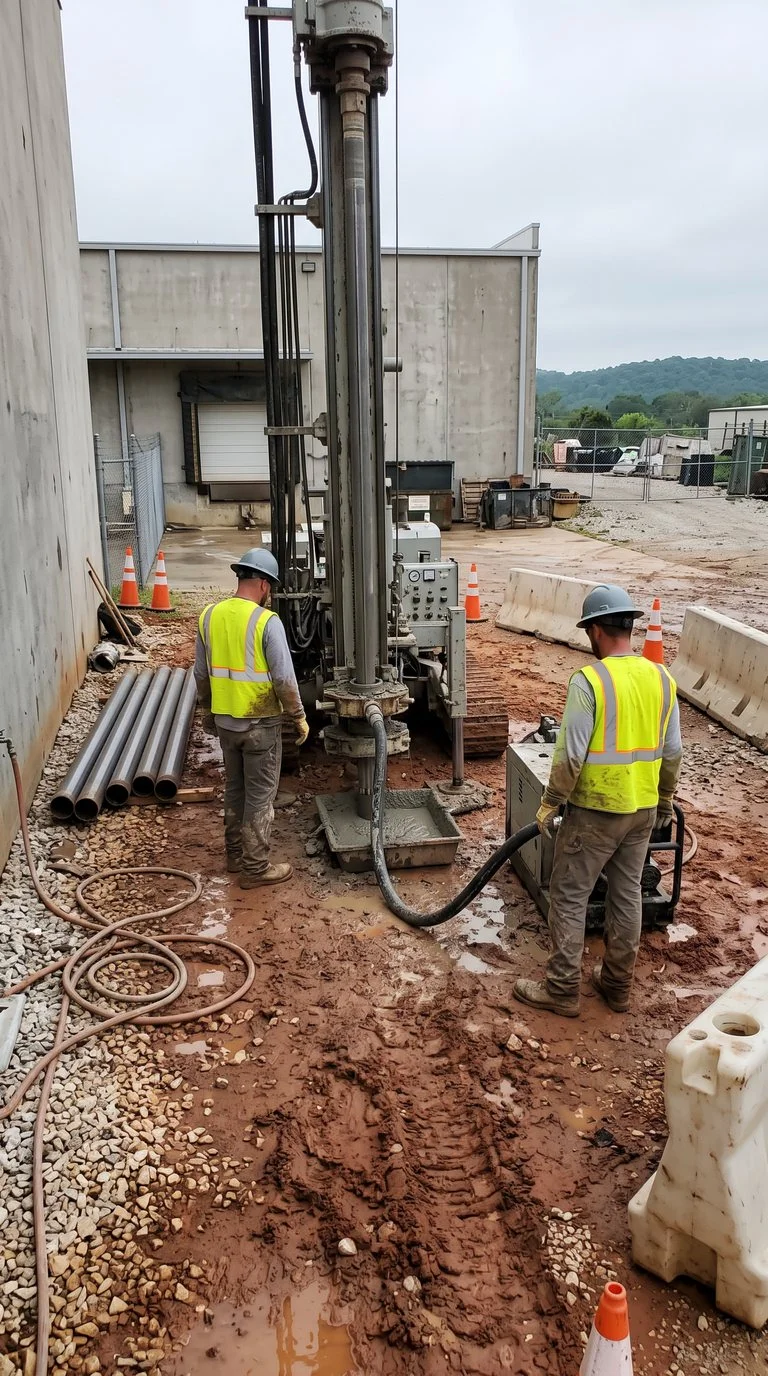
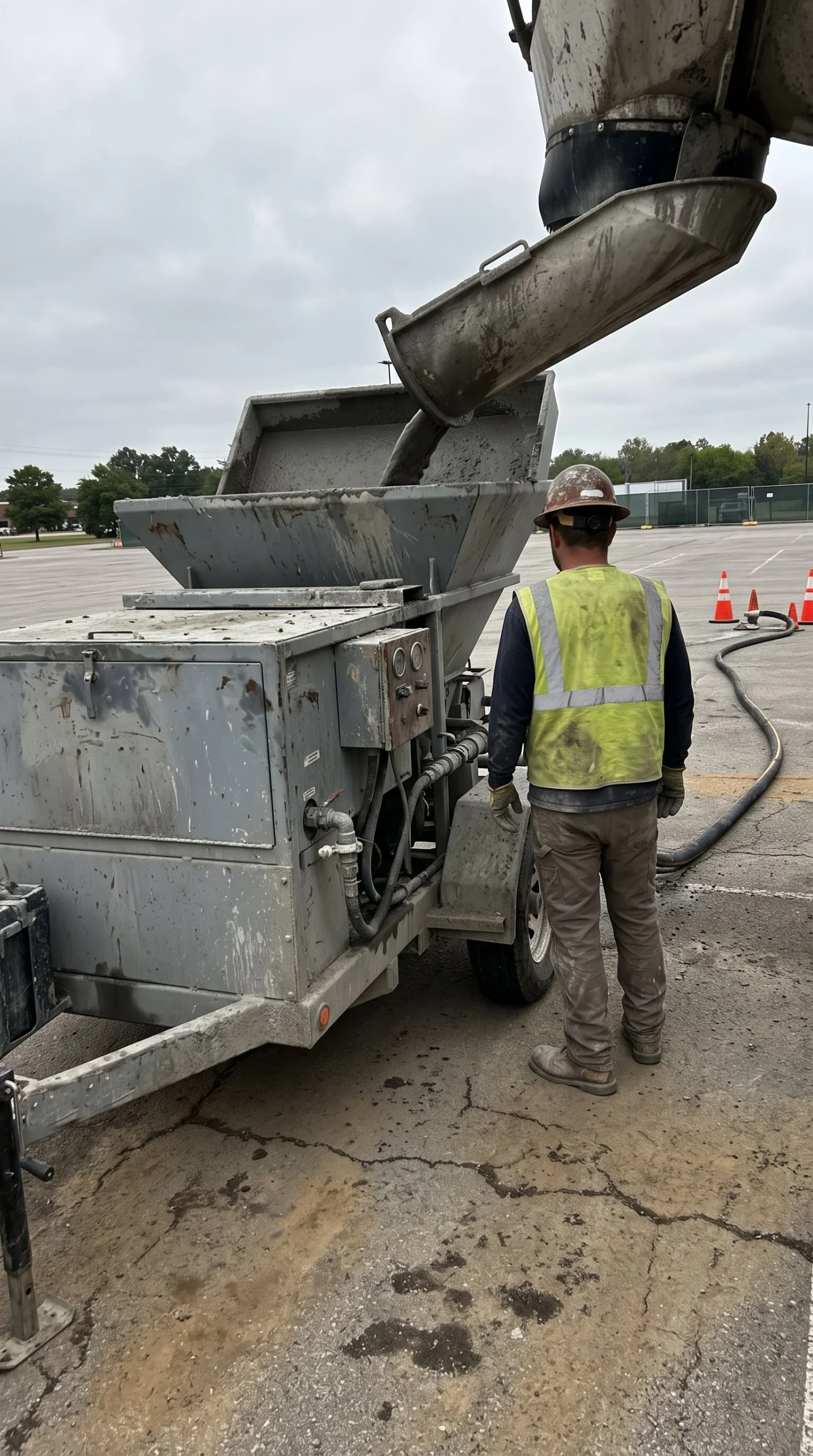

Fayetteville's void work runs large. A solution cavity under a parking field, an abandoned main beneath a redevelopment site, or the annulus around a newly installed transmission line all need a fill that flows into irregular geometry, reaches a long way from the pump, and does not add dead load the surrounding ground was never asked to carry. Cellular concrete does that. It is a low-density controlled low-strength material, made by blending preformed foam into a cement slurry so the mix carries its own air rather than aggregate, and it pumps long distances at low pressure.
Because the material flows and self-consolidates, it reaches undercut zones and irregular solution features that a stiffer fill would bridge over and leave voided. That property matters more in karst than almost anywhere else, since the shape of a dissolution void is unknowable from the surface and rarely resembles the neat volume assumed in a takeoff. Placement is monitored against theoretical volume so a runaway take is caught early rather than after several truckloads.
For large-volume fills beneath Fayetteville pavement and commercial slabs, the low end of the density range does the work: enough strength to carry the design load, little enough weight to avoid re-stressing the ground around the void. Superior Grouting batches on site and tunes the foam-to-cement ratio per project so the cast density and compressive strength match the engineer's specification. ACI 229R describes controlled low-strength material as a self-consolidating cementitious mixture intended to result in a compressive strength of 1200 psi or less, and most applications target well below that. Superior Grouting provides mix design submittals and 28-day compressive strength testing on commercial and DOT projects.
Specifications in Northwest Arkansas divide roughly two ways. Lighter mixes serve load-reducing backfill and annular space applications where weight reduction is the point. Heavier sanded mixes are used as structural backfill beneath equipment pads and utility vaults where compressive performance is the priority. Same material family, different recipe, single mobilization.
When soil ravels into karst below, the slab above loses support long before anyone notices. Joints step, dock doors bind, drainage stops running where it was engineered to run. Polyurethane grouting resets that geometry quickly and without excavation. Closed-cell polyurethane foam, 2 to 4 PCF cured for standard slab work and up to 9 PCF where loads demand it, is injected through 5/8 inch ports, expands beneath the slab, fills the void, compresses loose soil, and cures in minutes.
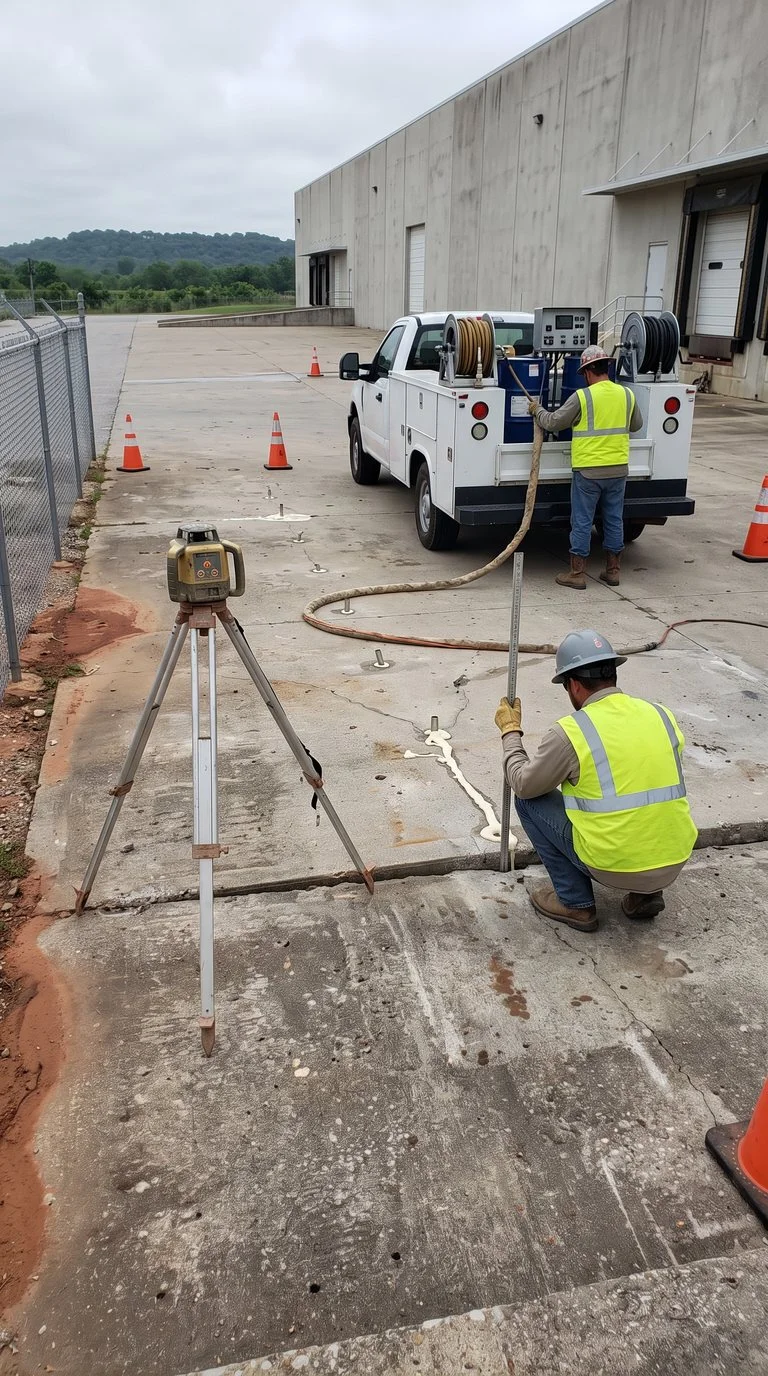
Concrete lifting in Fayetteville is most often specified for the surfaces Northwest Arkansas works on every day: distribution floors through the Springdale and Rogers corridor, retail and office plazas along the I-49 spine, and municipal walkways across Washington County. Crews drill on a grid, inject in sequence, and watch elevation at the slab surface. Because cure is measured in minutes, a warehouse bay returns to forklift traffic the same shift.
Differential settlement over karst shows up as cracked partitions, doors out of square, and separated veneer on commercial structures. Foam injected beneath grade beams and footings along the affected run compresses the soil envelope and fills the air gaps driving continued movement. The operational footprint is small: no perimeter excavation, no interior demolition, no extended facility closure.
Two properties decide it. Weight, because foam at 2 to 4 PCF adds almost nothing to ground that is already losing material downward into solution features, where a heavy cement slurry adds load to the exact mechanism causing the problem. And water, because the closed-cell structure blocks the moisture migration that would otherwise carry fines out from beneath the slab into solution-widened openings below. In karst, keeping fines in place is half the repair.
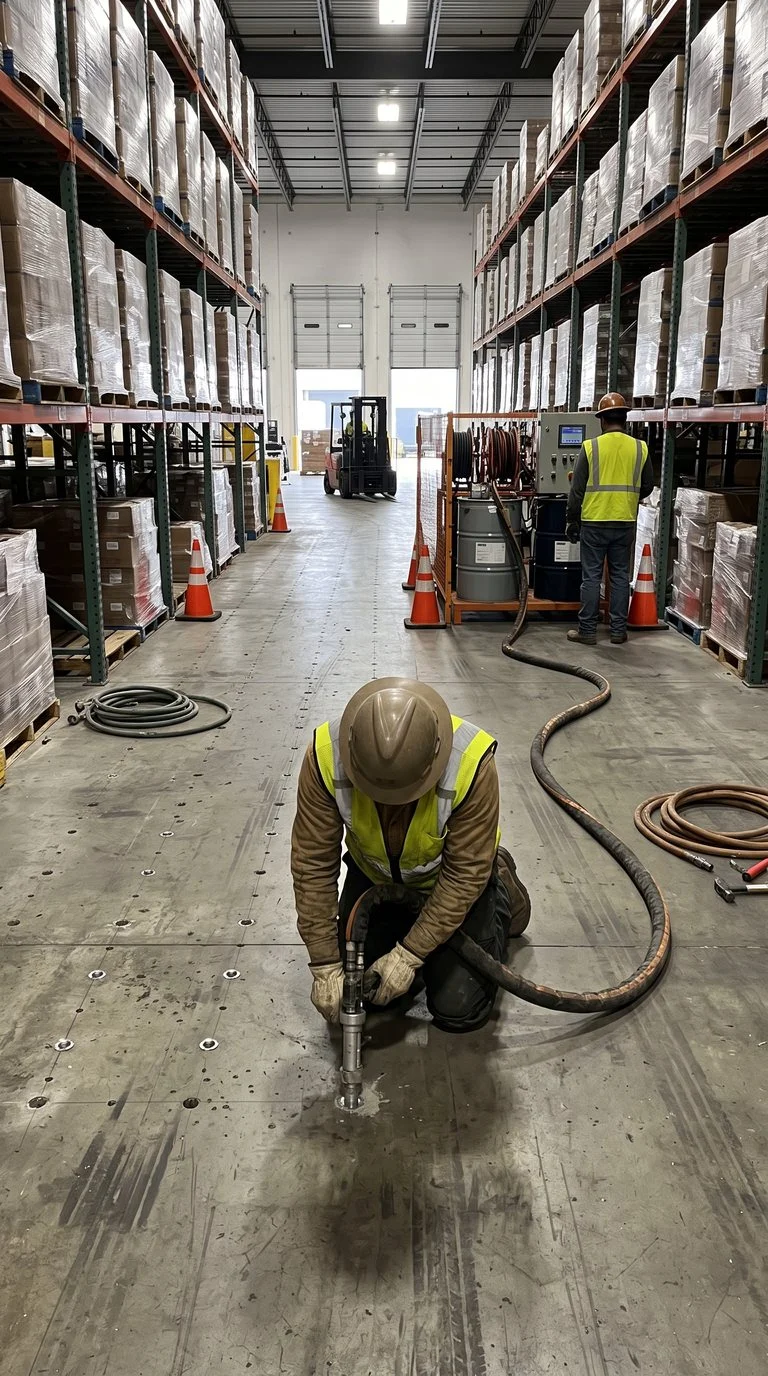
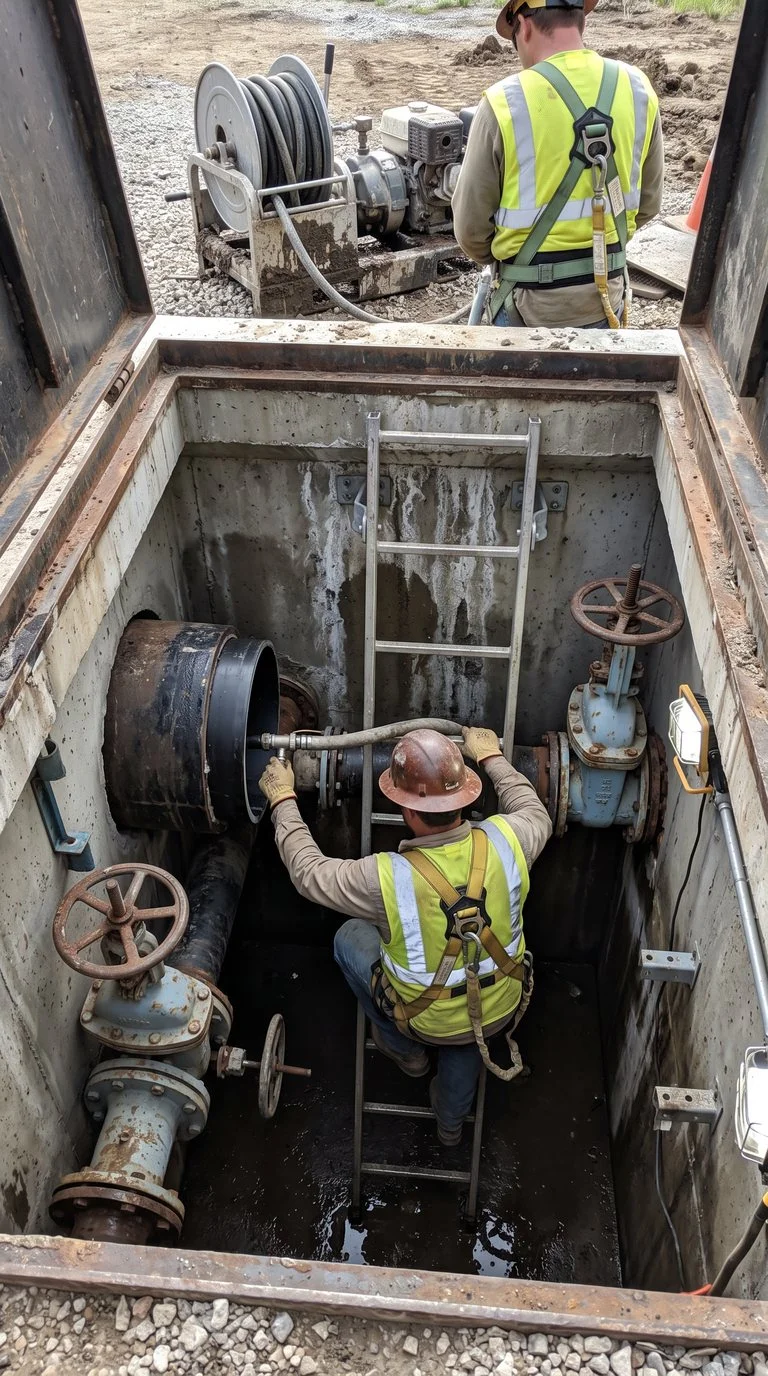
Municipal water infrastructure is the anchor of Superior Grouting's Arkansas work. The City of Fayetteville's West Transmission Water Line is a 48 inch steel main spanning over 11 miles, beginning at a new Beaver Water District facility near Elm Springs and running south through Elm Springs and Tontitown into Fayetteville. Construction began in November 2024 under a construction manager at-risk contract with Garney Companies, with engineering by McClelland Consulting Engineers. In the City's words, its existing transmission mains "are reaching capacity and will be unable to meet Fayetteville's increasing water demands in the near future." Projects of that scale generate casing and annular fills, abandonments, and void closures at multiple stages.
As new capacity comes online, older mains come out of service. An open pipe left in the ground is a settlement risk, a collapse risk, and in karst a direct pathway into the groundwater system, which is why municipal specifications require full interior fill end to end. Crews establish bulkheads at both ends of a run, vent the high points, and pump cementitious fill with the mix designed to the geometry of the line until return confirms a solid column.
Rehabilitating a main by slip-lining leaves an annular gap between the host pipe and the liner. Leave it empty and the liner carries load it was never designed to carry. Fill it too fast and grout buoyancy lifts the liner off line and grade. Placement therefore runs in staged lifts, with spacers or grout bags holding position and the line monitored for uplift throughout, and the mix chosen for annular volume, pumping distance, and the uplift the liner can tolerate.
Voids in Washington County are usually dissolution features in the Boone Formation or the raveled soil zones above them, and they rarely repeat in shape. Superior Grouting matches material to the void: low-density cellular for large-volume karst fills, higher-strength sanded mixes where loading demands compressive performance, and cementitious slurry for targeted closure of smaller pockets. In every case the control that matters is take monitored against theoretical volume, because in karst the difference between the two is the whole story.
Concrete leveling in Fayetteville is the surface half of a subsurface problem. The slab did not fail; the support under it went somewhere. Polyurethane foam restores design elevation without tearing out the slab, and because it is light and waterproof, it does not feed the mechanism that caused the settlement in the first place. Crews drill 5/8 inch ports, inject in sequence, monitor lift at the surface, and hand the area back the same shift.
Two-component polyurethane is injected at depth, expands against the underside of the slab, and compresses loose soil as it returns the slab to grade. Elevation is watched in real time and volume throttled in small increments, which is what makes the method suitable for surfaces that have to stay in service: dock aprons, plaza hardscape, warehouse bays, and municipal sidewalks across Fayetteville and the wider Northwest Arkansas corridor.
Cement-based raising adds weight to ground that is already losing material downward into karst. Polyurethane at 2 to 4 PCF does not, and its closed-cell structure blocks the water movement that would otherwise wash fines out from beneath the slab into the openings below. On Fayetteville commercial slabs, that weight-and-water combination is why foam holds where a heavier repair resettles.
Owners weigh four things: cost, mobilization, cure time, and lost operating days. Full tear-out on a large warehouse floor means demolition, haul-off, reinforcement, pour, and weeks of cure before equipment returns. Foam lifting on the same slab runs 50 to 70 percent less than full demolition and replacement, finishes inside a shift, and leaves the surface open to traffic the same day. On karst, replacement also resets the clock on the same settlement pattern without addressing what is happening below.
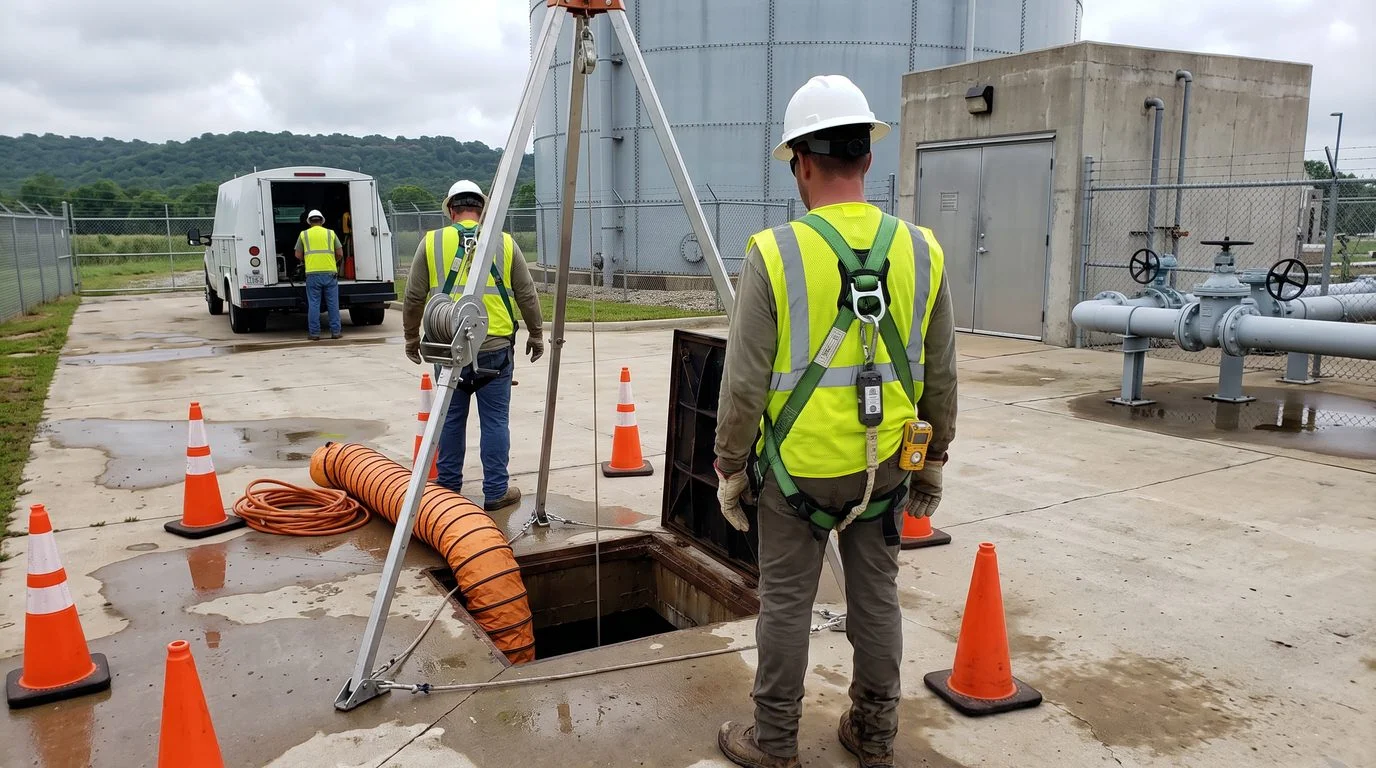
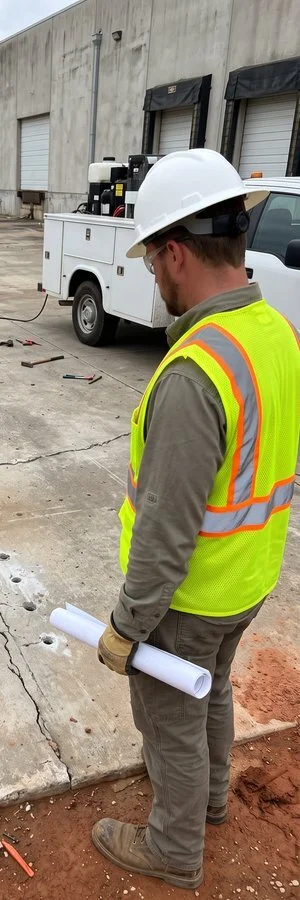
Superior Grouting Services, Inc. is headquartered at 8927 Meadow Vista Blvd in Houston, TX. Founder Ron Rumpza opened the business in 1983, and the company now serves commercial and industrial clients across Texas, Louisiana, Arkansas, New Mexico, and Florida, bringing four decades of specialty grouting practice to Northwest Arkansas water and infrastructure work.
Fayetteville, Springdale, Rogers, and Bentonville sit in a metro area the Census Bureau ranked among the ten fastest growing in the country by percentage growth in 2025, and the water, wastewater, and transportation systems underneath are being expanded and rehabilitated at the same time. That combination, new capacity going in while old lines come out, is the specific work Superior Grouting has done since 1983.
Earlier than a Gulf Coast project. Arkansas sits outside Superior Grouting's dense Texas and Louisiana corridor, so crews, pumps, and batch equipment are staged specifically for the trip rather than routed from nearby work. Custom mix designs add lead time on top of that. Send plans, specifications, photos, and any geotechnical report to a field engineer as early as the scope is known. Call 281-894-4175 or email sales@superiorgrouting.com.
Superior Grouting also serves commercial and industrial projects in New Mexico and Florida.