


Chemical Grouting After CIPP Lining: Why Residual Infiltration Paths Still Need Sealing
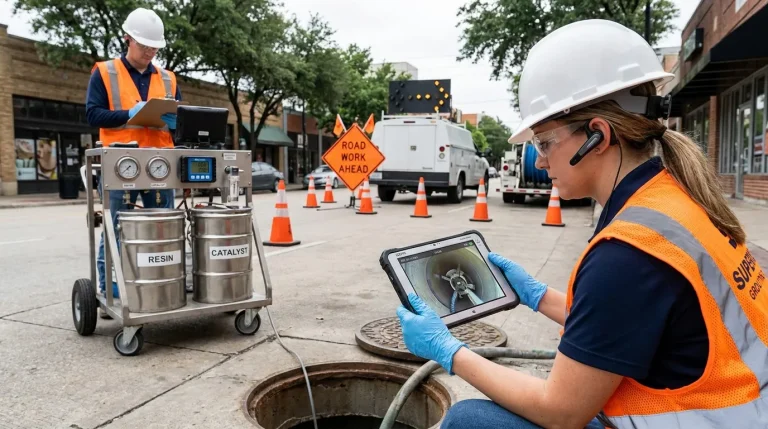
A cured-in-place pipe (CIPP) liner restores the structural function of a deteriorated sewer main, but the liner alone does not seal three residual infiltration paths that continue to admit groundwater into the collection system: the annular space between the host pipe and the new liner, the lateral service connections that penetrate the liner, and the manhole-to-liner termination joint. Chemical grouting at these three locations, executed as a paired scope with CIPP installation, seals the residual paths, delivers full I&I reduction, and preserves the structural investment in the liner. Programs that install CIPP without paired chemical grouting routinely underperform their I&I reduction expectations by 20 to 40 percent.
Cured-in-place pipe (CIPP) lining is one of the most widely used trenchless rehabilitation methods for municipal sanitary sewers. It replaces the structural function of a deteriorated host pipe with a new inner pipe formed in place from resin-impregnated fabric, without excavation. The method restores structural integrity, extends service life by 30 to 50 years, and is recognized within NASSCO specifications and municipal rehabilitation programs across the United States.
What CIPP lining does not do, however, is seal every infiltration path in the rehabilitated system. Three residual paths remain after the liner cures, each capable of admitting groundwater into the collection system despite the liner's presence. Programs that install CIPP alone and expect complete I&I reduction routinely find that treatment plant flows drop less than expected, and program managers investigate to find that residual paths continued to admit infiltration at rates that partially offset the liner's benefit.
This article explains the three residual paths, presents the paired-scope framework that combines CIPP lining with targeted chemical grouting, and provides the specification and coordination guidance municipal engineers need to build the paired scope into their rehabilitation programs. The audience is municipal engineers, wastewater program managers, consulting engineers of record, and CIPP contractors coordinating with specialty grouting subcontractors. Every parameter is advisory and project-specific; final scope, procedures, and coordination requirements must be validated by the engineer of record and matched to the applicable owner specification.
Why CIPP Alone Leaves Infiltration Paths Open
CIPP lining is designed to solve a specific problem: restore the structural function of a deteriorated pipe from within, without excavation. The resin-impregnated fabric liner cures against the host pipe wall, forming a new inner pipe with its own structural rating and its own smooth flow surface. For the pipe itself, this is the correct method. The liner does not, however, address every infiltration path in the rehabilitated system, because the liner is a structural rehabilitation method, not a joint-and-connection sealing method.
Municipal I&I reduction programs that treat CIPP as a complete solution consistently underperform their expected reduction targets. Post-installation flow monitoring routinely shows residual I&I persisting in lined segments at 20 to 40 percent of pre-installation levels. Program managers investigate, and the answer is nearly always the same: infiltration continues at the residual paths the liner cannot address. The specific paths are known, they are predictable, and they are addressable through paired chemical grouting services executed alongside or immediately after CIPP installation.
Three Residual Infiltration Paths a CIPP Liner Alone Cannot Seal
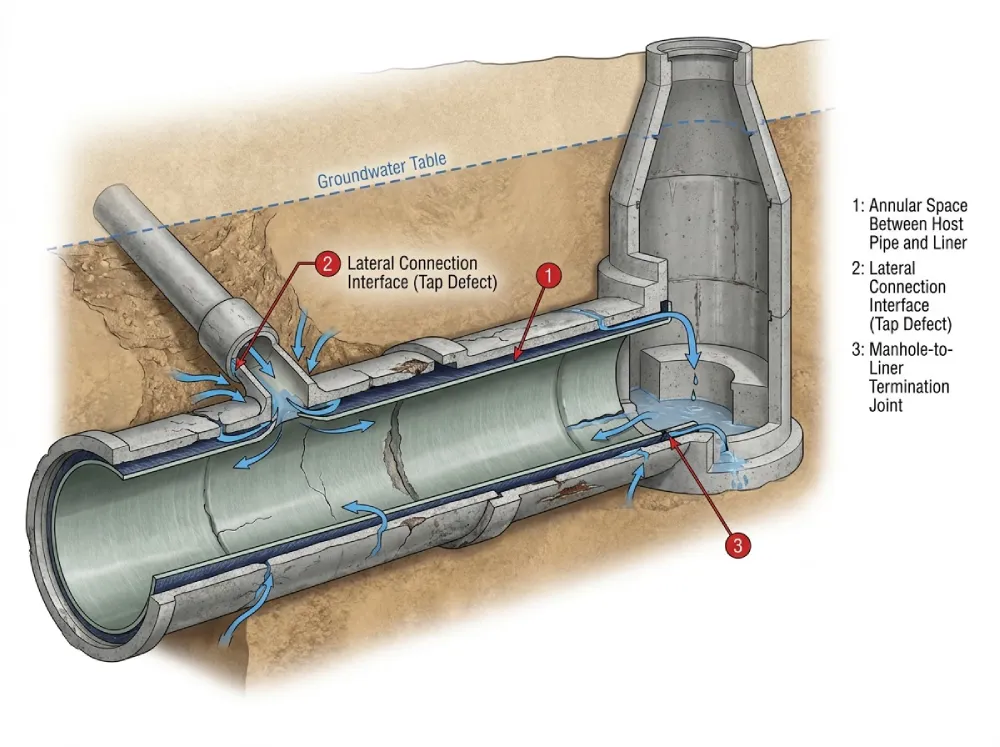
The three residual paths are consistent across CIPP installations and across sewer system types. Each has a specific mechanism and a specific chemical grouting remediation.
Path 1: The Annular Space Between Host Pipe and Liner
When a CIPP liner is installed, an annular space typically remains between the exterior of the new liner and the interior wall of the host pipe. In new installations with tight-fit liners, this annulus may be minimal; in older installations or on pipes with irregular geometry, the annulus can be substantial. In either case, the annulus is a continuous longitudinal void along the entire lined segment.
This annular space becomes an infiltration conduit when the host pipe has joint defects, cracks, or holes that admit groundwater. The water enters the annulus at any host pipe defect, flows along the annular space, and exits at the manhole or lateral connection where the annulus terminates. From the perspective of the collection system, the infiltration continues; the water simply takes a longer path.
Chemical grouting addresses this path by injecting hydrophobic polyurethane or acrylate gel into the annular space through ports drilled in the liner at predetermined intervals. The grout fills the annulus, cures to a rigid or gel structure, and eliminates the longitudinal conduit. Volume reconciliation between injected material and calculated theoretical annular volume confirms complete fill.
Path 2: Lateral Connection Interfaces
Service laterals connect private plumbing to the public sewer main at wye or tee junctions along the main. During CIPP installation, the liner passes across each lateral connection, temporarily blocking the lateral. A robotic cutter is then deployed inside the cured liner to reinstate each lateral connection by cutting an opening in the liner at the lateral location.
The cutting process creates an annular defect at the lateral tap. The liner does not bond continuously to the host pipe at the reinstatement, and the exposed edge of the cut lateral opening creates a small gap that admits infiltration from the surrounding disturbed soil at the tap. Even a well-executed lateral reinstatement produces this residual defect; it is intrinsic to the reinstatement process.
Chemical grouting addresses this path through packer injection at each reinstated lateral, with the packer isolating the tap zone and hydrophilic polyurethane or acrylamide gel injected into the annular defect between the liner and the host pipe at the reinstatement, plus the surrounding disturbed soil zone. The specialty grouting contractor executing this work coordinates with the CIPP contractor to schedule the grouting immediately after cutter reinstatement, before groundwater conditions can establish flow patterns through the residual defect.
Path 3: Manhole-to-Liner Termination Joint
The CIPP liner terminates at each end in a manhole (or in some cases at a launch or reception pit). The termination joint between the end of the liner and the manhole invert is a construction joint, sealed with a manufacturer-specified terminal sealant during CIPP installation. This seal is typically effective at the interior surface but does not extend into the annular space behind the liner, meaning the annulus can continue to admit infiltration at the termination and exit into the manhole channel.
Chemical grouting addresses this path through injection at the termination joint, sealing the annular space at the manhole-to-liner interface. Hydrophilic polyurethane is common at this application because the interface routinely has active groundwater presence, and the water-reactive cure provides the fast sealing needed for the specific geometry. Curtain grouting on the exterior of the manhole around the pipe entry can supplement the interior injection for structures where the annular defect extends into the surrounding soil.
The Paired-Scope Sequence: CIPP Then Chemical Grouting
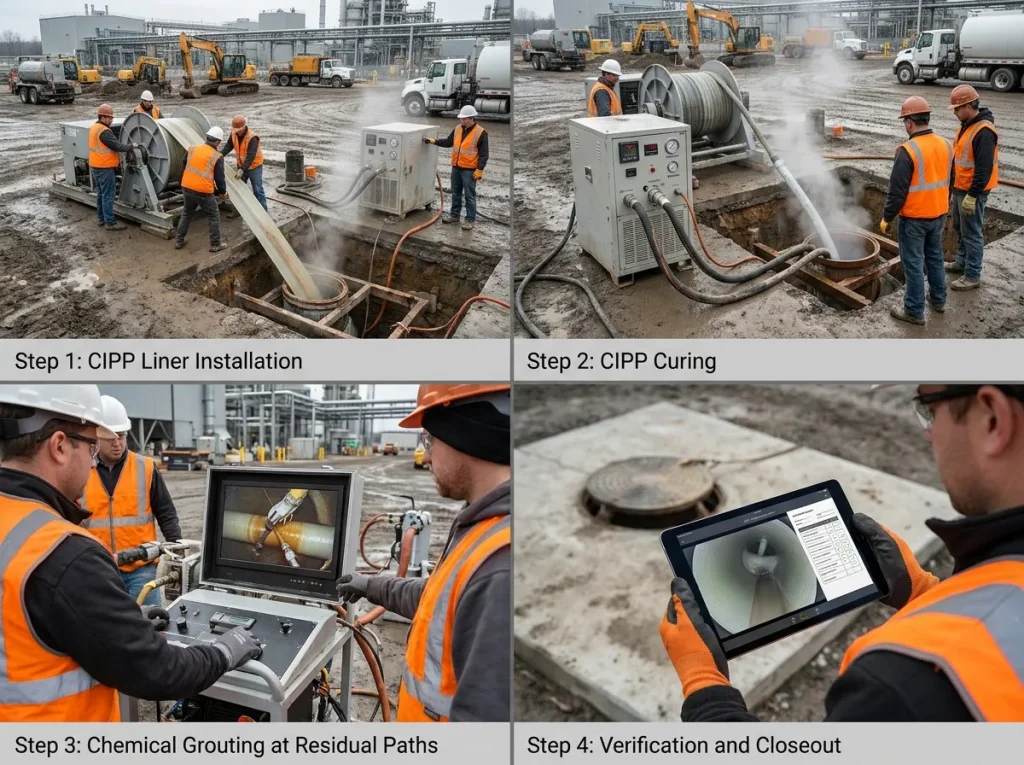
A well-executed paired-scope proceeds through a defined sequence that coordinates the CIPP contractor and the chemical grouting contractor across the same project timeline.
Step 1: CIPP Liner Installation
The CIPP contractor installs the liner per the approved specification: pipe cleaning, liner insertion (inversion or pull-in), cure (steam, UV, or ambient), and initial inspection. The paired chemical grouting scope has been documented in the project specification and the CIPP contractor is aware that grouting will follow.
Step 2: CIPP Curing and Lateral Reinstatement
The CIPP contractor completes the cure per manufacturer specification, then deploys a robotic cutter to reinstate each lateral connection. The cutter operator records each lateral location with distance, orientation, and post-reinstatement condition for the paired grouting scope. If any lateral reinstatement produces a visible defect beyond typical (fabric edges displaced, over-cut, mis-alignment), the CIPP contractor flags it for the grouting contractor.
Step 3: Chemical Grouting Execution
The chemical grouting contractor mobilizes typically within one to seven days of CIPP cure completion. The contractor executes packer injection at each reinstated lateral, injects the annular space through ports drilled in the liner at predetermined intervals (typically at each manhole plus intermediate ports on longer runs), and seals the manhole termination joints. Volume reconciliation confirms annular space fill; CCTV inspection at each treated point confirms the seal.
Step 4: Post-Grouting Verification and Program Reporting
Post-grouting verification includes CCTV inspection of the full lined segment, downstream flow monitoring compared to pre-CIPP and post-CIPP-alone baselines (where available), and closeout documentation delivered to the owner. The program manager reports the combined CIPP + chemical grouting reduction as a paired-scope outcome, which typically achieves 15 to 30 percent additional I&I reduction beyond the CIPP-alone result.
Coordination Between the CIPP Contractor and the Grouting Contractor
The paired scope requires coordination that most single-contractor procurements do not need. Key coordination elements:
- Specification integration. The project specification should reference both CIPP installation and paired chemical grouting as a coordinated scope with defined interfaces. Bid documents should identify which contractor holds which scope and how they coordinate.
- Schedule sequencing. Chemical grouting is scheduled within days of CIPP cure completion. Longer delays allow groundwater conditions to establish flow patterns through residual paths, which can complicate the grouting execution.
- Access sharing. Both contractors need access to the same manholes and work zones. Traffic control, dewatering, and site setup are shared or handed off cleanly between contractors.
- Documentation handoff. The CIPP contractor documents each lateral reinstatement location and condition. The grouting contractor uses this documentation to plan the packer injection scope.
- Warranty coordination. The combined warranty on the rehabilitated segment should reflect both contractors' work, with clear definitions of which party is responsible for which failure mode.
For utility owners procuring the paired scope, the cleanest approach is a single prime contractor (typically the CIPP contractor) with the specialty grouting contractor as a named subcontractor, or two prime contracts with an owner-managed coordination protocol. The void fill grouting and packer injection scope is executed under either structure, provided the specifications and schedules integrate cleanly.
When Paired Chemical Grouting Is Not Needed
Paired chemical grouting is not required on every CIPP installation. The scope may be omitted when:
- The host pipe is watertight before CIPP installation. New pipe reconstruction or recently rehabilitated segments with confirmed low infiltration may not have residual paths worth treating.
- The CIPP installation uses a tight-fit or interactive liner technology. Some newer CIPP formulations produce minimal annular space and integrate more effectively with lateral connections, reducing residual paths.
- The service life target is short. Rehabilitation programs with 10-year or shorter service life targets may not justify the additional grouting scope; longer-life programs (30 to 50 years) typically do.
- Pre-CIPP flow monitoring confirms minimal I&I in the segment. Segments with low baseline I&I have less residual infiltration potential and lower marginal benefit from paired grouting.
The engineer of record evaluates each project against these criteria during specification development. For most large-scale municipal I&I reduction programs targeting 30- to 50-year service life, paired chemical grouting delivers measurable additional reduction and justifies its incremental cost.
Cost Economics of Paired-Scope Rehabilitation
Paired-scope cost economics compare favorably against CIPP-alone rehabilitation when full I&I reduction is the program goal.
| Element | CIPP Alone | Paired CIPP + Chemical Grouting | Notes |
| CIPP liner installation | $50 to $150 per LF | $50 to $150 per LF | No change |
| Chemical grouting (annular fill) | $5 to $20 per LF | Added scope | |
| Chemical grouting (lateral reinstatements) | $400 to $1,500 per connection | Added scope, per connection count | |
| Chemical grouting (manhole terminations) | $500 to $2,000 per manhole | Added scope, at each end | |
| Typical increment for full paired scope | 0 percent | 10 to 25 percent | On top of CIPP-alone budget |
| I&I reduction | 60 to 80 percent on segment | 85 to 98 percent on segment | Meaningful marginal reduction |
| Program value at treatment plant | Baseline | Additional avoided cost | Depending on treatment plant capacity and cost per gallon |
For a typical municipal program spending $2 million on CIPP lining in a fiscal year, the paired chemical grouting scope typically adds $200,000 to $500,000 and captures the residual 20 to 40 percent of I&I that CIPP alone leaves in the system. The Environmental Protection Agency's collection systems technology fact sheets reference the paired-method approach as best practice for high-target I&I reduction programs.
Program-Level Reporting for Paired-Scope Rehabilitation
CMOM (Capacity, Management, Operation, and Maintenance) programs increasingly track paired-scope rehabilitation as a distinct category. Standard reporting elements:
- Segment-level pre-rehabilitation baseline flow. Established from pre-project flow monitoring at strategic points.
- Post-CIPP-alone interim measurement. Where feasible, flow monitoring after CIPP installation but before chemical grouting establishes the incremental benefit of the paired grouting scope.
- Post-paired-scope final measurement. Flow monitoring after both scopes complete, establishing the full rehabilitation outcome.
- Segment-level I&I reduction percentage. Reported to EPA and state regulators as evidence of program effectiveness.
- Cost per gallon of I&I removed. Increasingly reported by utilities as a program efficiency metric, with paired scope typically producing better cost-per-gallon-removed than CIPP alone on the same segments.
For utilities operating under consent decrees or capital investment mandates, the paired-scope reporting framework strengthens the compliance position and supports future capital allocation decisions.
Field-Tested Coordination Examples
Three composite scenarios illustrate how paired-scope coordination plays out in real municipal programs. Each is representative rather than specific to a past project.
Scenario 1: Small Municipal Interceptor Rehabilitation
A city rehabilitates a 4,000-foot 18-inch interceptor with CIPP lining. The specification includes paired chemical grouting for the annular space (11 injection points at manhole locations and intermediate ports), lateral reinstatements (23 laterals along the segment), and manhole termination joints (5 manholes). CIPP contractor completes installation and cure in three shifts; chemical grouting contractor mobilizes on shift 4 and completes work in two shifts. Total paired-scope adds 15 percent to the CIPP-alone budget and captures an additional 25 percent I&I reduction beyond the CIPP-only result.
Scenario 2: Large Municipal I&I Reduction Program
A large city with a consent decree procures $8 million of CIPP lining across multiple contract lots. The specification for each lot includes paired chemical grouting as a named requirement, with the specialty grouting contractor identified as a subcontractor to each CIPP prime. The paired scope adds approximately 18 percent to each contract lot and produces measurable I&I reduction reported quarterly to the state regulator. The consent decree compliance timeline is met.
Scenario 3: Post-CIPP Retroactive Grouting
A utility with existing CIPP installations from prior years finds ongoing residual I&I in lined segments. Investigation confirms the residual paths were not addressed at the time of CIPP installation. The utility procures a retroactive chemical grouting scope on the existing CIPP segments, treating the annular space, lateral reinstatements, and manhole terminations. The retroactive scope captures the residual I&I that the original CIPP installations left unaddressed, though at higher unit cost than would have been captured through paired-scope coordination at the time of the original installation.
When to Specify Retroactive Grouting on Existing CIPP
Utility owners with existing CIPP installations should consider retroactive chemical grouting when:
- Flow monitoring shows measurable I&I in previously lined segments
- CCTV inspection of lined segments reveals visible infiltration at lateral connections or manhole terminations
- The segment is within the useful life of the CIPP liner (typically the first 20 to 40 years of a 30 to 50 year design life)
- Program budget allows the incremental cost
- Regulator or consent decree compliance timeline requires additional I&I reduction
Retroactive grouting on existing CIPP is more expensive per unit than paired-scope grouting at installation, but it is substantially less expensive than any structural alternative (rehabilitation, replacement) and preserves the existing liner investment.
Key Takeaways
- CIPP lining restores pipe structural function but leaves three residual infiltration paths unsealed: annular space between host pipe and liner, lateral connection interfaces at reinstatements, and manhole-to-liner termination joints.
- Municipal I&I reduction programs that install CIPP alone typically underperform expected reduction by 20 to 40 percent due to residual infiltration at these paths.
- Chemical grouting executed as a paired scope with CIPP installation addresses all three residual paths and delivers 15 to 30 percent additional I&I reduction beyond CIPP-alone.
- The paired scope typically adds 10 to 25 percent to the CIPP-alone budget and produces meaningful marginal I&I reduction, improving cost-per-gallon-removed program metrics.
- Coordination between the CIPP contractor and the chemical grouting contractor requires specification integration, schedule sequencing, access sharing, documentation handoff, and warranty definition.
- Retroactive chemical grouting on existing CIPP installations is a viable option for utilities with measurable residual I&I on previously lined segments.
- Every parameter in this article is advisory and project-specific. Final scope, procedures, and coordination requirements must be validated by the engineer of record.
Frequently Asked Questions
Why do I need chemical grouting after CIPP lining is complete?
CIPP lining restores the structural function of a deteriorated sewer main but does not seal three residual infiltration paths: the annular space between the host pipe and the new liner, the lateral connection interfaces where the liner is cut for reinstatement, and the manhole-to-liner termination joints. Groundwater continues to enter through these paths after CIPP alone, typically at 20 to 40 percent of pre-CIPP infiltration rates. Chemical grouting seals these residual paths and delivers complete I&I reduction on the rehabilitated segment.
How much additional I&I reduction does paired chemical grouting provide?
Paired chemical grouting typically delivers an additional 15 to 30 percent I&I reduction beyond the reduction achieved by CIPP alone on the same segment. Combined paired-scope I&I reduction commonly reaches 85 to 98 percent of pre-rehabilitation baseline, compared to 60 to 80 percent for CIPP alone. Actual reduction depends on the residual infiltration profile of the specific segment; segments with substantial residual paths benefit more from the paired scope than segments where the pre-CIPP infiltration was concentrated in the pipe wall itself.
What are the three residual infiltration paths after CIPP lining?
The three residual paths are: (1) the annular space between the host pipe interior wall and the CIPP liner exterior, which acts as a longitudinal conduit for groundwater entering at any host pipe defect and exiting at a manhole or lateral connection; (2) the lateral connection interfaces at reinstatements, where the robotic cutter creates an annular defect at each cut lateral; and (3) the manhole-to-liner termination joints, where the annular space terminates at the manhole and can continue to admit infiltration. All three are consistent across CIPP installations and are addressable through chemical grouting.
How much does paired CIPP plus chemical grouting cost compared to CIPP alone?
Paired chemical grouting typically adds 10 to 25 percent to the CIPP-alone budget. Typical unit costs are $5 to $20 per linear foot for annular space fill, $400 to $1,500 per lateral connection reinstatement, and $500 to $2,000 per manhole termination. For a $2 million CIPP program in a fiscal year, the paired grouting scope adds approximately $200,000 to $500,000. The paired-scope adds meaningful I&I reduction beyond CIPP alone and improves the program's cost-per-gallon-removed metric.
When should chemical grouting happen in the CIPP installation timeline?
Chemical grouting is typically scheduled within one to seven days of CIPP cure completion. The CIPP contractor completes installation, cure, and lateral reinstatement first; the chemical grouting contractor mobilizes immediately after. Longer delays between CIPP completion and grouting are technically feasible but allow groundwater conditions to establish flow patterns through residual paths, which can complicate grouting execution. For programs procuring both scopes together, the schedule sequencing is documented in the project specification.
Can chemical grouting be added retroactively to CIPP installed years ago?
Yes. Retroactive chemical grouting on existing CIPP installations is a viable option when flow monitoring or CCTV inspection identifies measurable residual I&I in previously lined segments. The retroactive scope addresses the same three residual paths (annular space, lateral connections, manhole terminations) as paired-scope grouting at installation. Retroactive grouting is more expensive per unit than paired-scope grouting due to remobilization costs and coordination overhead, but is substantially less expensive than any structural alternative.
Who coordinates the paired scope between the CIPP contractor and the grouting contractor?
Coordination is typically managed by one of three parties: the utility owner's project manager (for owner-managed multi-prime contracts), the CIPP contractor as prime contractor with the grouting contractor as subcontractor (single-prime approach), or the consulting engineer of record (for owner-representative-managed programs). The cleanest structure is a single prime with the grouting contractor named as subcontractor, which simplifies scheduling, access, documentation, and warranty management. Two-prime structures are viable but require more owner or engineer coordination effort.
What documentation should I require for the paired scope?
Standard documentation for a paired-scope rehabilitation includes: CIPP installation records (liner specification, installation methodology, cure data), lateral reinstatement locations and post-reinstatement condition, chemical grouting daily injection logs at each treated location, volume reconciliation between injected material and calculated theoretical void volume, pre and post CCTV inspection of the full segment, downstream flow monitoring data, and combined warranty documentation covering both contractors' work. The closeout submittal integrates both contractors' documentation into a single project file.
Does paired chemical grouting affect the CIPP liner warranty?
Standard CIPP liner warranties are not typically voided by paired chemical grouting when the grouting is performed by a qualified specialty contractor following manufacturer-compatible procedures. Coordination between the CIPP manufacturer, the CIPP contractor, and the grouting contractor confirms compatibility during the specification phase. Some CIPP manufacturers explicitly recognize paired chemical grouting as a compatible or recommended companion scope. Warranty terms are project-specific and should be confirmed during procurement.
How do I add paired chemical grouting to my existing CIPP rehabilitation program?
Adding paired chemical grouting to an existing program involves specification amendment (incorporating the paired scope into new procurement documents), contractor pre-qualification (adding specialty grouting contractors to the approved bidder list), budget allocation (typically 10 to 25 percent increment on CIPP-alone budget), and program reporting update (tracking paired-scope outcomes distinctly from CIPP-alone outcomes). For utilities in Texas or Louisiana considering paired-scope rehabilitation, schedule an estimate with Superior Grouting to evaluate a specific segment or program.
Conclusion
CIPP lining is the standard structural rehabilitation method for deteriorated sanitary sewer mains, but it does not seal every infiltration path. Three residual paths (annular space, lateral connection interfaces, and manhole-to-liner termination joints) continue to admit groundwater after CIPP alone, typically at 20 to 40 percent of pre-CIPP infiltration rates. Chemical grouting executed as a paired scope with CIPP installation addresses all three residual paths, adds 10 to 25 percent to the CIPP-alone budget, and delivers 15 to 30 percent additional I&I reduction with combined reductions reaching 85 to 98 percent of pre-rehabilitation baseline. The paired scope requires coordination between the CIPP contractor and the chemical grouting contractor, but the coordination framework is well-established across NASSCO specifications and municipal best practice. Every parameter in this article is advisory and project-specific; final scope, procedures, and coordination requirements must be validated by the engineer of record against the applicable owner specification. To scope paired CIPP and chemical grouting for a Texas or Louisiana municipal collection system, contact Superior Grouting.