


How Chemical Grouting Reduces Inflow and Infiltration (I&I) in Municipal Sanitary Sewers: A Utility Owner's Playbook
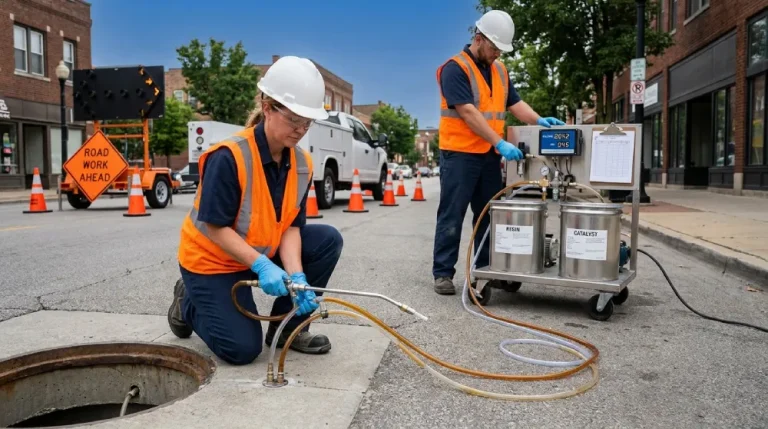
Chemical grouting reduces inflow and infiltration (I&I) in municipal sanitary sewers by injecting low-viscosity resins or gels into pipe joints, lateral connections, manhole walls, and utility penetrations to seal the infiltration pathway at the source. A properly executed chemical grouting program typically reduces I&I by 40 to 80 percent on treated segments, with a service life of 10 to 20 years or more when materials, injection procedures, and post-grouting verification are matched to the failure mode. The method is trenchless, operates on live sewer systems, and is recognized within NASSCO packer injection grouting specifications.
Municipal sanitary sewer systems in the United States lose measurable capacity every year to inflow and infiltration. Groundwater enters through failed joints and cracks. Storm water enters through defective manhole covers and improperly connected downspouts. The additional flow raises treatment plant loading, drives sanitary sewer overflows (SSOs) during wet-weather events, and can trigger regulatory enforcement under the Clean Water Act. Rehabilitation dollars, when they are available, must reach as many defects as possible, which is why municipal utilities need methods that seal the source without excavation and without service interruption.
This article is a utility owner's playbook for using chemical grouting as the core method within an I&I reduction program. It is written for municipal engineers, public works directors, collection system managers, and consulting engineers responsible for CMOM (Capacity, Management, Operation, and Maintenance) programs and sewer system evaluation surveys. Every parameter and timeline is advisory and project-specific; final scope, material class, injection procedure, and verification methodology must be validated by the engineer of record against the applicable owner specification and NASSCO or state DOT standards.
Why I&I Costs Utilities Money
Inflow and infiltration are not neutral. Every additional gallon of clear water in a sanitary sewer costs the utility in three ways: treatment plant capacity consumption (which translates to operational cost and eventually to capital expansion), pumping energy at lift stations along the collection system, and regulatory risk during wet-weather events when the extra flow exceeds sewer capacity and produces overflows.
For a typical municipal collection system, I&I commonly runs 30 to 60 percent of dry-weather flow, with wet-weather peaks that can multiply the base condition by 5 to 10 times. Treatment plant costs scale with volume: every dollar spent treating clean groundwater is a dollar not available for the sewage the plant exists to treat. On the regulatory side, EPA and state enforcement of SSO limits under the Clean Water Act has intensified over the past two decades, and utilities operating with excessive I&I face consent decrees, capital investment mandates, and enforcement penalties that dwarf the cost of proactive rehabilitation.
The chemical grouting services available for I&I reduction address the root cause, not the symptom. Sealing pathways at the source stops the additional flow from entering the collection system in the first place, which is measurable in downstream flow monitoring and in avoided capital and treatment costs.
The Four I&I Pathways Chemical Grouting Addresses
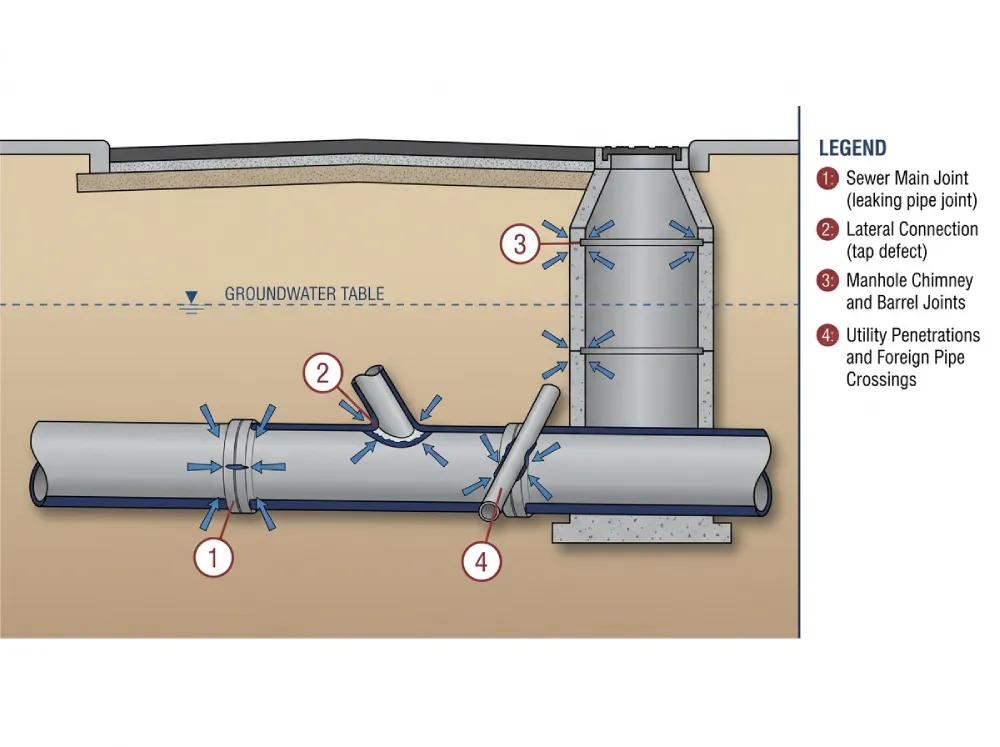
Municipal I&I enters the collection system through a limited number of pathway categories. Chemical grouting addresses four of these directly and effectively.
Pathway 1: Sewer Main Joint Infiltration
Pipe-to-pipe joints in gravity sanitary sewer mains are the most common infiltration source in aging collection systems. Vitrified clay, concrete, and PVC joints all degrade over time from ground movement, root intrusion, differential settlement, and simple age. Failed joints admit groundwater through the annular defect between adjacent pipe sections.
Chemical grouting addresses this pathway through packer injection: a specialized packer is positioned inside the pipe at the defective joint, sealed against the pipe wall on either side of the joint, and chemical grout is injected under controlled pressure into the joint and the surrounding soil. The grout expands or gels on contact with the infiltration water, forming a seal at the joint and a stabilized soil zone in the immediate exterior of the pipe.
Pathway 2: Lateral Connection Infiltration
Where a private service lateral connects to the public sewer main (at a wye, tee, or saddle), the connection is a discontinuity in the pipe wall. Poorly executed original construction, differential settlement between the main and the lateral, and root intrusion at the connection produce annular defects that admit infiltration. Lateral connections are also a common source of inflow when the lateral itself has surface connections (foundation drains, area drains, roof downspouts inadvertently connected).
Chemical grouting addresses the connection defect through packer injection at the lateral tap, with the packer isolating the tap zone and the grout sealing the annular gap between the lateral and the main. For lateral-to-main sealing following cured-in-place pipe (CIPP) lining of the main, chemical grouting closes the residual infiltration path that the liner alone cannot address.
Pathway 3: Manhole Barrel and Chimney Infiltration
Manholes are the vertical access structures where much of the collection system is inspected, maintained, and monitored. They are also a significant infiltration source in aging systems. The chimney-to-corbel joint, the barrel-to-cone transition, the bench-to-invert connection, and the pipe-to-manhole penetration are all common defect locations. The typical manhole in a mature municipal system contributes 10 to 20 gallons per day of infiltration when defects are present; multiplied across a system with 5,000 to 15,000 manholes, this becomes a measurable share of total I&I.
Chemical grouting addresses manhole infiltration through interior injection ports drilled through the manhole wall around each defect, with hydrophilic polyurethane or acrylamide gel injected into the surrounding soil to form a curtain seal. Curtain grouting on the exterior of the manhole is particularly effective for structures where interior access to specific defects is limited, sealing the manhole against groundwater from the soil side rather than the interior wall side.
Pathway 4: Utility Penetrations and Foreign Pipe Crossings
Municipal streets carry buried utilities from multiple owners: water, gas, electric, communications, storm drainage, and sanitary sewer. Where a foreign utility crosses or penetrates the sanitary sewer envelope, the disturbed backfill zone becomes an infiltration pathway. These utility penetrations are particularly common at street intersections and along corridors where multiple utility upgrades have occurred over decades.
Chemical grouting seals these pathways through injection at the penetration location, with the grout filling the disturbed soil zone and creating a barrier against groundwater migration along the utility trench. This application is coordinated with the affected utility owner to confirm no conflict with the foreign infrastructure.
How Chemical Grouting Reduces I&I: The Mechanism
Chemical grouts differ from cementitious grouts in a single critical property: viscosity. Chemical grouts, in liquid form before cure, have viscosities close to water (1 to 5 centipoise for acrylamide and acrylate gels, 100 to 500 centipoise for polyurethane systems). Cementitious grouts have viscosities orders of magnitude higher because they carry solid particles (Portland cement, fly ash, or ultrafine cement) that cannot pass through the fine pores and micro-cracks where I&I actually enters.
The low viscosity of chemical grout is the reason the method works. When injected under controlled pressure at a defect, the liquid grout permeates the surrounding soil, fills the micro-defects in the concrete or pipe wall, and forms a continuous barrier at the exact location where infiltration was occurring. Hydrophilic polyurethane grouts react with the infiltrating water on contact, expanding to fill the space and forming a flexible water-activated gel. Acrylamide and acrylate gels react through a chemical catalyst system to polymerize in place, forming an impermeable gel barrier. The Environmental Protection Agency's Sanitary Sewer Overflow guidance and I&I control resources recognize chemical grouting within the toolkit of trenchless rehabilitation methods for CMOM programs.
Building an I&I Reduction Program with Chemical Grouting
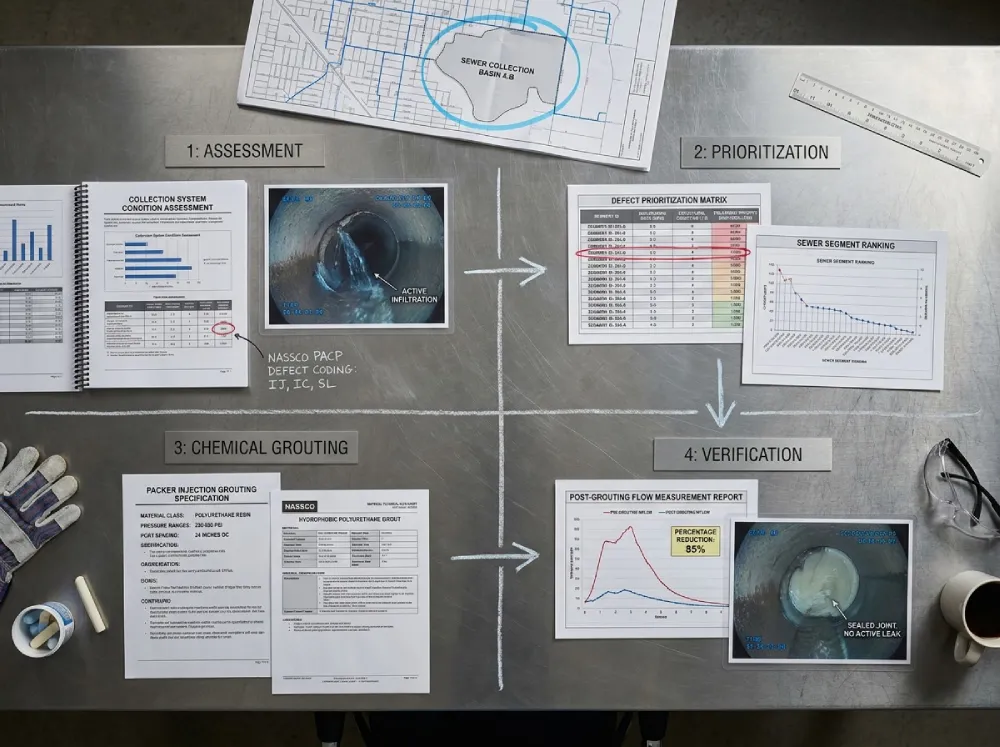
A well-executed I&I reduction program using chemical grouting proceeds through four phases. The framework is standardized across NASSCO training materials, EPA guidance, and municipal best practice.
Phase 1: Assessment
Assessment identifies where I&I is entering the collection system. Standard methods include:
- CCTV inspection of sewer mains with NASSCO PACP defect coding to identify joint defects, cracks, and lateral connection issues
- Manhole assessment with NASSCO MACP defect coding to identify barrel, chimney, and penetration defects
- Flow monitoring at strategic points in the collection system to quantify dry-weather versus wet-weather flow patterns and localize excessive I&I
- Smoke testing to identify inflow sources (surface connections, cross-connected storm drains)
- Dye testing to confirm specific infiltration pathways
The assessment output is a defect inventory with location, severity, and estimated flow contribution for each identified pathway. This becomes the input to Phase 2.
Phase 2: Prioritization
Not every defect is worth grouting. Prioritization ranks defects by three criteria: I&I contribution (higher flow rate defects rank higher), structural condition (defects on otherwise sound pipes rank higher than those on structurally failing pipes that need lining or replacement), and access (defects in accessible locations rank higher than those requiring extraordinary work).
A typical municipal prioritization output is a tiered list: Tier 1 defects (highest I&I contribution on sound infrastructure) get scheduled for immediate grouting, Tier 2 defects get scheduled within the next fiscal year, and Tier 3 defects are documented for future reevaluation. Defects on structurally failing infrastructure are routed to lining or replacement programs rather than grouting.
Phase 3: Chemical Grouting Execution
Execution proceeds under a NASSCO packer injection grouting specification or the owner's equivalent standard. Standard elements include:
- Material class selection (hydrophilic polyurethane, hydrophobic polyurethane, acrylamide gel, or acrylate gel) matched to the defect type and water condition
- Packer positioning and pressure testing to confirm the isolation zone
- Injection pressure and volume monitoring with pressure decay confirmation
- Continuous documentation in the daily injection log
- Confined space entry protocols per OSHA 29 CFR 1910.146 where applicable
- Post-injection CCTV or visual verification at each treated defect
A qualified specialty grouting contractor executes this phase under the engineer of record approved procedure with full QA/QC documentation.
Phase 4: Verification
Verification confirms that the grouting produced the intended I&I reduction. Standard methods include:
- Post-grouting CCTV re-inspection to confirm each treated defect is sealed
- Downstream flow monitoring compared to pre-grouting baseline
- Volume reconciliation between injected material and calculated theoretical void volume
- Smoke testing or dye testing at re-inspected defects
- Program-level flow reduction reporting to the utility owner and regulator where applicable
The verification output becomes part of the CMOM report and supports the utility's compliance position with EPA and state regulators.
Chemical Grouting Versus Alternative Methods for I&I Reduction
Chemical grouting is not the only method for I&I reduction. The comparison matrix below positions it against the realistic alternatives.
| Method | Best Use Case | I&I Reduction Potential | Service Life | Relative Cost |
| Chemical grouting (packer injection) | Joint and connection defects on sound pipe | 40 to 80 percent on treated segments | 10 to 20 years or more | Low to moderate |
| Cured-in-place pipe (CIPP) lining | Structurally compromised pipe | Near-total (structural) | 30 to 50 years | High |
| Manhole coating and lining | Manhole wall infiltration | 50 to 90 percent on treated structure | 15 to 25 years | Moderate |
| Pipe bursting or replacement | Collapsed or failed pipe | Complete (new pipe) | 50+ years | Very high |
| Spot repair | Isolated structural defects | Complete at the defect | 20 to 40 years | Moderate |
For most municipal collection systems, the correct program uses chemical grouting on the highest-count defect category (joint infiltration), CIPP lining on structurally compromised segments, manhole coating on defective structures, and pipe replacement on failed infrastructure. The methods are complementary, not competing, and the program prioritization determines the mix.
Regulatory Drivers Behind I&I Reduction Programs
Several federal and state regulatory drivers push utilities toward proactive I&I reduction:
- EPA CMOM (Capacity, Management, Operation, and Maintenance) guidance requires utilities to demonstrate that collection system capacity is adequate for dry and wet weather flows. Chronic I&I that produces SSOs is a CMOM compliance issue.
- Clean Water Act enforcement on SSOs. Repeat SSOs during wet weather can trigger consent decrees and mandatory capital investment programs.
- State-level regulatory frameworks (Texas TCEQ, Louisiana LDEQ, and equivalents) that mirror federal SSO enforcement with state-specific reporting requirements.
- Utility rate case and bond covenant requirements that increasingly reference I&I reduction targets as capital efficiency measures.
For utilities in Texas and Louisiana, underground utility grouting services that specifically target I&I reduction provide compliance value in addition to the direct operational cost savings.
Cost and Program Economics
Chemical grouting economics compare favorably against the alternatives on the specific defect category it addresses.
| Cost Element | Typical Range | Notes |
| Chemical grouting per pipe joint | $200 to $600 per joint | Packer injection with material and labor |
| Chemical grouting per manhole | $1,500 to $5,000 per structure | Depending on defect count and complexity |
| Chemical grouting per lateral connection | $400 to $1,500 per connection | Packer injection at the tap |
| Alternative: CIPP lining per LF | $50 to $150 per linear foot | Full-pipe rehabilitation |
| Alternative: Open-cut replacement | $200 to $500 per linear foot | Full excavation and replacement |
| Alternative: Manhole rehabilitation (full) | $8,000 to $25,000 per structure | Coating, lining, or reconstruction |
For a typical municipal collection system with 500 identified defective joints, a chemical grouting program at $400 per joint averages $200,000 in direct cost. The equivalent CIPP lining scope on the same segments could exceed $2,000,000. The chemical grouting program reduces 60 to 70 percent of the target I&I at 10 percent of the alternative cost, which is why it is a foundational method in most municipal I&I reduction programs.
Measurement and Reporting for CMOM Programs
CMOM programs require ongoing measurement of I&I reduction results. A chemical grouting program integrates into CMOM reporting through the following measurement framework:
- Pre-program baseline flow monitoring at strategic points in the collection system
- Segment-level defect inventories developed during Phase 1 assessment
- Program-level treatment scheduling with expected I&I reduction per segment
- Post-treatment flow monitoring at the same strategic points
- Reduction reporting as a percentage of pre-program baseline
- Compliance reporting to EPA and state regulators as part of the annual CMOM report
For utilities working under consent decrees or capital improvement mandates, this measurement framework becomes the primary documentation of program effectiveness. A void fill grouting or infiltration control scope executed with rigorous QA/QC documentation supports the utility's compliance position.
Common Program Pitfalls
Three pitfalls recur in municipal chemical grouting programs. Recognizing them improves outcomes.
- Grouting structurally failed pipe. Chemical grouting seals defects on otherwise sound pipe. If the pipe itself is structurally compromised (crushed, longitudinally cracked, deflected beyond tolerance), grouting the joints does not save the pipe and the rehabilitation dollar is misspent. These segments belong on the CIPP or replacement schedule.
- Ignoring surface inflow sources. Chemical grouting stops infiltration (groundwater entry). It does not stop inflow (surface water entry via manhole covers, cross-connected storm drains, illegal roof and foundation drains). Programs that address only infiltration underperform their expected I&I reduction because inflow sources are unaddressed.
- Skipping verification. Programs that inject grout without post-treatment CCTV or flow monitoring cannot prove reduction, cannot report to regulators, and cannot defend budget requests. Verification is not optional; it is the deliverable that makes the program measurable.
Key Takeaways
- Chemical grouting reduces municipal sanitary sewer I&I by 40 to 80 percent on treated segments through trenchless injection at joint, lateral, manhole, and utility penetration defects.
- Four common I&I pathways: sewer main joints, lateral connections, manhole barrel and chimney joints, and utility penetrations. Chemical grouting addresses all four.
- A well-executed I&I reduction program proceeds through four phases: assessment, prioritization, chemical grouting execution, and verification.
- Chemical grouting is complementary to CIPP lining and pipe replacement, not competing. The correct program mix depends on defect type and pipe condition.
- Regulatory drivers (EPA CMOM guidance, Clean Water Act SSO enforcement, state-level programs) push utilities toward proactive I&I reduction, and chemical grouting is a foundational tool in that response.
- Cost economics favor chemical grouting on the joint-defect category by roughly 10x compared to full-pipe alternatives on the same segments.
- Every parameter in this article is advisory and project-specific. Final scope, material class, injection procedure, and verification methodology must be validated by the engineer of record against the applicable owner specification.
Frequently Asked Questions
What is inflow and infiltration (I&I) in a sanitary sewer system?
Inflow and infiltration (I&I) is the entry of clear water into a sanitary sewer system through defects and connections other than the sanitary flow it is designed to carry. Infiltration is groundwater entering through pipe joints, cracks, manhole defects, and utility penetrations. Inflow is surface water entering through manhole covers, illegal roof drain connections, and cross-connected storm drains. Both consume treatment plant capacity and drive sanitary sewer overflows during wet weather.
How much can chemical grouting reduce I&I in my collection system?
Chemical grouting typically reduces I&I by 40 to 80 percent on treated segments when the program is properly assessed, prioritized, executed, and verified. Program-level reduction across the full collection system depends on the share of total I&I contributed by grouting-addressable defects. Most municipal systems can achieve 30 to 50 percent overall I&I reduction with a properly executed chemical grouting program combined with complementary methods (CIPP, manhole rehabilitation, inflow source disconnection) for the remaining pathways.
How long does chemical grouting last in a sanitary sewer application?
Chemical grouting service life is typically 10 to 20 years or more when materials, injection procedures, and post-grouting verification are properly matched to the defect and site conditions. NASSCO packer injection grouting specifications reference anticipated service life of 25 years or more for work executed to industry standard of care. Actual service life depends on material class selection, execution quality, groundwater chemistry, and continued structural integrity of the host pipe.
Is chemical grouting approved by NASSCO for sewer rehabilitation?
Yes. NASSCO maintains formal specifications for packer injection grouting and provides training through The NASSCO Training Source. Municipal sewer rehabilitation programs across the United States reference NASSCO specifications directly or through state or local standards derived from NASSCO. The engineer of record for a specific project is the authoritative source for the applicable specification and any project-specific modifications.
Can chemical grouting stop active water leaks in a live sewer?
Yes. Chemical grouting is specifically designed for live sewer operation without service interruption. Hydrophilic polyurethane grouts react with the infiltrating water on contact, expanding to fill the space and forming a flexible water-activated seal. Acrylamide and acrylate gels react through a chemical catalyst system to polymerize in place. Both material classes seal active infiltration within seconds to minutes of injection, allowing the sewer to remain in service throughout the work.
What is the difference between packer injection grouting and curtain grouting?
Packer injection grouting seals defects from the interior of the pipe or structure, using an inflatable packer to isolate the defect zone and inject grout directly into the joint or crack. Curtain grouting seals structures from the soil side, injecting grout into the surrounding soil to create an impermeable barrier around the structure. Packer injection is standard for pipe joints and lateral connections. Curtain grouting is common for manholes and below-grade structures where exterior access is available.
How does chemical grouting compare to CIPP lining for I&I reduction?
Chemical grouting and CIPP lining address different failure modes. Chemical grouting seals joint and connection defects on otherwise sound pipe at a fraction of CIPP cost. CIPP lining replaces the structural function of the pipe on segments where the pipe itself is compromised. For most municipal I&I reduction programs, the two methods are used together: chemical grouting on joint defects, CIPP lining on structurally compromised segments. Program economics favor chemical grouting on the joint-defect category by roughly 10x.
What NASSCO PACP defect codes indicate chemical grouting is appropriate?
NASSCO PACP defect codes indicating chemical grouting candidacy include infiltration codes (I-series: dripper, runner, gusher classifications), joint offset codes where the joint remains structurally intact, and cracking codes on otherwise sound pipe. Structural defects requiring lining or replacement (severe multiple cracks, broken pipe, collapsed pipe, deformed pipe) are not chemical grouting candidates. The engineer of record reviews the PACP coding output during Phase 2 prioritization to route each defect to the correct rehabilitation method.
How much does a chemical grouting I&I reduction program cost?
Chemical grouting program cost depends on the defect count and access conditions. Typical unit costs run $200 to $600 per pipe joint, $1,500 to $5,000 per manhole, and $400 to $1,500 per lateral connection. For a program targeting 500 identified joint defects, direct grouting cost averages $200,000. Alternative rehabilitation on the same segments (CIPP lining, replacement) commonly runs 5 to 15 times higher. Site-specific estimates validated by the engineer of record are the correct basis for procurement.
Who should manage a municipal I&I reduction program using chemical grouting?
I&I reduction program management typically combines the utility owner's engineering staff, a consulting engineer of record, and a qualified specialty grouting contractor. The utility owner defines program goals and budgets, coordinates with regulators, and manages the CMOM reporting. The consulting engineer of record develops the assessment methodology, prioritizes defects, writes the specifications, and validates the contractor's work. The specialty contractor executes the field work under approved procedures with full QA/QC documentation. To evaluate a chemical grouting scope for a Texas or Louisiana municipal collection system, schedule an estimate with Superior Grouting.
Conclusion
Chemical grouting is a foundational method for municipal I&I reduction programs, addressing four common infiltration pathways (sewer main joints, lateral connections, manhole barrel and chimney defects, and utility penetrations) at a fraction of the cost of full-pipe rehabilitation. A properly executed program proceeds through four phases (assessment, prioritization, injection, verification), integrates with NASSCO specifications and CMOM reporting frameworks, and delivers measurable I&I reduction that supports regulatory compliance and capital efficiency. Chemical grouting complements rather than competes with CIPP lining, manhole rehabilitation, and pipe replacement; the correct program mix is defined by defect type and pipe condition. Every parameter in this article is advisory and project-specific; final scope, material class, injection procedure, and verification methodology must be validated by the engineer of record against the applicable owner specification and NASSCO or state DOT standards. To scope a chemical grouting I&I reduction program for a Texas or Louisiana municipal collection system, contact Superior Grouting.