


Polyurethane Grouting for Utility Infrastructure: Manholes, Tunnels, and Underground Structures
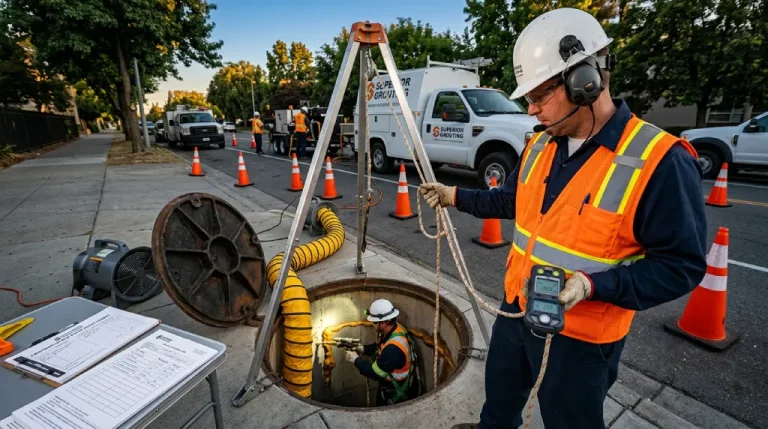
Polyurethane grouting addresses two distinct utility infrastructure rehabilitation needs: hydrophilic systems for active infiltration sealing in manholes, tunnels, and below-grade structures, and hydrophobic systems for annular space fill behind CIPP liners and structural void fill in underground rehabilitation. Both classes are recognized within NASSCO MACP and PACP standards and AWWA water infrastructure rehabilitation specifications. Work proceeds under OSHA 29 CFR 1910.146 confined-space entry protocols, NSF/ANSI 61 compliance where adjacent to potable water systems, and full QA/QC documentation aligned with owner submittal requirements.
Underground utility infrastructure (sanitary sewer, storm drainage, water distribution, communication conduits, transportation tunnels) deteriorates from infiltration, exfiltration, structural deformation, and connection failures. Rehabilitation methods range from full replacement to in-situ trenchless rehabilitation, and polyurethane grouting fits multiple roles within the trenchless toolkit. The method is one of a small number of approaches that can stop active water infiltration while the system remains in service.
This article presents the application of polyurethane grouting in utility infrastructure rehabilitation. The audience is municipal water and wastewater engineers, utility owners, CIPP rehabilitators, sanitary sewer evaluation specialists, and the engineering teams that specify rehabilitation programs. Every parameter and recommendation is advisory and project-specific; final scope, material class, injection pressure, and procedure require validation by the engineer of record against the project specification and the governing owner standard.
Why Utility Infrastructure Needs a Different Toolkit
Utility infrastructure rehabilitation has constraints that surface-level slab work does not. The work environment is below grade in confined spaces, the system is often active during work, the materials are in contact with water or waste streams, and the rehabilitation must be performed without service interruption in many cases. Polyurethane grouting addresses these constraints through material class selection (hydrophilic vs. hydrophobic), procedure adaptation (confined-space entry, in-service injection), and material compliance (NSF/ANSI 61, food-grade, potable-water adjacent).
Polyurethane grouting services for utility infrastructure require the same engineering discipline as surface slab work, with additional requirements for confined-space safety, in-service operation, and water quality compliance. The combination is not provided by every concrete contractor; specialized utility rehabilitation capability is required.
Hydrophilic vs. Hydrophobic Selection for Utility Infrastructure
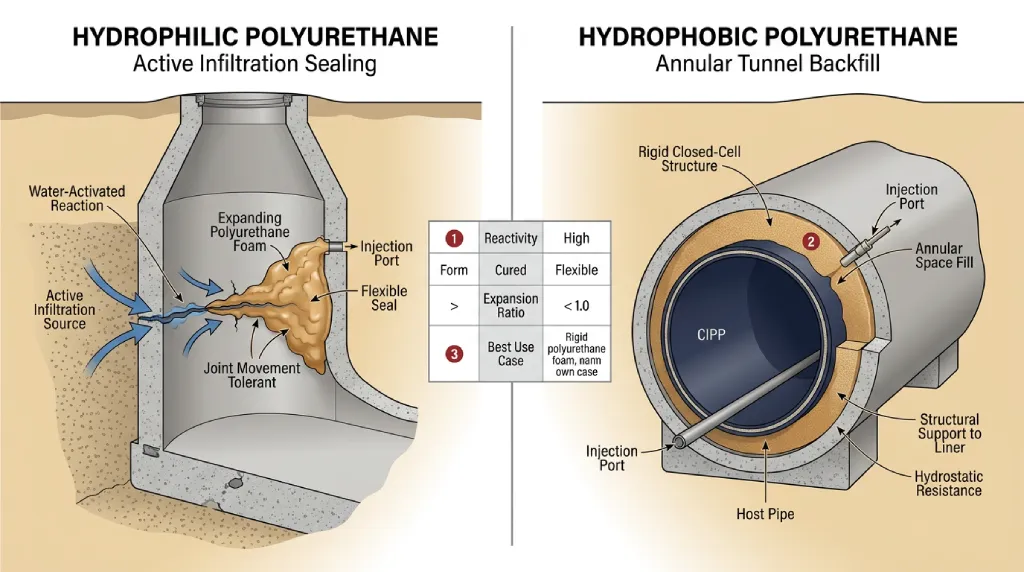
Material class selection in utility infrastructure follows directly from the failure mode being addressed. The two polyurethane classes are fundamentally different in their cure chemistry and their cured form.
Hydrophilic Polyurethane: Active Infiltration Sealing
Hydrophilic polyurethane reacts with water as part of its cure chemistry. The reaction triggers when the resin contacts water, the foam expands rapidly to fill the available space, and the cured product is a flexible water-reactive gasket that maintains its seal under hydrostatic pressure.
Best use cases:
- Active infiltration sealing at manhole joints, chimney-to-corbel interfaces, and pipe-to-manhole connections
- Crack sealing in tunnels, vaults, and below-grade structures with active water inflow
- Joint sealing in interceptor sewers, force mains, and large-diameter pipelines
- Sealing around penetrations through below-grade walls
Key properties:
- Cream time 3 to 30 seconds (water-activated)
- Rise time 30 seconds to 2 minutes (rapid expansion)
- Final form: flexible water-activated gasket seal
- Joint movement tolerance: excellent
Hydrophobic Polyurethane: Annular Space Fill and Structural Support
Hydrophobic polyurethane cures by internal catalyst with reduced water dependency. The reaction produces a rigid closed-cell foam that provides structural fill and support without the flexibility of hydrophilic systems.
Best use cases:
- Annular space fill behind cured-in-place pipe (CIPP) liners
- Structural void fill in tunnel rehabilitation
- Annular grouting in pipe sliplining rehabilitation
- Void fill behind segmental tunnel liners
- Bedding restoration around buried pipes and culverts
Key properties:
- Cream time 10 to 60 seconds (catalyst-controlled)
- Rise time 30 seconds to 3 minutes
- Final form: rigid closed-cell foam
- Compressive strength: 25 to 150+ psi depending on density
- Hydrostatic resistance: excellent
The choice between the two classes is driven by the failure mode rather than by preference. Active infiltration requires hydrophilic. Annular space fill and structural support require hydrophobic. Some applications use both classes in sequence: hydrophilic first to seal active infiltration, then hydrophobic to fill any remaining void.
Manhole Rehabilitation Applications
Manholes are the most common municipal utility structure requiring polyurethane grouting rehabilitation. Common rehabilitation scenarios:
Chimney Joint Infiltration
The chimney section connecting the manhole frame to the upper barrel is a frequent infiltration source as the structure ages and the chimney joints fail. Hydrophilic polyurethane injection through the chimney wall seals the joint while the manhole remains in service. The work is typically completed in 2 to 4 hours per manhole including confined-space entry setup.
Pipe-to-Manhole Penetration Sealing
The connection between incoming and outgoing pipes and the manhole structure is another frequent infiltration source. The penetration boot, mortar collar, or original construction joint can crack and admit infiltration. Hydrophilic polyurethane injection through ports in the manhole wall, around the penetration, seals the connection.
Manhole Barrel Crack Sealing
Cracks in the precast concrete or brick manhole barrel admit infiltration and may indicate structural distress. Hydrophilic polyurethane sealing addresses the infiltration; structural assessment by the engineer of record determines whether additional structural rehabilitation (liner installation, partial reconstruction, or replacement) is needed.
Frame and Cover Adjustment
Manhole frame and cover settlement relative to the surrounding pavement is addressed by void fill grouting of the bedding around the manhole rather than by structural rehabilitation of the manhole itself. This is treated as a surface-pavement application rather than a confined-space utility application.
Tunnel and Pipeline Rehabilitation Applications
Larger-diameter underground infrastructure (sewers, force mains, water transmission, transportation tunnels) uses polyurethane grouting in several rehabilitation scenarios.
Annular Space Fill After CIPP Liner Installation
When a cured-in-place pipe (CIPP) liner is installed in a host pipe, an annular space remains between the host pipe interior wall and the new liner exterior. This space requires fill to prevent migration of soil through joints in the host pipe, to provide structural support to the liner under hydrostatic loading, and to restore the as-built load transfer between the liner and surrounding soil. Hydrophobic polyurethane is the standard fill material for this application, with the lightweight closed-cell foam selected over heavier cementitious alternatives to reduce the load on the host pipe and the liner.
Tunnel Segmental Liner Backfill
Segmental tunnel liners installed during rehabilitation projects require backfill in the annular space between the liner and the surrounding tunnel excavation. Hydrophobic polyurethane provides the backfill, with the cured foam supporting the liner against external loading while minimizing the weight that the liner system must support.
Sliplining Annular Fill
Pipeline rehabilitation by sliplining (installing a smaller-diameter pipe inside an existing larger pipe) requires fill of the annular space between the host pipe and the slipliner. Hydrophobic polyurethane is selected when the application requires lightweight fill that does not load the host pipe, or where rapid cure is required to maintain project schedule.
Bedding Restoration Around Buried Pipes
When inspection reveals voids in the bedding around a buried pipe (commonly from infiltration that has washed away the bedding material), hydrophobic polyurethane injection restores the bedding without requiring excavation. The work is performed from the surface through small-diameter ports drilled to the pipe depth.
Confined Space Entry and OSHA Compliance
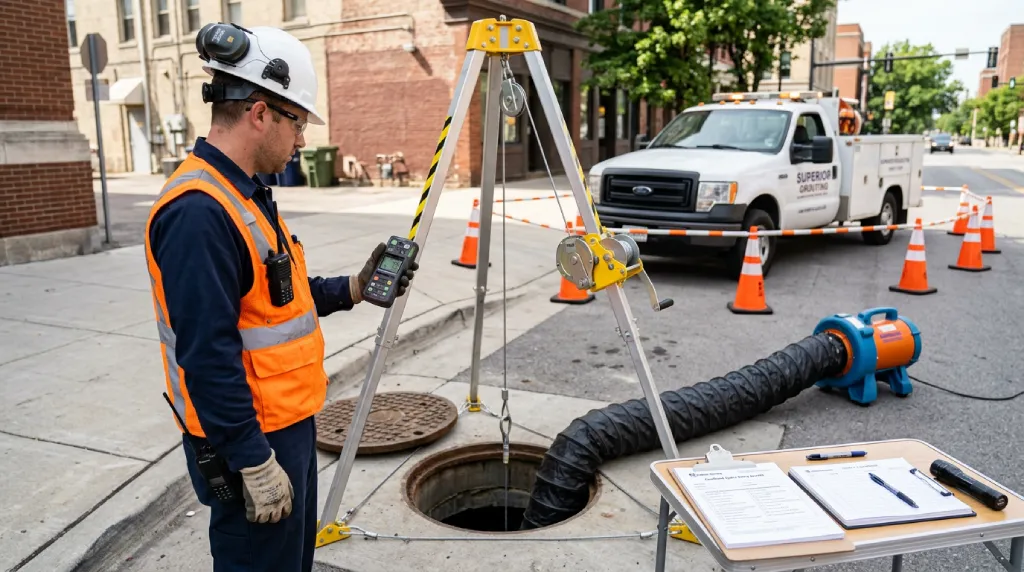
Most utility infrastructure polyurethane grouting work involves entry into confined spaces governed by OSHA 29 CFR 1910.146. The standard requires comprehensive entry protocols that a qualified specialty grouting contractor maintains as a baseline capability.
Required Protocols
- Entry permit: Written permit signed by the entry supervisor before entry, documenting atmospheric monitoring, ventilation, communication, and rescue procedures.
- Atmospheric monitoring: Continuous monitoring of oxygen, lower explosive limit (LEL), carbon monoxide, and hydrogen sulfide during entry; alarms at threshold levels.
- Ventilation: Forced-air ventilation of the confined space during entry to maintain breathable atmosphere and dilute any reaction emissions.
- Communication: Two-way communication between the attendant at the entry point and the entrant inside the space throughout the entry.
- Rescue and retrieval: Tripod or other retrieval system positioned at the entry point with retrieval line attached to the entrant's harness, plus trained rescue personnel available within prescribed response time.
- Attendant: Dedicated attendant remains at the entry point throughout the entry, monitoring atmospheric conditions and entrant status, with authority to order evacuation.
- PPE: Confined-space PPE including harness, communication headset, retrieval line, respirator where atmospheric conditions require, and standard PPE (hard hat, safety glasses, hearing protection where applicable).
Atmospheric Considerations Specific to Sewer and Wastewater Work
Sanitary sewer and wastewater confined spaces present additional atmospheric hazards: hydrogen sulfide from organic decomposition, methane from anaerobic processes, oxygen deficiency, and bacterial exposure. Pre-entry atmospheric testing extends beyond standard four-gas monitoring to include site-specific contaminants. Some entries require supplied-air respirators or self-contained breathing apparatus.
The Occupational Safety and Health Administration provides comprehensive guidance through the OSHA Permit-Required Confined Spaces standard at 29 CFR 1910.146.
NSF/ANSI 61 Compliance for Potable Water Adjacent Applications
When polyurethane grouting is performed adjacent to potable water systems (water treatment facilities, water main rehabilitation, water storage tank surrounds, distribution system manholes), NSF/ANSI 61 compliant formulations are required. The certification confirms the cured material does not leach unacceptable contaminants into drinking water under defined contact conditions.
NSF compliance documentation is part of the submittal package for any potable water adjacent application. The specifying engineer identifies the NSF requirement during the design phase, and the contractor's submittal documents the product certification with the NSF mark. Non-NSF formulations should not be used in potable water adjacent applications even when the application appears separate from the water system.
NASSCO Standards Alignment
The National Association of Sewer Service Companies (NASSCO) develops and maintains rehabilitation standards used by municipal owners across the United States. Polyurethane grouting integrates with several NASSCO frameworks:
- MACP (Manhole Assessment Certification Program): Manhole condition assessment using NASSCO MACP coding informs the rehabilitation scope and method selection. Defects coded for infiltration, structural distress, or joint failure are common candidates for polyurethane injection.
- PACP (Pipeline Assessment Certification Program): Pipeline condition assessment using NASSCO PACP coding identifies pipe defects (cracks, joint failures, infiltration sources) that may be addressed by polyurethane sealing or that may indicate a need for liner installation with subsequent annular space fill.
- LACP (Lateral Assessment Certification Program): Service lateral condition assessment may identify defects addressed by polyurethane sealing at the lateral-to-main connection.
NASSCO certification of inspection personnel ensures consistent defect identification across projects, which in turn supports consistent rehabilitation scope and method selection.
Verification for Utility Infrastructure Rehabilitation
Utility infrastructure polyurethane work uses verification methods adapted to the underground context:
- Pre and post infiltration measurement: Where infiltration is the failure mode, pre-injection and post-injection inflow measurement (via flow monitoring at the manhole or downstream measurement) confirms infiltration reduction.
- CCTV inspection: Pre and post injection CCTV documents the work area and confirms cured material placement.
- Volume reconciliation: Injected material volume compared against calculated theoretical void volume.
- Boroscope or visual inspection: Where access allows, direct inspection of cured material at injection ports.
- Hydrostatic testing: For pipelines being restored to service after rehabilitation, hydrostatic testing per AWWA or similar standards confirms structural integrity.
- Smoke testing: Where applicable, smoke testing identifies any remaining infiltration sources after rehabilitation.
All verification outputs join the closeout submittal delivered to the owner. For NASSCO-managed programs, the inspection findings are coded per the applicable standard.
Coordination with Other Trades
Utility infrastructure rehabilitation projects often involve multiple trades working in sequence: condition assessment, cleaning, installation of liners or seals, post-rehabilitation inspection. Polyurethane foam injection is typically scheduled at specific points in this sequence:
- After condition assessment and before liner installation, to seal infiltration sources that would compromise the liner installation
- Concurrent with or immediately after liner installation, to fill the annular space
- After rehabilitation completion, to address infiltration or void issues identified in post-rehabilitation inspection
- Standalone scope where the rehabilitation is limited to infiltration sealing without other trade involvement
A qualified contractor coordinates with the lead rehabilitation contractor and the owner's project manager to schedule polyurethane work appropriately within the overall project sequence.
Cost and Schedule for Utility Infrastructure Work
Cost and schedule for utility infrastructure polyurethane work differ from surface slab work due to confined-space requirements, in-service operation, and per-unit scope rather than per-square-foot scope:
| Application | Typical Cost Range | Typical Schedule |
| Manhole infiltration sealing | $1,500 to $5,000 per manhole | 2 to 4 hours per manhole |
| CIPP annular space fill | $5 to $20 per linear foot | Coordinated with liner installation |
| Tunnel segmental liner backfill | Project-specific | Coordinated with tunnel scope |
| Bedding restoration | $50 to $150 per linear foot | 1 to 3 work days per 1,000 LF |
| Vault and below-grade structure sealing | $2,000 to $10,000+ per structure | 4 to 8 hours per structure |
Ranges are advisory and project-specific; actual cost depends on access conditions, atmospheric requirements, material class, infiltration severity, and owner specification. A site-specific estimate validated by the engineer of record is the correct basis for procurement.
Key Takeaways
- Hydrophilic polyurethane reacts with water to form a flexible seal and is the standard material class for active infiltration control in manholes, sewers, and below-grade structures.
- Hydrophobic polyurethane cures by internal catalyst to form a rigid closed-cell foam and is the standard material class for annular space fill, void fill, and structural support behind liners.
- NASSCO MACP and PACP standards reference polyurethane injection within their manhole and pipeline rehabilitation frameworks.
- Confined-space entry per OSHA 29 CFR 1910.146 is mandatory for work inside manholes, tunnels, and below-grade structures, with full atmospheric monitoring, ventilation, retrieval systems, and attendant protocols.
- NSF/ANSI 61 compliant polyurethane formulations are available and required for applications adjacent to potable water systems.
- Verification includes pre and post infiltration measurement (where applicable), CCTV inspection, volume reconciliation, and structural integrity confirmation.
- Every parameter in this article is advisory. Final material selection, injection procedure, and safety protocols must be validated by the engineer of record against the project specification.
Frequently Asked Questions
Can polyurethane grouting stop active water leaks in sewer manholes?
Yes. Hydrophilic polyurethane reacts with water as part of its cure chemistry, and the rapid expansion forms a flexible water-activated gasket seal that blocks active infiltration. The material is injected through ports drilled in the manhole wall around the infiltration source, and the cure occurs in seconds to minutes. The flexible seal maintains its function under hydrostatic pressure and tolerates joint movement. Typical work is completed in 2 to 4 hours per manhole including confined-space entry setup. Verification through pre and post inflow measurement confirms infiltration reduction.
What is the difference between hydrophilic and hydrophobic polyurethane?
Hydrophilic polyurethane reacts with water as part of its cure chemistry and forms a flexible water-activated gasket seal; it is used for active infiltration sealing in manholes, sewers, and below-grade structures. Hydrophobic polyurethane cures by internal catalyst with reduced water dependency and forms a rigid closed-cell foam; it is used for annular space fill, void fill, and structural support in tunnel and pipeline rehabilitation. The choice is driven by the failure mode being addressed: active infiltration requires hydrophilic, annular space fill and structural support requires hydrophobic.
Is polyurethane grouting approved by NASSCO for sewer rehabilitation?
Polyurethane grouting integrates with NASSCO inspection frameworks (MACP for manholes, PACP for pipelines, LACP for laterals) and is referenced within rehabilitation specifications used by municipal sewer owners. NASSCO coding of defects (infiltration, joint failures, structural distress) identifies candidates for polyurethane sealing. Specification details for material class, injection procedure, and verification vary by owner; the engineer of record is the authoritative source for the specific requirements applicable to a given project. Contractors typically submit product data sheets, injection procedures, QA/QC plans, and confined-space entry plans for engineer review before work proceeds.
How is polyurethane grouting performed in a confined space safely?
Confined space entry for polyurethane grouting follows OSHA 29 CFR 1910.146 protocols. Required elements include a written entry permit, continuous atmospheric monitoring (oxygen, LEL, carbon monoxide, hydrogen sulfide), forced-air ventilation, two-way communication between attendant and entrant, a tripod or other retrieval system with retrieval line attached to the entrant's harness, a dedicated attendant at the entry point throughout the entry, and confined-space PPE including harness, communication headset, and respirator where atmospheric conditions require. Sanitary sewer entries require additional atmospheric testing for hydrogen sulfide and methane.
Is polyurethane safe for use in drinking water infrastructure?
NSF/ANSI 61 compliant polyurethane formulations are available and required for applications adjacent to potable water systems including water treatment facilities, water main rehabilitation, water storage tank surrounds, and distribution system manholes. NSF certification confirms the cured material does not leach unacceptable contaminants into drinking water under defined contact conditions. The certification documentation is part of the submittal package for any potable water adjacent application. Non-NSF formulations should not be used in potable water adjacent applications.
How does polyurethane grouting compare to chemical grouting in sewer rehabilitation?
Polyurethane grouting and chemical grouting (typically acrylamide or acrylate-based) serve similar functions in sewer rehabilitation but with different material characteristics. Polyurethane uses a two-component reactive resin system with documented cure profile, established standards, and broad municipal acceptance. Chemical grouting uses water-based reactive systems that polymerize in place; some chemical grout materials have regulatory restrictions due to toxicity concerns of uncured components. For most municipal applications, polyurethane is the standard class; chemical grouting is used in specialty applications where its specific properties are required and where regulatory acceptance has been established.
Can polyurethane grouting be used in active sanitary sewers without bypass pumping?
Often yes. Polyurethane injection through ports in the manhole wall or pipe wall can be performed while the sewer remains in active flow conditions, with the injection occurring above the flow line or at the joint defects without contaminating the flow. The work approach is specified in the project documentation and coordinated with the sewer system operator. Where the injection geometry requires temporary flow management, bypass pumping or flow plugging may be specified. Confined-space atmospheric considerations in active sewers include hydrogen sulfide and methane testing in addition to standard four-gas monitoring.
How is polyurethane grouting used for CIPP annular space fill?
After cured-in-place pipe (CIPP) liner installation, hydrophobic polyurethane is injected into the annular space between the host pipe and the new liner. The hydrophobic foam expands to fill the annular volume, cures to a rigid closed-cell structure, and provides structural support to the liner while preventing migration of soil through host pipe defects. Injection is typically through ports drilled in the liner at predetermined intervals. Volume reconciliation against the calculated theoretical annular volume confirms complete fill. The lightweight foam is selected over heavier cementitious alternatives to minimize the load on the host pipe and liner.
What inspection methods verify polyurethane utility rehabilitation work?
Verification methods adapted to underground context include pre and post infiltration measurement (where infiltration is the failure mode), CCTV inspection of the work area documenting cured material placement, volume reconciliation comparing injected material against calculated theoretical void volume, boroscope or direct visual inspection at injection ports where access allows, hydrostatic testing per AWWA or applicable standards for pipelines being restored to service, and smoke testing where applicable to identify any remaining infiltration sources. All verification outputs join the closeout submittal delivered to the owner. For NASSCO-managed programs, inspection findings are coded per the applicable standard.
How do I scope a polyurethane grouting project for my utility system?
The starting point is a documented condition assessment per the applicable inspection standard (NASSCO MACP for manholes, PACP for pipelines, or owner-specific protocols). The assessment identifies defects requiring rehabilitation, classifies their severity, and supports method selection. With assessment documentation in hand, a qualified specialty grouting contractor proposes a scope including material class, injection procedure, confined-space entry plan, QA/QC plan, and verification methodology. The engineer of record validates the proposed scope before procurement commits. To scope polyurethane grouting for a Texas or Louisiana utility system, schedule an estimate with Superior Grouting.
Conclusion
Polyurethane grouting serves utility infrastructure rehabilitation through two distinct material classes addressing two distinct failure modes: hydrophilic polyurethane for active infiltration sealing in manholes, tunnels, and below-grade structures, and hydrophobic polyurethane for annular space fill, structural support, and void fill in CIPP-lined sewers, tunnels, and pipeline rehabilitation. The work integrates with NASSCO inspection frameworks, AWWA water infrastructure specifications, and OSHA confined-space entry protocols. NSF/ANSI 61 compliant formulations are available and required for potable water adjacent applications. Verification through CCTV, infiltration measurement, volume reconciliation, and hydrostatic testing produces the documented record that municipal owners require for closeout. Every parameter and recommendation in this article is advisory and project-specific; final scope, material class, injection procedure, and safety protocols require validation by the engineer of record against the project specification and the governing owner standard. To scope polyurethane grouting work for a municipal utility system or industrial underground infrastructure in Texas or Louisiana, contact Superior Grouting.