


What Does Polyurethane Grouting for Government Projects Require?
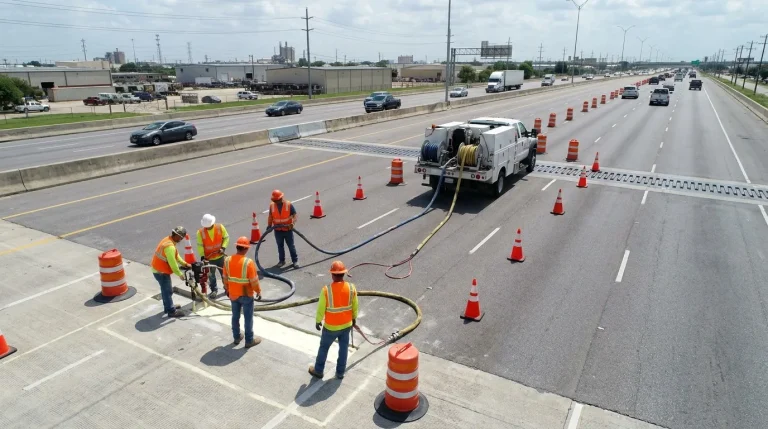
Polyurethane grouting for government projects requires a contractor to meet the agency's procurement rules, bonding and insurance requirements, and a written technical specification covering materials, methods, tolerances and verification. Agencies also expect complete documentation, from submittals before work begins to closeout records that support acceptance and payment.
Introduction
Cities, counties, state transportation departments, school districts and federal facilities all use polyurethane foam injection to repair settled pavement, bridge approaches, drainage structures and floor slabs. The appeal is practical: lanes and buildings reopen quickly, excavation is avoided, and traffic control windows stay short. Public work, however, comes with procurement rules and specification requirements that private projects rarely impose.
This article explains what polyurethane grouting for government projects usually requires, from how agencies buy the work to what the technical specification should say. It is written for public works managers, specification writers and engineers who want to procure the work correctly, and it reflects how an established provider of industrial grouting services prepares for public bids across Texas and Louisiana.
How Government Agencies Procure Grouting Work
Public agencies spend public funds, so the way they buy construction services is set by statute and policy rather than by preference. The procurement route affects the schedule, the documents a contractor must submit and how much design responsibility sits with the agency versus the contractor.
The most common routes for polyurethane work on public works construction projects include:
- Competitive sealed bids: the agency issues an invitation for bid with plans and specifications, and the lowest responsive, responsible bidder is awarded the contract.
- Competitive sealed proposals: the agency weighs qualifications, approach and price together, which suits projects where method and experience matter as much as cost.
- Job order and indefinite delivery contracts: a contractor is pre-qualified for repeated repairs over a set term, and individual work orders are issued as needs arise.
- Cooperative purchasing: an agency uses a contract already awarded through a purchasing cooperative, where its own rules allow.
- Emergency procurement: a shortened process for urgent public safety repairs, such as a failing bridge approach, subject to the agency's emergency provisions.
In Texas, municipal purchasing is governed by Chapter 252 of the Local Government Code, and alternative delivery methods for public work are addressed in Chapter 2269 of the Government Code. Federal work follows the Federal Acquisition Regulation. Thresholds and procedures change over time, so they should always be confirmed with the procuring agency at the time of bid.
| Procurement Route | Best Suited For | Contractor Submits | Governing Reference |
|---|---|---|---|
| Competitive sealed bid | Well-defined scope with complete specifications | Bid form, bid security, required affidavits | Tex. Local Gov't Code Ch. 252 or agency policy |
| Competitive sealed proposal | Projects where method and experience drive value | Technical proposal, qualifications, price | Tex. Gov't Code Ch. 2269 |
| Job order or on-call contract | Recurring slab and pavement repairs over a term | Unit prices, qualifications, work plans per order | Agency contract terms |
| Federal contract | Federal facilities and federally owned assets | Offer per solicitation, representations and certifications | Federal Acquisition Regulation |
| Emergency procurement | Urgent safety repairs | Scope, price and schedule for the emergency work | Agency emergency provisions |
Contract Requirements Beyond the Scope of Work
Government contracts carry obligations that sit outside the technical work but still decide whether a contractor can bid, be awarded and be paid. Missing one of them can make an otherwise strong bid non-responsive, so they deserve attention early in the pursuit.
The requirements that appear most often on public grouting contracts include:
- Bid security: a bid bond or certified check, usually a set percentage of the bid amount.
- Performance and payment bonds: required on Texas public work above the thresholds in Chapter 2253 of the Government Code, and on federal construction under the Miller Act.
- Insurance certificates: general liability, auto, workers' compensation and any umbrella limits the agency specifies, often with the agency named as additional insured.
- Prevailing wage compliance: wage rates and certified payroll where the agency or federal funding requires them, including Davis-Bacon on federally funded construction.
- Domestic content rules: Build America, Buy America provisions on federally funded infrastructure, which can affect how construction materials are sourced and certified.
- Safety program documentation: written safety plans, training records and site-specific plans for traffic control and confined spaces.
- Registration and certifications: vendor registration with the agency and any historically underutilized business or disadvantaged business participation goals.
These requirements vary by agency and funding source, and they are updated periodically. Contractors and specification writers should read each solicitation closely rather than relying on the terms of a previous contract with the same owner.
What the Technical Specification Should Cover
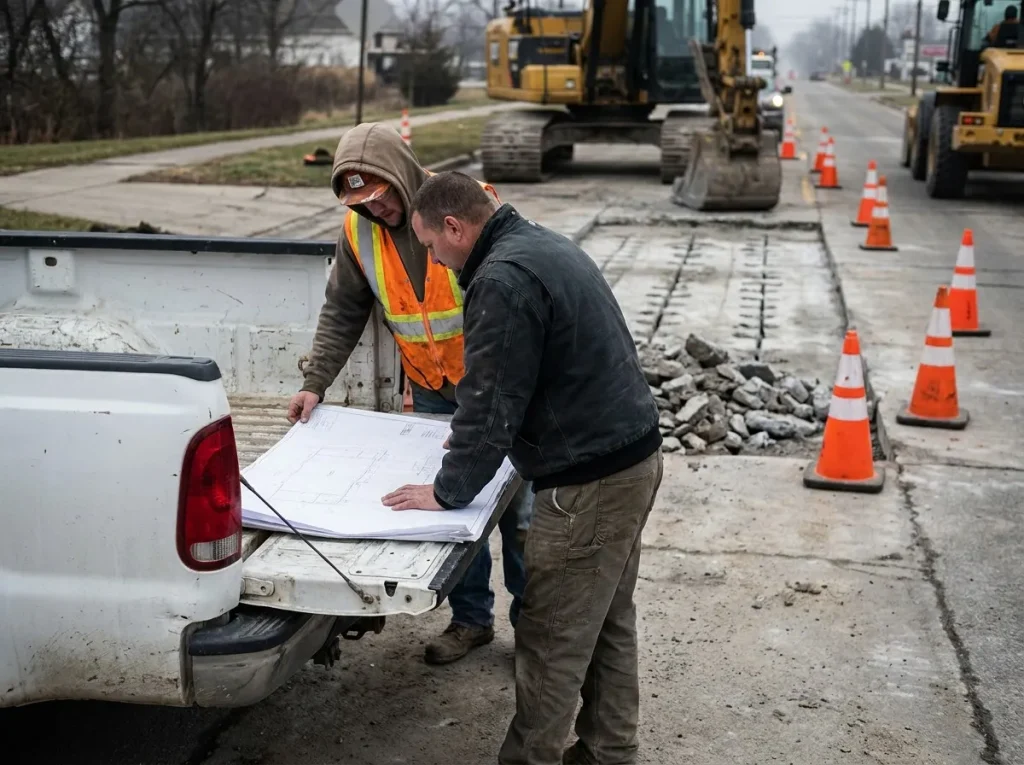
A clear specification protects the agency, the engineer and the contractor by defining exactly what is being bought. For polyurethane work, a thin specification that only calls for "foam injection to raise the slab" leaves too much open, and it invites bids that are not comparable because each bidder assumes a different material, method and standard of proof.
A well-written specification for polyurethane injection on public work typically addresses:
- Scope and limits: the panels, slabs or structures to be treated, with plan sheets or marked locations.
- Material properties: minimum density and compressive strength for the structural foam, with the test methods used to confirm them.
- Injection method: hole diameter and pattern limits, injection depth, and how lifting will be staged.
- Lift tolerances: the allowable deviation from target elevation and, for pavements, joint alignment and ride requirements.
- Monitoring requirements: lift monitoring at each injection point and observation of adjacent panels, drains and utilities.
- Traffic and access: lane closure windows, traffic control plans and the time allowed before reopening.
- Verification and acceptance: final surveys, deflection testing where needed, hole patching and the documentation required for payment.
| Specification Item | What to Define | Common Verification | Reference Standard |
|---|---|---|---|
| Foam density | Minimum apparent density for the structural foam | Laboratory test on field or product samples | ASTM D1622 |
| Compressive strength | Minimum strength at the specified density | Laboratory test on field or product samples | ASTM D1621 |
| Elevation tolerance | Allowable deviation from target grade | Pre- and post-injection survey | Project specification or ACI 117 |
| Pavement support | Target deflection after treatment | Falling weight deflectometer | ASTM D4694 |
| Roadway work | Materials, traffic control and measurement for payment | Agency inspection | TxDOT Standard Specifications or local equivalent |
Where the specification sets injection pressures, lift increments or density targets, those values should be reviewed against the actual slab or pavement design. Final design parameters for any public asset should be confirmed by the engineer of record for the project.
Performance Versus Prescriptive Language
Public specifications for polyurethane work generally take one of two forms. A prescriptive specification tells the contractor exactly how to perform the work, including hole spacing, injection sequence and sometimes the material to be used. A performance specification states the results the agency must receive, such as final elevation, foam properties and pavement support, and leaves the method to the contractor within stated limits.
Each approach has a place in public work:
- Prescriptive language suits agencies with a long record of similar repairs and a proven method they want repeated across many sites.
- Performance language suits projects where site conditions vary and experienced bidders can propose the most efficient method.
- Hybrid specifications combine firm performance criteria with a few prescriptive limits, such as maximum hole diameter or required lift monitoring, which is often the most practical option.
Whichever form is chosen, the specification should avoid naming a single manufacturer where agency rules require open competition. Stating minimum material properties and the ASTM methods used to confirm them keeps the bid competitive while still protecting the quality of the finished repair, and it gives inspectors a clear basis for accepting or rejecting the work.
Safety and Site Controls on Public Sites
Public projects put crews next to live traffic, occupied buildings and public utilities, so agencies expect safety planning to be documented before mobilization rather than handled informally in the field. Polyurethane systems also involve chemical components that must be stored, handled and disposed of according to their safety data sheets.
The site controls that public owners most often ask to see in writing include:
- Traffic control: plans that follow the agency's traffic control standards, with closure times, flagging and signage defined for each phase.
- Confined space procedures: permits and monitoring for work inside vaults, manholes or culverts under OSHA 29 CFR 1910.146 or the construction equivalent.
- Chemical handling: storage, spill response and personal protective equipment for polyurethane components, based on the manufacturer's safety data sheets.
- Utility protection: locates, marked no-drill zones and monitoring of drains and conduits during injection.
- Public protection: barriers, dust and noise controls, and communication with building occupants or the traveling public.
These plans do more than satisfy a contract clause. On a bridge approach or an occupied public building, they decide how many hours of work can be completed each shift, which in turn affects the schedule, the number of mobilizations and the price the agency receives.
Common Pitfalls in Public Polyurethane Projects
Most problems on public polyurethane contracts trace back to the solicitation rather than to the field work. When bid documents leave key decisions open, bidders fill the gaps with their own assumptions, and those assumptions surface later as disputes over quantities, acceptance or payment.
The pitfalls that appear most often are:
- Quantities without investigation: estimating material without an elevation survey or void mapping leads to large overruns or underruns once injection begins.
- Vague acceptance language: phrases such as "restore to original grade" without a tolerance leave inspectors and contractors with no shared test.
- Mismatched payment units: paying by area when the real driver is void volume, or by weight without requiring logged quantities, makes pay applications hard to verify.
- Unrealistic closure windows: specifying reopening times that do not allow for lift monitoring and hole patching invites shortcuts.
- Proprietary product language: naming a single manufacturer can limit competition, so performance criteria and test methods are the safer basis for a public specification.
Each of these pitfalls is easy to avoid when the specification is reviewed by someone familiar with how polyurethane work is actually performed and measured. A short constructability review before advertisement usually costs far less than resolving one disputed pay item after the work is finished.
Submittals, Inspection and Documentation
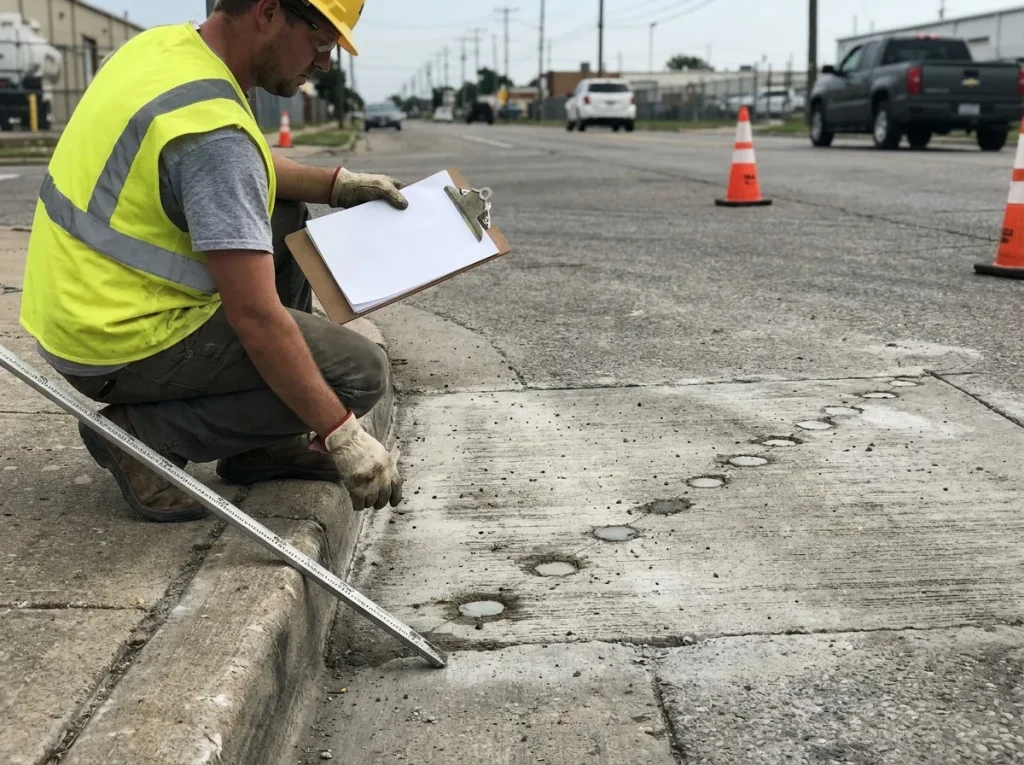
Documentation is where public projects differ most from private work. An agency must be able to show that it received what it paid for, so every stage of the work leaves a paper trail that inspectors, auditors and future engineers can follow.
A typical submittal and documentation sequence for polyurethane work on government projects includes:
- Pre-construction submittals: product data sheets, material certifications, safety data sheets, the proposed injection plan and the contractor's quality control plan.
- Work plans and traffic control: sequencing by panel or lane, closure times and traffic control plans approved by the agency.
- Daily records: injection logs showing locations, volumes, lifts and times, along with inspector sign-off where required.
- Test results: laboratory results for foam samples and any deflection or survey data called for in the specification.
- Closeout package: as-built records, final surveys, warranty documents and any exceptions with their resolution.
Inspectors on public work often compare the daily logs against their own observations, so records should be complete and consistent. Measurement for payment is frequently tied to documented quantities, such as pounds of material placed or square feet of slab treated, which makes accurate logging part of getting paid as well as part of quality control.
Key Takeaways
- Polyurethane grouting for government projects is bought through statutory procurement routes such as sealed bids, proposals and job order contracts.
- Bonds, insurance, prevailing wage, domestic content and safety documentation can decide whether a bid is responsive.
- A strong specification defines foam density, compressive strength, injection method, lift tolerances and acceptance tests.
- Named test methods such as ASTM D1621 and ASTM D1622 make bids comparable and results verifiable.
- Submittals, daily logs and closeout records are central to inspection, acceptance and payment on public work.
- Requirements change by agency and funding source, so each solicitation should be read on its own terms.
Preparing a Public Project for Polyurethane Repair
Agencies and engineers can make polyurethane work easier to bid and easier to accept by preparing a few items before the solicitation goes out. Good preparation reduces questions during the bid period, narrows the spread between bids and lowers the risk of change orders once work begins.
Practical steps before issuing a solicitation include:
- Investigate first: survey elevations and locate voids so the scope and quantities in the bid documents reflect real conditions.
- Choose measurable criteria: tie acceptance to surveys, tests and tolerances rather than general wording.
- Plan the traffic windows: confirm closure times with operations staff so the specification reflects what is achievable.
- Define payment units: decide whether the work will be paid by material weight, area treated or lump sum, and align logging requirements with that choice.
- Review related work: decide whether cellular grout, compaction grouting or other methods are needed alongside polyurethane.
Examples of this kind of public work include bridge approaches, which we discussed in our article on bridge approach slab repair, and roadway panels, covered in our look at municipal road and street repair. For settled floors in public buildings, the same principles apply to concrete slab lifting services inside maintenance facilities and warehouses. If you are drafting a solicitation now, you can send your project specification to our estimating team for a constructability review before it is issued.
Conclusion
Polyurethane grouting for government projects combines a fast, low-disruption repair method with the procurement discipline public funds require. Agencies that choose the right procurement route, confirm bonding and compliance obligations, and write specifications around measurable material and performance criteria receive bids that can be compared fairly and results that can be accepted with confidence.
For contractors and specification writers alike, the common thread is documentation. Clear submittals, consistent daily logs and complete closeout records turn a quick repair into a verified public asset, and they give the next engineer a reliable account of what was done and why.
Prepare your public grouting specification with our team Request a constructability review for your agency bid