


Municipal Road and Street Repair with Polyurethane Grouting: Public Works Applications
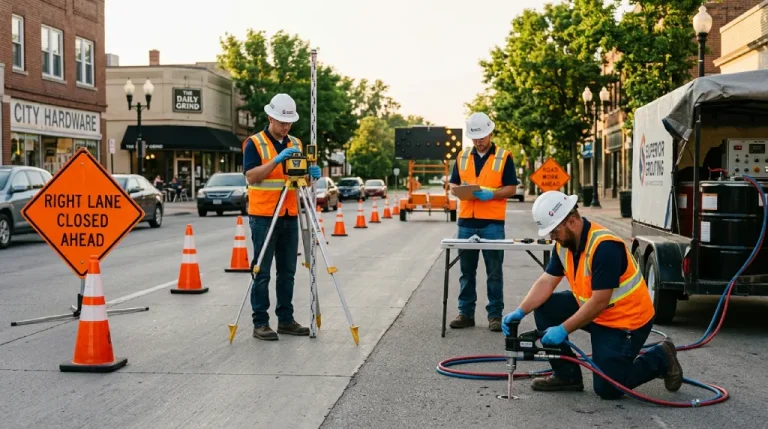
Polyurethane grouting is an approved municipal road and street repair method for settled pavement supported by sound underlying concrete or stable subbase. The method addresses four common failure modes: drainage washout under pavement, fill consolidation under repeated heavy loading, utility cut backfill differential settlement, and manhole frame settlement. Work executes under MUTCD-compliant lane closures in 4 to 8 hours per bay, with same-shift return-to-service and DOT-specification-aligned QA/QC documentation. The method is recognized by FHWA pavement preservation guidance and by state DOTs including TxDOT for use in maintenance scopes.
Settled pavement is a recurring municipal maintenance line item. Streets settle at utility cuts, around manhole frames, at intersections under repeated heavy truck loading, and along drainage paths where subgrade washout undermines support. The traditional repair scope (mill and overlay, partial replacement, or full reconstruction) is expensive, slow, and disruptive to traffic and adjacent businesses. Polyurethane grouting addresses a meaningful share of these maintenance scopes with a shorter work window, lower cost, and substantially less surface disruption.
This article presents the municipal and public works application of polyurethane grouting. The audience is municipal engineers, public works directors, DOT maintenance engineers, county road departments, and general contractors managing public works repair subcontracts. Every parameter and recommendation is advisory and project-specific; final scope and method selection must be validated by the engineer of record against the project specification and the governing owner standard.
Why Municipal Roads Settle in the First Place
Municipal pavement is engineered for a specific design loading profile, drainage condition, and subgrade behavior. When any of those underlying conditions change after construction, the pavement responds with measurable surface distress. Settlement is the most common form of distress because the underlying causes (drainage, loading, utility cuts, manhole structures) are present in nearly every urban street.
Understanding the failure mode is the precondition for selecting the right repair method. Settled pavement that has lost subgrade support behaves differently from cracked or alligator-patterned pavement that has lost structural integrity. Both look bad. Only one is appropriate for polyurethane grouting.
Polyurethane grouting services for municipal applications restore subbase and subgrade support beneath sound pavement. The method does not restore failed pavement. Recognizing the difference is the first decision in municipal procurement.
The Four Failure Modes Polyurethane Grouting Addresses on Municipal Roads
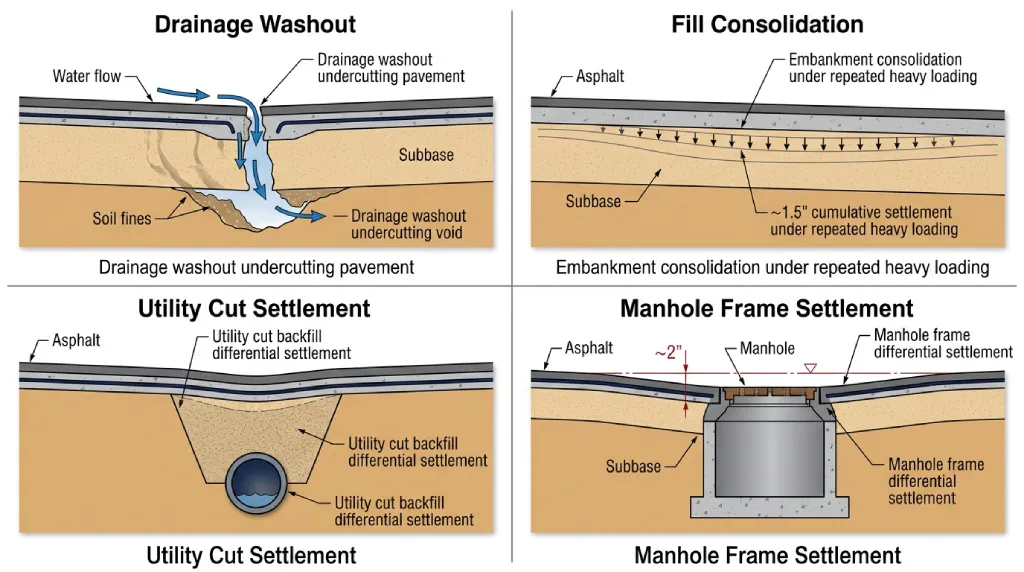
A small set of failure modes accounts for the majority of municipal pavement settlement work. Each has a distinct mechanism, a distinct signature, and a distinct fit with polyurethane grouting.
Mechanism 1: Drainage Washout Under Pavement
Surface water enters compromised pavement joints, descends through the subbase, and washes fine soil out from beneath the pavement structure. Over successive wet seasons, the washout creates progressively larger voids, the pavement loses uniform support, and the surface settles into the void. This is the dominant failure mode on streets near storm drains, at intersections where drainage patterns concentrate, and on grades where surface water travels along the pavement edge.
The signature is a localized depression that grows over time, often with visible water staining at the pavement edge or at joints. The void is typically 1 to 4 inches deep and extends a few feet back from the entry point. Polyurethane grouting fills the void and restores the pavement profile; paired drainage correction (joint sealant repair, drain inlet replacement, or downspout redirection) addresses the root cause.
Mechanism 2: Fill Consolidation Under Repeated Heavy Loading
Subbase fill placed at the time of original construction continues to consolidate under traffic loading. Even with modern compaction specifications, some post-construction settlement is expected; intersections, freight corridors, transit bus routes, and bus stops accumulate consolidation faster than other street segments because the loading is repeated and concentrated. Settlement appears as a broad shallow depression rather than a sharp localized void.
The signature is wide-area settlement of 0.5 to 2 inches across the loaded zone, often with rutting in the wheel paths and elevation differentials visible at curb and gutter. Polyurethane grouting restores support uniformly across the depression. Where loading conditions remain (the heavy truck route does not change), the rehabilitation should be expected to last a full service cycle but not indefinitely.
Mechanism 3: Utility Cut Backfill Differential Settlement
Trench backfill placed during utility installation (water main, sanitary sewer, storm drain, gas, electric, telecom) settles differently than the surrounding undisturbed soil. Even when the backfill is properly compacted to specification, the trench zone experiences differential settlement relative to adjacent undisturbed material. Over several years, the differential becomes visible as a settled trench line crossing the pavement, often accompanied by reflective cracking along the trench edges.
The signature is a linear depression aligned with the buried utility, typically 1 to 3 inches deep, with characteristic edge cracks. Polyurethane grouting fills the void created by the differential settlement and lifts the pavement back to profile. For utilities that may require future access, the void fill placement should be coordinated with the utility owner so that the polyurethane installation does not encumber future maintenance.
Mechanism 4: Manhole Frame Settlement
The frame and grate of a manhole are rigidly mounted to the manhole structure, which is founded on its own bedding system. The surrounding pavement is founded on the subbase and is independent of the manhole. Over time, the pavement settles relative to the rigid manhole structure, creating a dish-shaped depression that surrounds the manhole and produces an audible bump for vehicles. This is a near-universal feature on aging municipal streets.
The signature is a circular or elliptical depression centered on the manhole, typically 1 to 2 inches deep at the frame edge, with the depression tapering outward to design profile within 2 to 4 feet. Polyurethane grouting restores support around the manhole structure without disturbing the manhole bedding. Coordination with the utility owner (often a separate department from streets) confirms that the work does not interfere with planned manhole replacement or rehabilitation.
When Polyurethane Grouting Is NOT the Right Municipal Scope
The method has clear limits. Conditions that disqualify polyurethane grouting on municipal streets include:
- Structurally failed pavement. Through-pavement alligator cracking, full-depth cracking, severe potholes with reinforcement exposure, and large delaminated zones indicate the pavement itself has failed. The correct scope is partial replacement, mill-and-overlay, or full reconstruction depending on extent.
- Active drainage defect not corrected. If the underlying drainage washout source has not been addressed, polyurethane fills the existing void but a new void will form on the same path. The combined scope (drainage correction plus polyurethane injection) is the correct municipal approach.
- Underlying soil instability. Where the subgrade itself is failing (active slope movement, liquefiable soils, organic-rich material), polyurethane addresses only the void condition and does not stabilize the underlying soil. Compaction grouting, jet grouting, or ground improvement is the appropriate scope.
- Asphalt fatigue or oxidation damage. Aged asphalt with widespread surface oxidation, raveling, or block cracking is reaching end of pavement life and needs resurfacing or replacement; polyurethane underneath does not restore the surface.
Work Zone Setup and Traffic Control
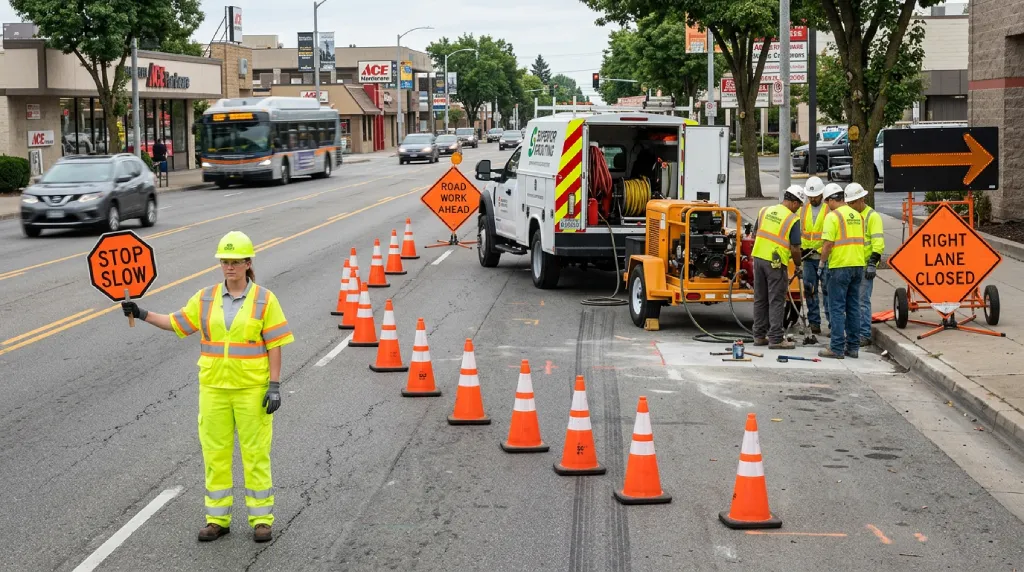
Municipal road work is executed under MUTCD-compliant traffic control plans. The work zone setup follows standard temporary traffic control requirements for short-duration mobile or stationary operations:
- Advance warning signs ("ROAD WORK AHEAD", distance signs)
- Lane closure signs ("RIGHT LANE CLOSED", "LEFT LANE CLOSED")
- Channelizing devices (retroreflective orange cones at MUTCD-specified taper length)
- Arrow boards for through-lane direction
- Flagger control where two-way single-lane operation is required
- Termination area marking returning traffic to normal operation
The work zone footprint for a typical polyurethane injection on a single roadway lane occupies the closed lane only. The Superior Grouting service truck and trailer-mounted rig stage within the closed lane; equipment does not extend into adjacent travel lanes or onto sidewalks except for short crossings.
Work windows are commonly scheduled to minimize traffic impact:
- High-volume arterials and collectors: overnight closures (typically 8 PM to 6 AM)
- Residential streets and low-volume routes: daytime windows
- School zones: outside school hours
- Transit routes: coordinated with the transit operator
The traffic control plan is submitted to the owner (municipal traffic engineer or state DOT district) for review and approval before mobilization. A qualified specialty grouting contractor maintains MUTCD-compliant equipment and trained flagger personnel as standard.
DOT and Owner Specification Alignment
State DOTs and municipal owners reference polyurethane injection within their pavement maintenance and preservation specifications. The reference framework varies by owner:
- FHWA pavement preservation guidance recognizes polyurethane subgrade stabilization as a treatment within the preservation toolkit, available through the FHWA Pavement Preservation program.
- TxDOT recognizes polyurethane injection within its maintenance specifications and standard procedures for slab stabilization and void fill on highway and bridge applications.
- AASHTO M and AASHTO T methods reference related test methods used in the QA/QC plan submittal.
- Municipal owners typically reference state DOT specifications by adoption or by parallel local standard.
For a specific project, the engineer of record or owner's representative is the authoritative source for the material class, injection pressure limits, lift tolerance, verification requirements, and submittal content applicable to the work. Contractor submittals typically include product technical data sheets, injection procedures, QA/QC plans, traffic control plans, and safety plans for engineer review before work proceeds.
The Municipal Project Execution Sequence
A municipal polyurethane grouting project executes through a standard sequence adapted from the general project execution process to public works conditions. Polyurethane foam injection on a municipal scope typically proceeds as follows:
- Pre-construction coordination with the owner's representative, utility owners (water, sewer, gas, electric, telecom), affected adjacent property owners, and traffic engineering. Coordination identifies utility locations, project boundaries, work window, and traffic control plan approval.
- Subgrade investigation by ground-penetrating radar (GPR) sweep along the work area to confirm void extent, with boroscope confirmation at representative locations where access allows. The investigation documents the void volume and depth for the injection plan.
- Traffic control deployment at the scheduled work window per the approved plan. The closed lane is delineated by advance warning, taper cones, and termination markings before any work begins.
- Port layout and drilling at 24 to 48-inch spacing along the work area with depth varying by documented void location. Drilling uses dust-suppression equipment to minimize fugitive emissions in the work zone.
- Staged polyurethane injection in 1/8 to 1/4-inch lifts per port with continuous elevation monitoring via laser level and pressure monitoring at the manifold. Each port is recorded in the daily injection log.
- Verification and finishing with post-injection elevation survey, volume reconciliation, boroscope inspection at representative ports, and port finishing flush with the pavement surface using approved sealant or non-shrink grout per the project specification.
- Traffic control removal after the injection material has reached return-to-service strength per the product technical data sheet, typically 1 to 4 hours after injection completion.
- Closeout documentation delivered to the owner within 5 to 10 business days, including pre and post elevation surveys, daily injection logs, volume reconciliation, photographs, and material certifications.
Cost and Downtime Comparison
For owners evaluating polyurethane grouting against traditional municipal repair methods, the comparison favors polyurethane for settlement-only scopes:
| Method | Typical Cost Range (Per SF) | Lane Closure Duration | Best Use Case |
| Polyurethane grouting | $6 to $14 | 4 to 8 hours per bay | Settlement on sound pavement |
| Mill and overlay (partial) | $10 to $25 | 2 to 5 days | Surface distress on sound base |
| Partial pavement replacement | $25 to $60 | 5 to 14 days | Localized structural failure |
| Full pavement reconstruction | $40 to $100+ | 2 to 6 weeks | Comprehensive rebuild |
| Mudjacking (cement slurry) | $5 to $12 | 1 to 3 days | Light residential lifting only |
Cost ranges are advisory and project-specific; actual cost depends on depth, lift, subgrade condition, regional market, traffic control complexity, and owner specification requirements. A site-specific estimate validated by the engineer of record is the correct basis for procurement.
Sustainability and Public Works Reporting
Municipal sustainability reporting increasingly captures construction waste, embodied carbon, and operational disruption in capital and maintenance projects. Polyurethane grouting performs well across all three dimensions:
- Material embodied carbon is roughly two orders of magnitude lower than full pavement reconstruction on comparable scope.
- Demolition waste is negligible (drilling produces approximately one to three quarts of pavement dust per work shift).
- Operational disruption is hours rather than days or weeks.
For owners reporting against state or federal sustainability frameworks, the project closeout submittal can include the material volume, embodied carbon calculation, and avoided demolition waste documentation. Many municipalities and DOTs now include sustainability metrics in their preservation reporting.
Coordination with Utility Owners
Municipal streets carry buried utilities owned by departments and entities separate from the streets department. Polyurethane grouting work near or above buried utilities requires coordination with each affected utility owner:
- Water and sanitary sewer (typically the public works or water utility department)
- Storm drainage (typically the streets or stormwater department)
- Natural gas (typically a private utility)
- Electric (typically a private utility or municipal electric)
- Telecommunications (multiple private providers)
Standard coordination involves 811 dig-safe locates before drilling, confirmation of pipe and conduit depths in the work area, and adjustment of port locations or depths where buried utilities require setback. For void fill grouting projects adjacent to active water mains, NSF/ANSI 61 compliant polyurethane formulations are specified where required.
Field-Tested Application Scenarios
The following composite scenarios illustrate municipal polyurethane grouting applications. Each is representative rather than specific to a past project.
Intersection Settlement at Heavy Truck Route
A signalized intersection on a major freight corridor shows 1.5-inch differential settlement in the wheel paths approaching the stop bar. Pavement is sound 8-inch reinforced concrete with asphalt overlay. GPR confirms wheel-path consolidation voids averaging 2-inch depth. Owner schedules an overnight 6-hour closure window. Polyurethane grouting is the appropriate scope; rehabilitation completes within the work window with same-shift return-to-service.
Utility Cut Settlement Along Recently Replaced Water Main
A water main replacement completed 3 years prior has produced a linear settlement along the trench line crossing the roadway, with reflective cracking along the edges. Pavement is sound otherwise. Polyurethane grouting fills the differential settlement zone and restores the pavement profile. Coordination with the water utility confirms the work does not interfere with planned future maintenance.
Manhole Frame Settlement Around Sanitary Manhole
A 30-year-old sanitary manhole shows a 2-inch dish-shaped depression in the surrounding pavement, creating a vehicle bump that residents have complained about. Manhole structure is sound; the issue is differential settlement of the pavement relative to the rigid manhole. Polyurethane grouting restores support around the manhole. The sanitary utility department coordinates the scope to confirm no conflict with planned manhole rehabilitation.
Drainage Washout at Storm Drain Inlet
A street near a low point shows progressive settlement around a storm drain inlet. Investigation reveals the inlet structure has a failed joint at the connection to the storm pipe, allowing subgrade soil to migrate into the storm system. Polyurethane grouting alone treats the symptom. The correct scope is inlet joint repair PLUS polyurethane injection to fill the existing void. Without inlet repair, the void will recur.
Key Takeaways
- Polyurethane grouting addresses four recurring municipal roadway failure modes: drainage washout, fill consolidation, utility cut settlement, and manhole frame settlement.
- The method is appropriate when the underlying pavement structure is sound and the failure is in the subbase or subgrade; it does not repair structurally failed pavement.
- Work executes under MUTCD-compliant traffic control with lane-by-lane closures of 4 to 8 hours per bay, allowing same-shift return-to-service.
- FHWA and state DOT guidance (including TxDOT) recognize polyurethane injection as an approved municipal maintenance scope.
- Cost per square foot is roughly 30 to 50 percent of mill-and-overlay and 15 to 30 percent of full pavement reconstruction on comparable settlement-only scopes.
- Polyurethane is most durable when paired with drainage correction at the underlying failure cause; standalone injection without root-cause correction will recur.
- Every parameter and timeline in this article is advisory and project-specific. Final scope must be validated by the engineer of record and the owner's maintenance standards.
Frequently Asked Questions
Is polyurethane grouting approved for municipal road and street repair?
Yes. Polyurethane grouting is recognized within FHWA pavement preservation guidance and within state DOT maintenance specifications including TxDOT. Municipal owners typically adopt state DOT specifications by reference or maintain parallel local standards. Specification details vary by owner, and the engineer of record or owner's representative is the authoritative source for the specific material class, injection pressure limits, lift tolerance, verification requirements, and submittal content applicable to a given project. Contractors typically submit product data sheets, injection procedures, QA/QC plans, and traffic control plans for engineer review before work proceeds.
What types of municipal pavement problems can polyurethane grouting fix?
Polyurethane grouting addresses pavement settlement caused by subbase or subgrade failure on otherwise sound pavement structure. Common applications include drainage washout under pavement, fill consolidation under repeated heavy loading at intersections and freight corridors, utility cut backfill differential settlement, and manhole frame settlement. The method does not repair structurally failed pavement (through-pavement cracking, severe potholes with reinforcement exposure, alligator cracking) or address asphalt fatigue and oxidation damage at end of pavement life.
How long does a typical municipal polyurethane grouting project take?
Typical work windows range from 4 to 8 hours per bay for municipal lane closures, executed as lane-by-lane closures rather than full street closures. Polyurethane grout reaches tack-free in 5 to 15 minutes and supports return-to-service load within 1 hour in most formulations, allowing the lane to reopen within the work window. High-volume arterials and collectors commonly use overnight closures (8 PM to 6 AM); residential streets and low-volume routes can be executed during approved daytime windows. Exact duration depends on void extent, lift target, and the approved traffic control plan.
How much does polyurethane grouting cost compared to mill and overlay?
For settlement-only scopes on sound underlying pavement, polyurethane grouting typically costs 30 to 50 percent of mill-and-overlay on comparable areas. A settled roadway zone that would cost $10 to $25 per square foot for mill and overlay can typically be addressed by polyurethane at $6 to $14 per square foot, with downtime reduced from 2 to 5 days to one work shift. All ranges are advisory and project-specific; actual cost depends on depth, lift, subgrade condition, regional market, traffic control complexity, and owner specification requirements.
What MUTCD traffic control is required for polyurethane grouting work?
Polyurethane grouting on municipal streets is executed under MUTCD-compliant temporary traffic control. Typical work zone setup includes advance warning signs ("ROAD WORK AHEAD"), lane closure signs, channelizing devices (retroreflective orange cones at MUTCD-specified taper length), arrow boards for through-lane direction, flagger control where two-way single-lane operation is required, and a termination area returning traffic to normal operation. The work zone footprint occupies the closed lane only; the service truck and rig stage within the closed lane. The traffic control plan is submitted to the owner for review and approval before mobilization.
How does polyurethane grouting handle work near buried utilities?
Standard coordination involves 811 dig-safe locates before drilling, confirmation of pipe and conduit depths in the work area, and adjustment of port locations or depths where buried utilities require setback. For projects adjacent to active water mains, NSF/ANSI 61 compliant polyurethane formulations are specified where required. The injection procedure and material technical data sheets are reviewed against the documented utility locations before work begins. A qualified contractor maintains insurance coverage and damage protocols that meet municipal utility coordination requirements.
Will polyurethane grouting damage the underlying pavement structure?
When properly executed, polyurethane grouting does not damage sound pavement. Port diameter is typically five-eighths of an inch, small enough that the pavement surface is essentially undisturbed once the port is finished. Injection pressures are managed below the pavement structural limit to prevent surface heave or cracking. Lift increments are staged at 1/8 to 1/4 inch per stage to avoid stress concentration. A qualified contractor monitors pressure and elevation continuously during injection and pauses for relaxation when readings approach the engineer-of-record-approved limits.
How is the work verified for municipal acceptance?
Verification on municipal projects follows standard QA/QC protocols including post-injection elevation survey comparing the final pavement profile to the documented pre-injection baseline and to the owner's flatness or rideability tolerance, volume reconciliation comparing injected material volume against calculated theoretical void volume, post-cure boroscope inspection at representative port locations where access allows, and a final profile survey confirming the rideability standard is met. All verification outputs join the closeout submittal delivered to the owner within 5 to 10 business days of work completion.
Can polyurethane grouting be used in residential areas of the city?
The method is appropriate for any settled pavement that meets the engineering criteria (sound underlying pavement, subgrade or void failure mode, traffic conditions amenable to short lane closures). Residential streets are commonly within scope, with work scheduled during daytime hours and traffic control coordinated to allow resident access. Schools, transit stops, and similar sensitive locations are scheduled outside operating hours where possible. Note that polyurethane grouting is performed on commercial and industrial pavement and on municipally-owned roadways; it is not specified for individual homeowner driveways or private residential sidewalks within Superior Grouting's commercial scope.
How do I include polyurethane grouting in a municipal preservation program?
A municipal pavement preservation program typically integrates polyurethane grouting as a treatment within the preservation toolkit, applied to candidates identified through annual condition surveys, citizen complaints, or routine maintenance inspections. Candidate identification flags pavement segments showing localized settlement on otherwise sound pavement structure. The treatment is specified in the maintenance procurement using the same submittal framework as other preservation methods (product data sheets, injection procedures, QA/QC plans, traffic control plans). Engineer of record review confirms scope appropriateness for each segment. To evaluate polyurethane grouting for inclusion in a Texas or Louisiana municipal preservation program, schedule an estimate with Superior Grouting.
Conclusion
Polyurethane grouting is an approved and cost-effective method for municipal road and street repair where pavement settlement is the failure mode and the underlying pavement structure remains sound. The method addresses four recurring municipal failure modes (drainage washout, fill consolidation, utility cut settlement, manhole frame settlement) within short MUTCD-compliant lane closures, produces same-shift return-to-service, and delivers DOT-specification-aligned QA/QC documentation. Cost is typically 30 to 50 percent of mill-and-overlay on settlement-only scopes, and operational disruption is hours rather than days. When the scope is correctly matched to conditions and paired with root-cause correction where warranted, the rehabilitation lasts a full service cycle. Every parameter and recommendation in this article is advisory; final design must be validated by the engineer of record against project-specific conditions and the governing municipal or DOT specification. To scope municipal polyurethane grouting work in Texas or Louisiana, contact Superior Grouting.