


Curtain Grouting for Manhole and Lift Station Rehabilitation: The Soil-Side Water Barrier Method
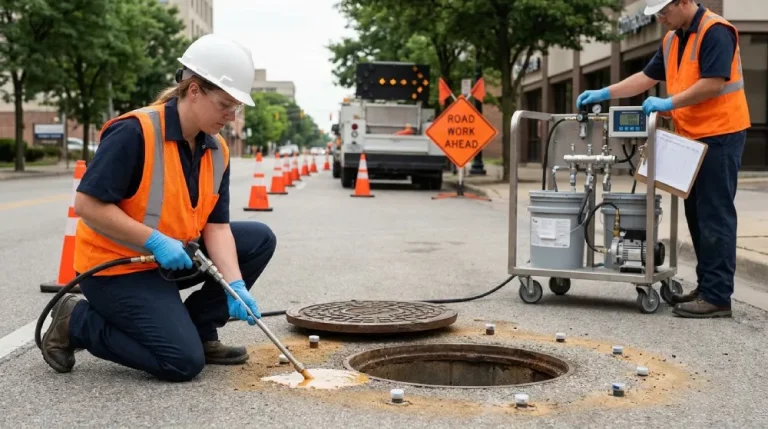
Curtain grouting seals municipal manholes and lift station wet wells from the soil side rather than the interior wall, by injecting low-viscosity chemical grout through drilled ports around the structure perimeter to form a continuous impermeable barrier in the surrounding soil. The method is preferred where infiltration enters through multiple diffuse defects rather than a single identifiable joint, where interior access is limited by structural condition or confined-space complexity, or where the surrounding soil itself is the migration path for groundwater. Curtain grouting typically achieves 80 to 95 percent infiltration reduction on treated structures with a service life of 10 to 20 years or more when the material class and injection pattern are correctly matched to soil and groundwater conditions.
Municipal sanitary sewer systems rely on manholes as the vertical access points for the collection system and on lift stations as the pumping infrastructure between drainage basins. Both structure types share a common failure mode: infiltration of groundwater through the structure walls, joints, and pipe penetrations, adding clear water to the wastewater flow. Rehabilitation methods that address these defects one at a time from the interior work when a small number of specific defects can be identified. When infiltration is diffuse, distributed across many small defects, or entering through the soil rather than a single wall defect, interior injection often falls short.
Curtain grouting is the soil-side rehabilitation method that addresses these harder infiltration cases. This article presents the curtain grouting approach for manhole and lift station rehabilitation, positioning it within the broader chemical grouting toolkit and explaining when it is the correct method versus alternative approaches. The audience is municipal engineers, water and wastewater program managers, and consulting engineers writing rehabilitation specifications. Every parameter and recommendation is advisory and project-specific; final material class, injection procedure, and verification methodology must be validated by the engineer of record against site conditions and the applicable owner specification.
Why Manholes and Lift Stations Are the Problem Structures
Manholes and lift station wet wells share several structural characteristics that make them chronic infiltration sources in aging collection systems. Both are typically constructed of precast concrete or brick sections joined at horizontal and vertical construction joints. Both have pipe penetrations at multiple elevations where sewer mains, force mains, or laterals connect to the structure. Both are surrounded by disturbed backfill soil from original construction that settles differently over time from adjacent undisturbed soil. Both are typically installed with the majority of the structure below the water table in wet-climate regions.
The result is that manholes and lift stations accumulate infiltration defects over their service life at joint locations, pipe penetration interfaces, wall cracks from ground movement, and bench and invert connections. A typical mature municipal system with 5,000 to 15,000 manholes contributes a substantial share of total system I&I from these structures, and every lift station wet well in service adds to that total.
Interior injection through the manhole wall works well when the defects can be individually identified through inspection and the interior access permits systematic treatment of each defect. When the defects are numerous, when they are subtle enough that CCTV or visual inspection misses them, when access is constrained by confined-space complexity or structure condition, or when infiltration enters through the surrounding soil rather than a specific wall defect, chemical grouting services executed as curtain grouting from the exterior often deliver better results than interior treatment alone.
Curtain Grouting vs Interior Injection: The Soil-Side Approach
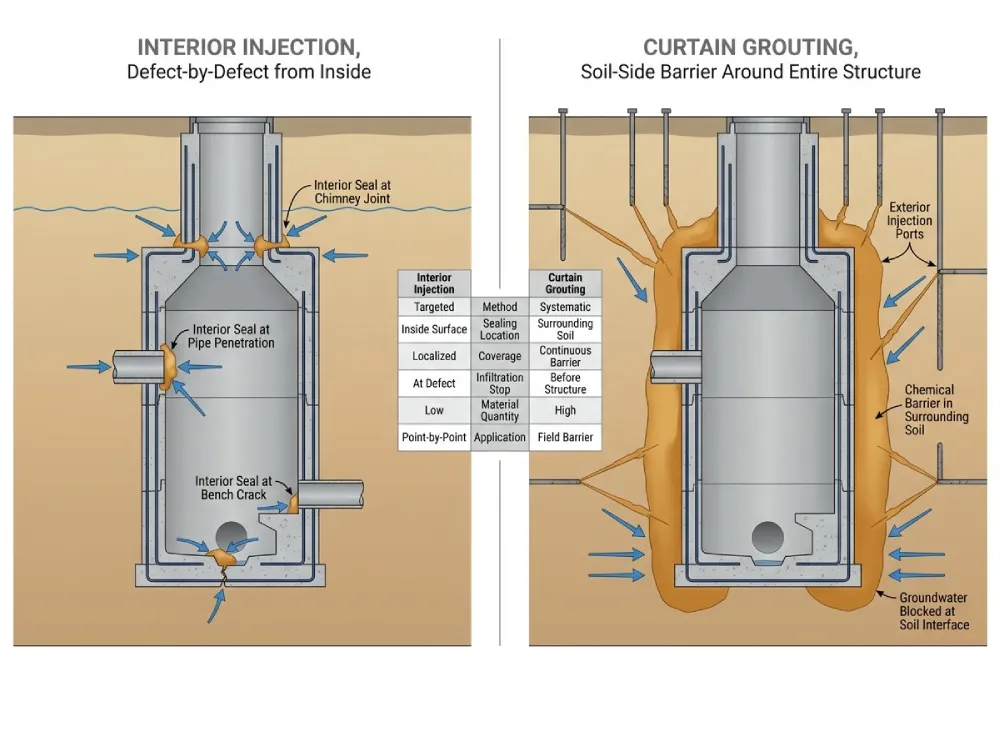
The fundamental difference between curtain grouting and interior injection is the location of the sealing barrier. Interior injection places a seal at the interior wall surface of the structure, at each identified defect. Curtain grouting places a seal in the surrounding soil, at a distance from the structure wall, forming a barrier that groundwater cannot pass through to reach any point on the structure exterior.
Interior Injection: Defect-by-Defect from Inside
Interior injection is the standard method for manhole rehabilitation when specific defects can be identified through interior inspection. The technique involves entering the manhole (with full confined-space entry protocols per OSHA 29 CFR 1910.146), drilling injection ports through the manhole wall at each identified defect, injecting hydrophilic polyurethane or acrylate gel into the defect and the immediate exterior soil zone, and confirming the seal through post-injection visual inspection.
Interior injection is efficient when defect count is limited (perhaps 3 to 8 significant defects per structure), when interior access is unrestricted, when the defects are geometrically well-defined (specific joints, cracks, or pipe penetrations), and when the surrounding soil is not a significant infiltration pathway on its own.
Curtain Grouting: Soil-Side Barrier Around the Structure
Curtain grouting is the alternative when interior injection is not the best fit. The technique involves drilling injection ports from grade around the structure perimeter, angled downward to bracket the structure depth, and injecting low-viscosity chemical grout (typically acrylamide or acrylate gel) into the surrounding soil. The gel permeates the soil pore space and cures in place, forming a continuous impermeable barrier in the soil around the entire structure.
Curtain grouting is appropriate when infiltration is diffuse across many defects (rather than concentrated at a few), when interior access is limited or complicated (structural condition, atmospheric hazards, extreme depth), when the surrounding backfill soil is itself a migration path for groundwater (poor original backfill, chronic saturation), or when the treatment goal is to establish a long-term barrier that does not depend on defect-by-defect identification.
The two methods are not exclusive. Many rehabilitation projects use both: curtain grouting to establish a soil-side barrier around the structure, and interior injection at any specific high-flow defects that persist after the curtain is established. A qualified specialty grouting contractor evaluates the specific structure conditions during the pre-construction walk and proposes the method mix that fits.
When Curtain Grouting Is the Right Method
Curtain grouting fits a specific set of project conditions. The following framework identifies when the method is the appropriate choice.
Condition 1: Infiltration Is Diffuse Rather Than Concentrated
When CCTV or interior inspection identifies numerous small defects rather than a few large ones, curtain grouting is often more efficient than defect-by-defect interior injection. A manhole with 15 or 20 small joint defects along a barrel is a curtain grouting candidate; a manhole with 2 or 3 clear defect locations is often better treated with interior injection.
Condition 2: The Surrounding Soil Is the Migration Path
When original backfill was placed with poor compaction, or when the surrounding soil has become a preferred migration path for groundwater over time, sealing the manhole wall alone leaves the soil pathway open. Groundwater simply migrates through the soil to find any residual defect. Curtain grouting seals the soil pathway itself.
Condition 3: Interior Access Is Restricted
Structures with severe structural distress, active gas hazards beyond standard four-gas monitoring, extreme depth (over 30 feet), or geometric constraints (small diameter, restricted openings) may not permit safe or efficient interior injection. Curtain grouting from grade eliminates the confined-space entry requirement while still achieving the rehabilitation goal.
Condition 4: The Rehabilitation Goal Is Long-Term Protection
Where the owner is investing in a structure that will remain in service for another 20 to 30 years, curtain grouting establishes a soil-side barrier that continues to protect against future defects as they develop. Interior injection addresses only the specific defects identified at treatment; curtain grouting protects against emerging defects that have not yet developed at the time of treatment.
Condition 5: The Structure Is Part of a Program-Level Rehabilitation
For large-scale programs treating many structures across a service area, curtain grouting provides consistent per-structure treatment scope, predictable pricing, and standardized documentation. Interior injection scope varies with defect count and access; curtain grouting scope is more uniform per structure.
Curtain Grouting Execution: The Systematic Approach
A well-executed curtain grouting project on a manhole or lift station follows a standardized sequence.
Step 1: Pre-Construction Site Investigation
The engineer of record and specialty contractor evaluate the structure and surrounding soil conditions. Site investigation includes structure inspection (structural condition assessment, defect mapping where possible), soil investigation (grain size, groundwater elevation, backfill history), and access assessment (traffic control requirements, utility conflicts).
Step 2: Injection Pattern Design
The injection pattern establishes port spacing, depth, and angle around the structure perimeter. Standard patterns include: circular ring pattern (ports arrayed in a circle at 3-to-5-foot spacing around the manhole), extended perimeter pattern (larger diameter for lift stations or where deeper treatment is needed), and multi-level pattern (multiple ring elevations for deep structures with varying groundwater and soil conditions).
Port depth typically brackets the structure elevation, extending 2 to 3 feet below the deepest infiltration source and rising to grade. Port angle is typically 20 to 45 degrees from vertical, directed inward toward the structure to establish overlapping treatment zones.
Step 3: Traffic Control and Site Setup
MUTCD-compliant traffic control is deployed per the approved plan. Lane closure, cones, arrow board, and flagger control as required by the location. The chemical grouting equipment stages within the closed area.
Step 4: Port Drilling
Ports are drilled through the pavement or ground surface at the designed pattern using a small-diameter rotary drill. Dust suppression captures fugitive material during drilling. Port depth is verified with a depth gauge before injection begins.
Step 5: Systematic Injection
Chemical grout is injected through each port in the designed sequence, typically working around the structure perimeter to build the barrier progressively. Injection pressure is controlled to permeate the surrounding soil without lifting the pavement or heaving the structure. Volume per port is monitored against the design theoretical volume for the treatment zone.
The material class is selected during specification: acrylamide or acrylate gel for fine-grained soils and where chemical resistance matters, hydrophilic or hydrophobic polyurethane where the soil is coarser or where structural fill is also needed. For chemical grouting after CIPP-related work where the same crew is coordinating multiple scopes, material selection considers both the curtain grouting objective and any adjacent structural rehabilitation.
Step 6: Port Finishing and Site Restoration
Each port is sealed at grade with non-shrink grout matched to the pavement surface, and the site is restored per the traffic control removal plan. Documentation of port locations, depths, and injection volumes is recorded for the closeout submittal.
Step 7: Verification
Verification typically includes downstream flow monitoring compared to pre-treatment baseline, interior CCTV inspection of the treated structure (where interior access exists), and where applicable, dye or smoke testing to confirm the barrier is effective. Verification results become part of the CMOM program documentation.
Lift Station Applications: Wet Wells, Dry Wells, and Valve Vaults
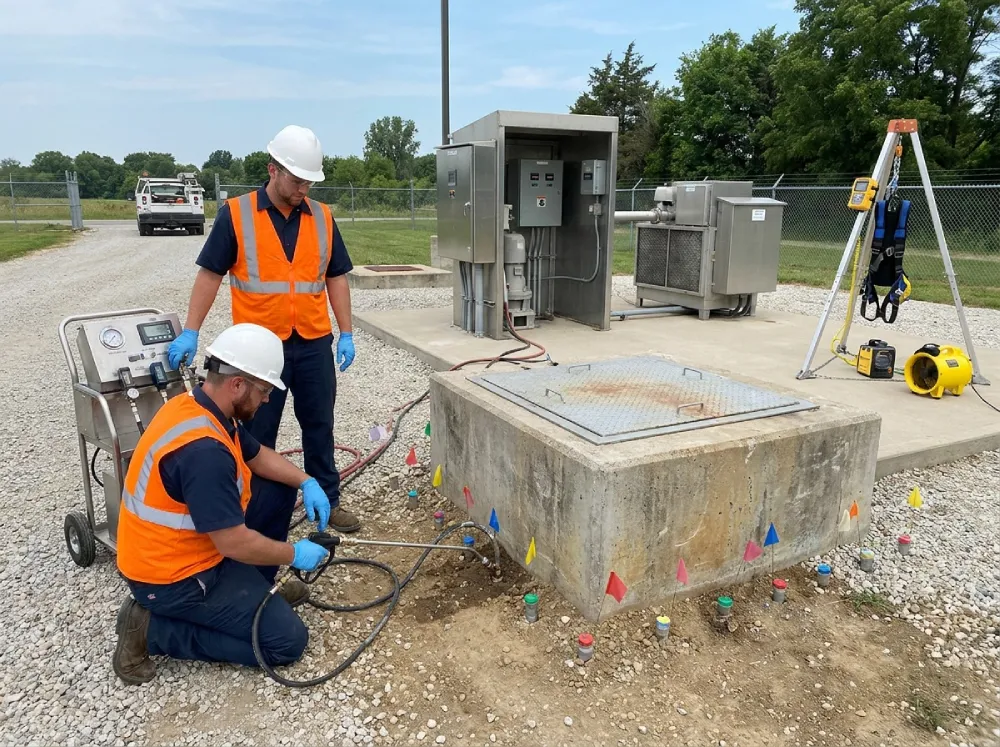
Lift stations present additional considerations beyond typical manhole treatment. Curtain grouting for lift station rehabilitation addresses several distinct structural elements.
Wet Well Applications
The wet well is the primary reservoir where wastewater accumulates before pumping. Infiltration into the wet well adds to pump run time, increases downstream treatment plant loading, and can cause operational issues if the wet well is undersized for combined dry-weather-plus-infiltration flow.
Curtain grouting around the wet well perimeter creates a soil-side barrier that reduces infiltration without requiring the wet well to be taken out of service. Wet wells with active infiltration through concrete or block walls, joint defects at multiple elevations, or pipe penetrations that admit groundwater are strong candidates for the method.
Dry Well Applications
Some lift stations use a dry well design with the pumps mounted at grade or in a separate below-grade chamber. Infiltration into the dry well affects pump electrical systems and can cause operational safety issues. Curtain grouting around the dry well perimeter blocks the soil-side infiltration path.
Valve Vault Applications
Force main valve vaults, air release valve vaults, and other utility vaults share the same infiltration profile as manholes and often benefit from curtain grouting treatment. The soil-side barrier prevents groundwater from reaching the vault interior where valves and instrumentation are exposed to moisture damage.
Material Class Selection for Curtain Grouting
Material class selection for curtain grouting follows the general framework for chemical grouting, with specific considerations for the soil-side barrier objective.
| Site Condition | Recommended Material Class | Rationale |
| Fine-grained backfill soil (silts, clayey sands) | Acrylamide or acrylate gel | Only gel classes permeate fine soils |
| Coarse-grained backfill (sands, gravels) | Acrylate gel or polyurethane | Both permeate coarse soil; acrylate preferred for gel-barrier objective |
| Mixed soil with variable grain size | Acrylate gel | Handles the widest range of soil conditions |
| Potable water adjacent | NSF/ANSI 61 compliant polyurethane or acrylate | Regulatory compliance required |
| Chemical exposure from industrial waste | Acrylate gel | Superior chemical resistance |
| Wet-dry cycling in surrounding soil | Acrylate gel or hydrophobic polyurethane | Both tolerate wet-dry cycles |
| Restricted acrylamide use jurisdictions | Acrylate gel or NSF-compliant polyurethane | Compliant alternatives |
| Deep structure (>30 feet) with saturated soil | Acrylate gel | Consistent permeation at depth |
The engineer of record specifies the material class during specification development; the contractor confirms the specific product technical data sheet during submittal review.
Coordination with Other Rehabilitation Methods
Curtain grouting is often executed as part of a broader manhole or lift station rehabilitation program. Common paired methods include:
- Interior manhole coating or lining. Curtain grouting establishes the soil-side barrier; the interior coating protects the structure interior from corrosion. Both methods together produce a comprehensive rehabilitation.
- Interior injection at high-flow defects. Curtain grouting handles the diffuse infiltration; targeted interior injection addresses any concentrated defects that persist after the curtain is established.
- Pipe penetration sealing. For pipe penetrations that connect to the structure, void fill grouting or targeted injection at each penetration complements the curtain treatment.
- Bench and invert repair. Structural repair of the manhole bench and invert flow channel, executed before or after curtain grouting depending on the project sequence.
- Frame and cover replacement. Deteriorated frames and covers are typically replaced independent of the curtain grouting scope.
A qualified specialty contractor coordinates the paired scope with the engineer of record and the utility owner to sequence the work appropriately.
Cost Economics of Curtain Grouting
Curtain grouting cost economics compare favorably against alternative rehabilitation methods on the specific structure conditions the method addresses.
| Method | Typical Cost Per Structure | Best Use Case |
| Curtain grouting (manhole) | $3,000 to $8,000 | Diffuse infiltration, soil migration path |
| Curtain grouting (lift station wet well) | $8,000 to $25,000 | Wet well infiltration with soil-side barrier objective |
| Interior injection (manhole, 3 to 8 defects) | $1,500 to $5,000 | Concentrated defects with clear interior access |
| Interior manhole coating (comprehensive) | $10,000 to $30,000 | Structure interior corrosion protection |
| Manhole reconstruction (full) | $20,000 to $60,000 | Structurally failed manhole |
| Lift station wet well replacement | $150,000 to $500,000+ | Structurally failed wet well |
For a typical municipal program treating 100 manholes with diffuse infiltration, curtain grouting at $5,000 per structure averages $500,000 in direct cost. The comparable interior coating alternative on the same structures could exceed $2,000,000, and the reconstruction alternative could reach $6,000,000. Curtain grouting captures the infiltration reduction at 10 to 25 percent of the alternative rehabilitation cost.
Verification and Long-Term Performance
Curtain grouting verification adapts to the soil-side treatment approach. Standard methods:
- Downstream flow monitoring. Compare inflow to the treated segment before and after treatment, over a period long enough to capture wet-weather events. Flow reduction validates the curtain's effectiveness.
- Interior CCTV or visual inspection. Where interior access exists, post-treatment inspection confirms visible reduction in infiltration at defect locations.
- Dye or smoke testing. Injection of tracer materials at the soil side confirms the barrier is intact (dye should not appear at the structure interior).
- Long-term monitoring. Periodic re-inspection (annual or biannual) confirms the curtain continues to perform over the service life.
The long-term performance of a properly executed curtain grouting installation is typically 10 to 20 years or more. Acrylate gel installations in fine-soil environments have documented performance beyond 25 years in some municipal records. Actual service life depends on soil chemistry, groundwater stability, surrounding utility work, and continued structural integrity of the treated structure.
Regulatory and Program Fit
Curtain grouting fits within several regulatory and program frameworks that drive municipal rehabilitation decisions:
- EPA CMOM (Capacity, Management, Operation, and Maintenance) programs use curtain grouting as an infiltration control method. The EPA Sanitary Sewer Overflow guidance recognizes chemical grouting including curtain grouting as a legitimate tool in the rehabilitation toolkit.
- NASSCO MACP (Manhole Assessment Certification Program) provides the inspection framework that identifies defect patterns supporting curtain grouting selection.
- State DOT and municipal standards vary by jurisdiction but generally reference chemical grouting including curtain grouting for public works rehabilitation.
- Consent decree compliance programs use curtain grouting for structures where interior treatment has been attempted and found insufficient, or where diffuse infiltration is the primary failure mode.
For utilities operating under consent decrees or capital investment mandates, the underground utility grouting services delivered as curtain grouting provide compliance value alongside the direct operational cost savings.
Field-Tested Application Examples
Three composite scenarios illustrate curtain grouting decisions in practice. Each is representative rather than specific to a past project.
Scenario 1: 40-Year-Old Sanitary Manhole with Diffuse Infiltration
A city inspection identifies significant I&I contribution from a manhole 40 years in service. CCTV shows 12 to 15 small defects across the barrel and pipe penetrations. Interior injection could address each defect individually but would require extensive confined-space work and defect-by-defect verification. Curtain grouting is selected for the systematic soil-side barrier approach. Work completes in 6 to 8 hours; verification via downstream flow monitoring shows 90 percent infiltration reduction.
Scenario 2: Lift Station Wet Well with Chronic Groundwater Intrusion
A municipal lift station wet well shows chronic infiltration adding 5 to 15 gpm to normal wastewater flow depending on weather conditions. Prior interior treatment attempts have not delivered lasting results. Investigation identifies the surrounding backfill soil as the primary migration path. Curtain grouting around the wet well perimeter using acrylate gel is executed over two work shifts. Post-treatment infiltration drops to under 1 gpm, and the pump duty cycle returns to designed operation.
Scenario 3: Historic Brick Manhole with Restricted Interior Access
A brick manhole in a historic district shows infiltration but is not suitable for interior injection due to structural fragility and confined-space concerns. Curtain grouting from grade using acrylate gel around the manhole perimeter creates a soil-side barrier without disturbing the historic structure. Treatment completes without confined-space entry, and infiltration reduction is verified through downstream flow monitoring.
Key Takeaways
- Curtain grouting seals manholes and lift stations from the soil side by injecting low-viscosity chemical grout around the structure perimeter, forming a continuous impermeable barrier in the surrounding soil.
- The method is preferred when infiltration is diffuse across many defects, when the surrounding soil is a migration path, when interior access is restricted, or when long-term barrier protection is the goal.
- Curtain grouting typically achieves 80 to 95 percent infiltration reduction with service life of 10 to 20 years or more when material class and injection pattern are correctly matched to soil and groundwater conditions.
- Standard execution proceeds through seven steps: pre-construction investigation, pattern design, traffic control, port drilling, systematic injection, port finishing, and verification.
- Acrylamide and acrylate gels are typical material class selections for fine-soil applications; polyurethane and acrylate gels handle coarser soils. Selection follows the four-variable framework used for chemical grouting generally.
- Curtain grouting cost typically runs 10 to 25 percent of interior coating or reconstruction alternatives on comparable structures, delivering infiltration reduction at substantially lower program cost.
- Every parameter in this article is advisory and project-specific. Final material class, injection pattern, and verification methodology must be validated by the engineer of record against site conditions and the applicable owner specification.
Frequently Asked Questions
What is curtain grouting in manhole and lift station rehabilitation?
Curtain grouting is a chemical grouting method that seals a manhole or lift station from the soil side rather than the interior wall. Chemical grout is injected through ports drilled from grade around the structure perimeter, permeating the surrounding soil and curing in place to form a continuous impermeable barrier around the entire structure. Groundwater cannot pass through the barrier to reach any point on the structure exterior. The method is preferred where interior injection is not the best fit due to defect distribution, access constraints, or long-term protection goals.
When is curtain grouting the right choice versus interior injection?
Curtain grouting is preferred when infiltration is diffuse across many small defects, when the surrounding backfill soil is a migration pathway for groundwater, when interior access is restricted by structural condition or confined-space complexity, or when the rehabilitation goal is long-term soil-side protection. Interior injection is preferred when defects are concentrated at a few identifiable locations, interior access is unrestricted, and the surrounding soil is not a significant infiltration pathway. Many projects use both methods together.
How effective is curtain grouting at reducing manhole infiltration?
Curtain grouting typically achieves 80 to 95 percent infiltration reduction on treated structures when the material class and injection pattern are correctly matched to soil and groundwater conditions. Effectiveness depends on soil grain size (permeation into fine soils requires gel-class materials), groundwater dynamics (stable versus fluctuating), backfill quality (uniform versus disturbed), and the accuracy of the port pattern design. Verification through downstream flow monitoring quantifies the actual reduction on each project.
How long does curtain grouting last?
Curtain grouting service life is typically 10 to 20 years or more when properly executed. Acrylate gel installations in fine-soil environments have documented performance beyond 25 years in some municipal records. Actual service life depends on soil chemistry, groundwater stability, surrounding utility work that may disturb the barrier, and continued structural integrity of the treated structure. Long-term monitoring through periodic re-inspection confirms the curtain continues to perform.
What material classes are used for curtain grouting?
Curtain grouting typically uses acrylamide gel or acrylate gel for fine-grained soils where deep permeation is required, or hydrophobic polyurethane and acrylate gel for coarser soils. Acrylate gel is often the default for mixed soil conditions because it handles a wide range of grain sizes and offers chemical resistance for aggressive wastewater environments. Material class selection follows the four-variable framework used for chemical grouting: defect type, water condition, soil grain size, and application context.
How much does curtain grouting cost per manhole or lift station?
Curtain grouting cost typically runs $3,000 to $8,000 per manhole and $8,000 to $25,000 per lift station wet well, depending on structure size, depth, soil conditions, and access requirements. For a program treating 100 manholes at $5,000 per structure, the direct cost averages $500,000. Comparable alternatives (interior coating, reconstruction) can run 5 to 10 times higher on the same structures. Site-specific estimates validated by the engineer of record are the correct basis for procurement.
Can curtain grouting be executed without entering the manhole or lift station?
Yes. Curtain grouting is entirely a soil-side operation executed from grade around the structure perimeter, with no confined-space entry required for the injection work itself. This eliminates OSHA 29 CFR 1910.146 confined-space entry requirements for the treatment phase, though verification steps that involve interior CCTV inspection do require entry per standard confined-space protocols. For structures where confined-space entry is unsafe or impractical, curtain grouting is the primary method choice precisely because it does not require entry.
Does curtain grouting work on old brick manholes?
Yes. Curtain grouting is particularly well suited to older brick manholes because the soil-side approach does not require drilling through fragile brick masonry or entering structurally compromised interiors. The method treats the surrounding soil rather than the manhole wall itself, avoiding disturbance of the historic structure. Many municipal preservation programs specifically favor curtain grouting for brick manhole rehabilitation because it preserves the structure while eliminating the infiltration.
How is curtain grouting verified for municipal acceptance?
Verification typically includes downstream flow monitoring compared to pre-treatment baseline (over a period long enough to capture wet-weather events), interior CCTV or visual inspection where access permits, dye or smoke testing to confirm the barrier integrity, and periodic long-term re-inspection to confirm continued performance. Verification outputs are documented in the closeout submittal and included in the utility's CMOM program reporting.
Can curtain grouting be combined with interior manhole rehabilitation?
Yes. Curtain grouting is frequently combined with interior methods for comprehensive manhole rehabilitation. Common paired scopes include curtain grouting (soil-side infiltration barrier) plus interior coating or lining (structure interior corrosion protection), curtain grouting plus targeted interior injection at any concentrated high-flow defects, and curtain grouting plus bench and invert repair. The combined approach delivers both infiltration control and structural protection on the same rehabilitated structure. To scope a curtain grouting or combined manhole rehabilitation project in Texas or Louisiana, schedule an estimate with Superior Grouting.
Conclusion
Curtain grouting is the soil-side chemical grouting method that addresses the harder infiltration cases: diffuse defects across manhole barrels, soil-based migration pathways around lift station wet wells, restricted interior access on aging or fragile structures, and long-term protection goals extending decades into the future. The method injects low-viscosity chemical grout through ports drilled from grade around the structure perimeter, forming a continuous impermeable barrier in the surrounding soil that blocks groundwater before it reaches the structure. Properly executed curtain grouting achieves 80 to 95 percent infiltration reduction with service life of 10 to 20 years or more, at 10 to 25 percent of the cost of interior coating or reconstruction alternatives on comparable structures. The method fits within EPA CMOM programs, NASSCO MACP frameworks, and state and municipal rehabilitation standards. Every parameter in this article is advisory and project-specific; final material class, injection pattern, and verification methodology must be validated by the engineer of record against site conditions and the applicable owner specification. To scope curtain grouting for a municipal manhole or lift station rehabilitation program in Texas or Louisiana, contact Superior Grouting.