


How Is Polyurethane Grouting Quality Assurance Verified?

Polyurethane grouting quality assurance is verified by comparing documented conditions before, during and after injection against acceptance criteria set in the project specification. That means a baseline elevation survey, controlled injection with pressure and lift monitoring, material records for every batch, and a final survey and inspection that prove the slab reached grade and the voids beneath it were filled.
Introduction
Polyurethane foam injection works quickly, and that speed is one of the reasons facility owners and public agencies choose it for settled slabs, pavement panels and void fill beneath loaded floors. Speed also creates a risk, because a slab that returns to service within hours leaves very little time to confirm that the work below it was done correctly.
Polyurethane grouting quality assurance closes that gap by turning each stage of the work into a record that can be checked against a defined target, so the owner is not left relying on how the surface looks once the crew has gone.
This article walks through how an experienced grouting company plans, measures and documents polyurethane work so that an owner, an inspector or an engineer of record can accept it with confidence. It covers the baseline data collected before injection, the controls that apply during lifting, the tests that verify material performance, and the closeout documents that should arrive with the final invoice.
Why Quality Assurance Matters More for Fast-Curing Materials
Traditional cementitious repairs give crews and inspectors days to evaluate a pour, take cylinders and correct problems before loads return. Polyurethane systems react and gain most of their strength within minutes, which means a problem that is not caught during injection becomes part of the finished structure. Verification therefore has to happen in real time rather than after the fact.
The consequences of skipping that discipline are practical and expensive for commercial and industrial owners:
- Over-lifting: a slab raised past its target elevation can crack at joints or create a trip edge that must be ground or replaced.
- Uneven support: voids left partly filled allow the panel to rock under traffic and settle again within a season.
- Hidden migration: expanding foam that travels into drains, conduits or adjacent joints can create a second problem while the first is being fixed.
- Unverifiable results: without records, an owner has no basis for acceptance and no evidence if the repair is disputed later.
Quality assurance is the planned system of checks that prevents these outcomes, while quality control is the set of field measurements that proves each check was met. A sound program defines both in writing before the first hole is drilled, so that everyone on site knows what "done" looks like.
Baseline Data Collected Before Injection
Every verification step later in the project depends on the quality of the information gathered at the start. If the starting elevation, crack pattern and void locations are not documented, there is nothing to compare the finished work against, and any claim of success becomes a matter of opinion rather than measurement.
A thorough pre-injection assessment for polyurethane foam injection typically records the following:
- Elevation survey: a grid of readings across the affected slab and adjacent stable areas, tied to a fixed benchmark that will not move during the work.
- Condition survey: photographs and sketches of existing cracks, spalls, joint offsets and any damage to equipment pads or racking.
- Void investigation: probing, coring or ground-penetrating radar to locate voids and estimate their extent before material quantities are set.
- Utility locate: marked drains, conduits and embedded lines so the injection pattern avoids them.
- Load and use review: traffic, rack loads and operating schedules that determine how the area is staged and when it can reopen.
This baseline also shapes the injection plan itself. Hole spacing, injection depth, target lift and the sequence of panels all follow from what the survey shows, and the plan should be written down so that field decisions can be checked against it rather than made from memory.
| Baseline Item | What It Establishes | Typical Method | Reference Standard |
|---|---|---|---|
| Elevation survey | Starting grade and target lift per point | Digital level or laser level tied to a benchmark | Project specification |
| Floor flatness and levelness | Existing FF/FL values where specified | Floor profile measurement | ASTM E1155 |
| Void location and extent | Where material is needed and how much | Probing, coring or ground-penetrating radar | Project specification |
| Crack and joint condition | Pre-existing damage for later comparison | Photo log and sketch plan | Internal QA record |
| Utility locations | Areas to avoid or protect during injection | Utility locate and as-built review | Owner requirements |
Controls Applied During Injection
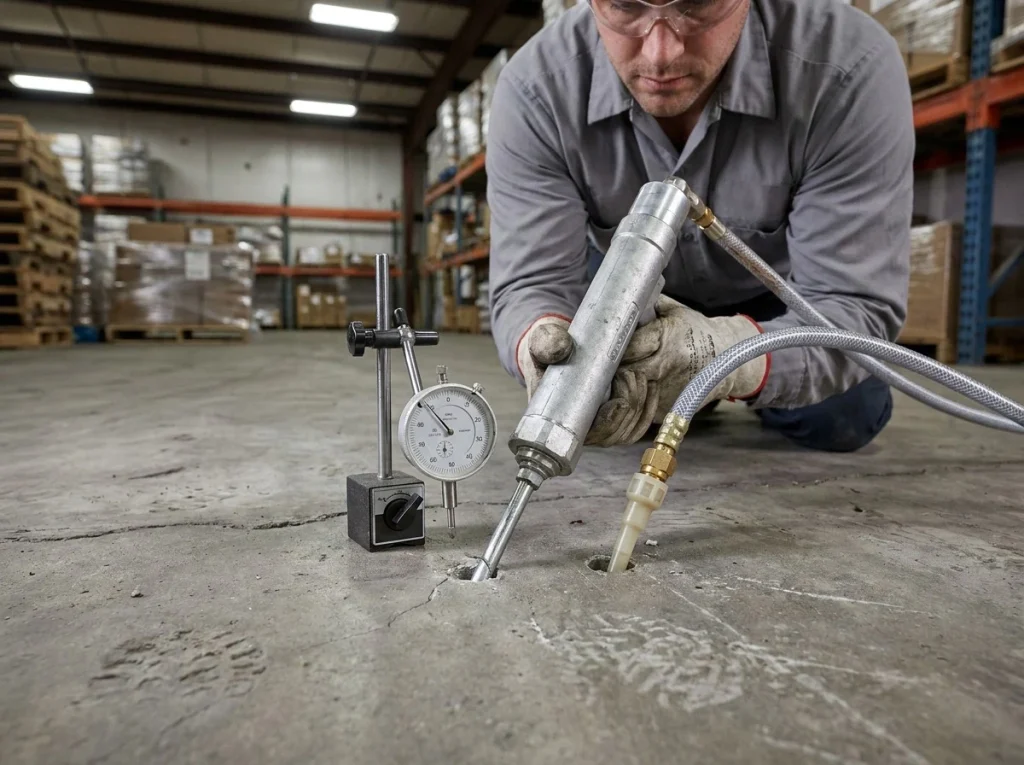
The injection phase is where quality assurance becomes quality control, because every lift is measured while it happens. Crews inject in small increments, watch the slab respond, and stop at defined limits rather than relying on feel. The discipline of the method matters more than the speed of the rig.
The core field controls on a well-run polyurethane project include:
- Lift monitoring: a laser receiver or dial indicator at each injection point shows the slab moving in fractions of an inch, so the operator can stop at the target elevation.
- Incremental lifting: panels are raised in small, alternating stages across the injection pattern to avoid bending the slab or cracking joints.
- Pressure observation: a sudden drop or spike in injection pressure can signal that material has found a void, a crack or an unintended path.
- Material conditioning: component temperatures and mix ratio are checked at the start of each shift and whenever conditions change, because both affect reaction time and foam density.
- Migration watch: crews check drains, joints and adjacent panels during injection so any material escaping the target zone is caught immediately.
Each of these controls produces a record, and the daily injection log ties them together. A useful log lists every hole by location, the volume placed, the observed lift, the time and any anomalies, which turns a busy shift into a traceable sequence that an inspector can review line by line.
Where a project specification sets pressure limits, lift increments or density targets, those values govern the work. Final design parameters for any specific slab or pavement should be confirmed by the engineer of record for the project, since slab thickness, reinforcement and subgrade conditions all change what is safe.
Material Verification and Testing
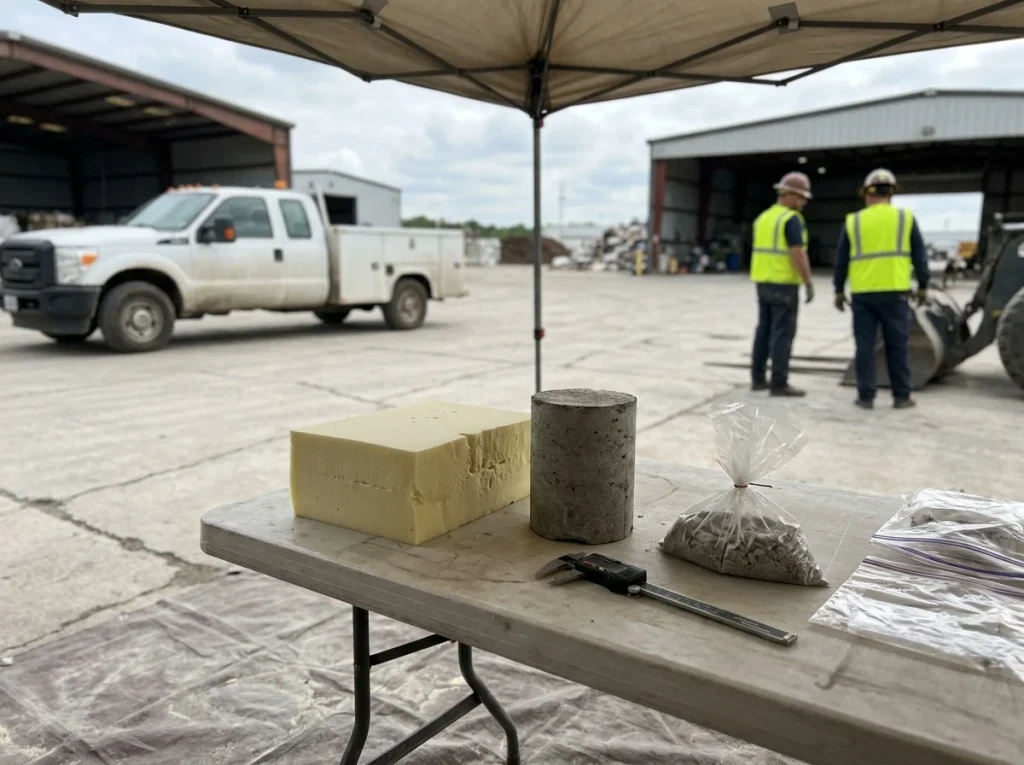
Controlling the process is only half of the picture, because the foam itself must meet the properties the design assumed. High-density structural polyurethane is specified by density and compressive strength, and both depend on correct component ratio, temperature and handling. Material verification confirms that what went into the ground matches what was specified on paper.
Owners and inspectors should expect a material verification package that covers the following:
- Certificates and data sheets: manufacturer certifications and technical data for each component batch delivered to site.
- Lot tracking: batch or lot numbers recorded against the dates and areas where each was used.
- Field samples: foam samples captured during injection, labeled by location and time, for density and strength testing when the specification requires them.
- Equipment checks: proportioning equipment calibration and hose temperature settings recorded at startup.
Laboratory testing of field samples gives an objective answer to whether the installed foam performs as intended. The table below shows the common tests and what each one confirms.
| Property | Why It Matters | Test Method | Reference Standard |
|---|---|---|---|
| Apparent density | Confirms correct mix ratio and expansion | Measured on cut field samples | ASTM D1622 |
| Compressive strength | Confirms load capacity beneath the slab | Compression test on field samples | ASTM D1621 |
| Component temperature | Controls reaction rate and final density | Recorded at the proportioner each shift | Manufacturer data sheet |
| Mix ratio | Off-ratio foam can be weak or brittle | Ratio check at startup and after changes | Manufacturer data sheet |
| Placed volume | Compared against estimated void volume | Proportioner counters or volume logs | Project specification |
Volume reconciliation is one of the simplest and most useful checks in the whole program. When the placed volume is far above the estimate, material may have migrated or found a larger void than expected, and when it is far below, some voids may remain unfilled. Either result deserves an explanation in the closeout record.
Common Quality Problems and How Verification Catches Them
Most polyurethane quality problems are not caused by the material itself but by gaps in planning, monitoring or recordkeeping. Knowing the usual failure points helps an owner or inspector focus attention where it matters most, and it explains why each control in the program exists rather than treating the checklist as paperwork.
The problems that appear most often on commercial and industrial slabs, and the checks that catch them, are:
- Wrong benchmark: when the reference point sits on a slab that is itself moving, every reading is wrong, so the baseline survey must be tied to a stable point such as a column footing or an independent monument.
- Lifting too fast: raising one point too far ahead of its neighbors bends the panel, and incremental lifting with a receiver at every active hole prevents it.
- Off-ratio material: cold components or a worn proportioner produce foam that is weaker than specified, which temperature logs and field samples reveal.
- Unmapped utilities: foam entering a drain or conduit can block it, so utility locates and migration checks during injection are essential.
- Missing records: a shift with no log entries leaves a gap that cannot be reconstructed, which is why logs are completed as work happens, not at the end of the day.
Each of these problems is preventable, and each leaves evidence when it occurs. A crew that reviews its own logs at the end of every shift can spot an unusual volume, a pressure anomaly or a lift that stopped short of target while the equipment is still on site and the correction is still inexpensive.
This review also gives the owner's representative a natural point to ask questions. A short daily conversation about what was lifted, what was placed and what did not go to plan builds shared confidence in the result and avoids surprises during final acceptance, especially on projects where several areas are treated over a number of shifts.
Post-Injection Verification and Acceptance
Once injection is complete, the work has to be proven against the acceptance criteria rather than assumed to be correct. Post-injection verification repeats the baseline measurements so that the before and after conditions can be compared directly, point by point, on the same benchmark.
The standard acceptance checks for commercial concrete lifting and slab stabilization are:
- Final elevation survey: readings at the same grid points as the baseline, showing the achieved lift and the remaining deviation from target.
- Joint and crack inspection: a walk-through comparing current conditions with the pre-injection photo log to confirm no new damage.
- Void confirmation: spot coring, probing or repeat radar scans in areas where voids were mapped, to show they are now filled.
- Hole patching: confirmation that every injection hole has been patched flush with a compatible cementitious material.
- Load or deflection testing: on pavements and heavy-traffic slabs, deflection testing before and after the work where the specification calls for it.
For projects focused on void filling under concrete slab areas, deflection data is often the clearest proof of success. A panel that deflected under a test load before injection and responds as a supported slab afterward gives the owner measurable evidence that the subgrade contact has been restored.
| Acceptance Check | Pass Condition | Method | Reference Standard |
|---|---|---|---|
| Final elevation | Within the tolerance stated in the specification | Survey on original benchmark | Project specification or ACI 117 |
| Floor flatness | Meets specified FF/FL values where required | Floor profile measurement | ASTM E1155 |
| Pavement support | Reduced deflection under test load | Falling weight deflectometer | ASTM D4694 |
| Void fill | No remaining voids at test locations | Coring, probing or radar | Project specification |
| Surface condition | No new cracking or joint damage | Visual inspection against photo log | Internal QA record |
Key Takeaways
- Polyurethane grouting quality assurance compares measured conditions before, during and after injection against written acceptance criteria.
- A baseline elevation survey tied to a fixed benchmark is the foundation of every later verification step.
- Lift monitoring, incremental injection and pressure observation are the main field controls that prevent over-lifting and cracking.
- Material records, lot tracking and field sample testing confirm the installed foam matches the specified density and strength.
- Final surveys, void confirmation and deflection testing prove the result rather than assuming it.
- A complete closeout package gives owners and inspectors a traceable record they can accept and keep on file.
The Closeout Package Owners Should Receive
The final deliverable from a polyurethane project is not only a level slab but a record that proves how it got there. A closeout package allows a facility manager to answer questions from insurers, auditors or future contractors years after the crew has left, and it gives a public agency the documentation it needs to accept the work and release payment.
A complete package for polyurethane work usually includes:
- Injection plan: the approved hole pattern, sequence and target elevations.
- Daily logs: hole-by-hole volumes, lifts, times and any anomalies with the actions taken.
- Survey records: baseline and final elevation data on the same benchmark, with a comparison table.
- Material records: certificates, lot numbers, temperature and ratio checks, and any laboratory results.
- Inspection records: photos of pre-existing conditions, completed patching and final surface condition.
- Exceptions report: any area that did not meet a criterion, the reason and the agreed resolution.
When these records are organized before the crew mobilizes, verification becomes part of the daily routine instead of a scramble at the end of the job. Owners comparing contractors can ask to see a sample package, and the selection criteria we covered for polyurethane grouting contractors explain why documentation deserves as much weight as equipment and price.
If you are preparing a specification or planning a slab repair, you can request a verification plan for your slab lifting project before work is scheduled.
Conclusion
Polyurethane grouting quality assurance turns a fast repair into a verified one. By documenting starting conditions, controlling each lift in real time, testing the material that was placed and repeating the surveys at the end, a project produces measurable proof that the slab reached grade and the support beneath it was restored.
For facility managers and public owners, that proof carries value well beyond the day of the repair. It supports acceptance and payment, answers questions from auditors and insurers, and gives the next engineer a clear record of what was done. Verification is not an extra step added to polyurethane work; it is the method that makes the result dependable.
Plan a verified polyurethane repair with our team Ask us for a sample polyurethane closeout package